South Korea is an attractive destination for international businesses looking to access advanced technology, skilled professionals and one of Asia’s most developed economies. From technology and manufacturing to finance, gaming and professional services, the country offers opportunities for companies seeking to expand their international workforce.
However, hiring in South Korea involves more than identifying qualified candidates and agreeing on salaries. Foreign employers must understand Korean employment regulations, payroll obligations, statutory insurance, employee benefits and termination requirements before bringing local talent onto their teams.
An Employer of Record (EOR) can provide an alternative employment arrangement for businesses looking to hire internationally without immediately establishing their own local employing entity. Through an EOR arrangement, a local provider becomes the legal employer and manages specified employment responsibilities, while the client company generally directs the employee’s day-to-day work.
Understanding how an Employer of Record in South Korea operates, what local employment requirements apply and which hiring arrangement suits your business can help you make a more informed expansion decision.
Content Outline
Key Summary
An EOR Can Simplify International Hiring
An Employer of Record can manage employment contracts, payroll administration, statutory contributions and employee administration on behalf of a foreign business, subject to the applicable Korean employment and labor-dispatch requirements.
Establishing a Local Entity Is Not Always Necessary
Foreign companies can directly employ individuals in South Korea without necessarily establishing a local branch. However, direct employment involves payroll, social insurance, tax and other compliance considerations.
South Korea Has Specific Employment Requirements
Employers must understand the Labor Standards Act, minimum wage, working hours, annual leave, severance pay and mandatory social insurance obligations.
The 2026 Minimum Wage Is KRW 10,320 Per Hour
South Korea’s statutory minimum wage increased to KRW 10,320 per hour on 1 January 2026. The monthly equivalent is KRW 2,156,880 based on 209 hours.
EOR Arrangements Require Careful Legal Assessment
Using an EOR does not automatically eliminate employment risks. The arrangement must comply with applicable labor-dispatch regulations, employment protections and other relevant requirements.
Choose an EOR Provider Based on Local Capabilities
Businesses should evaluate a provider’s legal employment structure, local expertise, payroll capabilities, employee support and ability to manage country-specific compliance.
What Is an Employer of Record in South Korea?
An Employer of Record (EOR) is a third-party organisation that legally employs workers on behalf of another company.
Instead of establishing its own employing entity in a foreign market, a business can engage an EOR provider to manage the formal employment relationship, including employment contracts, payroll, statutory contributions and employment administration.
The client company generally retains responsibility for directing the employee’s daily activities, work assignments, performance and business objectives.
How Does an EOR Work in South Korea?
A typical EOR arrangement involves two connected relationships:
- EOR and employee: The EOR enters into the employment relationship and assumes the contractual employer responsibilities within the agreed service scope.
- Client company and employee: The client company directs the employee’s daily work, responsibilities and business activities, subject to the applicable legal framework.
The EOR may manage:
- Locally compliant employment documentation.
- Employee onboarding and registration.
- Monthly payroll calculations and salary payments.
- Applicable income tax withholding.
- Mandatory social insurance administration.
- Employee benefits and leave administration.
- Employment records and HR documentation.
- Offboarding and final employment payments.
However, the legal treatment of an EOR arrangement in South Korea requires particular attention. Depending on the actual working arrangement, the Act on the Protection, etc. of Temporary Agency Workers (Dispatch Act), equal-treatment requirements and potential employee reclassification risks may apply.
Businesses should therefore assess the proposed structure before engaging employees through an EOR.
Why Use an Employer of Record When Hiring in South Korea?
South Korea offers access to a highly developed workforce, but managing employment in another jurisdiction can create additional administrative and compliance responsibilities.
An EOR may help international businesses manage these responsibilities without immediately building their own local HR and payroll infrastructure.
1. Simplify Employment Administration
Managing employment documentation, payroll schedules, employee benefits and statutory reporting requires familiarity with local regulations.
An EOR can centralise these administrative responsibilities, helping businesses manage their international workforce more efficiently.
2. Reduce the Administrative Burden of International Hiring
Establishing internal payroll and HR processes in another country can require additional resources.
An EOR provides an alternative by managing specified employment administration through an existing local employment structure.
This can be particularly useful for businesses hiring an initial employee or evaluating a new market.
3. Manage Payroll and Statutory Contributions
South Korean employers must account for several mandatory social insurance schemes, income tax withholding and employment-related payments.
An EOR can coordinate payroll calculations, applicable deductions, employer contributions and statutory administration according to local requirements.
4. Support Employment Compliance
Employment regulations differ significantly between countries.
An EOR with appropriate local capabilities can help businesses manage employment documentation, payroll obligations, leave administration and other statutory requirements.
However, the client company must still understand its responsibilities under the applicable legal arrangement.
5. Maintain Operational Flexibility
Businesses entering South Korea may not initially need a permanent local HR department or a fully established subsidiary.
An appropriate EOR arrangement may provide a more flexible approach to employment administration while the business evaluates its longer-term operational requirements.
South Korea Employment Laws and Regulations Foreign Employers Should Know
Understanding South Korean employment laws is essential before hiring local employees.
The primary legislation governing employment relationships is the Labor Standards Act, which establishes minimum standards for wages, working hours, holidays, leave and other employment conditions.
Foreign companies and organisations employing workers in South Korea must consider the relevant statutory requirements.
1. Employment Contracts in South Korea
South Korean employers must provide employees with written employment conditions.
The employment agreement should clearly establish the essential terms of employment, including:
- Employee and employer information.
- Job responsibilities and position.
- Employment commencement date.
- Workplace and working location.
- Salary and payment arrangements.
- Working hours and break periods.
- Weekly holidays and annual leave.
- Other applicable employment conditions.
Written employment documentation is important for establishing the parties’ responsibilities and demonstrating compliance with local requirements.
Employers should ensure that employment agreements reflect the actual working arrangement and comply with mandatory Korean employment standards.
2. Minimum Wage in South Korea (2026)
South Korea updates its statutory minimum wage annually.
Effective 1 January 2026, the minimum wage is:
| Wage Category | 2026 Minimum Wage |
| Hourly | KRW 10,320 |
| Daily (8 hours) | KRW 82,560 |
| Monthly (209 hours) | KRW 2,156,880 |
The monthly equivalent assumes a standard calculation of 209 hours, including paid weekly rest hours.
Employers must ensure that employee compensation meets the applicable minimum wage requirements.
The minimum wage generally applies regardless of industry. Certain statutory exceptions, including limited probationary arrangements, may apply under specific conditions.
Employer consideration: Minimum wage compliance should be assessed alongside contractual working hours, overtime, allowances and other wage components rather than looking at the monthly salary alone.
3. Working Hours and Overtime Regulations
South Korea generally follows a statutory working-hour framework of:
- Standard working hours: 8 hours per day.
- Standard weekly working hours: 40 hours.
- General maximum weekly working hours: 52 hours, including up to 12 hours of overtime under the ordinary statutory framework.
Employees are generally entitled to a minimum 30-minute break after four hours of work and a one-hour break after eight hours.
Overtime, night work and holiday work may require additional compensation.
| Working Arrangement | General Requirement |
| Standard daily hours | 8 hours |
| Standard weekly hours | 40 hours |
| General overtime limit | 12 additional hours per week |
| Daily break | At least 30 minutes after 4 hours |
| Longer workday break | At least 1 hour after 8 hours |
| Overtime premium | Generally at least 50% additional wages |
| Night work | Generally subject to a 50% premium |
| Holiday work | Subject to statutory additional payment rules |
The application of working-hour and overtime provisions depends on the applicable legislation, workplace circumstances and any lawful exceptions.
Employers should maintain accurate working-time records and establish clear overtime approval procedures.
4. Annual Leave and Public Holidays
South Korean employees are entitled to statutory paid annual leave based on their length of service and attendance.
Under the Labor Standards Act, the general annual leave entitlement includes:
| Employee Service Period | Annual Leave Entitlement |
| Less than 1 year | 1 paid leave day for each month of continuous service |
| 1 year or more, with at least 80% attendance | 15 paid leave days |
| 3 years or more | Additional leave based on service, subject to statutory limits |
Employees who meet the relevant statutory requirements may receive additional annual leave as their service period increases.
Employers must also account for statutory public holidays and weekly paid holidays where applicable.
A proper leave management process should include:
- Annual leave entitlement calculations.
- Leave requests and approvals.
- Accurate leave balance records.
- Applicable public holiday arrangements.
- Unused leave treatment and payment obligations.
5. Mandatory Social Insurance in South Korea
South Korea operates four major social insurance schemes:
- National Pension.
- National Health Insurance.
- Employment Insurance.
- Industrial Accident Compensation Insurance.
Employers must assess employee eligibility and applicable registration and contribution requirements.
The following table provides an overview of the principal 2026 contribution rates.
| Social Insurance | Employee Contribution | Employer Contribution |
| National Pension | 4.75% | 4.75% |
| National Health Insurance | 3.595% | 3.595% |
| Long-Term Care Insurance | 0.4724% | 0.4724% |
| Employment Insurance (unemployment benefit component) | 0.9% | 0.9% |
| Employment Insurance (additional employer programmes) | N/A | Additional 0.25%–0.85%, depending on applicable criteria |
| Industrial Accident Compensation Insurance | Generally 0% | Varies by industry |
Important considerations:
- National Pension contributions are subject to applicable income limits and contribution bases.
- Health insurance and long-term care contributions are generally shared equally between employers and employees.
- Employment Insurance employer contributions include additional amounts depending on the applicable employment stabilisation and vocational development programme.
- Industrial Accident Compensation Insurance is generally paid entirely by the employer, with rates varying by industry and other applicable factors.
- Foreign employees may be subject to different eligibility rules, exemptions or reciprocal arrangements depending on nationality, visa status and applicable agreements.
Employers should calculate the total employment cost using the applicable contribution bases rather than simply adding the headline percentages.
6. Severance Pay Requirements
South Korea has statutory retirement benefit requirements for eligible employees.
Generally, employees who have worked continuously for at least one year and meet the applicable average working-hour threshold are entitled to severance benefits.
The general statutory calculation is:
Severance Pay = 30 Days of Average Wages × Years of Continuous Service
Average wages are generally calculated using the employee’s average remuneration over the three months preceding the relevant calculation date, subject to statutory rules.
Employers should consider:
- Employee eligibility.
- Continuous service periods.
- Average wage calculations.
- Payment deadlines.
- Applicable retirement benefit arrangements.
Severance pay is an important component of total employment costs and should be included in workforce budgeting.
7. Employee Termination Requirements
Employment termination in South Korea requires careful consideration of statutory protections.
Under the Labor Standards Act, an employer generally needs justifiable cause to dismiss an employee where the relevant provisions apply.
Employers should also consider:
- Statutory dismissal notice requirements.
- Applicable exceptions to advance notice.
- Written notification of dismissal reasons and effective dates.
- Unpaid wages and other outstanding entitlements.
- Severance payment obligations.
- Applicable restrictions on dismissal.
For employers covered by the relevant provisions, dismissal generally requires 30 days’ advance notice or payment in lieu of notice, subject to statutory exceptions.
Termination procedures should be reviewed before implementation to avoid disputes and potential legal exposure.
Can Foreign Companies Hire Employees in South Korea Without Establishing a Local Entity?
Yes. Foreign companies can directly employ individuals in South Korea without necessarily establishing a local branch or subsidiary.
However, this does not mean that foreign employers are exempt from Korean employment, payroll, tax or social insurance obligations.
Businesses considering direct employment should evaluate:
- Payroll registration and salary withholding.
- Mandatory social insurance participation.
- Employment contract requirements.
- Applicable tax reporting obligations.
- Permanent establishment exposure.
- Local employment administration.
- Employee termination responsibilities.
An important distinction is that not having a local legal entity does not automatically mean having no corporate tax or permanent establishment exposure.
For example, an employee’s activities, authority to negotiate or conclude contracts, and the nature of the business conducted in Korea may affect the foreign company’s tax position.
Businesses should assess these considerations before selecting an employment structure.
EOR vs Direct Employment vs Establishing a Local Entity in South Korea
Choosing the right hiring structure depends on your business objectives, workforce requirements and long-term plans.
The following comparison highlights the main differences.
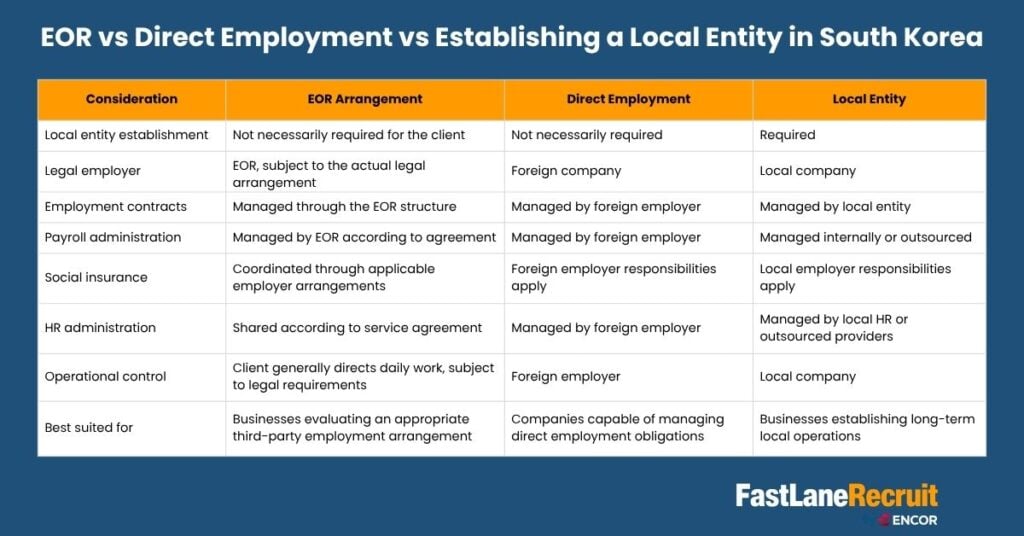
| Consideration | EOR Arrangement | Direct Employment | Local Entity |
| Local entity establishment | Not necessarily required for the client | Not necessarily required | Required |
| Legal employer | EOR, subject to the actual legal arrangement | Foreign company | Local company |
| Employment contracts | Managed through the EOR structure | Managed by foreign employer | Managed by local entity |
| Payroll administration | Managed by EOR according to agreement | Managed by foreign employer | Managed internally or outsourced |
| Social insurance | Coordinated through applicable employer arrangements | Foreign employer responsibilities apply | Local employer responsibilities apply |
| HR administration | Shared according to service agreement | Managed by foreign employer | Managed by local HR or outsourced providers |
| Operational control | Client generally directs daily work, subject to legal requirements | Foreign employer | Local company |
| Best suited for | Businesses evaluating an appropriate third-party employment arrangement | Companies capable of managing direct employment obligations | Businesses establishing long-term local operations |
Which option should you choose?
- Consider an EOR arrangement when you need an appropriate third-party employment structure and want to outsource specified employment administration.
- Consider direct employment when your business can manage Korean payroll, employment compliance and applicable tax obligations.
- Consider establishing a local entity when you intend to build a substantial, long-term presence in South Korea or require a local corporate structure for wider business operations.
The most suitable option depends on the actual employment arrangement, regulatory requirements and business activities.
How to Choose the Right Employer of Record Provider in South Korea
Selecting an EOR provider involves more than comparing monthly service fees.
Businesses should assess whether the provider has the appropriate legal structure, local capabilities and operational resources to support the intended employment arrangement.
Here are six important factors to evaluate.
1. Local Legal and Employment Expertise
Choose a provider that understands South Korean employment regulations, including the Labor Standards Act, Dispatch Act, social insurance requirements and statutory employee benefits.
Ask how the provider structures employment arrangements and addresses potential worker classification risks.
2. Payroll and Tax Administration
A reliable provider should demonstrate its ability to manage:
- Monthly payroll calculations.
- Salary payments.
- Applicable tax withholding.
- Social insurance contributions.
- Statutory reporting.
- Payroll documentation.
3. Transparent Pricing
Request a detailed cost breakdown before entering an agreement.
An EOR quotation should clarify whether the following items are included:
- Monthly EOR management fees.
- Employee salary.
- Employer social insurance contributions.
- Severance accruals or payments.
- Employee benefits.
- Onboarding and offboarding fees.
- Additional administrative charges.
4. Employment Contract Management
Ensure that employment agreements are prepared according to local requirements and clearly establish employee entitlements, responsibilities and working conditions.
5. Employee Support and HR Administration
Consider how the provider handles employee onboarding, payroll queries, leave requests, employment documentation and offboarding.
Employee experience is an important part of maintaining a stable international workforce.
6. Long-Term Expansion Capabilities
If you intend to expand beyond South Korea, consider whether the provider can support hiring across multiple countries.
Working with an EOR partner that has established coverage in several markets may simplify regional employment administration and vendor coordination.
Also Read: Red Flags When Choosing EOR Providers: 10 Warning Signs to Watch For
How FastLaneRecruit Supports International Hiring and Employment
International expansion requires more than recruiting qualified employees. Businesses also need a reliable approach to employment contracts, payroll, statutory contributions and local HR administration.
FastLaneRecruit provides Employer of Record services across selected international markets, helping businesses hire employees without immediately establishing their own local employing entities in supported countries.
Our EOR services are designed to manage key employment responsibilities, including:
Employment Contracts and Onboarding
We coordinate employment documentation and onboarding processes according to the requirements of the relevant supported market.
Payroll and Salary Administration
We manage payroll processing, salary payments and applicable statutory deductions according to local requirements.
Statutory Contributions and Benefits
Our team coordinates applicable employer contributions, employee benefits and statutory employment administration.
Ongoing HR and Employment Administration
We support employment-related administration throughout the employee lifecycle, including onboarding, payroll coordination and offboarding.
Multi-Country Employment Support
Businesses expanding into multiple markets can work with FastLaneRecruit to explore employment solutions across our established service locations.
Important: FastLaneRecruit’s currently published EOR coverage does not include South Korea. Businesses planning to hire in Korea should confirm the appropriate local employment arrangement with a qualified Korean employment and tax adviser. Our team can assist with EOR requirements in the international markets we currently support.
Why Businesses Choose FastLaneRecruit
Managing employees across international markets can create additional administrative work and compliance responsibilities.
FastLaneRecruit helps businesses simplify international employment through a combination of regional expertise and coordinated EOR services.
1. Established Regional Coverage
We support EOR employment across selected markets in Asia Pacific, Europe and the Middle East & Africa.
2. Local Employment Expertise
Employment laws, payroll requirements and statutory contributions vary between countries. Our approach considers the specific requirements of each supported market.
3. End-to-End Employment Administration
From employment contracts and onboarding to payroll and offboarding, we coordinate key employment processes throughout the employee lifecycle.
4. Flexible International Hiring
Businesses can explore hiring solutions in supported markets without immediately establishing their own employing entity in every country.
5. Transparent Service Scope
We help businesses understand the relevant employment administration requirements, service scope and associated costs before proceeding.
6. Backed by FastLane Group
As part of FastLane Group, FastLaneRecruit combines international employment support with broader regional business and corporate services expertise.
FastLaneRecruit’s Global EOR Coverage
FastLaneRecruit supports international hiring across selected markets in three major regions.
-FastLaneRecruit operates in
- Asia Pacific: Malaysia, Singapore, Hong Kong, China, India, Philippines, Taiwan, Vietnam, Australia,
- Europe: United Kingdom, Switzerland
- Middle East & Africa: UAE, Saudi Arabia, Qatar
Our multi-country coverage allows businesses to explore international employment solutions through one EOR partner rather than coordinating multiple providers independently.
Service availability and scope are subject to the relevant country’s employment requirements and individual hiring circumstances.
How Does FastLaneRecruit’s EOR Process Work?
For supported markets, FastLaneRecruit follows a structured employment process to help businesses manage international hiring.
Step 1: Discuss Your Hiring Requirements
Tell us about your target country, employee requirements, job responsibilities, expected salary and hiring timeline.
Our team will assess the appropriate EOR service scope for your intended market.
Step 2: Review Employment Requirements and Costs
We review the relevant employment arrangements, statutory obligations, payroll considerations and service fees.
This helps your business understand the expected employment costs before proceeding.
Step 3: Prepare Employment Documentation
Once the arrangement is confirmed, we coordinate the employment contract and required onboarding documentation.
Step 4: Complete Employee Onboarding
We manage the agreed onboarding procedures, including applicable employee information and employment administration.
Step 5: Manage Payroll and Ongoing Employment Administration
Throughout the employment relationship, we coordinate payroll, statutory contributions, employee administration and other agreed employment responsibilities.
Simplify International Hiring with FastLaneRecruit
Expanding into a new country requires the right employment structure, reliable payroll administration and an understanding of local employment obligations.
Whether you are hiring your first international employee or building a workforce across multiple markets, FastLaneRecruit can help you explore EOR solutions in our supported countries.
Our team works with businesses to understand their hiring requirements, coordinate employment administration and manage the operational responsibilities associated with international employment.
Planning to hire internationally?
Speak with FastLaneRecruit about your workforce requirements and discover how our Employer of Record services can support your expansion across Asia Pacific, Europe and the Middle East.
Book a Free Consultation with an Expert.
Frequently Asked Questions About Employer of Record South Korea
1. What is an Employer of Record in South Korea?
An Employer of Record is a third-party organisation that legally employs workers on behalf of another company.
The EOR manages specified employment responsibilities, such as employment contracts, payroll, statutory contributions and HR administration, while the client company generally directs the employee’s day-to-day work.
In South Korea, EOR arrangements must be structured carefully to comply with applicable labor-dispatch regulations and employment requirements.
2. Is using an EOR legal in South Korea?
EOR arrangements can be lawful in South Korea, but the actual employment structure must comply with applicable regulations.
The Act on the Protection, etc. of Temporary Agency Workers may apply depending on how employees are supplied, supervised and managed.
Businesses should assess the arrangement’s legal structure, equal-treatment obligations and potential employee reclassification risks before proceeding.
3. Can a foreign company hire employees in South Korea without a local entity?
Yes. A foreign company can directly employ individuals in South Korea without necessarily establishing a local branch or subsidiary.
However, it must consider applicable employment, payroll, tax and social insurance requirements. Permanent establishment exposure should also be assessed based on the company’s activities in Korea.
4. What is the minimum wage in South Korea in 2026?
The 2026 minimum wage is KRW 10,320 per hour.
This is equivalent to KRW 82,560 for an eight-hour working day and KRW 2,156,880 per month based on 209 hours.
The minimum wage applies from 1 January to 31 December 2026.
5. What social insurance contributions are required in South Korea?
South Korea has four major social insurance schemes:
- National Pension.
- National Health Insurance.
- Employment Insurance.
- Industrial Accident Compensation Insurance.
Employers and employees generally share National Pension, National Health Insurance and certain Employment Insurance contributions. Industrial Accident Compensation Insurance is generally funded entirely by employers.
Applicable contribution rates and eligibility depend on the insurance scheme, employee circumstances and other statutory conditions.
6. How much does it cost to hire an employee in South Korea?
The total employment cost depends on several factors:
- Employee gross salary.
- Employer social insurance contributions.
- Applicable employee benefits.
- Severance pay obligations.
- Overtime and additional wage payments.
- Payroll and employment administration.
- Recruitment and onboarding costs.
Businesses should calculate total employment costs rather than comparing salaries alone.
7. How long does it take to hire employees in South Korea through an EOR?
The timeline depends on the employment structure, employee documentation, immigration requirements and applicable regulatory procedures.
Before confirming an onboarding date, businesses should ensure that the proposed EOR arrangement is legally appropriate and that all necessary employment and registration requirements can be completed.
8. Can an EOR manage payroll and employee benefits in South Korea?
An appropriately structured EOR arrangement may cover payroll administration, statutory insurance contributions, employment benefits and employee documentation.
The exact responsibilities depend on the legal arrangement and the service agreement.
9. What is the difference between an EOR and establishing a company in South Korea?
An EOR is a third-party employment arrangement that can allow a business to hire through an existing local employment structure without immediately establishing its own employing entity.
Establishing a local company gives the business its own legal presence and greater control over its local operations but also creates additional corporate, accounting, tax and compliance responsibilities.
The right option depends on the company’s long-term business objectives.
10. Which countries does FastLaneRecruit provide EOR services in?
FastLaneRecruit currently provides EOR services across selected international markets:
- Asia Pacific: Malaysia, Singapore, Hong Kong, China, India, Philippines, Taiwan, Vietnam and Australia.
- Europe: United Kingdom and Switzerland.
- Middle East & Africa: UAE, Saudi Arabia and Qatar.
South Korea is not currently included in our published EOR coverage. Contact our team to discuss hiring requirements in our supported markets.