
Expanding into a new country can open the door to valuable talent without requiring your business to build an entire operation from scratch. But once you start hiring internationally, payroll, employment contracts, benefits, tax obligations, and local labor laws can quickly become difficult to manage.
That is why many businesses compare established Employer of Record (EOR) providers such as G-P (Globalization Partners) and Remote before choosing a global employment partner.
Both offer EOR solutions designed to help businesses hire employees internationally without establishing their own legal entity in every market. However, they differ in areas such as country coverage, pricing, technology, payroll, compliance support, contractor management, and service delivery.
This guide compares G-P vs Remote across the factors that matter most when selecting an EOR and explains what businesses should evaluate before making a decision.
Content Outline
Key Summary
G-P and Remote both provide EOR services
Both providers enable businesses to hire employees internationally without first establishing a local entity in every country. Their EOR services generally cover areas such as employment contracts, payroll, benefits, and local employment compliance.
G-P currently offers broader stated country coverage
G-P states that its EOR supports hiring in 180+ countries. Remote currently advertises EOR hiring in 90+ countries on its pricing and EOR pages. Country availability should still be checked for the exact market and employment model you need.
Pricing is not the only factor
G-P currently publishes EOR pricing starting at US$599 per employee/month, while Remote lists US$699 per employee/month. Actual employment costs can also include salary, employer taxes, statutory contributions, benefits, and other country-specific costs.
Remote may appeal to businesses prioritizing a unified, self-service experience
Remote emphasizes its centralized platform, employee lifecycle workflows, payroll, benefits, and compliance tools.
G-P may appeal to businesses prioritizing broad international coverage
G-P emphasizes its 180+ country footprint, local employment expertise, compliance capabilities, AI-powered workflows, and support for the employee lifecycle.
The best EOR depends on your business
There is no universally best EOR. The right choice depends on your target countries, hiring volume, budget, compliance requirements, payroll needs, support expectations, and long-term expansion plans.
G-P vs Remote: At-a-Glance Comparison
| Factor | G-P | Remote |
| EOR | Yes | Yes |
| Stated EOR coverage | 180+ countries | 90+ countries |
| Starting EOR price | From US$599/employee/month | US$699/employee/month |
| Global payroll | Yes | Yes |
| Contractor management | Yes | Yes |
| Employee onboarding | Yes | Yes |
| Benefits administration | Yes | Yes |
| Compliance support | Yes | Yes |
| Global employment platform | Yes | Yes |
| Best suited to | Broad international expansion and enterprise-oriented global employment | Businesses prioritizing a unified platform and streamlined global HR workflows |
Pricing and country coverage can change. Confirm the exact commercial terms and availability for your countries before signing a contract.
What Is an Employer of Record?
An Employer of Record (EOR) is a third-party organization that legally employs workers on behalf of another business in a country where that business may not have its own legal entity.
The EOR typically manages employment administration such as:
- Locally compliant employment contracts
- Payroll processing
- Employer tax and statutory obligations
- Employee benefits administration
- Onboarding and offboarding
- Employment documentation
- Local employment compliance
The client business generally continues to manage the employee’s day-to-day work, responsibilities, performance, and business objectives.
Why businesses use an EOR
An EOR can be particularly useful when a company wants to:
- Hire its first employee in a new country
- Test a new market before establishing an entity
- Hire specialized international talent
- Build a distributed workforce
- Enter a market faster
- Reduce the administrative burden of international employment
For companies considering global expansion, the EOR model can therefore provide an alternative to immediately establishing a foreign subsidiary.
G-P vs Remote: Key Differences
1. Country Coverage
Country coverage is one of the first things businesses should compare.
G-P currently states that it supports EOR hiring in 180+ countries, while Remote currently advertises EOR hiring in 90+ countries.
However, a larger headline country count does not automatically mean a provider is better for your business.
What to verify
Before choosing an EOR, ask:
- Is EOR employment available in my target country?
- Is the worker employed directly by the provider or through another structure?
- Are payroll and benefits available in the same country?
- Are contractor services available?
- Who handles local compliance?
- What happens if local employment rules change?
Decision tip: Choose based on coverage in the countries you actually need, rather than the provider’s global country count alone.
2. EOR Pricing
Pricing can materially affect the economics of international hiring.
G-P currently lists its EOR service starting at US$599 per employee/month, while Remote lists its EOR service at US$699 per employee/month. Both providers can also have country-specific employment costs beyond the platform/service fee.
G-P pricing
G-P states that its EOR starts at US$599 per employee/month, with volume discounts available for larger team.
Remote pricing
Remote currently lists its EOR at US$699 per employee/month and describes its EOR pricing as transparent.
Look beyond the headline price
Your total cost of employment can also include:
- Employee salary
- Employer social contributions
- Statutory taxes
- Benefits
- Insurance
- Visa and immigration costs
- Background checks
- Currency conversion
- Additional services
- Country-specific requirements
Best practice: Request a complete cost breakdown rather than comparing only the monthly EOR management fee.
3. Payroll and Global Payments
Payroll is a core part of EOR management.
Both G-P and Remote provide global employment and payroll capabilities, but businesses should evaluate how each provider handles payroll calculations, statutory deductions, payments, reporting, and corrections in their target countries.
G-P states that its platform supports global payroll and paying employees in 150+ currencies.
Remote promotes local payroll as part of its EOR service and also offers standalone international payroll for businesses that already have legal entities in other countries.
Questions to ask
Before signing an EOR agreement, ask:
- Who calculates payroll?
- Who files employer taxes?
- Who handles statutory contributions?
- What are the payroll cut-off dates?
- How are payroll corrections handled?
- How are off-cycle payments handled?
- What currencies are supported?
- What reporting is available to Finance?
4. Compliance and Employment Risk
International hiring involves more than paying an employee correctly.
An EOR needs to account for local rules involving:
- Employment contracts
- Working hours
- Paid leave
- Termination
- Social insurance
- Employer contributions
- Employee benefits
- Tax obligations
- Mandatory notices
- Data protection
- Worker classification
G-P positions its EOR around local payroll, labor-law compliance, benefits, and employment support across 180+ countries.
Remote similarly emphasizes local employment compliance, benefits, payroll, and compliance protections as part of its EOR offering.
Why compliance should influence your decision
The cheapest provider is not necessarily the lowest-risk provider.
A better evaluation asks:
How effectively can the EOR help us maintain compliant employment throughout the employee lifecycle?
That includes onboarding, payroll, leave, compensation changes, transfers, and termination.
5. Employee Onboarding and Lifecycle Management
A strong EOR should reduce administrative work from the moment you hire someone through their eventual offboarding.
Important capabilities include:
- Offer and contract generation
- Localized employment agreements
- Employee document collection
- Payroll setup
- Benefits enrollment
- Leave management
- Compensation changes
- Employment amendments
- Offboarding
- Final payroll
G-P highlights AI-guided workflows, locally compliant contracts, benefits, payroll, and employee lifecycle management.
Remote similarly provides country-specific onboarding workflows, localized contracts, payroll setup, lifecycle tools, benefits administration, and offboarding functionality.
6. Contractor Management
Not every international worker needs to be an employee.
Some businesses also work with independent contractors, freelancers, or project-based talent.
Both G-P and Remote offer contractor-related services. G-P provides G-P Contractor, while Remote offers Contractor Management alongside its global employment products.
EOR vs contractor management
| EOR | Contractor Management |
| Designed for employees | Designed for independent contractors |
| EOR becomes legal employer | Contractor remains independently engaged |
| Payroll and employment benefits | Contractor invoices and payments |
| Local employment compliance | Contractor classification and payment compliance |
| Best for ongoing employment | Best for genuine independent contracting |
Important: Businesses should not choose contractor status simply because it appears cheaper. Worker classification must be assessed against the actual working relationship and applicable local law.
7. Technology and Integrations
Technology can significantly affect how efficiently your HR and Finance teams operate.
When comparing G-P vs Remote, consider:
- HRIS integrations
- Payroll integrations
- API availability
- Reporting
- Employee self-service
- Role-based access
- Approval workflows
- Data security
- Analytics
- Audit trails
G-P currently promotes custom APIs, analytics, AI-powered workflows, and integrations with existing systems.
Remote promotes centralized global HR workflows and integrations designed to reduce duplicate data entry and administrative work.
What matters most
Don’t choose an EOR simply because its platform has more features.
Ask:
Will this technology integrate cleanly with the systems our HR, Finance, and IT teams already use?
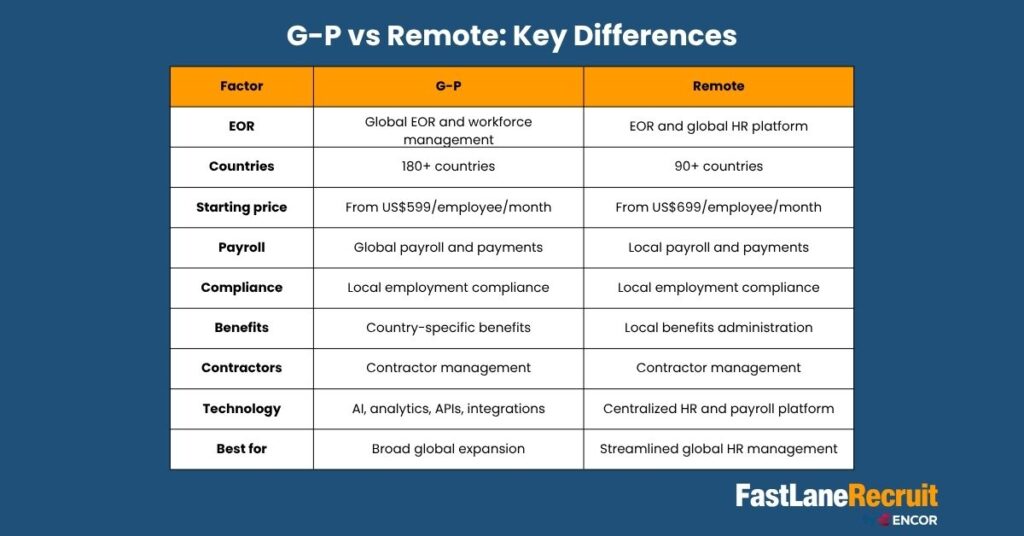
| Factor | G-P | Remote |
| EOR | Global EOR and workforce management | EOR and global HR platform |
| Countries | 180+ countries | 90+ countries |
| Starting price | From US$599/employee/month | From US$699/employee/month |
| Payroll | Global payroll and payments | Local payroll and payments |
| Compliance | Local employment compliance | Local employment compliance |
| Benefits | Country-specific benefits | Local benefits administration |
| Contractors | Contractor management | Contractor management |
| Technology | AI, analytics, APIs, integrations | Centralized HR and payroll platform |
| Best for | Broad global expansion | Streamlined global HR management |
G-P vs Remote: Which EOR Is Better for Your Business?
The better provider depends on what you prioritize.
Choose G-P if broad country coverage is your priority
G-P may be worth considering if your business:
- Plans to hire across many countries
- Needs broad international coverage
- Wants an EOR with an extensive global employment platform
- Has complex international workforce requirements
- Values structured compliance and HR support
G-P currently states that it supports employment in 180+ countries and offers EOR, contractor, and global employment solutions.
Choose Remote if platform simplicity is a priority
Remote may be worth considering if your business:
- Wants a centralized global HR platform
- Values self-service workflows
- Needs EOR and payroll capabilities within one environment
- Wants transparent published EOR pricing
- Prioritizes streamlined employee lifecycle management
Remote currently lists EOR pricing at US$699 per employee/month and advertises hiring in 90+ countries.
Consider another EOR if your requirements are more specific
G-P and Remote are not the only options.
If your priority is a particular country, regional expertise, cost structure, direct employment model, or hands-on support, compare several EOR providers before making a final decision.
That is particularly important when your hiring plans include multiple countries across Asia-Pacific, Europe, or the Middle East.
How to Choose the Right EOR
Instead of asking only “Which EOR is the best?”, evaluate providers against your own requirements.
1. Check your target countries
Make a list of every country you plan to hire in during the next 12–24 months.
2. Compare the total cost
Look beyond the headline monthly fee.
Calculate:
EOR fee + salary + employer taxes + statutory contributions + benefits + additional services
3. Verify the employment model
Ask who legally employs your workers and how the provider operates in each target country.
4. Evaluate compliance support
Find out who handles:
- Employment contracts
- Payroll taxes
- Social contributions
- Labor-law updates
- Terminations
- Statutory filings
5. Test the technology
Ask for a product demonstration and assess whether the workflow is practical for HR and Finance.
6. Check support and escalation
Ask:
- Who handles urgent payroll issues?
- Who handles employment-law questions?
- What are the escalation channels?
- What response times apply?
7. Consider your long-term expansion plan
An EOR may be ideal for entering a market quickly. But if you eventually establish your own subsidiary, your requirements may change.
The best provider should support your current hiring needs and future global workforce strategy.
Also Read: Employer of Record Philippines: Best Solution for Global Companies Hiring Remote Teams in 2026
Questions to Ask an EOR Before Signing
Before choosing G-P, Remote, FastLaneRecruit, or another provider, ask these questions:
| Question | Why it matters |
| Do you support EOR employment in my target country? | Confirms actual availability |
| Who is the legal employer? | Clarifies employment responsibility |
| Do you operate through your own entity or a partner? | Helps assess operational control |
| What is included in the monthly fee? | Prevents unexpected costs |
| What additional fees may apply? | Improves TCO visibility |
| Who handles payroll taxes and filings? | Clarifies compliance responsibility |
| What benefits are mandatory? | Helps budget accurately |
| How quickly can employees be onboarded? | Supports hiring timelines |
| What happens during termination? | Helps manage employment risk |
| What support is available locally? | Important for country-specific issues |
Why Businesses Choose FastLaneRecruit
Choosing an EOR is ultimately about more than finding a platform.
Businesses need a partner that can help them hire compliantly, manage employees efficiently, and expand into new markets with greater confidence.
FastLaneRecruit supports global employment across: Malaysia, Singapore, Hong Kong, China, India, Philippines, Taiwan, Vietnam, Australia, United Kingdom, Switzerland, UAE, Saudi Arabia, Qatar
Hire without establishing a local entity
FastLaneRecruit’s EOR model can help businesses hire employees in supported markets without requiring them to establish their own local entity first.
This can be particularly useful for companies that want to:
- Test a new market
- Hire a small initial team
- Enter a country faster
- Access international talent
- Reduce employment administration
- Manage payroll and local compliance
- Expand before committing to a subsidiary
Support beyond payroll
Global employment involves more than salary payments.
FastLaneRecruit can support key areas of the employment lifecycle, including:
- EOR employment
- Payroll
- Hiring
- Compensation and benefits
- Employment compliance
- Visas and permits
- Contractor solutions
- International workforce administration
This allows businesses to focus on managing their people and growing their operations, while the employment administration is handled by an experienced global employment partner.
G-P vs Remote vs FastLaneRecruit: What Should You Consider?
Rather than choosing a provider solely from a comparison table, consider which EOR can best support your actual expansion plans.
| Decision factor | What to evaluate |
| Country coverage | Does the provider support your current and planned markets? |
| Local compliance | Who manages local employment requirements? |
| Pricing | What is the complete cost per employee? |
| Payroll | How are payroll, taxes, and statutory contributions handled? |
| Benefits | Are locally appropriate benefits available? |
| Hiring speed | How quickly can you onboard employees? |
| Support | Who handles urgent local employment issues? |
| Scalability | Can the provider support you as your workforce grows? |
| Entity strategy | Can you hire without establishing your own entity? |
| Long-term expansion | Does the solution fit your future market-entry strategy? |
The right decision is therefore not simply G-P vs Remote.
It is:
Which EOR can provide the right combination of compliance, country coverage, cost, support, and scalability for your business?
Choose an EOR That Fits Your Global Expansion Strategy
G-P and Remote are both established EOR providers, but the best EOR is the one that aligns with your company’s actual international hiring strategy.
If broad country coverage is your priority, G-P’s stated 180+ country footprint may be relevant. If transparent published pricing and a centralized global HR platform are important, Remote may be worth evaluating.
But you do not have to limit your evaluation to two providers.
FastLaneRecruit can help businesses hire and manage employees across supported markets without the immediate need to establish a local entity.
Whether you’re hiring your first international employee or building a multi-country workforce, our EOR specialists can help you evaluate the appropriate employment approach, local requirements, payroll, benefits, and compliance considerations for your target market.
Ready to compare your EOR options?
Talk to FastLaneRecruit about your international hiring plans and find the right EOR solution for your business.
Book a Free Consultation with an Expert
Frequently Asked Questions About G-P vs Remote
Is G-P better than Remote?
Neither provider is universally better. G-P currently advertises broader EOR country coverage, while Remote emphasizes a centralized global HR platform and publishes a US$699/month EOR price. The better choice depends on your target countries, budget, workforce requirements, and preferred operating model.
Is Remote cheaper than G-P?
Based on current published starting prices, G-P starts at US$599 per employee/month, while Remote lists US$699 per employee/month for EOR. However, the total cost of employment can be substantially different once salary, employer contributions, benefits, and country-specific costs are included.
What is the difference between G-P and Remote?
Both provide EOR services, payroll capabilities, benefits administration, compliance support, and international workforce solutions. Key differences include their published country coverage, pricing, platform approach, and specific product capabilities. G-P states 180+ countries, while Remote currently advertises 90+ EOR countries.
Can G-P and Remote hire employees without a local entity?
Yes. Both position their EOR services as solutions for hiring employees in countries where the client does not have its own local legal entity.
Does an EOR handle payroll and taxes?
Generally, yes. An EOR typically manages payroll administration and applicable employment tax and statutory obligations in accordance with the local employment arrangement. The exact responsibilities should be confirmed in the service agreement.
What should I compare besides EOR pricing?
Compare country coverage, legal employment structure, compliance support, payroll, benefits, onboarding, support, integrations, termination procedures, additional fees, and scalability.
Is an EOR better than setting up a local entity?
Not necessarily. An EOR can be useful for entering a market quickly, hiring a small team, or testing demand without immediately establishing a subsidiary. A local entity may make more sense when you have substantial long-term operations and need direct control over the local business structure.
Can FastLaneRecruit be an alternative to G-P or Remote?
FastLaneRecruit provides EOR and global employment solutions across supported markets in Asia-Pacific, Europe, and the Middle East. If you are comparing EOR providers, you can evaluate FastLaneRecruit based on your target countries, workforce size, hiring requirements, compliance needs, and expansion plans.