Hiring employees in another country can be straightforward until the employment relationship crosses borders. Suddenly, your business needs to consider local employment contracts, payroll, statutory contributions, benefits, tax requirements, termination rules, and regulatory changes.
An Employer of Record (EOR) can provide a practical way to hire internationally without immediately establishing your own local entity. However, not all EOR structures operate in the same way.
One of the most important questions to ask is:
Who is the legal employer of your employee in the country where you are hiring?
An EOR may employ workers through its own local entity, a third-party partner, or a combination of both depending on the country. Understanding this structure is important because it can affect compliance accountability, contractual relationships, escalation processes, and how employment risks are managed.
For businesses evaluating international employment providers, owned entities EOR compliance is therefore more than a technical distinction. It is an important part of EOR due diligence.
Content Outline
Key Summary
Owned-entity EORs provide direct legal-employer accountability
With an owned-entity model, the EOR employs the worker through a local legal entity within its corporate structure. This can create a clearer chain of responsibility for employment administration and local compliance.
Entity ownership does not automatically guarantee compliance
An owned entity is an important structural factor, but it does not by itself guarantee perfect payroll, employment-law, tax, or regulatory compliance. Businesses should evaluate the provider’s actual local capabilities and contractual responsibilities.
Partner-based EOR models are not automatically non-compliant
A partner model can also support compliant employment. However, it introduces another organization into the employment chain, making it important to understand who the legal employer is and who is responsible when something goes wrong.
Country-level verification matters
A provider’s global country count does not tell you whether it owns the employing entity in every market. Businesses should ask for the entity model in each country where they plan to hire.
EOR compliance has limits
An EOR can manage many employer-side responsibilities, but the client may retain responsibilities relating to day-to-day management, worker activities, business operations, intellectual property, and certain tax or permanent establishment risks.
The right EOR should fit your expansion strategy
Companies should evaluate entity structure alongside local compliance expertise, payroll capabilities, benefits, onboarding, support, country coverage, contract terms, and scalability.
What Is an Owned-Entity EOR?
An owned-entity EOR employs workers through a local legal entity that belongs to the EOR provider or its corporate group.
Instead of your company establishing a subsidiary in the target country, the EOR’s local entity becomes the legal employer for the employment arrangement.
A simplified structure looks like this:
Your company → EOR’s local entity → Employee
The EOR’s local entity may be responsible for employment administration such as:
- Employment contracts
- Payroll administration
- Statutory contributions
- Employee benefits
- Required employment records
- Local employment compliance
- Onboarding and offboarding processes
- Other employer obligations applicable to the country
The exact scope varies by jurisdiction and contract.
This differs from a partner-based EOR model, where the EOR works with a separate local company that becomes the legal employer.
Partner model:
Your company → EOR provider → Local partner → Employee
Both structures can be viable. The key difference is where legal-employer responsibility sits and how many parties are involved in delivering the employment arrangement.
Why Does Entity Ownership Matter for EOR Compliance?
Entity ownership matters because the identity and structure of the legal employer can influence how compliance responsibilities are managed.
When an EOR uses its own local entity, the provider has a direct corporate presence through which the employment relationship is administered.
This can provide greater clarity around:
Legal employer responsibility
The employment contract should identify the actual legal employer. Buyers should verify that the entity named in the employment agreement is the entity responsible for employing the worker.
Local compliance
The employing entity must operate according to applicable employment requirements, including relevant rules on contracts, wages, working time, leave, statutory contributions, benefits, and termination.
Payroll accountability
Payroll errors can create employee dissatisfaction and regulatory issues. Businesses should establish who calculates, approves, funds, and corrects payroll and statutory payments.
Regulatory changes
Employment laws change frequently. A capable EOR should have processes for monitoring applicable local requirements and updating employment practices when rules change.
Escalation and issue resolution
When a payroll, employment, or regulatory issue occurs, a clear legal-employer structure can make it easier to determine who is responsible for resolving the problem.
Industry guidance similarly recommends that buyers verify the EOR’s legal employer structure and country-by-country entity model rather than relying only on headline country coverage.
Owned Entity vs. Partner EOR: What’s the Difference?
Understanding the difference can help businesses make a more informed EOR decision.
| Factor | Owned-Entity EOR | Partner-Based EOR |
| Legal employer | EOR’s own local entity | Third-party local entity |
| Corporate control | Directly within EOR group | Shared with or dependent on partner |
| Compliance relationship | More direct | May involve an additional party |
| Escalation path | Generally simpler | May require coordination between EOR and partner |
| Country coverage | May require more infrastructure | Can expand coverage through local partners |
| Accountability | More directly connected to EOR entity | Depends on contracts between parties |
| Due diligence | Verify EOR entity | Verify both EOR and local partner arrangements |
Important: An owned-entity model is not automatically better in every circumstance, and a partner model is not automatically non-compliant. The right choice depends on the country, hiring requirements, risk profile, service agreement, and provider’s operational capabilities.
The key question is not simply “Does the EOR own entities?”
It is:
“Who will legally employ my employee in each country, and what responsibilities will each party assume?”
What Should Businesses Check Before Choosing an EOR?
Choosing an EOR based solely on price or country count can create problems later.
Instead, evaluate the provider using a country-by-country compliance checklist.
1. Confirm the Legal Employer
Ask:
- What is the exact legal name of the employing entity?
- Is it owned by the EOR or operated by a local partner?
- Which entity signs the employment contract?
- Which entity appears on the employee’s payslip?
- Can the provider provide evidence of its local registration where appropriate?
This is one of the most important questions in EOR due diligence.
2. Understand Local Employment Compliance
Check how the provider handles:
- Employment contracts
- Minimum employment standards
- Working hours
- Statutory leave
- Employee benefits
- Social security
- Payroll taxes
- Termination procedures
- Required employment records
Local employment compliance should be assessed at the country level, not simply based on the provider’s global reputation.
3. Evaluate Payroll and Statutory Administration
Ask how the EOR manages:
- Salary calculations
- Payroll deadlines
- Tax withholding
- Social contributions
- Statutory reporting
- Payroll corrections
- Currency and payment processes
- Year-end reporting
A provider’s entity structure is only useful if its operational processes are equally robust.
4. Review the Allocation of Responsibilities
EOR compliance is not a complete transfer of every business risk.
A typical arrangement separates responsibilities between the EOR and the client.
| EOR may manage | Client may retain |
| Local employment contract | Day-to-day employee management |
| Payroll administration | Work assignments |
| Statutory contributions | Business activities |
| Employee benefits administration | Performance management |
| Employment administration | Compensation decisions within agreed structure |
| Local HR processes | Business-related tax considerations |
| Offboarding administration | Intellectual property and commercial matters |
The exact division depends on the country and contractual arrangement.
Businesses should therefore read the Master Services Agreement and country-specific terms, rather than assuming that an EOR assumes every compliance obligation.
Also Read:What Is an Employer of Record (EOR)?
Does an Owned-Entity EOR Eliminate Compliance Risk?
No.
This is an important distinction for businesses evaluating EOR services.
An EOR can significantly simplify the employer-side administration of international employment, but it does not make every cross-border business risk disappear.
For example, an EOR does not necessarily eliminate:
- Permanent establishment risk
- Worker misclassification risk outside the EOR arrangement
- Immigration requirements
- Business-related tax exposure
- Intellectual property considerations
- Risks arising from the client’s business activities
- Compliance issues caused by inaccurate information supplied by the client
The OECD’s 2025 Model Tax Convention update provides particularly relevant guidance for businesses with cross-border remote workers. It clarified how home-office arrangements can be considered when assessing permanent establishment under applicable treaty principles.
The OECD’s 2026 explanation notes that working from home in another country does not automatically create a taxable presence; the circumstances, permanence, working pattern, and commercial reasons for the arrangement matter.
Therefore, an EOR should be viewed as part of a broader global employment and compliance strategy, not as a universal tax-risk shield.
How Can an EOR Support Global Hiring Without a Local Entity?
Establishing a local subsidiary can make sense when a company has a substantial, long-term operation in a market.
But it may be disproportionate when a business wants to:
- Hire its first employee in a country
- Test a new market
- Build a small international team
- Access specialized overseas talent
- Enter a market quickly
- Support a distributed workforce
- Evaluate market demand before establishing a subsidiary
An EOR can provide an alternative employment structure by allowing eligible employees to be employed through the EOR rather than requiring the client to establish its own employing entity immediately.
FastLaneRecruit’s EOR model is designed for businesses that want to hire internationally without taking on the immediate burden of establishing their own local employment infrastructure. Its published service scope includes employment contracts, payroll administration, statutory requirements, benefits coordination, and other local employment processes depending on the country.
What Makes a Compliant EOR Provider?
A strong EOR should be evaluated on more than whether it advertises “global coverage.”
Look for these capabilities:
1. Clear legal-employer structure
You should know who legally employs your worker.
2. Country-specific compliance knowledge
Employment requirements should be managed according to the laws of the employee’s work location.
3. Reliable payroll administration
Payroll, tax withholding, statutory contributions, and payment deadlines need appropriate controls.
4. Transparent responsibilities
The contract should clearly explain what the EOR manages and what remains your responsibility.
5. Employee lifecycle support
The provider should be capable of supporting onboarding, employment changes, and compliant offboarding.
6. Local expertise
International employment is inherently jurisdiction-specific. A provider should have appropriate local knowledge and processes.
7. Clear escalation procedures
You should know who handles payroll errors, employee concerns, regulatory questions, and employment disputes.
8. Appropriate country coverage
Coverage should match your actual hiring roadmap rather than relying on a large headline country count.
EOR Compliance Checklist for Global Hiring
Before signing with an EOR, use this checklist:
Legal structure
- Confirm the legal employer in each target country
- Determine whether the entity is owned or partner-operated
- Verify the entity’s local registration where appropriate
- Review the contractual liability structure
Employment
- Review the local employment contract
- Confirm statutory benefits
- Understand working-time and leave requirements
- Review termination procedures
Payroll
- Confirm payroll cut-off dates
- Understand tax and statutory deductions
- Ask how payroll errors are corrected
- Confirm payment and currency arrangements
Risk management
- Clarify permanent establishment considerations
- Review worker classification responsibilities
- Understand immigration requirements
- Review data protection and confidentiality provisions
Service delivery
- Confirm onboarding timelines
- Identify your account contact
- Understand escalation procedures
- Review service levels and fees
- Confirm future expansion capabilities
When Should You Consider an Owned-Entity EOR?
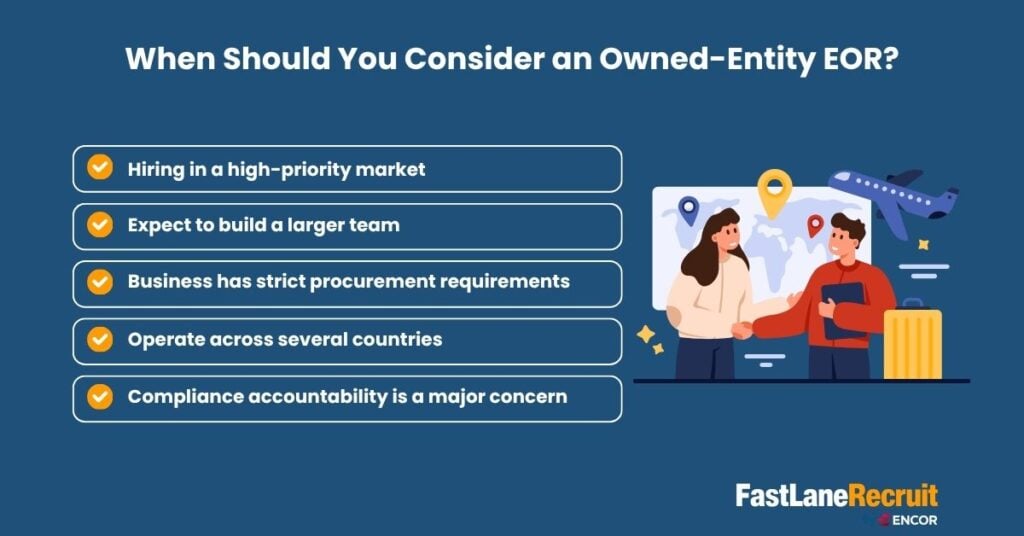
An owned-entity EOR can be particularly attractive when accountability, compliance visibility, and direct local employment infrastructure are important to your business.
Consider prioritizing this model when:
You are hiring in a high-priority market
If a country is central to your expansion strategy, having a clear understanding of the local employing structure becomes increasingly important.
You expect to build a larger team
As headcount grows, payroll, benefits, employment-law compliance, and employee support become increasingly operationally significant.
Your business has strict procurement requirements
Legal, HR, finance, and procurement teams may require detailed information about the legal employer and contractual responsibilities before approving an EOR.
You operate across several countries
A clear country-by-country entity map can make it easier to understand how your workforce is structured across jurisdictions.
Compliance accountability is a major concern
If your business operates in a regulated industry or has strict internal risk controls, you may want more transparency about who employs your people and manages local obligations.
When Is a Partner-Based EOR Still Worth Considering?
Owned entities should not automatically become the only selection criterion.
A partner-based model can still be appropriate where the provider has:
- Strong local partners
- Robust partner due diligence
- Clear contractual accountability
- Effective compliance controls
- Strong service-level agreements
- Transparent escalation processes
- Appropriate insurance and indemnification arrangements
The important issue is transparency.
Before signing, ask the provider:
“In which of our target countries do you use your own entity, and where do you use a local partner?”
Then ask:
“If the local partner makes a payroll or employment compliance error, who is contractually responsible for fixing it and compensating us?”
These questions reveal much more than a provider’s headline country count.
How FastLaneRecruit Supports International Hiring
FastLaneRecruit provides EOR solutions across selected markets in Asia Pacific, Europe, and the Middle East & Africa, including:Malaysia, Singapore, Hong Kong, China, India, Philippines, Taiwan, Vietnam, Australia, United Kingdom, Switzerland, UAE, Saudi Arabia, Qatar.
FastLaneRecruit’s published EOR information states that it operates through local entities across strategic Asian markets and supports local employment, payroll, statutory requirements, and compliance processes in supported countries.
For businesses expanding across multiple markets, this provides a practical route to international employment without requiring the company to immediately establish its own entity in every target country.
Our EOR services can support:
- International employee hiring
- Employment contracts
- Employee onboarding
- Payroll administration
- Statutory contributions
- Employee benefits coordination
- Local employment compliance
- Employee lifecycle administration
- International workforce expansion
The specific requirements and service scope can vary by country, so businesses should confirm the appropriate employment structure for each target market.
Why Choose FastLaneRecruit for EOR Services?
Regional and international coverage
Build teams across multiple markets through one EOR relationship instead of coordinating separate employment providers for every country.
Local employment support
We manage the employment-side processes required for eligible workers according to applicable local requirements.
Compliance-focused approach
Our EOR services are designed around local employment, payroll, statutory requirements, and employee administration.
Faster market entry
Use an EOR when establishing a full local entity is not yet appropriate for your expansion plans.
Scalable international hiring
Whether you are hiring your first overseas employee or building a multi-country workforce, we can help structure the employment process around your expansion needs.
FastLaneRecruit specifically positions its EOR offering as a way to hire internationally without immediately establishing a local company, while allowing the client to continue managing employees’ day-to-day work and performance.
Choose an EOR Structure With Confidence
International hiring is not simply about finding a provider that can put an employee on payroll. The legal-employer structure behind the EOR matters.
When comparing providers, look beyond country counts and monthly fees. Verify who employs your workers, how local compliance is managed, who handles payroll and statutory obligations, and what happens when something goes wrong.
An owned-entity EOR can provide a clearer line of legal-employer accountability, but the strongest EOR decision comes from evaluating entity structure, local expertise, compliance processes, payroll capability, contractual responsibilities, and your long-term expansion strategy together.
If you are planning to hire in Malaysia, Singapore, Hong Kong, China, India, Philippines, Taiwan, Vietnam, Australia, the United Kingdom, Switzerland, UAE, Saudi Arabia, or Qatar, FastLaneRecruit can help you assess the appropriate EOR structure for your target market.
Ready to Hire Internationally?
Speak with FastLaneRecruit about your hiring plans and find an EOR solution that fits your target country, workforce requirements, and expansion strategy.
Book a Free Consultation with an Expert!
Frequently Asked Questions About Owned Entities EOR Compliance
What is an owned-entity EOR?
An owned-entity EOR employs workers through its own locally registered legal entity or an entity within its corporate group. This differs from a partner-based EOR, which uses an independent local company as the legal employer.
Is an owned-entity EOR more compliant?
Not automatically. Entity ownership can provide clearer accountability and control, but it does not guarantee compliance. Businesses should also evaluate local employment expertise, payroll processes, statutory administration, contracts, benefits, and regulatory controls.
What is the difference between an owned EOR and a partner EOR?
An owned EOR employs workers through its own local entity, while a partner EOR uses an independent local company. The key difference is the legal-employer structure and how responsibility flows between the parties.
Does an EOR eliminate permanent establishment risk?
No. An EOR can address many employer-side employment responsibilities, but it does not automatically eliminate permanent establishment risk. The risk can depend on the client’s business activities, employee functions, working location, and applicable tax treaties. The OECD’s 2025 update specifically provides additional guidance on cross-border remote work and taxable presence.
What should I ask an EOR about entity ownership?
Ask:
- Who is the legal employer?
- Do you own the entity?
- What is the entity’s legal name?
- Which entity signs the employment contract?
- Who processes payroll?
- Who is responsible for statutory filings?
- What happens if there is a compliance error?
- Do you use a local partner in this country?
Does FastLaneRecruit use owned entities?
FastLaneRecruit states that it operates through local entities across strategic Asian markets and provides EOR services in multiple international markets. However, entity structure and service scope can vary by country, so businesses should confirm the legal-employer arrangement for their specific hiring market before engagement.
Which countries does FastLaneRecruit support for EOR?
FastLaneRecruit currently publishes EOR coverage across Malaysia, Singapore, Hong Kong, China, India, Philippines, Taiwan, Vietnam, Australia, United Kingdom, Switzerland, UAE, Saudi Arabia, and Qatar. Coverage and applicable service structures should be confirmed for the specific hiring requirement.
Is an EOR better than establishing a local entity?
It depends on your business strategy. An EOR can be useful for initial hiring, market testing, small teams, or faster expansion. Establishing your own entity may become more appropriate when you have a substantial, long-term operation and need direct corporate infrastructure in the country.