The Netherlands has become one of Europe’s most attractive destinations for international hiring. Known for its highly educated workforce, strong digital infrastructure, and strategic location within the European Union, the country offers businesses access to exceptional talent across technology, finance, engineering, logistics, healthcare, and professional services.
However, hiring employees in the Netherlands involves navigating local employment regulations, payroll requirements, tax obligations, and statutory benefits. For companies without a registered Dutch entity, managing these responsibilities independently can be complex and time-consuming.
This is where an employer of record Netherlands solution can help.
An Employer of Record (EOR) enables companies to legally hire employees in the Netherlands without establishing a local legal entity. The EOR becomes the legal employer on paper while the employee works exclusively for your business. This allows companies to expand internationally, access Dutch talent, and remain compliant with local employment laws without the administrative burden of setting up a subsidiary.
In this guide, we’ll explain how an employer of record Netherlands service works, the benefits of using one, compliance requirements, payroll obligations, and the step-by-step process for hiring Dutch employees successfully.
Content Outline
Key Summary
The Netherlands Offers Access to Highly Skilled Talent
The Netherlands is home to a highly educated workforce with strong expertise in technology, engineering, finance, logistics, and other high-demand industries, making it a top destination for international hiring.
An Employer of Record Simplifies International Hiring
An employer of record Netherlands provider enables businesses to hire employees legally without establishing a local entity, reducing the time and complexity of market entry.
Dutch Employment Laws Require Careful Compliance
Employers must comply with local regulations covering employment contracts, working hours, leave entitlements, payroll obligations, and employee protections.
EOR Services Manage Payroll and Benefits Administration
An EOR handles payroll processing, tax withholding, social contributions, holiday allowance, and statutory benefits, helping businesses stay compliant.
EOR Solutions Reduce Expansion Costs and Risks
Using an EOR eliminates the need for immediate entity setup while reducing administrative burdens and helping companies avoid common compliance challenges.
The Netherlands Is Ideal for Remote and Global Teams
Many businesses use an EOR to hire remote employees, support international expansion, retain relocating workers, and build distributed teams efficiently.
Choosing the Right EOR Provider Is Critical
Businesses should evaluate EOR providers based on local expertise, compliance support, payroll capabilities, data security, transparent pricing, and service quality.
Why Global Companies Hire Talent in the Netherlands
The Netherlands consistently ranks among the most competitive economies in Europe. Its business-friendly environment and highly skilled workforce make it a preferred location for companies expanding internationally.
Access to Highly Skilled Talent
Dutch professionals are recognized globally for their expertise in:
- Software development
- Artificial intelligence
- Data analytics
- Fintech
- Engineering
- Life sciences
- Logistics
- Renewable energy
The country also invests heavily in education and innovation, creating a strong pipeline of qualified professionals.
High English Proficiency
The Netherlands has one of the highest levels of English proficiency among non-native English-speaking countries. This significantly reduces communication barriers for international employers and remote teams.
Strategic Gateway to Europe
Located at the heart of Europe, the Netherlands provides easy access to major markets across the European Union.
Benefits include:
- Access to over 400 million EU consumers
- World-class transportation infrastructure
- International business ecosystem
- Strong digital connectivity
Thriving Startup and Innovation Ecosystem
Cities such as Amsterdam, Rotterdam, Eindhoven, and Utrecht have become major hubs for startups, technology companies, and multinational corporations.
This creates opportunities for businesses seeking highly skilled talent in fast-growing sectors.
Also Read: 10 Best Employer of Record (EOR) Services To Consider in 2026
What Is an Employer of Record in the Netherlands?
An Employer of Record (EOR) is a third-party organization that legally employs workers on behalf of another company.
Under an EOR arrangement:
| Responsibility | Employer of Record | Client Company |
| Employment contracts | ✓ | |
| Payroll processing | ✓ | |
| Tax withholding | ✓ | |
| Social contributions | ✓ | |
| Statutory benefits administration | ✓ | |
| Day-to-day work management | ✓ | |
| Performance management | ✓ | |
| Project assignments | ✓ |
The employee performs work for your business, but the EOR manages all local employment obligations.
This model allows organizations to hire employees in the Netherlands quickly while maintaining compliance with Dutch labor laws.
How Does an Employer of Record Netherlands Service Work?
When using an employer of record Netherlands provider, the process is straightforward.
The EOR:
- Hires the employee through its Dutch legal entity.
- Creates compliant employment agreements.
- Registers the employee with local authorities.
- Processes payroll and tax deductions.
- Administers mandatory benefits.
- Ensures compliance with employment regulations.
- Supports employee lifecycle management.
Meanwhile, your company manages the employee’s daily responsibilities, goals, and performance.
This arrangement provides the flexibility of international hiring without the complexity of entity establishment.
Why Use an Employer of Record in the Netherlands Instead of Setting Up a Local Entity?
Many businesses initially consider establishing a Dutch subsidiary. While this may make sense for large-scale operations, it often involves significant costs and administrative effort.
An EOR offers a faster and more efficient alternative.
EOR vs Local Entity vs Staffing Agency
| Feature | Employer of Record | Local Entity | Staffing Agency |
| Hire employees legally | ✓ | ✓ | Limited |
| No local company setup required | ✓ | ✗ | ✓ |
| Fast market entry | ✓ | ✗ | ✓ |
| Payroll administration | ✓ | Self-managed | Limited |
| Employment compliance | ✓ | Self-managed | Partial |
| Direct employee management | ✓ | ✓ | Limited |
| Long-term hiring solution | ✓ | ✓ | Less suitable |
| Lower setup costs | ✓ | ✗ | ✓ |
When an EOR Makes the Most Sense
An employer of record Netherlands solution is particularly valuable when:
- Hiring one or a few employees.
- Testing the Dutch market.
- Building a remote team.
- Expanding into Europe.
- Supporting employee relocation.
- Recruiting specialized talent quickly.
Benefits of Using an Employer of Record Netherlands
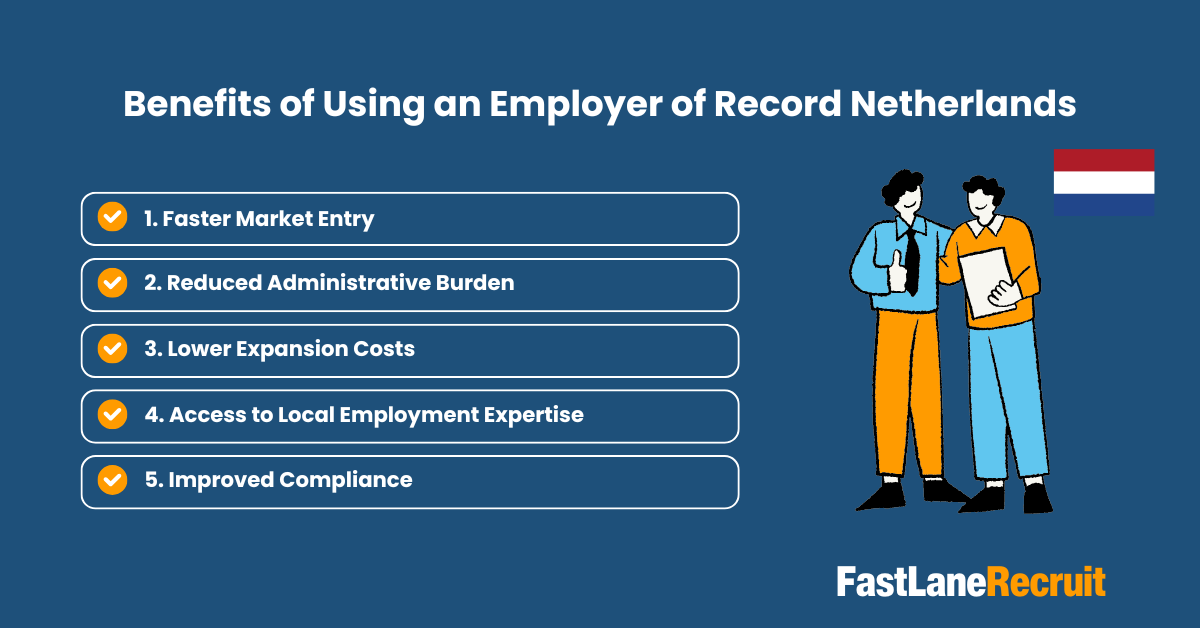
1. Faster Market Entry
Establishing a Dutch legal entity can take weeks or months.
An EOR allows companies to hire employees within days, helping businesses seize opportunities quickly.
2. Reduced Administrative Burden
Managing payroll, taxes, benefits, and employment compliance requires local expertise.
An EOR handles these responsibilities so your team can focus on growth.
3. Lower Expansion Costs
Setting up an entity often requires:
- Registration fees
- Legal advisors
- Tax consultants
- Local directors
- Accounting support
An EOR eliminates many of these costs.
4. Access to Local Employment Expertise
Dutch employment laws can be highly detailed.
An experienced EOR provides guidance on:
- Employment contracts
- Benefits
- Payroll obligations
- Leave entitlements
- Termination procedures
5. Improved Compliance
Non-compliance can result in penalties, disputes, and reputational risks.
An EOR helps ensure compliance with local regulations from day one.
Also Read: 20 Best Employer of Record in the Philippines: EOR Philippines Guide 2026
Challenges of Hiring Employees in the Netherlands
While the Dutch labor market offers many opportunities, international employers should be aware of several challenges.
Complex Employment Regulations
Dutch employment laws strongly protect employees.
Requirements often cover:
- Contract terms
- Working hours
- Leave entitlements
- Dismissal procedures
- Collective labor agreements
Worker Classification Risks
Incorrectly classifying workers as independent contractors when they should be employees can lead to tax liabilities and penalties.
Using an EOR helps reduce this risk.
Payroll Compliance
Employers must correctly calculate:
- Income tax withholding
- Social insurance contributions
- Holiday allowance
- Pension contributions
Failure to comply may result in fines or audits.
Employee Benefits Administration
The Netherlands provides extensive employee protections and benefits, which employers must administer correctly.
Termination Requirements
Ending employment relationships in the Netherlands generally requires careful compliance with local regulations and proper notice procedures.
Many dismissals require approval from relevant authorities or legal justification.
Understanding Dutch Employment Laws and Compliance
Employment compliance is one of the most important considerations when hiring in the Netherlands.
Employment Contracts
Dutch employees typically receive written employment agreements outlining:
- Position
- Salary
- Working hours
- Leave entitlements
- Notice periods
- Probation periods
Contracts should comply with Dutch labor regulations and applicable collective labor agreements.
Working Hours
The standard Dutch workweek typically ranges from 36 to 40 hours, depending on the employment agreement and industry practices.
The Netherlands is known for promoting a healthy work-life balance, and many employees work flexible or part-time schedules. Employers should ensure working hours comply with the Dutch Working Hours Act.
Minimum Wage
The Netherlands maintains a statutory minimum wage that is reviewed regularly. Employers must ensure employees receive at least the applicable minimum wage based on age and working hours.
For the latest rates, employers should refer to the official Dutch Government website.
Leave Entitlements
Dutch employees are entitled to various forms of statutory leave, including:
- Annual leave
- Sick leave
- Maternity leave
- Paternity leave
- Parental leave
- Adoption leave
- Emergency leave
The statutory annual leave entitlement is generally four times the employee’s weekly working hours.
Data Protection Requirements
Employers handling employee data in the Netherlands must comply with the General Data Protection Regulation (GDPR).
Businesses should establish clear procedures for collecting, storing, and processing employee information.
Useful Government Resources
For the most up-to-date regulations, employers should consult:
- Dutch Government (Government.nl)
- Netherlands Chamber of Commerce (KVK)
- Dutch Tax and Customs Administration (Belastingdienst)
- Employee Insurance Agency (UWV)
These official resources provide guidance on employment, payroll, taxation, and compliance requirements.
Also Read: Top 10 Reasons to Use an Employer of Record (EOR)
Payroll and Benefits Administration in the Netherlands
Payroll compliance is one of the most important responsibilities when employing workers in the Netherlands.
An employer of record Netherlands provider manages these obligations on your behalf.
Understanding Employer Costs in the Netherlands
Beyond salary, employers should budget for additional employment-related costs.
Typical Employer Obligations
| Cost Component | Employer Responsibility |
| Gross salary | Yes |
| Holiday allowance | Yes |
| Social insurance contributions | Yes |
| Employee insurance contributions | Yes |
| Pension contributions | Often applicable |
| Payroll administration | Yes |
| Employment compliance | Yes |
| EOR service fees | If applicable |
Actual employer costs vary depending on salary levels, pension arrangements, industry, and employment structure.
Payroll Taxes and Contributions
Dutch employers generally need to account for:
- Wage tax withholding
- National insurance contributions
- Employee insurance contributions
- Healthcare-related contributions
Payroll calculations must be accurate and submitted within required deadlines.
Holiday Allowance
One of the most distinctive employment benefits in the Netherlands is holiday allowance.
Employers typically provide an additional payment equivalent to at least 8% of annual gross salary.
This allowance is generally paid once per year and is intended to support employees during vacation periods.
Pension Contributions
While pension arrangements vary, many Dutch employees participate in occupational pension schemes.
Employers may be required to contribute depending on industry regulations and pension agreements.
Sick Leave
Employers have significant responsibilities regarding employee illness.
Employees may be entitled to continued salary payments during periods of sickness, subject to applicable regulations and employment agreements.
Additional Benefits Often Offered
To remain competitive, many employers also provide:
- Remote work allowances
- Professional development budgets
- Transportation allowances
- Additional vacation days
- Wellness programs
- Home office support
An experienced EOR can help structure competitive benefits packages that align with local market expectations.
Step-by-Step Guide to Hiring Employees Through an Employer of Record in the Netherlands
Using an employer of record Netherlands solution simplifies international hiring.
Here is the typical process.
Step 1: Define Your Hiring Requirements
Begin by identifying:
- Job role
- Responsibilities
- Reporting structure
- Salary range
- Benefits expectations
- Start date
Clear planning helps streamline onboarding.
Step 2: Select an Employer of Record Provider
Evaluate providers based on:
- Dutch employment expertise
- Compliance capabilities
- Payroll services
- Data security standards
- Customer support
- Local entity ownership
Choosing the right partner is critical for long-term success.
Step 3: Prepare a Compliant Employment Contract
The EOR prepares an employment agreement that complies with Dutch labor regulations.
The contract typically includes:
- Position title
- Compensation
- Working hours
- Leave entitlements
- Benefits
- Notice periods
Step 4: Complete Employee Onboarding
The employee provides necessary information and documentation.
This may include:
- Identification documents
- Address details
- Banking information
- Tax-related information
- Social security registration details
The EOR handles registration and onboarding procedures.
Step 5: Process Payroll and Benefits
Once employment begins, the EOR:
- Calculates payroll
- Processes salary payments
- Administers benefits
- Files payroll taxes
- Maintains compliance records
Step 6: Ongoing Employee Management
Your company directs the employee’s daily work while the EOR manages employment administration.
This includes:
- Payroll updates
- Leave administration
- Compliance monitoring
- Contract amendments
Also Read: Employer of Record vs. Staffing Agency
Industries That Benefit Most from EOR Hiring in the Netherlands
Several industries actively leverage employer of record services when expanding internationally.
Technology and Software Development
The Netherlands is home to a thriving tech ecosystem.
Companies frequently hire:
- Software engineers
- Product managers
- UX designers
- Data scientists
- Cybersecurity specialists
Financial Services and FinTech
Amsterdam has become a leading European financial center, creating strong demand for:
- Compliance professionals
- Financial analysts
- Risk specialists
- FinTech experts
Logistics and Supply Chain
The Netherlands serves as a major logistics hub due to:
- Rotterdam Port
- Schiphol Airport
- Extensive transportation infrastructure
This creates opportunities for logistics and supply chain professionals.
Renewable Energy
As sustainability initiatives grow, companies increasingly hire:
- Energy consultants
- Engineers
- Sustainability specialists
Healthcare and Life Sciences
The healthcare sector continues to require qualified professionals in clinical, research, and administrative roles.
Common Use Cases for an Employer of Record Netherlands
Hiring a Single Employee
Many companies want to hire one specialist without establishing a local entity.
An EOR makes this possible.
Testing Market Demand
Businesses entering Europe often use an EOR before making larger investments.
This allows them to evaluate opportunities while minimizing risk.
Building a Remote Team
Remote work has made international hiring more accessible.
An EOR supports compliant employment of distributed team members.
Supporting Employee Relocation
Companies frequently use EOR solutions to retain employees relocating to the Netherlands.
This can help maintain continuity while ensuring local compliance.
Hiring Skilled International Talent
Some EOR providers can support immigration and work authorization processes where appropriate, helping companies access broader talent pools.
Risks and Considerations When Choosing an EOR
While EOR solutions offer significant advantages, businesses should conduct due diligence before selecting a provider.
Local Expertise
Choose a provider with strong knowledge of Dutch employment regulations.
Data Security
Verify compliance with GDPR and other privacy requirements.
Transparent Pricing
Understand:
- Monthly fees
- Onboarding charges
- Payroll administration costs
- Additional service fees
Service Scope
Clarify which services are included:
- Payroll
- Benefits administration
- Compliance support
- Immigration assistance
- HR support
Entity Structure
Some providers own local entities directly, while others rely on partners.
Understanding the operating model can help assess service consistency and risk.
Employer of Record Provider Selection Checklist
Use the following checklist when evaluating providers.
| Selection Criteria | Importance |
| Local Dutch expertise | High |
| Compliance support | High |
| Payroll capabilities | High |
| GDPR compliance | High |
| Transparent pricing | High |
| Employee onboarding support | High |
| Benefits administration | High |
| Immigration assistance | Medium |
| Reporting capabilities | Medium |
| Dedicated account management | Medium |
A thorough evaluation helps ensure a smooth hiring experience for both employers and employees.
Also Read: Employers of Record – What You Need to Know!
Why Many Companies Also Hire Talent Across Asia Through EOR Solutions
While the Netherlands remains an attractive destination for international hiring, many organizations are simultaneously expanding their teams across Asia to access specialized talent, reduce operational costs, and support regional growth.
Employer of Record services make it possible to hire employees in multiple countries without establishing separate legal entities in each market.
For companies building global teams, Asia offers access to highly skilled professionals across technology, finance, customer support, engineering, manufacturing, and professional services.
Some of the most popular expansion destinations include:
- Malaysia
- Singapore
- Hong Kong
- China
- United Arab Emirates (UAE)
- Taiwan
These markets offer strong talent pools, strategic business locations, and growing opportunities for international companies.
Netherlands vs Malaysia vs Singapore vs Hong Kong vs China vs UAE vs Taiwan
When evaluating global hiring strategies, it is useful to compare talent markets and expansion considerations.
| Country | Key Talent Strengths | Business Environment | English Proficiency | Popular Industries |
| Netherlands | Technology, Engineering, FinTech | Strong EU access | Very High | Technology, Logistics, Finance |
| Malaysia | Technology, Shared Services, Finance | Cost-effective | High | IT, BPO, Finance |
| Singapore | Regional Headquarters, Finance, Technology | Highly developed | Very High | Finance, SaaS, Technology |
| Hong Kong | Financial Services, Professional Services | International gateway | High | Finance, Consulting |
| China | Manufacturing, Engineering, Technology | Large domestic market | Moderate | Manufacturing, Tech |
| UAE | Regional Middle East Hub | Business-friendly | High | Finance, Energy, Trade |
| Taiwan | Semiconductors, Technology, Engineering | Innovation-driven | Moderate to High | Electronics, Technology |
Each location offers unique advantages depending on your hiring objectives, budget, and expansion strategy.
Also Read: The Pros and Cons of Employers of Record
Why Choose FastLaneRecruit for Global EOR Services?
Expanding internationally requires more than simply finding talent. Companies must navigate employment laws, payroll regulations, statutory benefits, tax requirements, and onboarding processes across different jurisdictions.
FastLaneRecruit helps businesses hire and manage international employees compliantly through Employer of Record solutions across key Asian markets.
Our EOR services support hiring in:
With FastLaneRecruit, businesses can:
- Hire employees without establishing local entities
- Ensure compliance with local labor laws
- Simplify payroll and tax administration
- Reduce expansion timelines
- Access local HR expertise
- Support remote and distributed teams
Whether you’re hiring your first international employee or building a regional workforce, our team can help streamline the process from onboarding to payroll administration.
Looking to Expand Beyond the Netherlands?
If your business is considering growth across Asia-Pacific markets, FastLaneRecruit can help you establish compliant employment structures without the complexity of setting up multiple subsidiaries.
Speak with our team to learn how our Employer of Record solutions can support your international hiring strategy.
Conclusion
The Netherlands continues to be one of Europe’s most attractive destinations for international hiring. Its highly skilled workforce, strong digital economy, strategic location, and business-friendly environment make it an excellent choice for companies seeking top talent.
However, hiring employees in the Netherlands requires careful attention to employment laws, payroll obligations, tax compliance, and statutory benefits. For businesses without a local entity, navigating these requirements independently can be challenging.
An employer of record Netherlands solution offers a practical and efficient way to expand into the Dutch market while minimizing administrative complexity. By partnering with an experienced EOR provider, companies can hire quickly, remain compliant, and focus on growing their business.
Whether you are hiring a single specialist, building a remote team, testing a new market, or supporting employee relocation, an Employer of Record can provide the flexibility and compliance support needed for successful international expansion.
Ready to Hire International Talent Without Setting Up a Local Entity?
FastLaneRecruit helps businesses hire and manage employees compliantly through Employer of Record services across Malaysia, Singapore, Hong Kong, China, the UAE and Taiwan. Our team simplifies global hiring by managing employment contracts, payroll administration, statutory benefits, and compliance requirements, allowing you to focus on growing your business.
Contact FastLaneRecruit today to discover how our Employer of Record solutions can support your international expansion strategy and help you build a world-class global workforce.
Frequently Asked Questions About Employer of Record Netherlands Services
1. What is an employer of record in the Netherlands?
An employer of record Netherlands provider legally employs workers on behalf of another company. The EOR manages payroll, tax compliance, employment contracts, and statutory benefits, while the client company oversees the employee’s day-to-day work.
2. Can I hire employees in the Netherlands without opening a Dutch company?
Yes. An Employer of Record allows you to hire employees legally in the Netherlands without establishing a local legal entity.
3. How quickly can I hire through an EOR in the Netherlands?
The timeline varies depending on the provider and employment requirements, but many EOR arrangements can be completed significantly faster than establishing a local entity.
4. Is an EOR legal in the Netherlands?
Yes. Employer of Record services are commonly used by international businesses to hire employees compliantly while adhering to Dutch employment regulations.
5. What benefits must Dutch employees receive?
Mandatory benefits generally include:
- Annual leave
- Holiday allowance
- Sick leave protections
- Parental leave entitlements
- Social insurance coverage
Additional requirements may vary depending on industry regulations and collective labor agreements.
6. What is the difference between an EOR and a staffing agency?
An EOR serves as the legal employer and manages employment compliance, payroll, and benefits. A staffing agency typically focuses on sourcing temporary workers and may not provide the same long-term employment framework.
7. What is the difference between an EOR and a PEO?
A Professional Employer Organization (PEO) generally operates under a co-employment model and often requires the client company to maintain a local entity. An EOR can hire employees without the client establishing a legal presence in the country.
8. Can an EOR support remote employees?
Yes. Many companies use Employer of Record services to hire and manage remote employees working from the Netherlands.
9. Does an EOR handle payroll taxes?
Yes. Most EOR providers manage payroll calculations, tax withholding, reporting requirements, and payroll administration in accordance with local regulations.
10. How do I choose the best employer of record Netherlands provider?
Look for providers that offer:
- Strong local expertise
- Compliance support
- Transparent pricing
- Secure technology
- Payroll capabilities
- Responsive customer service
A provider with proven experience in international hiring can help reduce compliance risks and improve the employee experience.