
Work culture in Malaysia plays a critical role in shaping hiring outcomes, employee performance, and long-term business success for international companies. Malaysia is a strategically important ASEAN hub with a highly diverse workforce, competitive employment costs, and strong English proficiency in business environments.
However, hiring in Malaysia requires more than recruitment execution. It requires an understanding of workplace hierarchy, communication style, employee expectations, and compliance requirements. Global employers who overlook these cultural and structural factors often face misalignment in team performance, engagement, and retention.
For this reason, many companies entering Malaysia rely on Employer of Record (EOR) solutions to ensure compliant and efficient hiring without establishing a local entity
Content Outline
Key Summary
Hierarchical but structured workplace environment
Work culture in Malaysia is clearly hierarchical, with decision-making concentrated at senior levels. Clear reporting lines and defined roles improve efficiency and reduce workplace friction.
Indirect and respectful communication style
Communication is generally polite and indirect, with a strong focus on harmony and avoiding confrontation. Employers should adapt feedback and management styles accordingly.
Stable and structured working arrangements
Most roles follow standard working hours and a 5-day workweek, with strong respect for public holidays and cultural commitments.
Multicultural and multilingual workforce advantage
English is widely used in business, alongside Malay, Mandarin, and Tamil. This makes Malaysia a strong hub for regional hiring but requires adaptable communication.
Team-oriented and loyalty-driven employee culture
Employees value teamwork, stability, and long-term relationships, making retention strategies and group alignment important.
Communication and Onboarding Are Critical
Many offshore initiatives fail because of poor communication, unclear expectations, and inadequate onboarding. Regular collaboration and performance management are necessary for long-term success.
EOR simplifies hiring in Malaysia
Employer of Record (EOR) solutions allow companies to hire without entity setup, reducing compliance risk and speeding up market entry..
Overview of Work Culture in Malaysia
Work culture in Malaysia is shaped by a combination of cultural diversity, historical business practices, and modern corporate structures. The workplace environment is influenced by Malay, Chinese, Indian, and indigenous cultural values, creating a unique blend of formality, respect, and adaptability.
Key characteristics include:
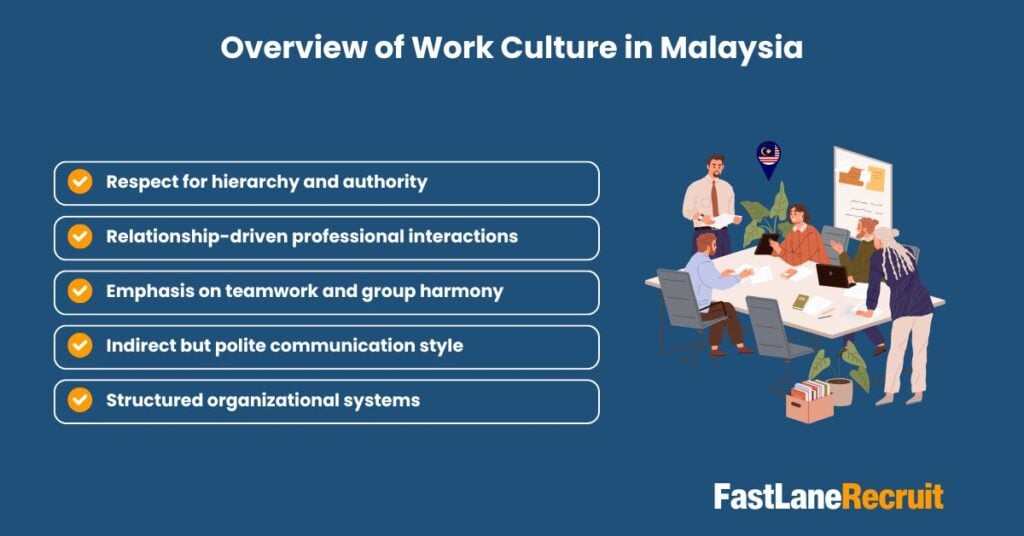
These characteristics define how decisions are made, how teams collaborate, and how employees interact with leadership.
Workplace Hierarchy and Organizational Structure
Strong Hierarchical Systems
Most Malaysian organizations operate within clearly defined hierarchical structures. Decision-making authority is typically concentrated at senior management levels, and employees are expected to follow formal reporting lines.
This structure influences workplace behavior in several ways:
- Senior leaders hold decision-making authority
- Employees show strong respect for managerial positions
- Direct challenges to authority are uncommon in formal settings
- Approval processes are typically multi-layered
Business Implication for Global Employers
Companies entering Malaysia should recognize that:
- Autonomy levels may be lower than in Western organizational models
- Clear instructions and structured delegation improve efficiency
- Leadership presence plays a key role in employee motivation
Understanding hierarchy is essential for building effective management systems and avoiding communication gaps.
Communication Style in Malaysian Workplaces
Indirect and High-Context Communication
Workplaces in Malaysia generally follow a high-context communication style, where messages are often implied rather than explicitly stated. Politeness and harmony are prioritized over direct confrontation.
Common communication characteristics include:
- Diplomatic language in both verbal and written communication
- Avoidance of direct disagreement in group settings
- Preference for subtle feedback delivery
- Strong emphasis on preserving professional relationships
Workplace Impact
For global employers, especially those from low-context communication cultures, this may require adjustment in:
- Feedback delivery methods
- Meeting facilitation styles
- Performance evaluation approaches
Misinterpretation of indirect communication is a common challenge in multinational teams operating in Malaysia.
Working in Malaysia: Employment Structure and Expectations
Standard Working Hours and Environment
The typical working structure in Malaysia includes:
- Five-day workweek in most industries
- Standard working hours around eight hours per day
- Office-based or hybrid arrangements depending on sector
While these standards apply broadly, variations exist across industries such as technology, manufacturing, and professional services.
Work-Life Balance Considerations
Malaysia places cultural importance on family and religious observances. Employers are generally expected to respect:
- Public holidays and cultural festivals
- Personal and family commitments
- Reasonable flexibility in scheduling where possible
However, certain sectors may require extended availability depending on operational demands.
Multicultural and Multilingual Workforce
One of Malaysia’s greatest strengths as an employment destination is its highly diverse and multicultural workforce. The country is home to a mix of Malay, Chinese, Indian, and other ethnic communities, creating a unique business environment where multiple languages, cultures, and perspectives coexist.
This diversity has helped Malaysia become a popular regional hub for multinational corporations, shared service centers, technology companies, and business process outsourcing (BPO) operations serving both local and international markets.
Languages Used in Business
Malaysia’s multilingual workforce allows businesses to communicate effectively across different markets throughout Asia and beyond.
Bahasa Malaysia as the National Language
Bahasa Malaysia (Malay) is the official national language and is widely used in government institutions, public administration, and domestic business communications.
Employers operating in Malaysia should ensure that employment contracts, workplace notices, and official documentation comply with any language requirements applicable to their workforce and industry.
Example:
A local retail company operating throughout Malaysia may issue employee handbooks and workplace policies in Bahasa Malaysia to ensure accessibility for all staff members.
English Widely Used in Corporate Environments
English serves as the primary business language for many multinational companies and is commonly used in:
- Corporate communications
- International business transactions
- Technology and IT sectors
- Financial services
- Professional services firms
- Shared service centers
Many Malaysian professionals possess strong English language skills, making the country an attractive destination for international employers building regional teams.
Example:
A global software company with employees in Kuala Lumpur may conduct meetings, prepare reports, and communicate with overseas offices entirely in English.
Mandarin and Tamil Commonly Used in Specific Sectors and Communities
Due to Malaysia’s significant Chinese and Indian populations, Mandarin and Tamil are frequently used in certain industries, customer-facing roles, and community-focused businesses.
Mandarin is particularly valuable in:
- Manufacturing
- Import-export businesses
- Retail operations
- Companies serving Chinese-speaking markets
Tamil is commonly used within parts of the Malaysian Indian community and may be important for customer service and workforce engagement in specific sectors.
Example:
A customer support center serving clients from Mainland China, Taiwan, and Singapore may actively recruit Mandarin-speaking employees to improve customer experience.
Workforce Implications
While Malaysia’s linguistic diversity offers substantial advantages, it also requires employers to develop thoughtful communication and management strategies.
Communication Strategies Must Be Adaptable
Organizations should recognize that employees may have different language preferences and communication styles.
Effective employers often:
- Provide multilingual training materials
- Use clear and simple communication
- Encourage cross-cultural collaboration
- Ensure key policies are understood by all employees
Example:
A manufacturing company may provide workplace safety instructions in both English and Bahasa Malaysia to ensure comprehension across the workforce.
English Is Often Used as the Standard Business Language
To maintain consistency across diverse teams, many organizations adopt English as their primary working language.
Benefits include:
- Easier collaboration with international offices
- Standardized reporting and documentation
- Improved communication across multicultural teams
However, employers should avoid assuming equal English proficiency across all roles and provide support where necessary.
HR Policies Should Consider Multilingual Inclusivity
Human resource practices should reflect the diversity of the workforce by ensuring employees have equal access to information regardless of language background.
Inclusive HR practices may include:
- Translating important policies and notices
- Offering multilingual onboarding programs
- Providing language support during training
- Recognizing cultural and religious diversity
Example:
An international company may offer onboarding materials in English while providing translated summaries in Bahasa Malaysia to support broader employee understanding.
Why Malaysia’s Diversity Is a Competitive Advantage
Malaysia’s multicultural workforce enables businesses to:
- Serve regional and international markets more effectively
- Access multilingual talent pools
- Build culturally diverse teams
- Support global customer service operations
- Expand throughout Southeast Asia with local market expertise
However, maximizing these advantages requires structured communication frameworks, inclusive leadership practices, and culturally aware HR strategies.
Employee Work Values and Behavioural Norms
Understanding workplace culture is just as important as understanding labour laws. Malaysian employees often bring values shaped by collectivist cultural traditions, respect for hierarchy, and a strong emphasis on workplace relationships.
Employers who understand these behavioural norms are generally better positioned to attract, engage, and retain talent.
Collectivist Work Culture
Malaysia is widely considered a collectivist society, where group interests and social harmony often take precedence over individual achievement.
This cultural characteristic influences how employees communicate, collaborate, and make decisions within organizations.
Team Harmony Over Individual Recognition
Many employees place significant value on maintaining positive workplace relationships and avoiding conflict.
As a result:
- Collaboration is often prioritized over competition
- Employees may avoid direct confrontation
- Team success may be valued more highly than personal recognition
Example:
An employee may choose to support team consensus rather than openly challenge a colleague during a meeting, even when holding a different opinion.
For managers, creating safe environments for constructive feedback can help balance collaboration with innovation.
Group Consensus in Decision-Making
Decision-making in Malaysian workplaces often involves consultation and consensus-building, particularly in larger organizations.
Employees may appreciate:
- Being consulted before major changes
- Collaborative problem-solving discussions
- Opportunities to contribute ideas within a group setting
Example:
Rather than implementing a new workflow immediately, managers may first seek feedback from department heads and team members to build support and alignment.
This approach often strengthens employee buy-in and reduces resistance to change.
Loyalty and Long-Term Employment Relationships
Job stability and long-term employment relationships are highly valued by many Malaysian employees.
Factors that often contribute to retention include:
- Career development opportunities
- Stable leadership
- Competitive benefits
- Positive workplace culture
- Strong manager-employee relationships
Example:
An employee may remain with an organization for many years if they feel respected, supported, and provided with clear opportunities for advancement.
Employers that invest in employee development frequently experience stronger retention outcomes.
Workplace Behaviour Traits
Respect for Senior Leadership
Hierarchical structures remain common in many Malaysian organizations.
Employees often demonstrate respect toward:
- Senior executives
- Managers
- Experienced colleagues
- Organizational authority
This respect may influence communication styles, with employees being less likely to openly challenge senior leaders in public settings.
Example:
During meetings, employees may wait for management direction before expressing alternative viewpoints.
Managers can encourage open discussion by actively inviting feedback and creating psychologically safe communication channels.
Preference for Stable Working Environments
Many Malaysian professionals value predictability, job security, and structured workplace environments.
Employees often respond positively to:
- Clear expectations
- Well-defined responsibilities
- Consistent management practices
- Long-term organizational planning
Frequent organizational disruption or unclear direction may negatively affect engagement and morale.
Cooperative Team-Based Problem-Solving Approach
Collaboration is generally preferred over highly competitive workplace dynamics.
Employees often enjoy working in environments that emphasize:
- Teamwork
- Mutual support
- Knowledge sharing
- Collective problem-solving
Example:
Cross-functional project teams may work closely together to achieve business objectives, with individuals contributing expertise while prioritizing overall team success.
What This Means for Employers
Organizations hiring in Malaysia should align management and performance systems with local workplace expectations while maintaining accountability and productivity standards.
Effective practices include:
- Combining individual and team-based performance metrics
- Recognizing both personal and group achievements
- Encouraging collaboration alongside innovation
- Providing structured career development pathways
- Creating inclusive communication processes
- Training managers in cross-cultural leadership
By understanding Malaysia’s multicultural workforce and workplace values, employers can build stronger teams, improve employee engagement, and create a more productive and inclusive working environment.
Hiring in Malaysia: Incorporation vs Employer of Record (EOR)
Challenges of Local Company Incorporation
Setting up a legal entity in Malaysia involves:
- Company registration and regulatory approvals
- Tax registration and compliance obligations
- Ongoing corporate governance requirements
- HR and payroll infrastructure setup
This process can be time-consuming and resource-intensive for foreign companies entering the market.
Also Read: Hiring in Malaysia: Costs, Process, and Compliance
Employer of Record (EOR) as a Strategic Alternative
An Employer of Record model allows companies to hire employees in Malaysia without establishing a local entity. FastLaneRecruit provides EOR services that manage:
- Employment contracts in compliance with Malaysian law
- Payroll administration and statutory contributions
- HR compliance and employee management support
- Legal employment responsibilities
Why EOR Is Increasingly Preferred
Global employers choose EOR because it provides:
- Faster market entry
- Reduced administrative burden
- Lower compliance risk
- Flexible workforce scaling
For companies testing the Malaysian market or expanding regionally, EOR is often the more efficient and lower-risk approach compared to incorporation.
Why Malaysia Is a Strategic Hiring Location
Malaysia continues to attract global employers due to several structural advantages:
Key Advantages
- Strong pool of educated and skilled professionals
- Competitive labor cost structure compared to regional markets
- High English proficiency in business sectors
- Strategic geographic location within ASEAN
- Established infrastructure for multinational operations
Business Value for Employers
Companies hiring in Malaysia benefit from:
- Scalable talent acquisition opportunities
- Regional operational efficiency
- Access to diverse skill sets across industries such as finance, IT, and shared services
These factors make Malaysia a preferred destination for regional expansion strategies.
Challenges in Managing Work Culture in Malaysia
Despite its advantages, employers should be aware of potential challenges:
- Indirect communication may lead to misunderstandings
- Hierarchical structures can slow feedback loops
- Cultural diversity requires adaptive management approaches
- Compliance requirements must be carefully managed
These challenges can be effectively mitigated through structured HR frameworks or local EOR partnerships.
Conclusion: Building Successful Teams in Malaysia
Understanding work culture in Malaysia is essential for global employers aiming to hire, manage, and retain talent effectively. The country offers strong business potential, but success depends on aligning with local workplace expectations, communication styles, and organizational structures.
For many companies, the most efficient approach is not direct incorporation but leveraging an Employer of Record model to ensure compliant and scalable hiring.
FastLaneRecruit supports global businesses in building teams in Malaysia without the complexity of establishing a legal entity, enabling faster and more strategic workforce expansion.
Get Expert Assistance from FastLaneRecruit
FastLaneRecruit provides dedicated Employer of Record (EOR) services in Malaysia designed for global companies looking to hire quickly and compliantly.
Our services include:
- Legal employment and contract management in Malaysia
- Payroll and statutory compliance handling
- HR administration and workforce support
- End-to-end employer of record solutions
Whether you are hiring your first employee or expanding a regional team, FastLaneRecruit ensures your entry into Malaysia is smooth, compliant, and cost-efficient.
Contact us to start building your team in Malaysia today with expert support.
FAQs: Work Culture in Malaysia & Working in Malaysia
What is the work culture in Malaysia like?
It is hierarchical, respectful, and relationship-driven with a strong emphasis on harmony and teamwork.
Is English widely used in workplaces in Malaysia?
Yes, especially in multinational companies and urban business environments.
What are typical working hours in Malaysia?
Generally 8 hours per day, 5 days per week depending on industry.
Is Malaysia good for hiring remote employees?
Yes, Malaysia offers skilled, cost-effective talent suitable for remote and hybrid roles.
Should companies set up a local entity to hire in Malaysia?
Not necessarily. Many companies use Employer of Record (EOR) services to hire legally without incorporation.