Malaysia’s job market in 2026 is entering a period of steady growth and rapid transformation. As industries continue to evolve through digitalisation, automation, and sustainability initiatives, the demand for skilled professionals is rising across multiple sectors. According to the Department of Statistics Malaysia (DOSM), the country has recorded over 9 million filled jobs, reflecting consistent hiring activity and a stable labour market. At the same time, the unemployment rate remains around 3%, showing that while jobs are available, competition for skilled talent has become much stronger.
Today, employers are not only looking to fill roles, but they are also looking for candidates with the right mix of technical expertise, adaptability, and future-ready skills. Key growth drivers shaping Malaysia’s job market include the expansion of the digital economy, investments in semiconductor and advanced manufacturing, rising ESG and sustainability requirements, healthcare expansion driven by demographic changes, and the continued growth of regional shared service hubs.
For both employers and professionals, this means one important shift: success in 2026 depends not just on job availability, but on accessing the right skills at the right time.
This guide explores the most in-demand jobs in Malaysia for 2026, key industry trends, salary insights, and the skills shaping the future of work.
Content Outline
Key Summary
Malaysia’s Job Market Is Growing but More Competitive
Job creation remains strong with steady employment levels, but competition for skilled talent is increasing across key industries.
Skills Matter More Than Job Titles
Employers now focus on practical skills in AI, data, engineering, ESG, and digital operations rather than just degrees or job titles.
AI Is Reshaping Work, Not Replacing It
AI is changing how jobs are done, with employers prioritising candidates who can use AI tools and adapt quickly to new technologies.
Talent Shortages Drive Strong Demand
Critical shortages exist in semiconductor, AI, cybersecurity, healthcare, and cloud roles, creating high competition for skilled professionals.
Growth Is Concentrated in Key Sectors
Top hiring industries include technology, manufacturing, finance, healthcare, ESG, construction, and digital marketing.
Salaries Are Rising for High-Skill Roles
Specialised roles in tech, engineering, and healthcare continue to command higher salaries due to limited talent supply.
Hiring Requires a Strategic Approach
Companies now rely on faster hiring, better talent access, and recruitment partners like FastLaneRecruit to stay competitive.
Malaysia Job Market Overview 2026: What’s Changing
Malaysia’s job market in 2026 is going through a major shift. While jobs are still being created across many industries, the way companies hire and the skills they look for have changed significantly.
Instead of hiring based only on degrees or job titles, employers are now focusing more on what candidates can actually do, how quickly they can adapt, and how well they can work with new technologies.
This shift is mainly driven by three major forces:
1. Skills-First Hiring Economy
In the past, many companies focused heavily on job titles, academic qualifications, or years of experience. Today, that approach is changing.
Employers in Malaysia are now more interested in skills and real capabilities rather than just formal job labels.
This means a candidate who can demonstrate strong practical skills may be considered even if their job title or background is slightly different from the role.
The most important skill areas in demand include:
- AI and Data Skills
Companies want people who can understand data, use analytics tools, and support decision-making with insights. - Engineering and Automation Skills
Manufacturing, technology, and infrastructure companies are looking for talent who can work with automated systems and modern engineering tools. - ESG and Compliance Knowledge
Businesses are paying more attention to sustainability, environmental rules, and corporate responsibility standards. - Digital Business Operations
Skills in online platforms, digital tools, and e-commerce systems are increasingly important across all industries.
What this means for job seekers and employers:
Skills development and practical experience now matter more than ever. Companies want people who can start contributing quickly.
2. AI-Driven Workforce Transformation
Artificial Intelligence (AI) is changing how work is done in almost every industry in Malaysia.
However, AI is not simply replacing jobs. Instead, it is changing the way jobs are performed and increasing the value of people who know how to use these tools effectively.
Most roles today now require a combination of traditional knowledge and AI-related skills.
Key expectations from employers include:
- Ability to work with AI tools
Employees are expected to use AI for tasks such as research, writing support, data analysis, and automation of repetitive work. - Data interpretation skills
It is not enough to collect data, professionals must be able to understand what the data means and how it supports business decisions. - Automation awareness
Many companies now use automated systems. Employees need to understand how these systems work and how to improve them. - Strong adaptability
Because AI tools and digital systems change quickly, employers value people who can learn new tools fast and adjust to new workflows.
Key takeaway: The most successful candidates are those who can combine human judgment with AI-powered tools, not those who avoid technology.
Also Read: Hybrid And Remote Work Trends in Malaysia
3. Talent Shortages in Critical Sectors
Even though Malaysia continues to create jobs and maintain stable employment levels, many employers still struggle to find the right talent in specific industries.
This is not a lack of jobs; it is a skills mismatch, where demand for certain expertise is higher than the available supply of qualified professionals.
The most affected areas include:
- Technical Engineering Roles
Industries such as manufacturing, infrastructure, and automation require skilled engineers, but experienced talent is limited. - Semiconductor Specialists
As Malaysia strengthens its position in global chip manufacturing, demand for chip design, testing, and production experts continues to grow. - Healthcare Professionals
Hospitals and healthcare providers face ongoing demand for nurses, doctors, and allied health workers due to population growth and ageing trends. - Cloud and Cybersecurity Experts
With more businesses moving online, companies urgently need professionals who can manage cloud systems and protect against cyber threats.
What this means for employers:
Hiring has become more competitive. Companies often need to move faster, offer better career development, and sometimes look beyond local talent pools to fill critical roles.
High-Demand Jobs in Malaysia 2026 by Sector
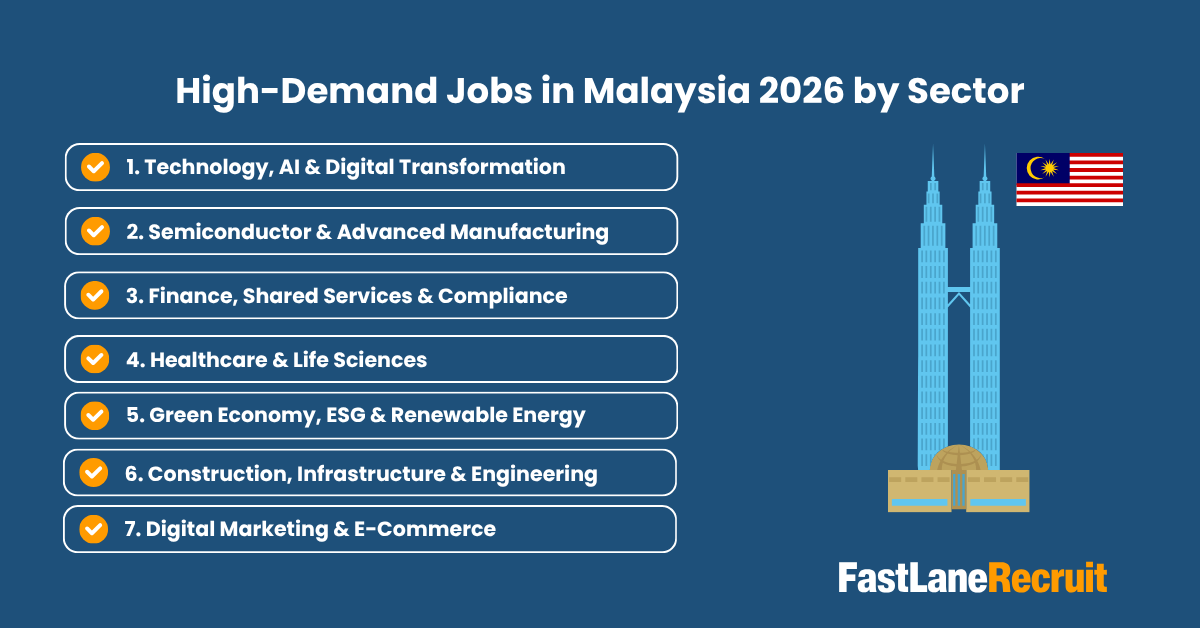
Malaysia’s job market in 2026 is shaped by rapid digital adoption, industrial growth, and strong demand for specialised skills. While opportunities exist across many industries, some sectors are experiencing significantly higher hiring demand due to technology shifts, policy changes, and global economic trends.
Below is a clearer breakdown of the most in-demand sectors, key roles, and what is driving hiring growth in each area.
1. Technology, AI & Digital Transformation
Technology continues to be the most important driver of job creation in Malaysia. Almost every industry, from banking to healthcare to retail, is now investing in digital systems, automation, and artificial intelligence.
As a result, companies are actively hiring professionals who can build, manage, and secure digital infrastructure.
Key roles in demand:
- AI & Machine Learning Engineer
- Data Scientist / Data Engineer
- Cloud Architect (AWS, Azure, Google Cloud)
- Cybersecurity Specialist
- IT & Digital Transformation Manager
Why demand is rising:
- More companies are moving systems to cloud platforms for flexibility and efficiency
- Cybersecurity threats are increasing as businesses become more digital
- AI tools are being integrated into daily business operations
- Malaysia’s digital economy is expanding through government and private investment
Important insight:
AI is not reducing job opportunities. Instead, it is changing the type of skills employers expect. Professionals who can combine technical expertise with business understanding are now more valuable than ever.
2. Semiconductor & Advanced Manufacturing
Malaysia plays an important role in the global semiconductor supply chain, especially in testing, assembly, and advanced electronics manufacturing. In recent years, the country has been moving toward higher-value chip design and engineering work.
This shift is creating strong demand for highly specialised technical talent.
Key roles in demand:
- IC Design Engineer
- Embedded Systems Engineer
- Automation & Robotics Engineer
- Process Engineer
- Quality Assurance & Test Engineer
Why this sector is growing:
- Global demand for semiconductors continues to rise across industries like AI, automotive, and electronics
- Malaysia is upgrading its industrial capabilities to move into higher-value manufacturing
- More multinational companies are expanding production and R&D facilities in the country
Key takeaway:
This sector requires highly technical skills, and experienced engineers are especially in short supply, making it one of the most competitive hiring areas.
Also Read: Operations Management Compliance in Malaysia
3. Finance, Shared Services & Compliance
The finance sector in Malaysia is evolving beyond traditional accounting and reporting. Today, finance professionals are expected to support business decisions, manage risk, and work with digital financial systems.
Shared service centres in Malaysia also continue to grow, especially for regional operations.
Key roles in demand:
- Financial Controller
- Compliance & Risk Manager
- Tax & Regulatory Specialist
- Financial Analyst (Data-driven)
- Fintech Product Specialist
Key drivers of demand:
- Implementation of e-invoicing systems in Malaysia
- Stronger financial regulations and compliance requirements
- Growth of regional shared service hubs in Malaysia
- Increased use of digital tools in financial reporting and forecasting
Key takeaway:
Finance roles are becoming more strategic. Employers now prefer candidates who can combine financial knowledge with data and technology skills.
4. Healthcare & Life Sciences
Healthcare remains one of the most stable and essential sectors in Malaysia. Demand continues to grow due to demographic changes and the expansion of both public and private healthcare services.
Key roles in demand:
- Registered Nurses
- Medical Technologists
- Specialist Doctors (various disciplines)
- Allied Health Professionals (therapists, lab technicians, etc.)
- Health Informatics Specialists
Why demand is rising:
- Malaysia’s ageing population is increasing healthcare needs
- Growth of private hospitals and healthcare facilities
- Expansion of medical tourism
- Increasing adoption of digital health systems and medical technology
Key takeaway:
Healthcare is a long-term growth sector with consistent demand, especially for skilled medical and support professionals.
5. Green Economy, ESG & Renewable Energy
Sustainability is now a core business priority, not just a corporate initiative. Companies in Malaysia are increasingly required to meet environmental standards and ESG reporting requirements.
This has created new career opportunities in green industries.
Key roles in demand:
- ESG & Sustainability Consultant
- Renewable Energy Engineer
- Solar Project Manager
- Carbon Reporting Specialist
- Green Finance Analyst
Key drivers:
- Stronger ESG reporting and compliance requirements
- National policies supporting energy transition and sustainability goals
- Increased corporate focus on reducing environmental impact
- Growth in renewable energy projects, such as solar and clean energy infrastructure
Key takeaway:
Green jobs are becoming mainstream roles across industries, not just limited to environmental organisations.
Also Read: Ultimate Guide to Employee Onboarding Checklist
6. Construction, Infrastructure & Engineering
Malaysia continues to invest in infrastructure development, industrial zones, and data centres, which keeps demand strong for construction and engineering professionals.
Key roles in demand:
- Construction Project Manager
- Civil & Structural Engineer
- Mechanical & Electrical Engineer
- Site Supervisor
- Skilled Technical Workers (welders, technicians, operators)
Industry trend:
Construction and engineering work is becoming more digital, with increased use of project management software, automation tools, and modern construction technologies.
Key takeaway:
Employers now prefer candidates who can combine traditional engineering skills with digital tools and modern project management methods.
7. Digital Marketing & E-Commerce
As more businesses move online, digital marketing and e-commerce roles are becoming essential for growth and customer engagement.
Companies are not just looking for marketing creativity; they also want data-driven decision-making skills.
Key roles in demand:
- SEO & Performance Marketer
- E-Commerce Specialist
- Content Strategist
- Digital Advertising Analyst
- CRM & Growth Marketing Specialist
Why demand is rising:
- Rapid growth of online shopping and digital platforms
- Increased competition in digital markets
- Stronger focus on measurable marketing performance
- Shift toward data-driven marketing strategies
Key takeaway:
Modern marketing roles now require both creativity and analytical skills to drive real business results.
Also Read: Workplace Dynamics and Their Impact on Your Organization
Salary Benchmarks for High-Demand Jobs in Malaysia (2026)
Salary levels in Malaysia for high-demand roles vary significantly depending on industry, skill level, years of experience, and the complexity of the role. In 2026, salaries are also being influenced by talent shortages, digital transformation, and increasing competition for specialised professionals.
In general, roles in technology, healthcare, and engineering tend to offer higher salary ranges due to strong demand and limited supply of skilled talent.
Below is an overview of estimated monthly salary benchmarks for key high-demand roles in Malaysia.
Estimated Salary Ranges by Role Category (2026)
| Role Category | Estimated Monthly Salary (RM) |
| AI / Data Scientist | 6,000 – 20,000+ |
| Cybersecurity Specialist | 5,500 – 12,000 |
| Semiconductor Engineer | 5,000 – 12,000 |
| Cloud Architect | 6,000 – 15,000 |
| Sustainability / ESG Consultant | 5,000 – 10,000 |
| Finance Controller | 8,000 – 15,000 |
| Healthcare Specialist Doctor | 10,000 – 25,000+ |
| Construction Manager | 7,000 – 14,000 |
What These Salary Ranges Really Mean
These figures represent typical market ranges, and actual salaries can vary based on:
- Level of experience (entry-level vs senior professionals)
- Company size (local firms vs multinational companies)
- Industry complexity (e.g., banking vs manufacturing vs startups)
- Technical specialization (AI, cloud architecture, niche engineering skills)
- Location within Malaysia (Klang Valley roles often pay more than regional areas)
Key insight: In 2026, employers are increasingly willing to offer higher compensation for roles that are difficult to fill, especially in AI, cybersecurity, semiconductor engineering, and healthcare.
Sector-by-Sector Salary Insights (2026)
1. Technology & AI Roles
Technology roles continue to command some of the highest salaries in Malaysia. Professionals with AI, machine learning, and cloud expertise are especially in demand.
- Entry-level roles: ~RM 6,000 – RM 9,000
- Mid-level specialists: ~RM 10,000 – RM 15,000
- Senior AI/Cloud Architects: RM 15,000 – RM 20,000+
Why salaries are high: Limited supply of advanced AI and cloud talent combined with rapid digital transformation across industries.
2. Cybersecurity Professionals
As cyber threats increase, cybersecurity has become a critical investment area for companies.
- Junior cybersecurity roles: RM 5,500 – RM 7,500
- Mid-level specialists: RM 8,000 – RM 12,000
- Senior security architects: RM 12,000+
Key driver: Businesses are prioritising data protection, compliance, and system security more than ever.
3. Semiconductor & Engineering Roles
Malaysia’s growing semiconductor industry continues to push demand for highly technical engineers.
- Process & test engineers: RM 5,000 – RM 8,000
- Specialist engineers: RM 8,000 – RM 12,000
- Senior engineering roles: RM 12,000+
Key driver: Global chip demand and Malaysia’s expansion into high-value semiconductor manufacturing.
4. Finance & Compliance Roles
Finance roles are shifting toward strategic decision-making and regulatory compliance.
- Financial analysts: RM 4,800 – RM 8,000
- Compliance specialists: RM 6,000 – RM 10,000
- Finance controllers: RM 8,000 – RM 15,000
Key driver: Stricter regulations and digital transformation in financial systems.
5. Healthcare Professionals
Healthcare remains one of the most stable and high-value career paths.
- Medical technologists & nurses: RM 3,500 – RM 7,500
- Specialists: RM 10,000 – RM 25,000+
Key driver: Growing healthcare demand due to population ageing and medical tourism expansion.
Also Read: RPO vs. In-House Recruitment: Which Hiring Strategy Works Best?
6. Sustainability & ESG Roles
Sustainability roles are still emerging but growing quickly across industries.
- ESG analysts: RM 5,000 – RM 7,000
- Sustainability consultants: RM 7,000 – RM 10,000+
Key driver: Companies aligning with global ESG reporting standards and climate commitments.
7. Construction & Infrastructure Roles
Infrastructure development continues to support steady demand in engineering and construction.
- Site engineers & supervisors: RM 5,000 – RM 8,000
- Project managers: RM 8,000 – RM 14,000
Key driver: Ongoing infrastructure projects and industrial expansion across Malaysia.
Key Tip: Salary Trends in 2026
Across all industries, one clear trend is emerging:
Specialised skills are driving higher salaries
Roles that combine technical expertise, digital knowledge, and problem-solving ability are seeing the strongest salary growth.
At the same time, companies are also offering better compensation packages for:
- Hard-to-fill technical roles
- AI and data-related positions
- Healthcare and engineering specialists
- Leadership roles in regulated industries
Skills Employers Are Looking For in 2026
Technical Skills
- Artificial Intelligence & Machine Learning
- Cloud platforms (AWS, Azure, GCP)
- Data analytics & engineering
- Cybersecurity frameworks
- ESG and compliance knowledge
- DevOps & automation tools
Soft Skills
- Problem-solving and critical thinking
- Adaptability in fast-changing environments
- Clear communication
- Cross-functional collaboration
- Project management
Key Insight: According to the World Economic Forum Future of Jobs Report, over 60% of employers now prioritise analytical thinking and adaptability as core skills for future hiring.
Hiring Challenges in Malaysia (Employer Perspective)
While Malaysia continues to experience steady job creation and strong economic activity, many employers are finding it increasingly difficult to hire the right talent quickly. The challenge is no longer about the availability of jobs; it is about the availability of highly skilled professionals in specific fields.
As industries become more digital, technical, and regulated, competition for specialised talent has intensified. This has made hiring more strategic, more competitive, and in many cases, more time-sensitive.
Below are the key challenges employers in Malaysia are currently facing in 2026:
1. Shortage of Niche Technical Talent
One of the biggest challenges in the market is the lack of professionals with highly specialised skills.
While general talent may be available, employers often struggle to find candidates with advanced expertise in areas such as:
- Artificial intelligence and machine learning
- Cloud architecture and DevOps systems
- Semiconductor design and engineering
- Advanced cybersecurity frameworks
Why this matters:
Many of these roles require years of training and experience, which means the talent pipeline is not growing fast enough to meet demand.
2. High Competition for Skilled Candidates
In-demand professionals often receive multiple job offers at the same time, especially in sectors like technology and engineering.
This leads to:
- Faster candidate decision-making timelines
- Increased competition among employers
- Greater reliance on employer branding and benefits
- More aggressive hiring strategies across industries
Key challenge:
Employers are not only competing locally, but they are also competing with regional and global companies hiring remote or hybrid talent.
Also Read: Difference Between Talent Sourcer vs Recruiter
3. Longer Hiring Timelines
As the talent pool becomes more competitive, hiring processes are taking longer than before.
This is often caused by:
- Limited availability of qualified candidates
- Multiple interview stages and technical assessments
- Delays in candidate decision-making
- Internal approval processes within companies
Impact on businesses:
Longer hiring cycles can slow down project delivery, delay expansion plans, and increase workload on existing teams.
4. Rising Salary Expectations in Critical Sectors
In roles where talent is scarce, salary expectations have increased significantly.
This is particularly visible in:
- Technology and AI roles
- Semiconductor engineering
- Cybersecurity
- Healthcare and medical professions
Key insight:
Salary expectations are no longer only based on experience; they are also influenced by global demand, remote work opportunities, and competing international offers.
As a result, companies must regularly review their compensation strategies to stay competitive.
5. Difficulty Accessing Passive Candidates
One of the most overlooked challenges in recruitment is reaching passive candidates, professionals who are not actively applying for jobs but may be open to better opportunities.
These candidates often:
- Are already employed in stable roles
- Do not actively search on job portals
- Require direct outreach and relationship-building
- Respond better to trusted recruiters or referrals
Why this matters:
Many of the best candidates in high-demand fields are passive, making traditional job postings less effective on their own.
Sectors Where Hiring Pressure Is Highest
Hiring challenges are not evenly spread across all industries. They are most intense in sectors where skills are highly specialised, and supply is limited.
1. Semiconductor Engineering
Malaysia’s growing role in the global semiconductor supply chain has increased demand for highly technical engineers. However, experienced professionals in chip design, testing, and process engineering remain limited.
2. AI and Data Roles
As companies accelerate digital transformation, demand for AI engineers, data scientists, and analytics professionals continues to rise faster than the talent supply.
3. Healthcare Professionals
Hospitals and healthcare providers face ongoing shortages of doctors, nurses, and allied health professionals due to rising healthcare needs and workforce gaps.
4. Cybersecurity Specialists
With increasing cyber threats and stricter data regulations, cybersecurity professionals are in high demand but short supply across both private and public sectors.
Why Hiring Is Now a Competitive Advantage
In 2026, hiring in Malaysia is no longer just an HR function, it is a business-critical strategy.
Companies that succeed are those that:
- Move quickly in decision-making
- Offer competitive and flexible compensation packages
- Invest in strong employer branding
- Partner with specialised recruitment experts to access hidden talent pools
Final insight:
The ability to attract and retain skilled talent is now directly linked to business growth and competitiveness in Malaysia’s evolving economy.
Why Global Companies Hire in Malaysia
Malaysia continues to be a strong talent hub for regional and global employers due to:
- Skilled multilingual workforce
- Strong digital and engineering talent pipeline
- Competitive regional positioning in Southeast Asia
- Established shared services ecosystem
- Government support for digital economy growth
This makes Malaysia a preferred location for:
- Regional hubs
- Engineering centres
- Customer support operations
- Finance & shared service centres
Also Read: Fixed-Term Employment Contracts: Pros and Cons for Employers
Hire in Malaysia with FastLaneRecruit
Hiring in Malaysia’s 2026 talent market is becoming increasingly competitive. The demand for skilled professionals continues to rise across technology, engineering, finance, healthcare, and ESG-related industries, while the supply of highly specialised talent remains limited.
In this environment, relying only on job postings is often not enough to attract the right candidates. Successful hiring today requires specialist recruitment expertise, strong market knowledge, and access to both active and passive talent pools.
FastLaneRecruit supports global companies by bridging this gap and making hiring in Malaysia faster, more targeted, and more efficient.
How FastLaneRecruit Supports Employers
FastLaneRecruit works as a strategic recruitment partner, helping companies identify, attract, and secure top talent in Malaysia’s competitive job market.
1. Access to Pre-Vetted, Job-Ready Talent
We connect employers with candidates who are already screened for skills, experience, and role suitability. This helps reduce hiring risks and ensures faster shortlisting of qualified professionals.
2. Recruitment Across Key High-Demand Industries
We support hiring across Malaysia’s most competitive sectors, including:
- Technology, AI, and digital transformation
- Finance, accounting, and shared services
- Engineering, semiconductor, and manufacturing
- Healthcare and life sciences
- Operations, business support, and regional hubs
This allows companies to build strong teams across both technical and non-technical roles.
3. Reduced Time-to-Hire Through Targeted Sourcing
Instead of broad and time-consuming searches, FastLaneRecruit focuses on targeted talent mapping and direct sourcing. This helps companies reach the right candidates faster and shorten overall hiring timelines.
4. Market Insights and Salary Benchmarking
We provide up-to-date insights on:
- Salary trends across industries
- Talent availability in key sectors
- Hiring competitiveness in Malaysia
- Role-specific expectations and skill demand
This helps employers make informed hiring decisions and stay competitive in attracting top talent.
5. Permanent and Contract Hiring Solutions
Different companies have different hiring needs. FastLaneRecruit supports both:
- Long-term permanent hiring for core business roles
- Flexible contract and project-based hiring for short-term or specialised needs
This flexibility allows businesses to scale efficiently based on demand.
Why Employers Choose FastLaneRecruit
In today’s market, the ability to hire the right talent quickly can directly impact business growth, project delivery, and regional expansion plans.
FastLaneRecruit helps employers:
- Reach hidden and passive talent pools
- Improve hiring speed and efficiency
- Reduce mismatches in recruitment
- Strengthen workforce planning with better market intelligence
- Build teams aligned with business growth strategies
Conclusion
Malaysia’s job market in 2026 is defined by opportunity and transformation. While demand remains strong across industries, the competition for skilled talent is intensifying, especially in technology, engineering, healthcare, and ESG-related roles.
For employers, success will depend on:
- Hiring based on skills, not just titles
- Acting quickly in a competitive market
- Partnering with recruitment experts who understand local dynamics
For talent, continuous learning and adaptability will be key to staying relevant in a fast-evolving economy.
Malaysia is not just a hiring destination; it is becoming a strategic talent hub for the region.
Build Your Malaysia Team with Confidence
Whether you are:
- Expanding into Malaysia for the first time
- Scaling your regional operations
- Or strengthening your existing local team
FastLaneRecruit provides the expertise and network needed to support your hiring goals with confidence.
Partner with FastLaneRecruit
Secure the right talent in Malaysia’s competitive 2026 job market with a recruitment partner who understands the industry, the skills landscape, and the evolving hiring trends.
Partner with FastLaneRecruit today to build your high-performing Malaysia team.
Frequently Asked Questions (FAQs)
1. What are the most in-demand jobs in Malaysia in 2026?
Technology (AI, data, cybersecurity), semiconductor engineering, healthcare, finance, and ESG-related roles are among the most in-demand.
2. Why is hiring competitive in Malaysia?
Because demand for skilled professionals is higher than supply in key technical and healthcare sectors.
3. Are AI jobs replacing human jobs in Malaysia?
No. AI is changing job requirements and increasing demand for advanced technical and analytical skills.
4. Which industries are growing fastest in Malaysia?
Digital economy, semiconductor manufacturing, healthcare, and green energy sectors are growing strongly.
5. Why do companies hire in Malaysia?
Due to strong talent availability, regional positioning, and established business infrastructure.