
Outsourcing has evolved from a simple cost-cutting tactic into a core business growth strategy used by startups, SMEs, and multinational corporations. In today’s highly competitive environment, companies are under pressure to scale faster, reduce operational friction, and access specialized talent without expanding internal headcount.
This is where outsourcing examples become highly relevant. Across industries, businesses outsource critical and non-core functions such as payroll, IT support, customer service, marketing, and logistics to external experts who can execute these tasks more efficiently and at scale.
The result is a more agile business model where internal teams focus on strategy, innovation, and revenue generation while external partners handle execution-heavy operations.
In this guide, we explore outsourcing examples for rapid growth and success, how outsourcing works in practice, and why it has become a fundamental part of modern business operations.
Content Outline
Key Summary
Outsourcing Has Become a Strategic Growth Tool
Modern businesses use outsourcing not only to reduce costs but also to improve efficiency, scalability, and competitiveness.
Outsourcing Helps Businesses Focus on Core Operations
Companies delegate functions like payroll, HR, IT, marketing, and customer support to external specialists with proven expertise.
Businesses Gain Access to Global Talent and Expertise
Outsourcing allows companies to hire skilled professionals worldwide without expanding internal headcount.
Outsourcing and Offshoring Are Different Models
Outsourcing refers to delegating work externally, while offshoring involves relocating operations to another country.
Different Outsourcing Models Offer Different Benefits
Onshore, nearshore, offshore, and cloud-based outsourcing each provide unique advantages in cost, communication, and operational control.
Many Business Functions Can Be Outsourced Efficiently
Payroll, IT support, customer service, logistics, marketing, and web development are among the most commonly outsourced services.
Outsourcing Supports Faster Business Scaling
Companies often outsource during rapid growth, talent shortages, or when managing increasing operational workloads.
Real-World Businesses Use Outsourcing to Stay Competitive
Startups, SaaS companies, e-commerce brands, and SMEs use outsourcing to improve flexibility and accelerate growth.
What Is Outsourcing?
Outsourcing is the practice of delegating specific business functions, processes, or tasks to external service providers instead of handling them internally.
These external providers can be:
- Specialized agencies
- Freelancers or consultants
- Third-party service firms
- Managed service providers (MSPs)
Core Concept
Instead of building internal departments for every function, businesses “rent expertise” from external specialists who already have the systems, skills, and infrastructure in place.
How Outsourcing Works in Practice
- A business identifies a non-core function (e.g., payroll, IT support)
- It selects an external provider with relevant expertise
- A service agreement or contract is established
- The provider executes the task or manages the function continuously
- The business monitors performance and outcomes
Example
A growing e-commerce brand may outsource customer service to a call center provider instead of hiring an in-house support team. This allows them to scale quickly during peak seasons without long recruitment cycles.
Outsourcing vs Offshoring
Although often confused, outsourcing and offshoring serve different strategic purposes.
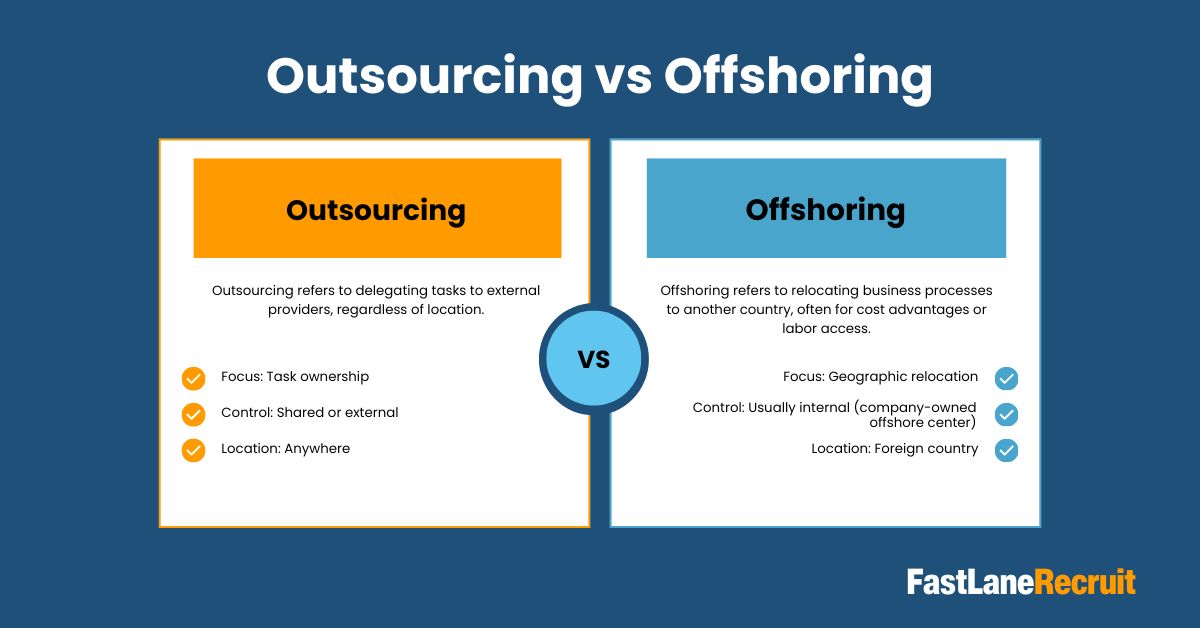
Key Insight
A company can:
- Outsource locally (onshore outsourcing)
- Outsource internationally (offshore outsourcing)
- Offshore without outsourcing (company-owned overseas office)
Understanding this distinction is essential for selecting the right operational strategy.
Why Businesses Use Outsourcing for Growth
Businesses increasingly rely on outsourcing not only for efficiency but also for competitive advantage.
Cost Efficiency and Resource Optimization
Outsourcing eliminates the need for:
- Full-time salaries
- Recruitment and onboarding costs
- Employee benefits and insurance
- Infrastructure and office expenses
This allows businesses to convert fixed costs into variable costs, improving financial flexibility.
Access to Global Expertise
Many outsourcing providers specialize in niche areas such as:
- Cybersecurity
- Cloud infrastructure
- Digital marketing
- Legal compliance
- Financial reporting
Instead of training internal staff, businesses gain immediate access to experienced professionals.
Faster Scaling and Time-to-Market
Outsourcing reduces dependency on internal hiring cycles. Businesses can:
- Launch products faster
- Expand operations quickly
- Handle sudden demand spikes
Operational Efficiency
Non-core functions are delegated externally, allowing internal teams to focus on:
- Product development
- Sales strategy
- Customer experience
- Business expansion
Risk Reduction and Compliance Support
Outsourcing providers often have:
- Compliance frameworks
- Industry certifications
- Legal expertise
This reduces operational and regulatory risks, especially in HR, payroll, and finance.
Types of Outsourcing Models
Understanding outsourcing models helps businesses choose the right setup.
Onshore Outsourcing
- Provider located in the same country
- Easier communication and compliance alignment
- Higher cost but lower cultural barriers
Nearshore Outsourcing
- Provider located in nearby countries
- Similar time zones
- Balanced cost and collaboration efficiency
Offshore Outsourcing
- Provider located in distant countries
- Significant cost savings
- Requires strong process management
Cloud-Based / Digital Outsourcing
- Fully remote service delivery
- Enabled by SaaS tools and digital platforms
- Common in marketing, design, IT, and admin services
Core Business Functions With Outsourcing Examples
These are the most common functional areas where outsourcing drives measurable growth.
Payroll & Accounting Outsourcing Examples
Payroll and finance functions require accuracy, compliance, and timeliness—making them ideal for outsourcing.
What Is Outsourced:
- Payroll processing and salary distribution
- Tax compliance and filing
- Bookkeeping and financial reporting
Why Companies Outsource:
- Reduces payroll errors
- Ensures legal compliance across regions
- Saves accounting overhead costs
Example:
A multinational company operating across multiple countries uses a global payroll provider to ensure employees are paid accurately in local currencies while complying with each country’s tax laws.
IT Support & Technology Outsourcing Examples
IT outsourcing supports digital infrastructure and cybersecurity management.
What Is Outsourced:
- Helpdesk support
- Network maintenance
- Cybersecurity monitoring
- Software updates and infrastructure management
Example:
An online retail company outsources cybersecurity monitoring to ensure 24/7 protection against data breaches while internal teams focus on platform development.
Customer Service Outsourcing Examples
Customer support is one of the most widely outsourced functions globally.
What Is Outsourced:
- Call center support
- Live chat assistance
- Email and ticket resolution
Example:
A global e-commerce brand outsources multilingual customer service to provide 24/7 support across different time zones, improving customer satisfaction and retention.
HR & Recruitment Outsourcing Examples
HR outsourcing helps businesses manage hiring and workforce administration efficiently.
What Is Outsourced:
- Recruitment and talent sourcing
- Employee onboarding
- Payroll coordination
- Benefits administration
Example:
A fast-growing tech startup outsources recruitment to quickly hire developers and reduce time-to-hire from weeks to days.
Marketing & Lead Generation Outsourcing Examples
Marketing outsourcing enables faster customer acquisition.
What Is Outsourced:
- SEO and content marketing
- Paid advertising (Google, LinkedIn, Meta)
- Lead generation campaigns
Example:
A SaaS company outsources LinkedIn advertising to generate high-quality B2B leads and accelerate sales pipeline growth.
Web Development & Creative Outsourcing Examples
Technical and creative functions are commonly outsourced due to skill specialization.
What Is Outsourced:
- Website design and development
- Mobile app development
- Content writing and branding design
Example:
A fintech startup outsources mobile app development to accelerate product launch and reduce engineering costs.
Logistics & Supply Chain Outsourcing Examples
Logistics outsourcing improves delivery performance and operational scalability.
What Is Outsourced:
- Warehousing and inventory management
- Order fulfillment
- Shipping and delivery coordination
Example:
An e-commerce company outsources logistics to reduce delivery delays and improve customer satisfaction during peak sales seasons.
20 Real Outsourcing Examples of Jobs Businesses Commonly Delegate
These job-level outsourcing examples show practical applications across industries.
Administrative & Support
- Virtual assistant
- Data entry clerk
- Personal assistant
Finance & Accounting
- Bookkeeper
- Payroll clerk
- Tax preparer
IT & Technology
- IT support specialist
- Software developer
- Web designer/developer
Marketing & Content
- Social media manager
- Marketing specialist
- Content writer
- Proofreader/editor
Customer & Sales
- Customer support representative
- Lead generation specialist
Specialized Services
- Legal counsel (on-demand advisory)
- Medical transcriptionist
- Event manager
- Drafter (CAD specialist)
- Security services
These outsourcing examples demonstrate how both simple and highly specialized roles can be externalized depending on business maturity.
When Should Businesses Consider Outsourcing?
Outsourcing is most effective when:
- A company is scaling rapidly and internal hiring is too slow
- Specialized skills are required temporarily or permanently
- Administrative workload is reducing operational focus
- Seasonal demand causes fluctuating resource needs
- Cost pressures require leaner operations
- Time-to-market needs to be accelerated
Real-World Business Scenarios
Startup Acceleration
A startup outsources software development to launch an MVP quickly and attract early investors.
E-Commerce Scaling
An online retailer outsources logistics to handle high-volume seasonal demand.
SaaS Growth
A SaaS company outsources marketing to generate consistent inbound leads.
SME Efficiency
A small business outsources HR and payroll to ensure compliance and reduce administrative burden.
Conclusion: Outsourcing as a Competitive Growth Engine
Modern businesses increasingly rely on outsourcing to stay competitive in fast-changing markets. By leveraging external expertise through proven outsourcing examples, companies can reduce operational complexity, improve efficiency, and accelerate growth.
Ultimately, outsourcing allows businesses to shift focus from execution-heavy tasks to strategic innovation and long-term expansion.
Get Assistance from FastLane Recruit
If your business is looking to scale efficiently without increasing internal hiring pressure, outsourcing recruitment and HR functions can significantly improve operational speed and workforce quality.
FastLane Recruit helps businesses:
- Streamline hiring processes
- Access qualified talent faster
- Scale teams efficiently across regions
Build faster. Hire smarter. Grow stronger.
FAQ
What are outsourcing examples in business?
Outsourcing examples include payroll processing, IT support, customer service, marketing campaigns, and recruitment services.
What jobs are commonly outsourced?
Common outsourced jobs include administrative assistants, accountants, developers, customer service agents, marketers, and legal consultants.
What is the difference between outsourcing and offshoring?
Outsourcing is hiring external providers, while offshoring is relocating business processes to another country.
Why do companies outsource?
Companies outsource to reduce costs, improve efficiency, access expertise, and scale operations faster.
Is outsourcing good for small businesses?
Yes, outsourcing helps small businesses access professional capabilities without high hiring and infrastructure costs.