
For contractors, recruitment agencies and businesses hiring flexible talent, the employment structure behind a worker can be just as important as the role itself. The wrong arrangement can create unnecessary payroll administration, tax exposure and compliance risk, while the right structure can make temporary hiring considerably easier to manage.
An umbrella company is one way of structuring contractor employment, particularly in the UK. It can employ a contractor, process payroll through PAYE and handle employment administration while the contractor works on assignments for an agency or end client.
However, an umbrella company is not the same as an Employer of Record (EOR), and choosing between the two depends on who is being hired, where they are located, how the engagement is structured and whether the business is expanding internationally.
This guide explains what an umbrella company is, how it works, what it costs, what contractors and businesses should check, and when an EOR may be a more appropriate solution.
Content Outline
Key Summary
An umbrella company employs the contractor
In a typical UK arrangement, the umbrella company becomes the contractor’s employer. The contractor performs work for an end client, usually through a recruitment agency, while the umbrella manages employment and payroll administration.
PAYE is central to the model
The umbrella generally processes the worker’s pay through Pay As You Earn (PAYE) and handles the relevant tax and National Insurance deductions. HMRC describes an umbrella company as a business that employs workers supplied to an agency or end client and carries employer responsibilities.
It is mainly a UK contractor model
An umbrella company is particularly associated with UK temporary and agency-based contracting. It should not automatically be treated as a global employment solution.
An umbrella company is different from an EOR
An umbrella company is generally designed around contractor and temporary-worker arrangements. An EOR is designed for a business that wants another organisation to become the legal employer of an employee, including when the business wants to hire internationally without immediately establishing a local entity.
UK compliance changed in April 2026
From 6 April 2026, new PAYE rules introduced joint and several liability across relevant labour supply chains involving umbrella companies. Recruitment agencies and, in certain circumstances, end clients can be liable for PAYE amounts that should have been accounted for.
What Is an Umbrella Company?
An umbrella company is a company that employs contractors or temporary workers and manages their employment administration and payroll while they perform assignments for another organisation.
The model is particularly common in the UK.
Instead of establishing their own limited company or being placed directly on an agency’s payroll, a contractor can become an employee of an umbrella company.
A typical arrangement looks like this:
End client → Recruitment agency → Umbrella company → Contractor
The contractor performs the work for the end client. The agency or client pays the umbrella according to the agreed arrangement, and the umbrella processes the contractor’s employment and payroll.
The contractor therefore has an employment relationship with the umbrella company rather than directly with the end client.
What does an umbrella company do?
Depending on the arrangement, an umbrella company may handle:
- Employment contracts
- Timesheet processing
- Payroll administration
- PAYE income tax deductions
- National Insurance contributions
- Holiday pay
- Workplace pension arrangements
- Statutory employment payments where applicable
- Payslips
- Invoicing the agency or client
- Employment-related administration
The exact responsibilities can vary by provider and contractual structure.
How Does an Umbrella Company Work?
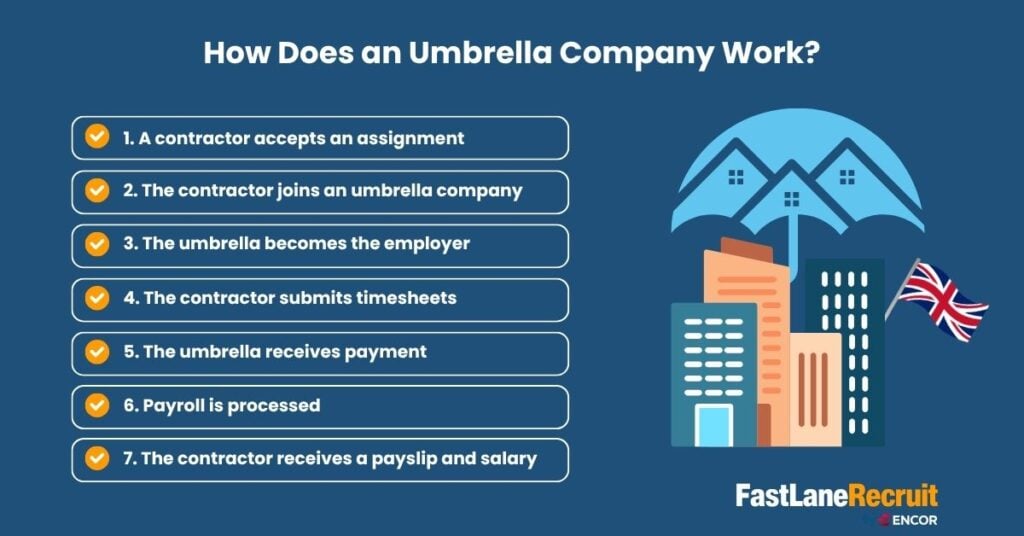
The process is relatively straightforward.
1. A contractor accepts an assignment
The contractor obtains temporary or contract work through a recruitment agency or directly from an end client.
2. The contractor joins an umbrella company
The contractor provides the necessary personal, employment and right-to-work information and signs an employment contract with the umbrella company.
3. The umbrella becomes the employer
The contractor is employed by the umbrella company while continuing to perform the assignment for the end client.
4. The contractor submits timesheets
The contractor records the hours or work completed according to the requirements of the agency, client and umbrella arrangement.
5. The umbrella receives payment
The agency or relevant party pays the umbrella according to the contractual arrangement.
6. Payroll is processed
The umbrella calculates the contractor’s pay and applies the relevant employment costs and deductions.
7. The contractor receives a payslip and salary
The worker receives their net salary through the umbrella’s payroll, with the applicable deductions shown on the payslip.
This basic process is consistent with HMRC’s explanation of how umbrella employment and payment operate.
Who Is Involved in an Umbrella Company Arrangement?
Understanding the different parties is essential because the contractor, client, agency and umbrella company have different responsibilities.
| Party | Typical responsibility |
| Contractor | Performs the work, submits timesheets and complies with assignment requirements |
| Recruitment agency | Sources the assignment and manages the agency-client relationship |
| Umbrella company | Employs the contractor and manages payroll and employment administration |
| End client | Provides the assignment and manages the contractor’s day-to-day work |
This structure can reduce the administrative burden on contractors who do not want to operate their own company.
For businesses and agencies, however, supplier due diligence remains important, particularly following the UK’s 2026 PAYE changes.
How Is an Umbrella Contractor Paid?
One of the biggest areas of confusion is the difference between an assignment rate and the contractor’s actual salary.
The amount paid by the client or agency to the umbrella company does not necessarily become the contractor’s gross salary.
The available funds may need to account for items such as:
- Umbrella company margin
- Employer National Insurance
- Apprenticeship Levy where applicable
- Holiday pay
- Employer pension obligations
- Contractor’s gross pay
- Income tax
- Employee National Insurance
- Other applicable deductions
Therefore:
Assignment rate ≠ take-home pay
HMRC specifically advises workers to understand how their gross pay is calculated and to check their payslips when working through an umbrella company.
What Are the Benefits of Using an Umbrella Company?
An umbrella arrangement can be useful when the employment model fits the contractor’s circumstances.
Less administrative work
The contractor does not necessarily need to establish and maintain their own limited company simply to complete a temporary assignment.
PAYE payroll
Tax and National Insurance are processed through the employment payroll system rather than leaving the contractor to manage those obligations independently.
Employment rights
Because the contractor is employed by the umbrella, they may receive applicable statutory employment rights and benefits, subject to eligibility and the terms of the employment arrangement.
These can include statutory holiday entitlement, statutory sick pay and workplace pension arrangements.
Flexibility between assignments
Contractors working on multiple temporary assignments may be able to maintain employment through the same umbrella while moving between assignments.
Simpler administration
For contractors who want to focus on their work rather than running a company, an umbrella can provide a relatively straightforward administrative structure.
What Are the Disadvantages or Risks of an Umbrella Company?
An umbrella company is not automatically the best solution for every worker or business.
Your assignment rate may not equal your salary
Contractors need to understand exactly which employment costs and deductions are taken before calculating expected take-home pay.
Provider fees matter
Umbrella companies generally charge a margin or fee for their services. The amount and how it is calculated should be clearly explained before joining.
Compliance quality varies
Contractors and agencies should carry out appropriate due diligence rather than choosing an umbrella purely because it offers the highest advertised take-home pay.
The 2026 UK rules increase the importance of due diligence
From 6 April 2026, responsibility for PAYE compliance in relevant umbrella-company labour supply chains can extend beyond the umbrella itself. HMRC states that the agency closest to the end client is generally responsible where there is an agency chain, while the end client may be responsible where there is no agency or in certain other circumstances.
For businesses, this means choosing and monitoring an appropriate labour supply chain is increasingly important.
What Changed for Umbrella Companies in 2026?
The UK introduced significant PAYE changes for labour supply chains involving umbrella companies from 6 April 2026.
Under the new rules, the party responsible for paying the worker’s PAYE can depend on the structure of the labour supply chain.
The rules are designed to tackle tax non-compliance in arrangements involving umbrella companies and other labour suppliers.
What does this mean for businesses?
Businesses and recruitment agencies should consider:
- Who is responsible for PAYE?
- Which organisation employs the worker?
- How many parties are in the labour supply chain?
- How is the umbrella provider’s compliance verified?
- Are payroll records and payslips transparent?
- Are contractual responsibilities clearly documented?
Professional recommendation: Don’t select an umbrella provider based solely on its advertised take-home pay or fee. Compliance controls, transparency, contractual responsibilities and the provider’s track record should form part of the assessment.
Umbrella Company vs EOR: What’s the Difference?
This is one of the most important distinctions for businesses considering international hiring.
An umbrella company and an EOR can both involve a third party acting as the worker’s legal employer, but they solve different business problems.
| Factor | Umbrella Company | Employer of Record |
| Primary use | Contractor/temporary worker engagement | Employee hiring |
| Common market | UK | International |
| Typical buyer | Contractor/agency/client supply chain | Hiring company |
| Legal employer | Umbrella company | EOR |
| Payroll | PAYE in the UK | Local payroll in the employee’s country |
| International expansion | Not its primary purpose | Core use case |
| Local entity | Typically not required for the contractor | EOR may provide the employment structure without the client’s own entity |
| Best suited for | Temporary/agency contractor arrangements | Hiring employees in markets where the company lacks an entity |
The practical distinction is simple:
If you’re managing a UK contractor arrangement, an umbrella company may be appropriate. If your business wants to hire an employee in another country without immediately establishing its own local entity, an EOR may be the better model.
Current industry guidance similarly distinguishes UK umbrella arrangements from EOR-based international employment.
Umbrella Company vs Limited Company
Contractors often compare an umbrella company with operating through their own limited company.
| Factor | Umbrella Company | Limited Company |
| Employer | Umbrella | Contractor’s own company |
| Payroll | Managed by umbrella | Managed by contractor/company |
| Administration | Lower | Higher |
| Company management | Not required | Required |
| PAYE | Processed by umbrella | Managed by company |
| Contractor responsibility | Generally lower | Generally higher |
| IR35 considerations | Relevant to the underlying engagement and employment model | Particularly important for personal service company engagements |
The right option depends on the nature of the assignment, tax position, IR35 considerations, expected duration, income level and the contractor’s willingness to manage a company.
There is no universal “best” structure.
Also Read: How to Use Employer of Record in the United Kingdom: UK EOR Guide
Is an Umbrella Company Right for Your Business?
An umbrella arrangement may make sense when:
Choose an umbrella model when:
- You are dealing with UK temporary contractors.
- The engagement runs through a recruitment agency.
- PAYE employment is appropriate.
- You want a third party to manage contractor payroll.
- The worker does not need to establish their own company.
Consider an EOR when:
- You want to hire an employee internationally.
- Your company does not have a local entity.
- You are entering a new country.
- You want to test a market before establishing a subsidiary.
- You need local employment contracts, payroll and statutory compliance.
- You are building a longer-term international team.
Consider establishing your own entity when:
- You expect substantial long-term operations in the market.
- You need direct control over the local legal structure.
- You expect significant local headcount or commercial activity.
- Your expansion strategy justifies the cost and administration of maintaining an entity.
The best structure depends on worker classification, country, duration, headcount, operational plans and local regulations.
Can an EOR Be a Better Alternative for Global Expansion?
For companies expanding beyond the UK contractor market, an EOR can solve a different problem.
An Employer of Record becomes the formal employer for the employment arrangement in the relevant country while the client company generally retains responsibility for the employee’s day-to-day work.
This can allow a business to:
- Hire employees without immediately establishing its own local entity, where legally available
- Enter new markets faster
- Manage local employment contracts
- Coordinate payroll
- Handle statutory employment requirements
- Support employee onboarding
- Manage employment administration
- Test a market before committing to a subsidiary
FastLaneRecruit currently provides EOR-based global employment support across Malaysia, Singapore, Hong Kong, China, India, Philippines, Taiwan, Vietnam, Australia, United Kingdom, Switzerland, UAE, Saudi Arabia, Qatar.
That makes the EOR model particularly relevant when a business’s question moves from:
“How can I process this contractor’s pay?”
to:
“How can my company legally hire and manage talent in another country?”
How FastLaneRecruit Can Help With International Hiring
An umbrella company can be useful for the right UK contractor arrangement. But if your objective is international workforce expansion, you may need a broader employment solution.
FastLaneRecruit helps companies evaluate and implement EOR-based employment structures across supported markets (including UK) without requiring the business to immediately establish a separate local entity.
Our support can include:
- International employee hiring
- Local employment arrangements
- Employment contracts
- Payroll administration
- Statutory employment requirements
- Employee benefits coordination
- Onboarding
- Ongoing employment administration
- Contractor-to-employee conversion
- Multi-country workforce expansion
For companies entering a new market, an EOR can also provide a practical way to test hiring requirements before deciding whether establishing a local subsidiary is justified.
Need help deciding between an umbrella company, EOR or local entity?
The right answer depends on your worker type, target country, hiring model, headcount and expansion timeline.
Rather than choosing a structure based solely on cost, evaluate the legal employment relationship and the responsibilities that need to be managed.
Talk to FastLaneRecruit about your hiring plans and find out which international employment model may fit your expansion strategy.
Final Decision Guide
If you’re still unsure which model to use, start with the question you’re actually trying to solve:
| Your situation | Potentially suitable model |
| UK temporary contractor through an agency | Umbrella company |
| UK worker on agency PAYE | Agency PAYE |
| Contractor operating through their own company | Limited company |
| First employee in another country | EOR |
| Testing a new international market | EOR |
| Building a larger permanent overseas workforce | EOR → potentially local entity later |
| Long-term substantial local operations | Local entity may become appropriate |
The key is not simply asking “What is an umbrella company?” but asking “What employment structure best matches the way my business plans to hire and operate?”
For UK contractor engagements, an umbrella company can provide a practical employment and payroll structure. For companies moving into international hiring, however, an EOR can provide a more appropriate framework for local employment, payroll and compliance.
Keep in touch with our experts before you start making the important decision.
Frequently Asked Questions About Umbrella Companies
What is an umbrella company?
An umbrella company is a third-party employer that employs contractors or temporary workers and manages their payroll and employment administration. In the UK, umbrella arrangements commonly involve PAYE and recruitment agencies.
How does an umbrella company work?
The contractor becomes an employee of the umbrella company, performs work for an end client, submits required timesheets and receives salary through the umbrella’s payroll after applicable deductions.
Is an umbrella company the same as an EOR?
No. Although both models can involve a third party acting as the legal employer, they are designed for different purposes. Umbrella companies are strongly associated with UK contractor and temporary-worker arrangements, while EOR services are designed to help businesses employ workers in a particular country, especially where the business does not have its own local entity.
Do umbrella companies pay tax?
An umbrella company generally operates PAYE payroll and deducts applicable income tax and National Insurance from the worker’s pay. Employer-side costs also need to be accounted for within the payment structure.
Does an umbrella company avoid IR35?
No. An umbrella company does not “avoid” IR35. Instead, contractors employed by an umbrella company are generally paid as employees through PAYE rather than operating through their own personal service company. PayStream likewise distinguishes umbrella employment from using a limited company under the IR35 framework.
Am I self-employed if I use an umbrella company?
Generally, no. If the umbrella company employs you, you are an employee of that umbrella company rather than a self-employed individual for that employment relationship.
Is an umbrella company suitable for international hiring?
Usually, an umbrella company should not be treated as a substitute for a global EOR solution. Umbrella structures are primarily associated with domestic contractor arrangements, particularly in the UK. For international employee hiring, an EOR may be more appropriate depending on the country and circumstances.
What should I check before choosing an umbrella company?
Check the employment contract, fee or margin, payroll process, payslip calculations, statutory benefits, insurance arrangements, compliance controls and the responsibilities of each party in the labour supply chain.
For businesses, supplier due diligence has become especially important following the UK’s 6 April 2026 PAYE changes.
Can FastLaneRecruit help if I want to hire internationally?
Yes. FastLaneRecruit provides EOR and global employment solutions across supported markets including Malaysia, Singapore, Hong Kong, China, India, Philippines, Taiwan, Vietnam, Australia, the United Kingdom, Switzerland, UAE, Saudi Arabia and Qatar.
What is better: an umbrella company or an EOR?
Neither is universally better. An umbrella company can be appropriate for a UK contractor arrangement, while an EOR is generally more suitable when a business wants to employ workers in another country without immediately establishing its own local entity.
The best option depends on the worker’s status, country, engagement type, duration and business expansion strategy.