
Modern businesses in the United Kingdom rely heavily on collaboration tools to keep teams connected and productive. Whether employees work in the office or remotely across different countries, the right collaboration software helps teams communicate clearly, manage projects smoothly, and share information securely.
Many UK companies now operate global teams. Some hire international employees or outsource functions to countries like Malaysia to improve efficiency and support business growth. With the right collaboration tools, managing distributed teams becomes much easier.
This guide covers the top 15 collaboration tools in the United Kingdom, including their features, use cases, and how to choose the right platform.
Disclaimer: This article is provided for general informational purposes only. The collaboration tools listed are based on market research and publicly available information at the time of writing. Features, pricing, and availability may change over time. Businesses should evaluate their own operational and compliance requirements before selecting any software solutions.
Content Outline
Key Summary
Collaboration Tools Support Modern Workplaces
Collaboration software helps UK businesses improve communication, organise projects, and support hybrid and remote working environments.
Remote Work Is Driving Tool Adoption
As more employees work remotely or across countries, collaboration tools have become essential for daily business operations.
Different Tools Serve Different Needs
Some platforms focus on messaging, while others specialise in project management, meetings, or document sharing.
Integration Improves Efficiency
The best collaboration tools connect with email, HR systems, CRM platforms, and accounting software to create a smoother workflow.
Security and Compliance Are Essential
UK businesses must choose tools that protect company data and follow regulatory requirements.
Collaboration Tools Enable Global Teams
Businesses can manage international employees more effectively using shared systems and structured communication.
EOR Services Support Global Hiring
Employer of Record services help UK companies hire Malaysian employees compliantly while collaboration tools support daily teamwork.
What Are Collaboration Tools?
Collaboration tools are software platforms that help teams work together more effectively. They usually include features such as:
- Messaging and video meetings
- Project management
- File sharing
- Task tracking
- Team coordination
These tools allow employees to stay connected regardless of location.
According to the Office for National Statistics, remote and hybrid working has become common across the UK workforce, making collaboration tools essential for business operations.
UK companies must also ensure secure handling of employee data in line with Information Commissioner’s Office guidelines and the GOV.UK regulatory framework.
Also Read: Examples of Outsourcing
Why Collaboration Tools Matter for UK Businesses
Collaboration tools have become essential for businesses across the United Kingdom. As more companies adopt hybrid and remote working models, teams often operate from different offices, cities, or even countries. The right collaboration tools make it easier for employees to stay connected, organised, and productive regardless of location.
Instead of relying on emails alone, modern collaboration platforms allow teams to communicate in real time, share documents instantly, and manage projects in one place. This helps reduce confusion and improves overall efficiency.
The growth of remote work has made collaboration tools even more important. Many UK businesses now work with distributed teams, including overseas employees and service providers. With clear communication and shared systems, companies can maintain consistent standards and smooth operations.
Key Benefits of Collaboration Tools
| Benefit | Explanation |
| Better communication | Teams stay connected through messaging and meetings |
| Higher productivity | Tasks and deadlines are easier to track |
| Global teamwork | Employees can work from different countries |
| Knowledge sharing | Files and documents are accessible |
| Flexible work | Supports hybrid and remote teams |
Many UK businesses now work with overseas teams. For example, companies may hire Malaysian developers or support staff to improve operations while maintaining high service standards.
Supporting Global Teams
Many UK businesses now work with overseas teams as part of their growth strategy. This allows companies to expand operations while maintaining strong service quality and efficient workflows.
For example, a UK technology company may work with software developers or customer support specialists in Malaysia while keeping management and planning functions in the UK. Collaboration tools help ensure everyone stays aligned and informed.
A typical setup might look like this:
| Team Function | Location | Collaboration Tools |
| Management | United Kingdom | Project dashboards and video meetings |
| Developers | Malaysia | Task tracking and shared documents |
| Support Team | Malaysia | Messaging and customer systems |
With the right systems in place, teams can work together effectively even when they are located in different regions. This allows UK businesses to scale operations while maintaining strong coordination and communication.
Collaboration tools are no longer optional, they are a key part of running a modern and efficient business.
Top 15 Collaboration Tools in the United Kingdom
1. Microsoft Teams
Microsoft provides Microsoft Teams, one of the most widely used collaboration tools in the UK.
Key features:
- Video meetings
- Team messaging
- File sharing
- Office integration
Best for:
- Medium to large organisations
2. Slack
Slack is a popular team communication platform.
Key features:
- Channels for teams
- Direct messaging
- App integrations
- Notifications
Best for:
- Fast communication
Also Read: Managing Remote Teams Best Practices
3. Zoom
Zoom is widely used for meetings and remote communication.
Key features:
- Video meetings
- Screen sharing
- Recording
- Webinars
Best for:
- Remote meetings
4. Asana
Asana helps teams manage projects and tasks.
Key features:
- Task tracking
- Workflow automation
- Deadlines
- Reporting
Best for:
- Project management
5. Trello
Trello uses boards and cards for task management.
Key features:
- Visual boards
- Task tracking
- Collaboration
Best for:
- Small teams
6. ClickUp
ClickUp combines project management and productivity tools.
Key features:
- Task tracking
- Time tracking
- Dashboards
Best for:
- Growing businesses
7. Monday.com
Monday.com is a flexible project management system.
Key features:
- Workflow automation
- Task tracking
- Custom dashboards
Best for:
- Structured teams
8. Notion
Notion Labs is an all-in-one workspace.
Key features:
- Documentation
- Notes
- Databases
- Collaboration
Best for:
- Knowledge sharing
Also Read: Best Practices for Remote Work Performance Management
9. Miro
Miro provides online whiteboards.
Key features:
- Brainstorming
- Visual planning
- Workshops
Best for:
- Creative teams
10. Google Workspace
Google offers cloud collaboration tools.
Key features:
- Google Docs
- Sheets
- Meet
- Drive
Best for:
- Cloud collaboration
11. ProofHub
ProofHub supports project coordination.
Key features:
- Task management
- Team discussions
- File sharing
Best for:
- Centralised projects
12. Teamwork
Teamwork is designed for client work.
Key features:
- Project tracking
- Time tracking
- Reporting
Best for:
- Agencies
13. Freshdesk
Freshdesk helps support teams collaborate.
Key features:
- Ticket management
- Automation
- Team collaboration
Best for:
- Customer service teams
14. Basecamp
Basecamp simplifies project communication.
Key features:
- Team messaging
- File sharing
- Task lists
Best for:
- Simple workflows
15. Dropbox
Dropbox supports document sharing.
Key features:
- Cloud storage
- File sharing
- Backup
Best for:
- Document collaboration
Comparison Table
| Tool | Best For | Key Feature |
| Microsoft Teams | Large teams | Integrated platform |
| Slack | Messaging | Fast communication |
| Zoom | Meetings | Video calls |
| Asana | Projects | Task management |
| Trello | Small teams | Visual boards |
| ClickUp | Growing teams | All-in-one |
| Monday.com | Structured teams | Workflows |
| Notion | Documentation | Knowledge base |
| Miro | Brainstorming | Whiteboards |
| Google Workspace | Collaboration | Cloud tools |
| ProofHub | Projects | Centralised tools |
| Teamwork | Agencies | Client management |
| Freshdesk | Support | Ticketing |
| Basecamp | Simple teams | Easy setup |
| Dropbox | Files | Storage |
Example: Managing a UK–Malaysia Remote Team
Many UK companies build international teams.
Example:
| Role | Location | Collaboration Tool |
| Project Manager | London | Microsoft Teams |
| Developer | Kuala Lumpur | Git + Slack |
| Designer | Penang | Miro |
| Support Staff | Johor | Freshdesk |
This setup allows businesses to:
- Maintain productivity
- Support global customers
- Improve operational efficiency
Also Read: Hiring Malaysian Talent: Employer of Record Malaysia Guide
How to Choose the Right Collaboration Tool
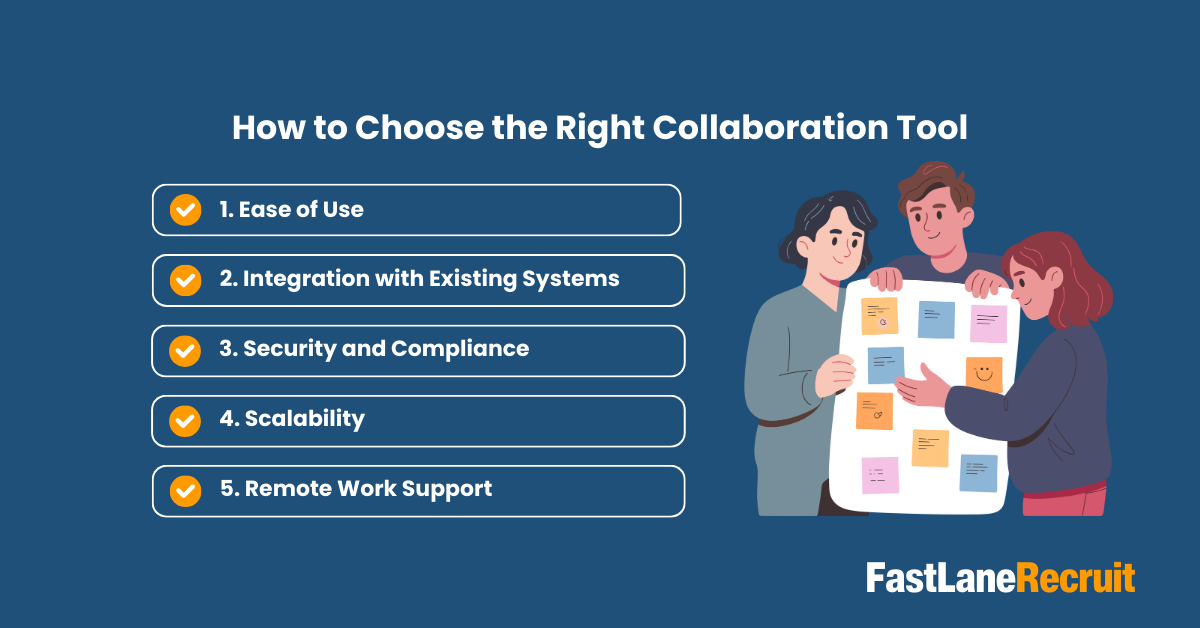
Selecting the right collaboration tool is an important decision for any business. The best platform should not only meet your current needs but also support your team as the business grows. Since many UK companies operate with hybrid or international teams, choosing the right software helps ensure smooth communication and efficient workflows.
Before selecting collaboration software, UK companies should carefully consider the following factors.
1. Ease of Use
The collaboration tool should be easy for employees to learn and use on a daily basis. If the software is too complicated, staff may avoid using it, which reduces the benefits of the system.
User-friendly tools help teams get started quickly with minimal training. This is especially important for businesses with employees working in different locations or time zones.
Simple interfaces and clear features make it easier for teams to:
- Send messages
- Share files
- Track tasks
- Join meetings
For example, platforms such as Slack and Microsoft Teams are widely used because employees can learn them quickly and start collaborating right away.
Tip:
If possible, test a free trial before making a decision. This helps ensure the tool fits your team’s working style.
2. Integration with Existing Systems
A good collaboration tool should work smoothly with the systems your business already uses. Integration helps avoid duplicate work and improves efficiency.
When tools connect together, information can flow automatically between systems. This saves time and reduces manual data entry.
UK companies should look for collaboration tools that integrate with:
- Email systems
- Human resource platforms
- Customer relationship management (CRM) systems
- Accounting software
- Cloud storage
For example:
| Business Function | Example Integration | Benefit |
| Outlook or Gmail | Centralised communication | |
| HR | Payroll or HR software | Easier employee management |
| CRM | Sales systems | Better customer tracking |
| Finance | Accounting software | Accurate reporting |
Integrated systems allow employees to work more efficiently because everything is connected in one digital environment.
3. Security and Compliance
Data protection is an important consideration for UK businesses. Collaboration tools often store sensitive information such as employee records, business plans, and client data. Choosing secure software helps protect this information.
Companies operating in the UK must follow data protection regulations such as the UK GDPR. Businesses should choose software providers that offer strong security features such as:
- Data encryption
- Secure login systems
- Access controls
- Regular backups
It is also important to understand where the data is stored and how it is protected.
Businesses can refer to official guidance from:
- The Information Commissioner’s Office for data protection requirements
- The GOV.UK website for workplace and digital guidance
These trusted sources provide useful information on maintaining compliance when using digital tools.
Recommendation:
Choose software providers that clearly explain their security standards and compliance policies.
Also Read: Building a High-Performing Offshore Accounting Team in Malaysia (Singapore Edition)
4. Scalability
Businesses grow and change over time. The collaboration software you choose should be able to support future expansion.
A scalable platform allows companies to:
- Add more users easily
- Create additional teams
- Manage larger projects
- Support international operations
For example, a small company may begin with a team of five employees but later expand to 50 or more staff members across multiple countries. A scalable collaboration tool ensures the system continues to work effectively as the organisation grows.
This is particularly important for UK companies planning to expand into global markets or hire international employees.
Tip:
Choose a platform that offers flexible plans so you can upgrade as your team grows.
5. Remote Work Support
Many UK companies now support remote or hybrid work arrangements. Collaboration tools should make it easy for employees to work effectively from anywhere.
Important features to look for include:
- Video meetings
- Instant messaging
- File sharing
- Mobile access
- Cloud storage
- Time zone support
These features help teams stay connected even when they are working from different locations.
For example:
| Feature | Why It Matters |
| Video meetings | Enables face-to-face communication remotely |
| File sharing | Allows teams to access documents anytime |
| Mobile access | Supports employees working outside the office |
| Cloud storage | Keeps files secure and accessible |
| Time zone support | Helps coordinate international teams |
Tools such as Zoom support virtual meetings, while platforms like Google Workspace allow teams to collaborate on documents in real time.
Also Read: Building a High-Performing Offshore Accounting Team in Malaysia (Hong Kong Edition)
Practical Example: UK Company Working with Overseas Teams
Many UK businesses collaborate with international teams as part of their business strategy. For example, a company may work with technical or administrative staff based in Malaysia while maintaining operations in the United Kingdom.
In this situation, collaboration tools help ensure that everyone stays connected and informed.
| Team | Location | Example Tools |
| Managers | United Kingdom | Project management and meetings |
| Technical Team | Malaysia | Task tracking and documentation |
| Support Staff | Malaysia | Messaging and file sharing |
With the right collaboration tools, businesses can maintain strong teamwork across different regions while supporting long-term growth.
Choosing the right collaboration software helps UK businesses build efficient and reliable teams, both locally and internationally.
Tips for Successful Team Collaboration
1. Set Clear Communication Rules
Define:
- Meeting schedules
- Response times
- Communication channels
2. Use Fewer Tools
Too many platforms create confusion.
Choose:
- One messaging tool
- One project tool
- One file tool
3. Train Employees
Provide onboarding sessions to help teams use tools effectively.
4. Protect Company Data
Follow UK data regulations.
Use:
- Secure logins
- Access controls
- Backups
5. Support Remote Employees
Provide:
- Clear workflows
- Documentation
- Regular meetings
Also Read: Building a High-Performing Offshore Accounting Team in Malaysia (Australia Edition)
Alternative Solution: Hire Malaysian Employees via EOR
Using collaboration tools is an important part of managing global teams, but technology alone is not enough. Businesses also need a reliable and compliant way to hire and manage international employees.
One practical solution for UK companies is hiring overseas employees through an Employer of Record (EOR) service.
An Employer of Record acts as the legal employer on behalf of your company. This allows businesses to hire employees in another country without needing to set up a local company or branch office. The EOR manages employment requirements while your business manages the employee’s daily work.
For UK companies looking to expand internationally, this approach can make global hiring much simpler and more structured.
What is an Employer of Record (EOR)?
An Employer of Record service allows businesses to legally hire employees in another country while the EOR provider handles administrative and compliance responsibilities.
This typically includes:
- Employment contracts
- Payroll processing
- Statutory contributions
- Tax reporting
- HR administration
- Local labour law compliance
Businesses can learn more about international hiring requirements from trusted sources such as the GOV.UK website, which provides guidance on employing staff overseas.
Also Read: Types Of Accounting Services That Can Be Outsourced
Why UK Companies Hire Employees in Malaysia
Malaysia has become a popular location for international hiring due to its skilled workforce, strong English proficiency, and business-friendly environment. Many UK companies build teams in Malaysia to support areas such as:
- Software development
- Customer support
- Finance and accounting
- Digital marketing
- Administrative support
With proper collaboration tools and structured hiring processes, companies can maintain strong communication and consistent performance across locations.
Benefits of Using an EOR Service
Hiring through an Employer of Record provides several advantages for UK businesses.
| Benefit | Explanation |
| Simplified hiring process | Companies can hire employees quickly without registering a local business entity. This reduces administrative work and speeds up expansion. |
| Local compliance support | The EOR provider ensures employment contracts and practices follow local labour regulations. This reduces compliance risks. |
| Payroll management | Salary payments, tax deductions, and statutory contributions are handled accurately according to local requirements. |
| HR administration | The EOR manages onboarding, leave management, and employment documentation. |
| Faster market entry | Businesses can start building teams without waiting months to establish a local entity. |
Example: UK Company Building a Team in Malaysia
A UK company expanding its operations may choose to build a support team in Malaysia while keeping management functions in the United Kingdom.
A typical structure may look like this:
| Team Function | Location | Support Provided |
| Management | United Kingdom | Strategy and planning |
| Technical Team | Malaysia | Development and technical support |
| Operations | Malaysia | Customer and administrative support |
Using collaboration tools together with an Employer of Record service allows teams to work smoothly across locations.
Why Work with FastLaneRecruit
FastLaneRecruit supports UK companies that want to hire employees in Malaysia through compliant Employer of Record services.
FastLaneRecruit helps businesses:
- Hire employees without setting up a local entity
- Ensure compliance with Malaysian employment regulations
- Manage payroll and statutory contributions
- Support onboarding and HR administration
- Build reliable international teams
This allows companies to focus on their core business activities while experienced specialists manage employment requirements.
Start Building Your Global Team
If your business is planning to expand internationally, hiring employees in Malaysia through an Employer of Record can be a practical and efficient solution.
FastLaneRecruit’s EOR services help UK businesses build international teams with confidence and full compliance.
Contact FastLaneRecruit today to learn how Employer of Record services can support your global hiring strategy.
By combining the right collaboration tools with structured hiring solutions, businesses can successfully build and manage global teams while supporting long-term growth.
Conclusion
Collaboration tools play an important role in helping UK businesses operate efficiently in a modern work environment. The right tools improve communication, support remote teams, and help organisations manage projects successfully.
As more UK companies work with international teams, collaboration software becomes even more important. Whether your team is local or global, choosing the right tools can make daily work much smoother.
For businesses planning to build teams in Malaysia, combining collaboration tools with Employer of Record services can provide a practical and scalable solution.
FastLaneRecruit helps UK companies hire Malaysian professionals while managing compliance and HR processes, making global expansion simpler and more effective. Contact us for a FREE call!