Managing a company’s finances can feel overwhelming, especially when you’re focused on growing your business. Outsourced accounting services are a smart way to handle financial tasks without the overhead of a full in-house team. From bookkeeping to payroll, invoicing, and even CFO-level guidance, outsourcing gives businesses access to experienced professionals who can streamline processes, reduce operational costs, and provide insights for smarter decision-making.
In this guide, we’ll break down what outsourced accounting is, its benefits and drawbacks, practical tips, and examples for companies leveraging Malaysian accounting talent.
Content Outline
Key Summary
Cost Efficiency
Outsourced accounting helps businesses save on salaries, benefits, and training by paying only for the services they need, reducing overhead significantly.
Access to Expertise
Gain specialized accounting knowledge from professionals familiar with international standards, tax compliance, and best practices, ensuring accurate and optimized financial management.
Scalability & Flexibility
Easily adjust accounting services as your business grows or during seasonal fluctuations, without the complications of hiring or downsizing internal staff.
Focus on Core Business
Free internal teams from time-consuming financial tasks so they can focus on strategy, customer relationships, innovation, and business growth.
Enhanced Accuracy & Fraud Prevention
Professional oversight, advanced software, and multi-level checks reduce errors and detect potential fraud early, safeguarding your company’s finances.
Time Savings
Outsourcing accounting tasks like payroll, AR/AP, and bookkeeping allows business owners to reclaim hours weekly for strategic decision-making.
Leveraging Malaysia & FastLaneRecruit’s EOR
Malaysia offers skilled accounting professionals and cost advantages, while FastLaneRecruit’s EOR simplifies hiring, payroll, and compliance, giving businesses a seamless outsourcing solution.
What Are Outsourced Accounting Services?
Outsourced accounting means hiring external experts or firms to take care of your company’s financial tasks instead of handling them entirely in-house. Think of it as bringing in a team of professionals who specialize in managing money, taxes, payroll, and other financial processes without the long-term costs and responsibilities of hiring full-time staff.
These services can cover a wide range of tasks depending on what your business needs:
- Basic bookkeeping – recording daily transactions like sales, purchases, and payments.
- Payroll management – calculating salaries, withholding taxes, and making sure employees are paid on time.
- Accounts receivable and payable – managing invoices, client payments, and vendor bills.
- Financial reporting – preparing reports like income statements, balance sheets, and cash flow statements to understand your company’s financial health.
- Strategic CFO services – providing financial guidance, budgeting, forecasting, and advice on business growth without hiring a full-time Chief Financial Officer.
Outsourced accounting allows businesses to:
- Reduce overhead costs – no need to pay full-time salaries, benefits, or training expenses for an in-house team.
- Access specialized expertise – professionals stay updated on accounting standards, tax laws, and best practices.
- Focus on core business – free up time and resources so your team can concentrate on growing your company rather than managing day-to-day finances.
Outsourced accounting is also known as Client Accounting Services (CAS). The providers can vary in size and scope:
- Freelancers or boutique firms – small teams or individuals who offer specialized services, ideal for startups or smaller businesses.
- Mid-sized specialized teams – firms with multiple experts handling a variety of accounting tasks for growing businesses.
- Larger CPA or virtual accounting firms – full-service teams capable of supporting multinational corporations, often with advanced tools and scalable solutions.
In short, outsourced accounting gives you professional support tailored to your business needs, helping you manage finances efficiently while staying focused on what you do best.
Also Read: Offshore Vs Local: Accountants 2025 Salary Benchmark Report (Australia Vs Malaysia Edition)
Common Outsourced Accounting Services and How They Help Your Business
Outsourced accounting covers a wide range of services depending on your company’s needs. Each service is designed to help your business save time, reduce errors, and focus on growth. Below is a breakdown of the most common services and the benefits they bring:
| Service | What It Involves | How It Benefits Your Business |
| Bookkeeping | Recording day-to-day financial transactions, including sales, purchases, receipts, and payments. | Keeps your financial records accurate, reduces mistakes, and frees up your team from tedious manual work. |
| Payroll Management | Calculating employee salaries, withholding taxes, making deposits, and ensuring compliance with laws. | Ensures employees are paid on time, reduces risks of payroll errors, and frees up HR and management resources. |
| Accounts Receivable / Payable (AR/AP) | Handling invoices, collecting payments from clients, and paying vendors. | Maintains healthy cash flow, minimizes late payments, and reduces the administrative burden on your staff. |
| Financial Reporting | Preparing balance sheets, income statements, and cash flow reports. | Provides clear insights into your company’s financial health and helps you make informed business decisions. |
| Tax Preparation & Compliance | Filing tax returns, keeping up with changing tax laws, and meeting deadlines. | Reduces the risk of penalties, ensures accurate filings, and helps you take advantage of potential tax savings. |
| CFO Services | Strategic planning, budgeting, forecasting, and guidance for business growth. | Gives executive-level insights without hiring a full-time CFO, helping with long-term planning and financial strategy. |
| Invoicing & Billing | Creating and sending invoices, following up on unpaid accounts. | Improves cash flow, reduces delays in payments, and allows your team to focus on core business activities. |
Why These Services Matter
By outsourcing these tasks, your business can:
- Save time – freeing internal staff from routine tasks.
- Reduce errors – professionals double-check records and use reliable software.
- Gain expert advice – get insights from specialists who understand best practices and compliance.
- Focus on growth – your team can concentrate on strategy, customer relationships, and expanding your business instead of handling financial administration.
For example, a company outsourcing payroll and bookkeeping to Malaysia can enjoy skilled accountants who handle all compliance requirements while reducing operational costs and letting the internal team focus on strategy and growth.
Benefits of Outsourced Accounting
Outsourcing your accounting can do more than just take a load off your internal team, it can help your business run more smoothly, save money, and make smarter financial decisions. Let’s break down the main benefits in simple terms:
1. Cost Efficiency
Outsourcing allows you to pay only for the services you actually need. There’s no need to hire full-time employees, pay salaries, provide benefits, or cover training costs. This can significantly reduce your overhead while still giving you access to high-quality financial support.
2. Access to Expertise
When you work with an outsourced accounting firm, you gain instant access to professionals who are experts in their field. They stay up-to-date with accounting standards, tax laws, and industry best practices. This means your financial processes are managed efficiently and correctly, giving you confidence that your business is compliant and optimized.
3. Scalability
Your business needs can change over time whether it’s seasonal fluctuations, rapid growth, or expansion into new markets. Outsourced accounting services are flexible and scalable, allowing you to adjust the level of support you need without the complications of hiring or downsizing staff.
Also Read: Building a High-Performing Offshore Accounting Team in Malaysia (Singapore Edition)
4. Focus on Core Activities
Handling accounting in-house can be time-consuming and distract your team from strategic goals. By outsourcing, you free up your internal staff to focus on growth, innovation, and customer relationships, rather than day-to-day financial management.
5. Enhanced Accuracy and Fraud Prevention
Outsourced accountants often use advanced software and robust internal controls to reduce errors and spot irregularities. This not only ensures accurate financial reporting but also adds a layer of protection against potential fraud, helping safeguard your business assets.
6. Time Savings
Outsourcing saves owners and employees hours every week. Instead of spending time on bookkeeping, payroll, and financial reports, your team can focus on making strategic decisions that drive business growth.
Example: Companies outsourcing to Malaysia can leverage skilled accountants who understand international accounting standards while reducing operational costs. This means tasks like payroll and bookkeeping are handled efficiently, giving your internal team more time to concentrate on expanding your business.
Potential Drawbacks to Consider and How to Minimize Them
Outsourcing accounting comes with many advantages, but it’s important to be aware of potential challenges and know how to address them. Here’s a practical guide with examples to illustrate each point:
1. Loss of Control
The Challenge: Handing over financial responsibilities to an external team can feel like giving up control over critical operations.
How to Minimize:
- Establish clear roles and responsibilities from the start.
- Set up regular reporting schedules—weekly, biweekly, or monthly.
- Choose a provider who encourages transparency.
Example: A small e-commerce startup outsourcing payroll to a Malaysian accounting firm schedules weekly financial reports. This way, the CEO stays informed about salaries, taxes, and vendor payments without handling the details daily.
2. Communication Barriers
The Challenge: Remote teams or providers in different time zones may delay responses or cause misunderstandings.
How to Minimize:
- Use collaboration tools like Slack, Teams, or Zoom.
- Schedule overlapping hours for urgent matters.
- Clarify response times and preferred communication channels.
Example: A U.S.-based SaaS company works with a virtual accounting team in Malaysia. By setting up a 2-hour daily overlap and using instant messaging, the company avoids delays and quickly resolves invoice queries.
Also Read: Building a High-Performing Offshore Accounting Team in Malaysia (Hong Kong Edition)
3. Technology Adaptation
The Challenge: Outsourced accounting often relies on cloud-based platforms, which may require learning new systems.
How to Minimize:
- Ask for onboarding or training from your provider.
- Introduce tools gradually, starting with one or two systems.
- Use user-friendly software for easier adoption.
Example: A mid-sized marketing agency switches to QuickBooks Online through their outsourced accounting provider. With a short training session, the in-house team can easily track expenses and generate reports, saving hours each week.
4. Service Costs
The Challenge: Even cost-effective outsourcing can have hidden fees if pricing is unclear.
How to Minimize:
- Request a detailed service agreement with fixed pricing.
- Clarify what services are included and what may incur extra fees.
- Compare quotes from multiple providers to ensure value for money.
Example: A logistics company outsourcing bookkeeping receives a package that covers payroll and AR/AP. By confirming upfront which services are included, they avoid surprise fees for tax filings or additional reporting.
5. Limited Customization
The Challenge: Standardized services may not meet highly specialized business requirements.
How to Minimize:
- Choose providers who offer tailored solutions for your industry.
- Start with standard services and expand gradually.
- Ensure workflows can adapt to your specific processes.
Example: A boutique software startup needs custom revenue recognition reports. Their outsourced accounting firm first handles standard bookkeeping and payroll, then builds the tailored reporting system to fit the startup’s subscription-based business model.
Pro Tip: Start small, outsourcing essential services first, then expand as trust grows. For example, a retail company might begin with bookkeeping and payroll before moving to CFO advisory and tax planning. This approach reduces risk, builds confidence, and allows your internal team to focus on growing the business.
Also Read: Building a High-Performing Offshore Accounting Team in Malaysia (Australia Edition)
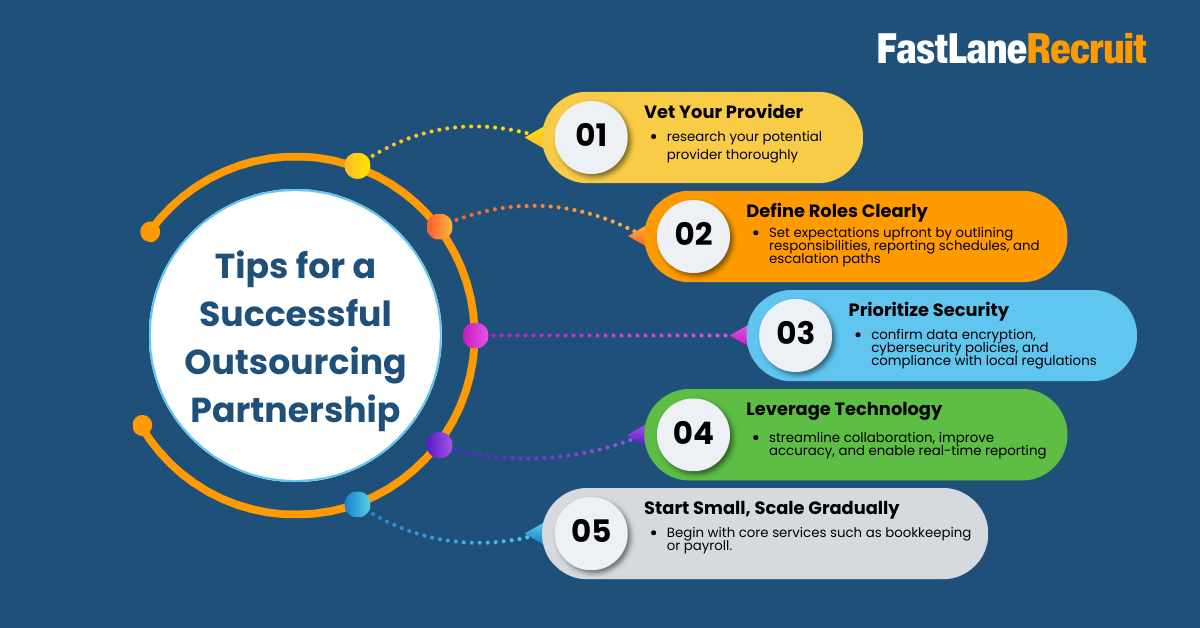
Tips for a Successful Outsourcing Partnership
Partnering with an outsourced accounting provider can transform how your business manages finances but only if the relationship is structured for success. Here are some practical tips to make the most of your outsourcing arrangement:
1. Vet Your Provider
Before signing any agreement, research your potential provider thoroughly. Look at their track record, read client testimonials, and ensure they have experience in your industry.
Example: A fast-growing e-commerce company checks that its Malaysian accounting partner has experience handling online retail businesses and understands international tax compliance. This ensures the provider can handle their specific needs from day one.
2. Define Roles Clearly
Set expectations upfront by outlining responsibilities, reporting schedules, and escalation paths. This reduces confusion and ensures everyone knows who is accountable for what.
Example: A software startup outsourcing payroll and AR/AP management creates a clear workflow document. It specifies that the provider handles monthly payroll, the internal finance manager reviews invoices weekly, and any urgent payment issues are escalated immediately via Slack.
3. Prioritize Security
Accounting involves sensitive financial data, so it’s crucial to confirm data encryption, cybersecurity policies, and compliance with local regulations. Ask about backups, disaster recovery, and whether the provider follows international security standards.
Example: A global consulting firm confirms that their outsourced accounting team in Malaysia uses secure cloud platforms with two-factor authentication, encrypted data transfers, and GDPR-compliant processes. This ensures client and company information stays protected.
4. Leverage Technology
Use cloud-based accounting tools to streamline collaboration, improve accuracy, and enable real-time reporting. Tools like QuickBooks Online, Xero, or NetSuite allow your team and the provider to access financial data anytime, anywhere.
Example: A marketing agency works with an outsourced bookkeeping team using Xero. Both teams can instantly see updated invoices, track cash flow, and generate reports without sending multiple emails or waiting for updates.
5. Start Small, Scale Gradually
Begin with core services such as bookkeeping or payroll. Once trust and workflows are established, expand to more advanced services like CFO-level support, tax planning, or financial forecasting.
Example: A retail brand starts by outsourcing payroll to a Malaysian accounting firm. After three months, they add bookkeeping, then later engage the provider for monthly financial reporting and cash flow analysis. This gradual approach reduces risk and ensures smooth integration.
Pro Tip: Schedule regular review meetings to track progress, discuss issues, and adjust services as your business grows. This keeps the partnership proactive rather than reactive and ensures both parties stay aligned.
Also Read: Types Of Accounting Services That Can Be Outsourced
Outsourcing vs In-House Accounting
Cost Efficiency
Outsourced accounting is often more cost-effective than maintaining an in-house team. Businesses pay only for the services they need, avoiding salaries, benefits, training, and software expenses. For example, a startup outsourcing payroll and bookkeeping to a Malaysian provider pays a fixed monthly fee for these services, rather than hiring full-time employees. In contrast, in-house accounting requires recruiting staff, covering salaries and benefits, and investing in accounting tools, which can be expensive even during slow periods.
Access to Expertise
Outsourced accounting gives businesses access to specialized professionals with diverse industry experience and up-to-date knowledge of regulations and accounting standards. For instance, an e-commerce company outsourcing to a Malaysian provider can leverage accountants familiar with international VAT, GST, and cross-border invoicing. On the other hand, in-house teams are limited to the skills and experience of their employees, and staying current with new laws or industry practices may require additional training.
Scalability and Flexibility
One of the biggest advantages of outsourcing is scalability. Services can be adjusted easily based on business growth or seasonal fluctuations. A retailer, for example, can hire outsourced accountants to manage increased holiday-season transactions and scale back during quieter months without hiring or laying off staff. In-house teams, however, require additional hiring and training to scale up, and downsizing can be costly and disruptive.
Control and Oversight
In-house accounting offers full control over financial operations, allowing management to supervise staff directly and make decisions immediately. Outsourced accounting requires trust and well-defined processes, but oversight can be maintained through regular reporting and clear communication protocols. For example, a company might schedule weekly video meetings and use dashboards from its outsourced provider to monitor transactions and financial health.
Also Read: How to Hire an Offshore Accountant in Malaysia
Time Efficiency
Outsourcing frees up internal teams to focus on strategic initiatives and core business operations. For instance, a tech startup can rely on outsourced accountants to manage payroll, accounts receivable and payable, and tax filings, while developers focus on product development. In-house teams, in contrast, often spend significant time on routine accounting tasks, leaving limited bandwidth for strategy and growth.
Fraud Prevention and Accuracy
External accounting teams provide additional checks and balances that reduce errors and detect potential fraud early. Outsourced providers often implement multi-level approvals and digital reconciliation tools to maintain financial integrity. Small businesses with only one or two internal accountants may be more vulnerable to mistakes or misuse of funds due to limited oversight.
Finding the Right Balance
Ultimately, the choice between outsourcing and in-house accounting depends on your business priorities. Outsourced accounting is ideal for companies seeking flexibility, expertise, and cost efficiency, while in-house accounting suits those who value control and direct oversight. Many businesses adopt a hybrid model, outsourcing routine tasks while keeping strategic financial decisions in-house, to achieve the best balance of efficiency, accuracy, and control.
Summary
| Aspect | Outsourced Accounting | In-House Accounting |
| Cost | Pay only for required services; lower overhead | Salaries, benefits, training costs higher |
| Expertise | Access to specialized professionals | Limited to internal team skills |
| Scalability | Flexible, easy to adjust services | Hiring/firing staff takes time |
| Control | Less direct oversight, requires trust | Full control over financial operations |
| Time Efficiency | Frees up internal teams for strategy | Staff handle day-to-day accounting |
| Fraud Risk | External checks reduce errors and fraud | Single-person oversight may increase risk |
Why Malaysia is a Smart Choice for Outsourced Accounting
Malaysia has become a hub for businesses looking to outsource accounting services, thanks to its strong talent pool, robust financial infrastructure, and strategic location in Southeast Asia. Companies across the globe are tapping into Malaysian expertise to streamline operations, ensure compliance, and reduce operational costs.
The accounting workforce in Malaysia is highly skilled and familiar with international standards such as IFRS (International Financial Reporting Standards), GST/VAT regulations, and global tax compliance requirements. This means businesses can confidently rely on Malaysian accountants for accurate financial reporting and advisory services.
Additionally, Malaysia’s time zone advantage allows for efficient collaboration with both Asian and Western markets, making it easier to maintain real-time financial management without long delays. For example, a U.S.-based company can outsource bookkeeping and payroll to Malaysia while still receiving timely updates during their working hours.
Key Features of Malaysia’s Accounting Environment
- Skilled Professionals: A large number of qualified accountants with CPA, ACCA, and MIA certifications.
- Technology Adoption: Malaysian firms leverage cloud-based accounting software such as Xero, QuickBooks Online, and NetSuite for real-time reporting.
- Regulatory Compliance: Adherence to local and international accounting standards, ensuring accurate tax filings and audit readiness.
- Cost Efficiency: Outsourcing to Malaysia provides quality accounting talent at a fraction of the cost of hiring locally in Western countries.
Example: A growing European e-commerce company outsourcing payroll and financial reporting to Malaysia reduced its accounting costs by 40% while maintaining high-quality, compliant services.
Also Read: Why Malaysia Is a Strategic Hub for Offshore Accountants
FastLaneRecruit’s EOR: Simplifying Your Malaysian Accounting Outsourcing
For companies exploring Malaysia as an outsourcing destination, FastLaneRecruit’s Employer of Record (EOR) service offers a seamless, risk-free way to hire and manage local accounting talent. With FastLaneRecruit, you don’t have to set up a legal entity in Malaysia, our EOR takes care of employment, payroll, compliance, and HR administration.
This solution is ideal for businesses that want the benefits of Malaysian expertise without the administrative burden of local incorporation. FastLaneRecruit ensures your outsourced accountants are fully compliant with Malaysian labor laws, taxes, and social contributions, giving you peace of mind.
Benefits of Using FastLaneRecruit’s EOR
- Quick Onboarding: Hire qualified Malaysian accountants quickly without lengthy local setup.
- Full Compliance: We handle payroll, taxes, statutory contributions, and HR obligations.
- Operational Efficiency: Focus on strategic growth while your accounting tasks are professionally managed.
- Cost-Effective: Reduce overhead and operational costs while accessing top talent.
- Flexible Engagements: Scale your team up or down as business needs change.
Example: A U.S.-based tech startup engaged FastLaneRecruit to hire a Malaysian accounting team. Within weeks, they had payroll, bookkeeping, and reporting fully outsourced, freeing the founders to focus on product development and growth strategy.
Why Global Businesses Choose Malaysia and FastLaneRecruit
Combining Malaysia’s accounting expertise with FastLaneRecruit’s EOR solution provides a powerful, low-risk outsourcing model. Businesses can access world-class accounting talent, maintain compliance, reduce operational costs, and scale their teams quickly, all while focusing on core business growth.
Conclusion
Outsourced accounting services are more than just cost-saving solutions; they are strategic tools that allow businesses to focus on growth, ensure compliance, and gain expert financial insights. While there are potential challenges like communication barriers and reduced direct control, these can be mitigated through careful provider selection, clear agreements, and the use of modern accounting technology.
For companies looking to hire skilled Malaysian accountants without the hassle of setting up payroll, HR, and local compliance, FastLaneRecruit’s EOR service offers a seamless solution. With dedicated teams handling everything from onboarding to full financial compliance, businesses can enjoy all the benefits of outsourcing while staying fully compliant and focused on growth.