
A Strategic Guide for Scaling Businesses
In 2026, outsourcing accounting is no longer just a cost decision. It is a strategic growth move.
Global companies face talent shortages, rising compliance complexity, operating cost pressure, and growing demand for real-time financial visibility. As finance teams move beyond bookkeeping into forecasting discipline, controls, compliance, analytics, and advisory support, more organizations adopt outsourcing or hybrid delivery models.
The global finance and accounting outsourcing market is large and continuing to expand, driven by talent constraints, compliance pressure, and digital delivery. In several mature markets, the accounting talent pipeline is tightening, creating hiring delays and capacity risk for finance teams.
So why are global companies outsourcing accounting functions? Let’s break it down.
Content Outline
Key Summary
Outsourcing Is Now a Capacity and Growth Strategy
In 2026, companies outsource accounting not just to manage expenses but to improve scalability, compliance, and access to financial expertise that supports expansion.
Global Talent Shortages Are Reshaping Finance Teams
Workforce gaps in Western markets are pushing businesses to access international accounting professionals to maintain operational continuity and reporting accuracy.
Hybrid Accounting Models Are Becoming the Standard
Companies are combining local finance leadership with offshore transaction teams to improve resilience, cost control, and regulatory alignment.
Technology Is Driving Modern Outsourcing
Cloud platforms, AI-powered reporting tools, and secure digital systems allow real-time collaboration, automation, and improved financial transparency.
Compliance and Internal Controls Are Stronger with Structured Partners
Professional outsourcing providers follow international standards such as IFRS and implement structured workflows that reduce risk and enhance audit readiness.
Malaysia Is Emerging as a Strategic Finance Hub
With strong English proficiency, alignment to international accounting standards, and oversight from bodies like the Inland Revenue Board of Malaysia and Companies Commission of Malaysia, Malaysia offers a deep pool of accounting talent with strong English working proficiency and broad familiarity with IFRS-based environments.
EOR Solutions Offer Control Without Entity Setup
FastLaneRecruit’s Employer of Record (EOR) model allows companies to hire Malaysian accountants directly while ensuring local compliance, combining flexibility with operational control.
What Is Accounting Outsourcing?
Accounting outsourcing is engaging an external team to run defined finance processes either fully managed (provider-led) or integrated (client-led) using shared systems.
Rather than building a full in-house accounting department, businesses partner with specialists who manage financial processes remotely using secure digital systems.
Depending on your needs, outsourced accounting can cover basic day-to-day tasks or higher-level financial management.
Common Functions That Can Be Outsourced
1. Bookkeeping
Recording daily financial transactions such as sales, expenses, receipts, and payments to keep your financial records organized and accurate.
2. Accounts Payable (AP)
Managing payments to suppliers and vendors, ensuring bills are processed correctly and paid on time.
3. Accounts Receivable (AR)
Tracking customer invoices, monitoring incoming payments, and following up on outstanding balances to maintain healthy cash flow.
4. Payroll Processing
Calculating employee salaries, tax deductions, statutory contributions, and ensuring employees are paid accurately and on time.
5. Financial Reporting
Preparing monthly, quarterly, or annual reports such as profit and loss statements, balance sheets, and cash flow statements to help business owners understand financial performance.
6. Tax Compliance
Ensuring your business follows local and international tax regulations, submits required filings, and stays compliant with authorities.
7. Financial Planning & Analysis (FP&A)
Providing budgeting, forecasting, and financial modeling to support better decision-making and business growth.
8. Virtual CFO Services
Offering strategic financial guidance without hiring a full-time Chief Financial Officer. This may include cash flow planning, investment analysis, fundraising support, and growth strategy advice.
Also Read: The Strategic Benefits of Outsourcing Operations Coordination
How Modern Accounting Outsourcing Works
Today’s outsourced accounting services operate through secure, cloud-based platforms. This means:
- Encrypted data storage with controlled access
- Standardized reporting schedules and dashboards
- Automation to reduce manual work and improve consistency
- Clear review controls to protect accuracy and audit readiness
- Real-time collaboration across teams and time zones
Even though the team may not sit in your office, you still maintain visibility and control over your financial information. Many companies gain better visibility because reporting becomes standardized, scheduled, and dashboard-driven.
In simple terms, accounting outsourcing allows businesses to focus on growth while experienced finance professionals handle the numbers efficiently and securely.
9 Strategic Reasons Global Companies Outsource Accounting
1. Improve Cost Structure and Finance Capacity Without Lowering Standards
Building an in-house finance team includes fixed salaries, benefits, training, infrastructure, and software investment.
Outsourcing can convert part of finance delivery from fixed headcount cost to scalable service capacity without reducing control over outputs.
| Cost Category | In-House Team | Outsourced Model |
| Salaries | Fixed annual payroll | Service-based pricing |
| Benefits | Healthcare, retirement, leave | Managed by provider |
| Recruitment | Advertising, HR hours | Managed externally |
| Software | Purchase & maintenance | Included in service |
| Infrastructure | Office space, IT systems | Provider-managed |
This structure gives businesses financial flexibility while maintaining professional standards.
2. Access Talent Faster to Protect Reporting Timelines
The accounting profession is undergoing workforce shifts globally, affecting hiring timelines and capacity planning.
Outsourcing allows businesses to:
- Access internationally trained accountants
- Scale hiring faster
- Reduce recruitment timelines
- Build specialized teams across borders
This is especially valuable for fast-growing companies entering new markets.
3. Improved Compliance and Regulatory Accuracy
Financial regulations continue to evolve. Compliance errors can lead to penalties, reputational damage, or audit complications.
Professional outsourcing providers stay aligned with:
- International Financial Reporting Standards (IFRS)
- Local tax regulations
- Industry-specific reporting rules
In Malaysia, employment and corporate compliance touchpoints often include LHDN and SSM; structured partners reduce reporting and documentation risk.
Partnering with professionals familiar with these standards reduces compliance risk.
Also Read: Why Malaysia Is an Attractive Hub for Operations Support
4. Faster Financial Optimization
Internal finance transformation can take months; specialized providers can implement standardized workflows faster because the playbooks and tooling already exist.
This speed matters when:
- Preparing for investment
- Expanding internationally
- Scaling operations
- Managing mergers or acquisitions
5. Access to Advanced Technology Without Heavy Investment
Modern outsourced accounting teams use:
- Cloud accounting platforms
- AI-driven automation
- Real-time financial dashboards
- Secure document management systems
This eliminates the need for companies to invest heavily in infrastructure while still benefiting from innovation.
Digital delivery through cloud platforms and automation is now a baseline expectation for modern finance operations.
6. Stronger Internal Controls and Fraud Mitigation
Outsourcing providers implement structured checks and balances, including:
- Segregation of duties
- Audit-ready reporting
- Dual verification processes
- Secure cloud storage
Strong providers operate with formal security controls (e.g., ISO 27001-aligned practices or SOC 2-type controls, depending on the provider) and enforce access management, audit trails, and secure storage.
7. Scalability During Growth or Seasonal Peaks
Outsourcing allows companies to:
- Increase headcount during tax season
- Add reporting capacity during fundraising
- Adjust payroll support during expansion
- Scale down during slower cycles
This flexibility protects cash flow and improves operational agility.
Also Read: How to Hire an Offshore Operations Coordinator in Malaysia
8. Freeing Leadership to Focus on Growth
Finance leaders often spend significant time on transactional work.
Outsourcing routine functions such as:
- Bookkeeping
- Accounts reconciliation
- Payroll
- Month-end close
Allows leadership to focus on:
- Strategy
- Forecasting
- Market expansion
- Investor relations
9. Access to On-Demand Expertise
Outsourcing enables access to:
- Fractional CFO services
- Financial controllers
- Tax advisors
- FP&A specialists
This gives businesses board-level insights without the commitment of multiple full-time executive hires.
Why Hire Malaysian Accountants?
Malaysia has emerged as a strong destination for accounting talent in Asia-Pacific.
Here’s why global businesses are increasingly hiring Malaysian finance professionals:
1. Strong Education & Professional Standards
Malaysia has strong professional accounting pathways and broad familiarity with IFRS-based reporting environments.
Many Malaysian accountants are trained in:
- IFRS
- UK and Australian frameworks
- Regional ASEAN compliance standards
2. English Proficiency and Multilingual Capabilities
Malaysia has strong English working proficiency across many corporate and professional environments, making collaboration with US, UK, and Australian clients seamless.
3. Stable Regulatory Environment
Malaysia’s financial and corporate governance frameworks are regulated by:
- Companies Commission of Malaysia
- Inland Revenue Board of Malaysia
This creates a structured, business-friendly environment for international operations.
4. Strategic Location in Southeast Asia
Malaysia serves as a gateway to ASEAN markets, making it attractive for regional finance hubs.
Also Read: Operations Management Compliance in Malaysia
Example: Comparing Hiring Models
| Factor | Local Western Hire | Generic Offshore Outsourcing | Malaysia-Based Offshore Team |
| Talent Availability | Limited in some regions | Broad (varies by provider and location) | Strong regional supply |
| Regulatory Familiarity | Strong locally | Varies | Strong IFRS alignment |
| Communication | High | Depends on region | High English proficiency |
| Cost Structure | Higher fixed cost | Lower variable cost | Balanced operational efficiency |
| Scalability | Moderate | High | High |
Malaysia offers a balanced solution combining professional standards, communication ease, and operational efficiency.
Hybrid Model: The New Standard in 2026
In 2026, many global companies are no longer choosing between fully in-house accounting or fully outsourced models. Instead, they are combining both approaches.
This is known as the hybrid accounting model and it has quickly become the preferred structure for growing and multinational businesses.
Rather than placing all finance responsibilities in one location, companies divide roles based on complexity, strategy, and operational efficiency.
Here’s how it typically works:
1. Local Finance Leaders Manage Strategy and Compliance
Key finance decision-makers remain in the company’s home country or primary market.
These roles may include:
- CFO or Finance Director
- Financial Controller
- Tax Manager
- Compliance Officer
They focus on:
- Strategic financial planning
- Investor reporting
- Regulatory oversight
- Audit coordination
- High-level decision-making
- Local tax and legal compliance
Keeping leadership close to headquarters ensures alignment with business goals and local regulatory requirements.
2. Offshore Teams Handle High-Volume Transactions
Routine and process-driven tasks are managed by offshore accounting professionals.
These typically include:
- Bookkeeping
- Accounts payable and receivable
- Payroll processing
- Bank reconciliations
- Data entry and transaction recording
- Month-end closing support
These tasks require accuracy and consistency but do not necessarily require physical presence in the same country.
By assigning transactional work to offshore teams, businesses reduce operational strain on local finance leaders and improve efficiency.
Also Read: Operations Coordinator Salary Guide 2026
3. Regional Hubs Like Malaysia Provide Scalable Support
Regional finance hubs such as Malaysia play an important role in hybrid structures.
Malaysia offers:
- International accounting standards alignment
- Strong English proficiency
- A structured regulatory framework under bodies like the Companies Commission of Malaysia and Inland Revenue Board of Malaysia
- A growing professional services ecosystem supported by the Malaysian Investment Development Authority
As a regional hub, Malaysia can provide:
- Dedicated offshore accounting teams
- Support across multiple time zones
- Scalable headcount as businesses grow
- Consistent compliance standards
This makes it easier for companies to build a long-term, structured offshore finance team rather than relying on ad-hoc outsourcing.
Why the Hybrid Model Works
The hybrid approach delivers several advantages:
Improved Resilience
If one region faces disruption (talent shortage, seasonal spikes, regulatory changes), operations can continue smoothly through distributed teams.
Better Cost Control
Companies maintain strategic oversight locally while optimizing operational costs through offshore execution.
Stronger Compliance Alignment
Local leaders ensure regulatory compliance in their home market, while offshore teams follow structured workflows and reporting standards.
Faster Scalability
Need to add two accountants during tax season? Or expand finance support during market entry? The hybrid model allows rapid scaling without restructuring the entire department.
A Practical Example
A US-based company expanding into Asia may:
- Keep its CFO and tax advisors in the US
- Hire Malaysian accountants to manage bookkeeping and reporting
- Use cloud-based accounting systems for real-time collaboration
This allows the business to maintain strategic control while benefiting from global talent and operational flexibility.
In short, the hybrid model is not about replacing local teams; it is about strengthening them. By combining local expertise with offshore efficiency and regional hubs like Malaysia, companies build finance functions that are more agile, cost-efficient, and prepared for global growth.
Practical Tips for Successful Accounting Outsourcing
Outsourcing accounting can deliver strong results but only when it is planned properly. A structured approach helps you avoid misunderstandings, protect your data, and build a long-term partnership that supports growth.
Before moving forward, consider these practical steps:
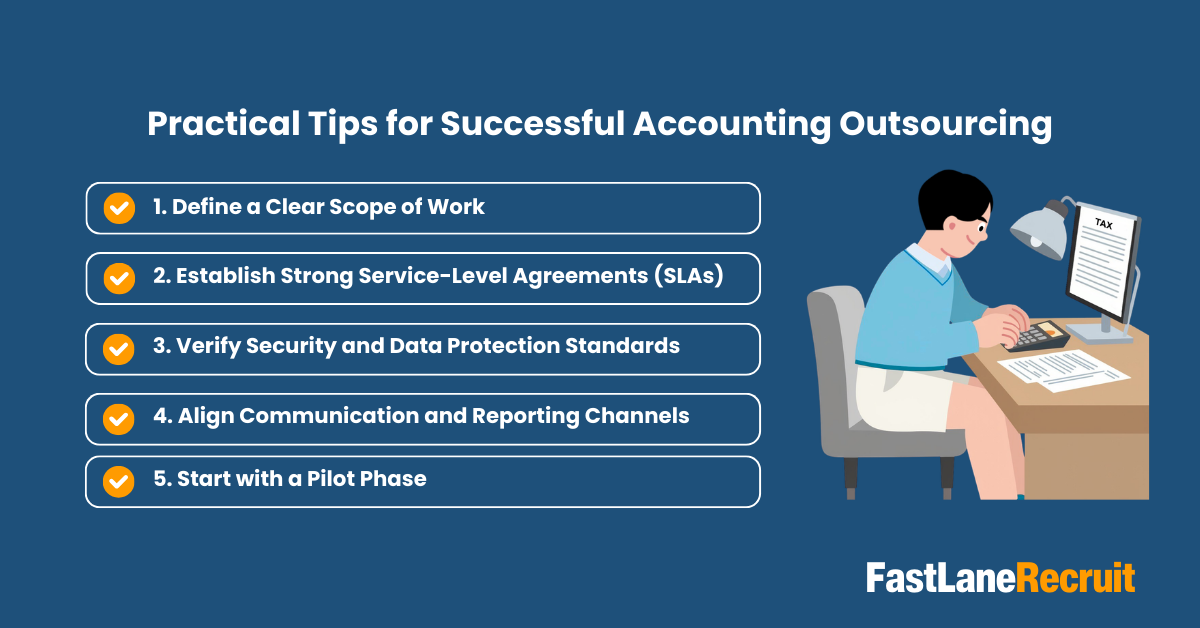
1. Define a Clear Scope of Work
Start by clearly identifying what you want to outsource.
Ask yourself:
- Which tasks will remain in-house?
- Which processes will the outsourced team handle?
- What reports do you expect monthly or quarterly?
- What level of decision-making authority will they have?
Be specific. Instead of saying “manage bookkeeping,” define:
- Number of transactions per month
- Reporting deadlines
- Reconciliation frequency
- Tools or systems to be used
Also establish measurable Key Performance Indicators (KPIs) such as:
- Accuracy rate
- Turnaround time
- On-time payroll processing
- Month-end closing timeline
Clarity at the beginning prevents confusion later.
Also Read: Offshore Vs Local: Accountants 2025 Salary Benchmark Report (Australia Vs Malaysia Edition)
2. Establish Strong Service-Level Agreements (SLAs)
An SLA is a formal agreement that defines service standards.
It should include:
- Turnaround times (e.g., invoices processed within 48 hours)
- Accuracy expectations
- Reporting schedules
- Confidentiality and data protection clauses
- Escalation procedures for urgent issues
A well-drafted SLA protects both sides and sets professional expectations from day one.
3. Verify Security and Data Protection Standards
Accounting involves sensitive financial and payroll data. Security must be a top priority.
Before signing any agreement:
- Confirm that financial data is stored in encrypted systems
- Ask about secure cloud platforms and access controls
- Review backup and disaster recovery procedures
- Check whether the provider follows international compliance standards
You may also want to request documentation of their internal data security policies.
Taking these steps reduces risk and builds trust.
Also Read: Building a High-Performing Offshore Accounting Team in Malaysia (Singapore Edition)
4. Align Communication and Reporting Channels
Clear communication ensures smooth collaboration, especially when teams are in different countries or time zones.
Set up:
- Regular weekly or bi-weekly check-ins
- Monthly financial review meetings
- Shared dashboards or reporting portals
- Defined contact persons on both sides
It is also important to define:
- How urgent issues are escalated
- Who approves final reports
- Expected response times
Strong communication avoids delays and strengthens the partnership.
5. Start with a Pilot Phase
Rather than outsourcing everything immediately, begin with a pilot project.
For example:
- Start with bookkeeping only
- Outsource accounts payable first
- Test payroll processing for one region
This allows you to:
- Evaluate quality and accuracy
- Assess communication flow
- Review reporting consistency
- Identify process improvements
If the pilot runs smoothly, you can scale confidently.
Bonus Tip: Maintain Strategic Oversight
Even when outsourcing, internal leadership should:
- Review reports regularly
- Monitor performance metrics
- Maintain control over key financial decisions
Outsourcing works best when it complements your internal finance leadership, not replaces it entirely.
When done correctly, accounting outsourcing becomes more than a cost-management tool. It becomes a structured, secure, and scalable system that strengthens your financial operations and supports long-term business growth.
Also Read: Building a High-Performing Offshore Accounting Team in Malaysia (Hong Kong Edition)
Is Outsourcing the Right Move for Your Business?
Which model fits you best?
- Outsourcing (provider-led): best when you want outcomes delivered with minimal management overhead.
- Hybrid (local leadership + offshore execution): best when you need scale without losing governance.
- EOR (your team, FastLaneRecruit employs): best when you want direct control over staff, systems, and KPIs without entity setup.
Consider outsourcing if:
- Your finance team is overwhelmed
- You are expanding internationally
- Recruitment timelines are long
- You require advanced reporting capabilities
- You want to improve cost efficiency while maintaining quality
An Alternative to Traditional Outsourcing: FastLaneRecruit’s EOR Solution
Traditional outsourcing works well for many businesses. However, some companies want more direct control over their finance team.
Instead of delegating accounting functions to a third-party provider, they prefer to build their own dedicated offshore team, selecting the professionals themselves, setting internal processes, and integrating them directly into their company culture.
The challenge? Setting up a legal entity in another country can be complex, time-consuming, and costly. It involves:
- Company registration
- Tax registration
- Employment contracts aligned with local labor law
- Payroll setup
- Statutory contributions
- Ongoing regulatory compliance
That’s where FastLaneRecruit’s Employer of Record (EOR) solution provides a smarter alternative.
What Is an Employer of Record (EOR)?
An Employer of Record is a service provider that legally employs staff on your behalf in another country.
You manage the employee’s daily work, performance, and responsibilities while the EOR handles the legal and administrative requirements.
This means you gain access to Malaysian accounting talent without having to establish a local subsidiary.
How FastLaneRecruit’s EOR Model Works
Through FastLaneRecruit’s EOR service, you can:
1. Hire Malaysian Accountants Directly
You choose the candidates.
You define their job scope.
You integrate them into your internal finance structure.
They work as dedicated team members under your operational management, while FastLaneRecruit manages employment compliance and payroll administration.
2. Maintain Operational Control
Unlike traditional outsourcing, where processes may be managed externally, the EOR model allows you to:
- Set your own workflows
- Use your existing accounting systems
- Define KPIs and reporting standards
- Oversee daily performance
This provides stronger alignment with your internal finance strategy.
Also Read: Building a High-Performing Offshore Accounting Team in Malaysia (Australia Edition)
3. Ensure Full Compliance with Malaysian Employment Laws
Malaysia has structured employment regulations covering:
- Employment contracts
- Payroll compliance
- Statutory contributions
- Tax reporting
- Employee benefits
These are governed by authorities such as the Inland Revenue Board of Malaysia and the Companies Commission of Malaysia.
FastLaneRecruit manages these requirements on your behalf, reducing compliance risk and administrative burden.
4. Avoid Setting Up a Local Subsidiary
Entity setup in a foreign country often involves:
- Legal incorporation fees
- Ongoing corporate filings
- Local directors or representatives
- Accounting and audit obligations
With an EOR solution, you can hire in Malaysia without opening a local company.
This significantly reduces entry barriers for global businesses testing new markets or building regional finance hubs.
5. Scale Quickly and Flexibly
Need to hire two accountants now and add a financial analyst later?
The EOR model allows you to:
- Expand your team quickly
- Adjust headcount based on growth
- Support seasonal financial cycles
- Enter the Malaysian market faster
This flexibility is especially valuable for startups, scale-ups, and companies undergoing international expansion.
Outsourcing vs EOR: What’s the Difference?
| Factor | Traditional Outsourcing | EOR Model with FastLaneRecruit |
| Control Over Staff | Limited | Full operational control |
| Team Integration | External provider team | Dedicated team under your management |
| Legal Entity Required | No | No |
| Employment Compliance | Managed by provider | Managed by FastLaneRecruit |
| Process Customization | Provider-driven | Fully customized to your internal system |
The EOR approach combines the flexibility of outsourcing with the structure and control of in-house hiring.
Why Malaysia Is an Ideal Location for Your Offshore Finance Team
Malaysia offers:
- Strong alignment with international accounting standards
- English-speaking finance professionals
- A structured regulatory framework
- Strategic access to ASEAN markets
By using FastLaneRecruit’s EOR service, you can tap into Malaysian accounting talent efficiently while maintaining full visibility over your finance operations.
Also Read: Types Of Accounting Services That Can Be Outsourced
Conclusion
In 2026, outsourcing is primarily a finance capacity strategy: protect timelines, strengthen controls, improve visibility, and scale delivery without rebuilding the entire function.
It is about:
- Accessing global talent
- Strengthening compliance
- Leveraging technology
- Scaling efficiently
- Supporting leadership with strategic insights
Malaysia stands out as a strong location for finance talent, offering professional standards, multilingual capabilities, and a stable regulatory framework.
Whether you choose full outsourcing or an EOR-supported offshore team, building a global finance function is no longer optional for growth-focused businesses; it is a competitive advantage.
If you’re exploring how to hire Malaysian accountants or expand your finance team globally, FastLaneRecruit is ready to support your next step.
Ready to Build Your Offshore Accounting Team?
If you’re considering expanding your finance function into Malaysia, whether to improve scalability, enhance compliance support, or strengthen operational efficiency, FastLaneRecruit can help you do it confidently.
Our team supports you with:
- Talent sourcing and screening
- Compliant employment setup
- Payroll and statutory management
- Ongoing HR and administrative support
- Seamless onboarding
Instead of choosing between outsourcing and setting up a foreign entity, choose a solution that gives you flexibility, control, and compliance, all in one.
Speak with FastLaneRecruit today to explore how our EOR solution can help you hire Malaysian accountantsand build a scalable global finance team.
