Expanding into Vietnam can give companies access to a large and increasingly important talent market, but hiring employees locally involves more than finding the right candidate. Employers need to consider employment contracts, payroll, personal income tax, social insurance, employee benefits, work permits and ongoing labor-law compliance.
An EOR Vietnam solution allows an international company to hire employees without immediately establishing its own Vietnamese legal entity. The EOR becomes the employee’s local legal employer while the client retains day-to-day direction and responsibility for the employee’s work.
For companies testing the Vietnamese market, hiring a small team or looking to move quickly, an Employer of Record can provide a practical alternative to setting up a subsidiary from the beginning.
Content Outline
Key Summary
An EOR can help you hire without establishing a local entity
An Employer of Record can employ workers locally on behalf of an overseas company, helping businesses enter Vietnam without first establishing their own employment entity.
EORs manage local employment administration
Depending on the provider and scope of service, an EOR can manage employment contracts, payroll, tax withholding, statutory insurance, benefits administration, onboarding and offboarding.
Vietnam has detailed employment requirements
Vietnamese employment law covers working hours, contracts, leave, termination, social insurance, health insurance, unemployment insurance and other employer obligations. Compliance should be built into the hiring process from the beginning.
EOR is particularly useful for market entry
Companies hiring a small number of employees, testing demand or entering Vietnam for the first time may find an EOR more practical than immediately establishing a local company.
Choosing the right EOR matters
A provider should be evaluated based on its local employment infrastructure, compliance capabilities, payroll expertise, work-permit support, benefits administration and ability to support your expected workforce.
What Is an Employer of Record in Vietnam?
An Employer of Record in Vietnam is a third-party organization that legally employs workers in Vietnam on behalf of a foreign company.
The EOR handles the formal employment relationship while the client company generally remains responsible for the employee’s day-to-day work, objectives, performance and business direction.
In simple terms:
Your company finds and manages the employee → the EOR legally employs the employee → the EOR manages local employment administration.
This arrangement can be useful when a company wants to hire in Vietnam but does not yet have its own local employment entity.
How Does an EOR Work in Vietnam?
The process generally follows this structure:
- Your company identifies the position and candidate.
- The EOR reviews the employment requirements.
- The EOR prepares a locally compliant employment contract.
- The employee signs the contract with the EOR.
- The EOR completes required onboarding and registrations.
- The EOR processes payroll and statutory deductions.
- Your company manages the employee’s daily responsibilities.
- The EOR manages local employment administration throughout the relationship.
- When employment ends, the EOR handles the required offboarding and final-payroll process.
The exact responsibilities vary between providers, so the service agreement should clearly define which party handles recruitment, payroll, benefits, immigration, equipment, expenses and termination decisions.
What Does an EOR Handle?
A Vietnam EOR service may cover:
- Local employment contracts
- Employee onboarding
- Payroll processing
- Personal income tax withholding
- Social insurance administration
- Health insurance administration
- Unemployment insurance where applicable
- Statutory employee benefits
- Leave administration
- Payslips
- Employment records
- Work permits and immigration support
- Compensation and benefits administration
- Employee offboarding
- Local employment compliance
The objective is not simply to outsource payroll. A good EOR provides the local employment infrastructure needed to employ people compliantly.
When Should You Use an EOR in Vietnam?
An EOR is not automatically the best option for every company. It becomes particularly useful in several situations.
You Do Not Have a Vietnamese Entity
If your company has no local subsidiary or employer entity in Vietnam, establishing one solely to hire a small number of employees can involve additional time, administration and ongoing obligations.
An EOR can provide an alternative route to employment without requiring your company to establish its own entity first.
You Are Testing the Vietnamese Market
An EOR can be useful when Vietnam is still a market-entry experiment.
For example, a company might want to hire:
- A sales representative
- Country manager
- Software developer
- Marketing specialist
- Customer support employee
- Operations professional
before committing to a permanent corporate structure.
You Need a Small Team
If you initially need only one or a handful of employees, an EOR may be more proportionate than creating a full local employment infrastructure.
You Need to Hire Quickly
Establishing an entity involves corporate, tax, banking, accounting and employment considerations. An EOR can streamline the employment side of expansion and allow a company to begin hiring sooner, subject to the employee’s circumstances and any immigration requirements.
How to Use an Employer of Record in Vietnam
Once you decide that an EOR is appropriate, the process can be broken down into eight practical steps.
Step 1: Assess Your Hiring Needs
Start by defining:
- Number of employees
- Job titles
- Work location
- Salary and currency
- Start date
- Working arrangement
- Employee benefits
- Probation requirements
- Whether the employee is Vietnamese or foreign
- Whether a work permit may be required
This information allows the EOR to determine the appropriate employment structure and cost.
Step 2: Choose an EOR
Compare providers based on:
- Local employment capability
- Vietnam payroll expertise
- Compliance support
- Benefits administration
- Work-permit support
- Contract management
- Payroll transparency
- Termination support
- Customer service
- Geographic coverage
Do not select an EOR based only on its monthly service fee. The quality of its local compliance infrastructure can have a much greater impact on your overall risk.
Step 3: Confirm Employee Details
The EOR will typically need information such as:
- Employee identity details
- Job position
- Compensation
- Work location
- Start date
- Working hours
- Benefits
- Bank information
- Tax information
- Immigration documentation where relevant
For foreign employees, work authorization should be reviewed before employment begins.
Step 4: Onboard the Employee
Once the employment arrangement is approved, the EOR handles the local onboarding process.
This may include collecting documentation, preparing the employment agreement and completing required employment or insurance registrations.
Step 5: Sign the Local Employment Contract
The employee enters into an employment relationship with the EOR under a locally compliant Vietnamese employment contract.
The contract should accurately reflect important terms such as:
- Position
- Salary
- Working location
- Working hours
- Contract duration
- Benefits
- Leave
- Probation
- Termination provisions
Step 6: Run Payroll
The EOR calculates and processes salary while managing applicable statutory deductions and employer contributions.
Vietnamese employment income is subject to personal income tax rules, and statutory insurance obligations need to be calculated according to the employee’s circumstances.
Step 7: Manage the Employment Relationship
Your company generally continues managing:
- Daily work
- Performance
- Responsibilities
- Business objectives
- Team integration
- Work allocation
The EOR manages the formal employment administration behind that relationship.
Step 8: Terminate or Offboard
Termination should not be treated as simply stopping payroll.
The EOR should help ensure that notice requirements, final salary, unused leave where applicable, severance and required documentation are handled according to Vietnamese requirements.
How to Hire Employees in Vietnam
Companies generally have three main approaches to hiring in Vietnam.
| Hiring method | Best suited for | Main consideration |
| Local entity | Long-term, larger operations | More control but greater setup and administration |
| Independent contractor | Genuine independent project-based work | Worker classification and misclassification risk |
| EOR | Small teams, market entry and international hiring | Ongoing EOR service cost |
Local Entity
Establishing a Vietnamese entity can make sense when a company has significant long-term operations, wants direct control over its local structure or expects a substantial workforce.
Contractor
Contractors can work for genuine independent engagements, but companies should not use contractor arrangements simply to avoid employment obligations.
If the individual operates like an employee—under the company’s direction, supervision and working arrangements—the classification should be reviewed carefully.
EOR
An EOR is often the middle ground for companies that need employees in Vietnam but are not ready to establish their own local entity.
Vietnam Employment Laws You Need to Know
Vietnam’s employment framework is primarily governed by the 2019 Labour Code, which came into effect in 2021. It covers areas including employment contracts, working time, rest periods, wages, termination, occupational safety and employee rights.
Employers should pay particular attention to:
- Employment contracts
- Working hours and overtime
- Minimum wages
- Probation
- Paid leave
- Termination procedures
- Severance obligations
- Social insurance
- Health insurance
- Unemployment insurance
- Employee representation
- Occupational safety
Vietnam also updated regional minimum wages from 1 January 2026. The monthly minimums are VND 5.31 million for Region I, VND 4.73 million for Region II, VND 4.14 million for Region III and VND 3.70 million for Region IV.
Practical point: A company’s compensation package should be assessed against the applicable regional requirements rather than relying on a single nationwide minimum salary.
Payroll and Taxes When Using an EOR in Vietnam
Payroll is one of the main reasons companies use an EOR.
For 2026, Vietnam’s personal income tax framework has also undergone important changes. A new Personal Income Tax Law was approved in December 2025, with major provisions taking effect during 2026, followed by implementing guidance issued during the year.
For employment income, Vietnam’s current framework provides progressive taxation for tax residents, while non-resident employment income is generally subject to a separate flat rate.
Mandatory insurance also needs to be considered.
Current standard contribution rates include:
- Social insurance: 17.5% employer / 8% employee
- Health insurance: 3% employer / 1.5% employee
- Unemployment insurance: 1% employer / 1% employee for applicable Vietnamese employees
Contribution rules and salary caps vary depending on the type of insurance and employee circumstances.
From July 2026, the basic salary used as a reference for certain social and health insurance contribution caps increased to VND 2.53 million, raising the corresponding SI/HI salary cap to VND 50.6 million.
For employers: payroll calculations should be reviewed against the latest Vietnamese regulations rather than relying on historical contribution percentages.
Employee Benefits and Leave in Vietnam
Employees in Vietnam are entitled to statutory protections covering areas such as:
- Annual leave
- Public holidays
- Sick leave
- Maternity-related leave
- Social insurance benefits
- Health insurance
- Unemployment insurance where applicable
Employees generally receive a minimum of 12 days of annual leave after completing 12 months of service, subject to statutory rules and additional entitlements in certain circumstances.
Maternity and other social-insurance-related benefits can involve specific eligibility and contribution requirements.
An EOR should therefore distinguish between:
Statutory benefits — required by Vietnamese law
and
Supplementary benefits — additional benefits offered to attract and retain employees.
For international employers competing for Vietnamese talent, supplementary benefits such as private healthcare, allowances, bonuses or enhanced leave can also form part of the compensation strategy.
Work Permits and Visas in Vietnam
Hiring a foreign employee in Vietnam requires additional consideration.
Vietnam’s work-permit framework was updated through Decree 219/2025/ND-CP, which introduced changes and streamlined aspects of the rules for foreign workers.
Depending on the employee and role, the process may involve:
- Determining whether a work permit is required
- Checking whether an exemption applies
- Preparing qualification and experience documentation
- Obtaining required approvals or documentation
- Applying for the appropriate work authorization
- Supporting immigration and residence requirements
An EOR with immigration capability can help coordinate this process, but employers should confirm the employee’s specific eligibility before promising a start date.
EOR vs Setting Up a Company in Vietnam
The right structure depends on your expansion strategy.
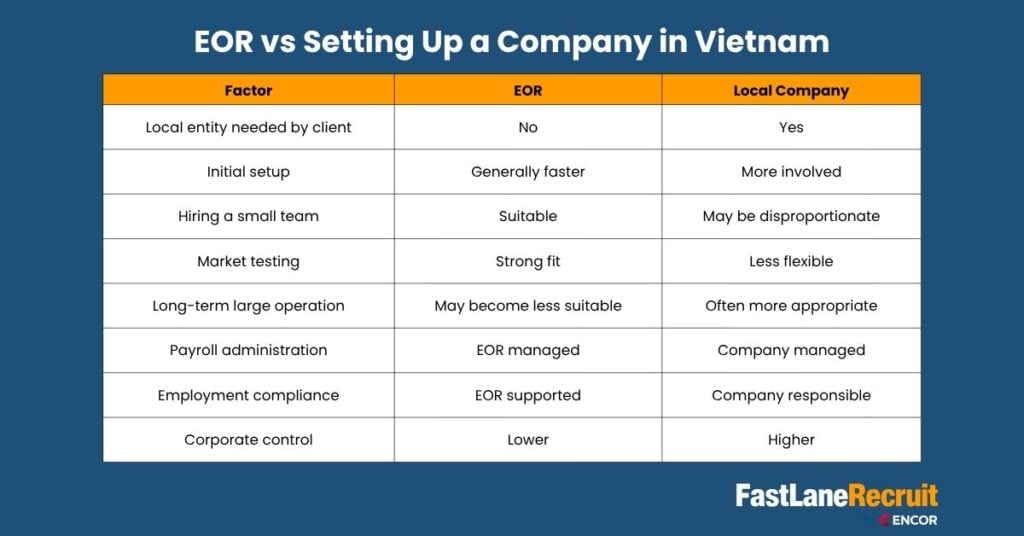
| Factor | EOR | Local Company |
| Local entity needed by client | No | Yes |
| Initial setup | Generally faster | More involved |
| Hiring a small team | Suitable | May be disproportionate |
| Market testing | Strong fit | Less flexible |
| Long-term large operation | May become less suitable | Often more appropriate |
| Payroll administration | EOR managed | Company managed |
| Employment compliance | EOR supported | Company responsible |
| Corporate control | Lower | Higher |
Rule of thumb: If you need a few employees to establish or test your presence in Vietnam, an EOR may be the more efficient starting point. If Vietnam will become a substantial, permanent operation, establishing your own entity may eventually make more commercial sense.
EOR vs PEO in Vietnam
Although EOR and PEO services are sometimes used interchangeably, they are not identical.
An EOR becomes the legal employer of the worker, while a PEO arrangement generally involves a co-employment structure where the client retains a direct employment relationship.
For companies without a Vietnamese entity, an EOR is often the clearer solution because it is specifically designed to provide a local employment structure.
Also Read: Guide to PEO vs EOR
How Much Does an EOR Cost in Vietnam?
There is no single standard EOR Vietnam price.
Pricing may depend on:
- Employee salary
- Number of employees
- Benefits
- EOR service fee
- Payroll requirements
- Work-permit requirements
- Currency and payment arrangements
- Additional HR services
- Employee location
- Contract type
A proper cost comparison should therefore look beyond the EOR fee.
Consider the total employment cost, including:
Salary + statutory employer contributions + benefits + EOR fee + immigration costs where applicable
This provides a more meaningful comparison against establishing and operating your own Vietnamese entity.
Benefits of Using an EOR in Vietnam
A well-managed EOR can provide several advantages.
Faster Market Entry
You can begin building a Vietnamese workforce without first building an entire local employment infrastructure.
Reduced Administrative Burden
Payroll, employment documentation, statutory contributions and other HR administration can be handled locally.
Compliance Support
An experienced EOR can help keep employment practices aligned with changing Vietnamese requirements.
Flexible Hiring
Companies can hire a small number of employees before deciding whether a permanent local entity is commercially justified.
Local Expertise
An established EOR provides access to local knowledge that an overseas HR team may not have.
Lower Expansion Complexity
Instead of coordinating multiple local specialists independently, an EOR can consolidate key employment processes into one service relationship.
Risks and Considerations When Using an EOR
EOR is not risk-free.
Before choosing a provider, consider:
Provider Compliance
Your company still needs confidence that the EOR is correctly handling local employment obligations.
Employment Control
The client should clearly understand which decisions it can make directly and which require EOR involvement.
Cost
An EOR introduces a recurring service fee, which should be compared against the cost and complexity of establishing your own entity.
Worker Classification
Contractors should not automatically be converted into EOR employees without assessing the underlying relationship and business requirements.
Data Protection
Employee personal and payroll information should be handled securely and according to applicable data-protection requirements.
Termination
Never assume that an employee can be terminated simply because the client requests it. The EOR should review the proposed termination against applicable Vietnamese requirements.
Who Should Use an EOR in Vietnam?
An EOR Vietnam solution is particularly suitable for:
- International companies entering Vietnam
- Companies without a Vietnamese entity
- Businesses hiring their first Vietnamese employee
- Companies testing the Vietnam market
- Startups expanding internationally
- Companies hiring remote employees in Vietnam
- Businesses building small specialist teams
- Companies that need local payroll support
- Businesses hiring foreign employees who require immigration assistance
For larger companies with an established Vietnamese operation, an EOR may be less necessary because the company can manage employment through its own entity.
How to Choose an EOR Provider in Vietnam
The cheapest EOR is not necessarily the best EOR.
Before signing an agreement, evaluate:
1. Local Employment Capability
Can the provider legally employ and administer employees in Vietnam?
2. Payroll Expertise
Does it understand Vietnamese payroll, tax and statutory contributions?
3. Compliance Infrastructure
How does it monitor regulatory changes and update employment processes?
4. Immigration Support
Can it assist with work permits and relevant employment authorization?
5. Benefits Administration
Can it manage statutory and supplementary employee benefits?
6. Transparent Pricing
Are salary, employer costs, benefits, EOR fees and additional charges clearly separated?
7. Offboarding Support
Does the provider have a structured process for compliant termination and final settlement?
8. Regional Coverage
If your workforce expands beyond Vietnam, can the provider support employees in other markets without requiring you to find a new provider each time?
Why FastLaneRecruit for EOR in Vietnam?
Once you’ve decided that an EOR is the right model, the next question is finding a provider that can manage the employment relationship from hiring through offboarding.
FastLaneRecruit provides EOR support designed to simplify international hiring while helping companies manage local employment requirements.
Our EOR services for Vietnam can include:
- Hiring and employment support
- Vietnam payroll
- Compensation and benefits
- Work visas and permits
- Independent contractor hiring
- International expansion
- Employment administration
- Offboarding support
This allows companies to focus on managing their people and business operations while FastLaneRecruit supports the local employment administration.
For companies building an international workforce, FastLaneRecruit can also support hiring across Malaysia, Singapore, Hong Kong, China, India, Philippines, Taiwan, Vietnam, Australia, United Kingdom, Switzerland, UAE, Saudi Arabia, Qatar.
That broader coverage can become particularly valuable when Vietnam is only one part of a regional expansion strategy.
EOR Hiring Checklist for Vietnam
Before hiring through an EOR Vietnam provider, confirm the following:
Hiring
- Job description finalized
- Employee classification confirmed
- Salary agreed
- Work location confirmed
- Start date confirmed
- Working hours agreed
Compliance
- Employment contract reviewed
- Applicable minimum salary checked
- Probation requirements reviewed
- Employee tax position assessed
- Social insurance requirements confirmed
- Health insurance requirements confirmed
- Unemployment insurance applicability checked
Immigration
- Nationality confirmed
- Work permit requirement assessed
- Exemption checked if applicable
- Required documentation prepared
- Visa/residence requirements reviewed
Payroll & Benefits
- Gross salary confirmed
- Employer statutory costs calculated
- Employee deductions calculated
- Benefits agreed
- Payroll schedule confirmed
- Expense policy confirmed
Offboarding
- Notice requirements understood
- Termination process reviewed
- Final salary calculated
- Benefits and leave reconciled
- Required documentation prepared
Need EOR support beyond Vietnam? FastLaneRecruit also supports employment solutions across Malaysia, Singapore, Hong Kong, China, India, the Philippines, Taiwan, Australia, the United Kingdom, Switzerland, the UAE, Saudi Arabia and Qatar.
Ready to Hire in Vietnam?
Expanding into Vietnam does not necessarily mean establishing a company before hiring your first employee. For businesses that need a faster, more flexible route into the market, an EOR Vietnam solution can provide the local employment infrastructure needed to build a team while reducing administrative complexity.
If you are considering hiring employees, managing payroll, providing compensation and benefits, arranging work permits or engaging contractors in Vietnam, FastLaneRecruit can help you determine the appropriate employment approach for your expansion plans.
Talk to FastLaneRecruit about your Vietnam hiring requirements and find out how our EOR services can support your next hire.
FAQs About EOR Vietnam
What is an EOR in Vietnam?
An Employer of Record in Vietnam is a third-party organization that legally employs workers on behalf of a foreign company while the client generally manages the employee’s day-to-day work.
Can I hire employees in Vietnam without setting up a company?
Yes. An EOR can provide a local employment structure that allows an overseas company to hire employees without establishing its own Vietnamese entity.
How does EOR Vietnam payroll work?
The EOR calculates and processes employee payroll, handles applicable deductions and manages required employer contributions and tax administration.
Does an EOR handle Vietnamese employment contracts?
Yes. A Vietnam EOR generally prepares and administers employment contracts that comply with applicable local requirements.
Can an EOR hire foreign employees in Vietnam?
An EOR can support foreign-worker employment, but work-permit and immigration requirements depend on the employee, role and applicable exemptions.
Is EOR better than setting up a company in Vietnam?
It depends on your expansion plans. EOR is often attractive for small teams, market testing and faster entry, while a local entity may be more appropriate for a large, long-term Vietnamese operation.
What does an EOR cost in Vietnam?
Costs vary by provider, employee salary, benefits, statutory contributions, service fees and additional requirements such as immigration support. A total employment-cost comparison provides a better basis for evaluating EOR pricing.
Is an EOR the same as a PEO?
No. An EOR generally becomes the legal employer, while a PEO typically operates through a co-employment structure. The distinction is important when a company does not have its own local entity.
How quickly can I hire through an EOR in Vietnam?
Timing depends on employee documentation, contract preparation, onboarding and, for foreign employees, work authorization. Vietnamese hires can generally be simpler than hires requiring immigration processing.
What should I look for in a Vietnam EOR provider?
Prioritize local compliance capability, payroll expertise, transparent pricing, benefits administration, immigration support, employee support and a reliable offboarding process.