Hiring employees in India can give international companies access to a large and diverse talent market, but managing local employment requirements can become complicated when you do not have an Indian legal entity.
An Employer of Record (EOR) in India provides a practical way to hire and employ local workers without immediately establishing your own entity. The EOR becomes the legal employer and manages employment administration such as local contracts, payroll, statutory requirements and benefits, while your company retains control over the employee’s day-to-day work.
For companies entering India, testing the market, or building a small team, using an EOR can provide a faster and more manageable alternative to setting up a subsidiary.
Content Outline
Key Summary
Hire in India Without Establishing an Entity
An EOR can employ eligible workers in India on your behalf, allowing your company to begin hiring without first creating its own Indian employing entity.
Keep Operational Control
The EOR is generally responsible for the formal employment relationship, while your company continues to manage the employee’s responsibilities, objectives, performance and daily work.
Simplify Payroll and Compliance
An EOR can manage payroll administration, applicable tax deductions, statutory contributions, employment documentation and other employer obligations according to local requirements.
What Is an Employer of Record in India?
An Employer of Record in India is a third-party organization that legally employs workers on behalf of another company.
The EOR becomes the formal employer for employment and administrative purposes, while the client company directs the employee’s actual work.
This creates a practical division of responsibilities:
| Responsibility | EOR | Client company |
| Local employment contract | ✓ | |
| Payroll administration | ✓ | |
| Statutory deductions and contributions | ✓ | |
| Employment compliance administration | ✓ | |
| Benefits administration | ✓ | |
| Day-to-day management | ✓ | |
| Work allocation and objectives | ✓ | |
| Performance management | Shared | ✓ |
| Business strategy | ✓ |
How Does an EOR Work in India?
The process typically starts when a company selects an EOR provider and provides details about the employees it wants to hire.
The EOR then:
- Establishes the appropriate employment arrangement.
- Prepares a locally compliant employment contract.
- Onboards the employee.
- Processes payroll and applicable statutory deductions.
- Administers agreed benefits.
- Supports ongoing employment compliance.
- Handles required employment administration when the relationship ends.
This allows the company to focus on building and managing its Indian team rather than creating an entire local employment infrastructure from the beginning.
What Does an EOR Handle?
Depending on the provider and employment arrangement, EOR services may cover:
- Local employment contracts
- Employee onboarding
- Payroll processing
- Salary payments
- Applicable tax withholding
- Statutory contributions
- Employee benefits administration
- Leave administration
- Employment documentation
- Work permits and visa support where applicable
- Employment compliance
- Offboarding and final settlements
The exact scope should always be confirmed with the EOR provider before signing an agreement.
When Should You Use an EOR in India?
An EOR is not necessarily the right structure for every business. It is most useful when the need for speed and flexibility outweighs the immediate need to establish a permanent local entity.
You Do Not Have an Indian Entity
If your company wants to employ people in India but does not have a local employing entity, an EOR can provide an alternative route to direct employment.
You Are Testing the Indian Market
An EOR can allow a company to hire initial employees and evaluate market potential before committing to a more permanent corporate structure.
You Need to Hire a Small Team
Establishing and maintaining an entity may be disproportionate when a company only needs to employ a handful of people.
You Need to Hire Quickly
An EOR can reduce the administrative work involved in setting up employment infrastructure, helping companies move from hiring decisions to onboarding more efficiently.
How to Use an Employer of Record in India
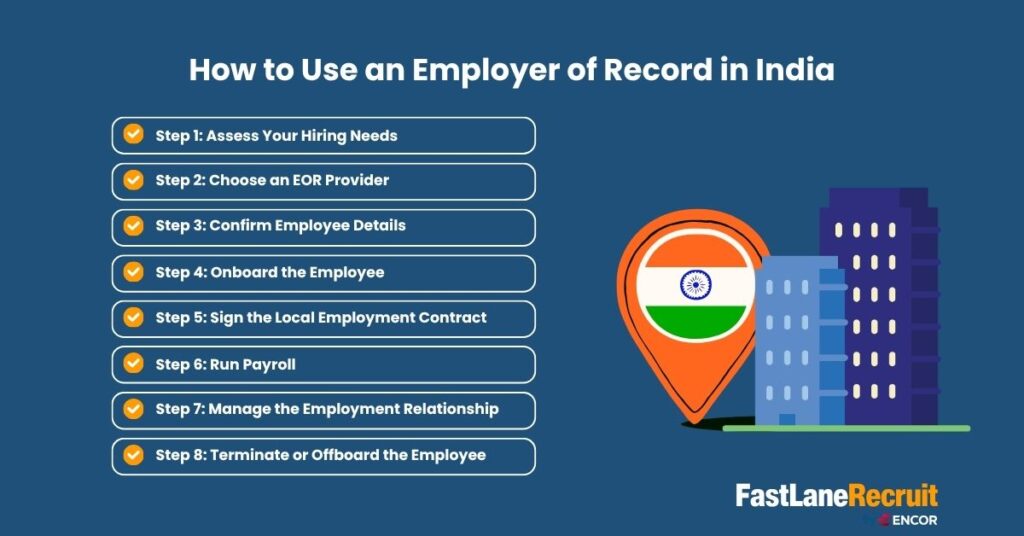
Using an EOR should be treated as a structured hiring process rather than simply outsourcing payroll.
Step 1: Assess Your Hiring Needs
Define:
- Number of employees
- Job roles
- Locations
- Expected start dates
- Compensation
- Benefits
- Employment duration
- Visa or work authorization requirements
This information helps determine whether an EOR is appropriate and what the total employment cost may be.
Step 2: Choose an EOR Provider
Evaluate providers based on:
- India employment-law expertise
- Payroll capabilities
- Compliance processes
- Benefits administration
- Visa and work-permit support
- Pricing transparency
- Employee support
- Onboarding process
- Experience with international companies
Step 3: Confirm Employee Details
Provide the EOR with the information required to establish employment, such as the employee’s role, salary, location, start date and applicable benefits.
Step 4: Onboard the Employee
The EOR collects required documentation and completes the employment onboarding process.
The employee should understand both the legal employment relationship with the EOR and their working relationship with your company.
Step 5: Sign the Local Employment Contract
The EOR prepares the employment agreement in accordance with applicable Indian requirements.
The contract should clearly establish key terms such as compensation, working arrangements, benefits, leave, confidentiality and termination provisions.
Step 6: Run Payroll
The EOR calculates and processes payroll, including applicable deductions and statutory obligations.
Your company typically funds the required employment costs, while the EOR handles the administrative process.
Step 7: Manage the Employment Relationship
After onboarding, your company generally remains responsible for the employee’s daily work, objectives and performance.
The EOR manages the formal employment administration.
Step 8: Terminate or Offboard the Employee
When employment ends, the EOR helps administer the required termination and offboarding process, including applicable notice, final payments, documentation and statutory requirements.
How to Hire Employees in India
International companies generally have several ways to build an Indian workforce.
| Hiring structure | Local entity required? | Speed | Administrative responsibility | Best suited for |
| Own entity | Yes | Slower | High | Established long-term operations |
| Contractor | Usually no employing entity, subject to circumstances | Fast | Shared | Genuine independent engagements |
| EOR | EOR provides employment structure | Faster | EOR-managed | International hiring and market entry |
The important distinction is that an independent contractor should not simply be used as a substitute for an employee. If the actual working relationship resembles employment, worker classification and applicable Indian requirements should be assessed carefully.
For companies that need genuine employees without immediately establishing their own entity, an EOR can provide a more structured option.
India Employment Laws You Need to Know
India’s employment framework combines national requirements with state-specific rules, meaning employers need to consider both central and local requirements.
Important areas can include:
- Employment contracts
- Minimum wage requirements
- Working hours
- Leave and holidays
- Social security
- Provident Fund requirements
- Employee State Insurance, where applicable
- Professional tax, depending on the state
- Gratuity
- Income-tax withholding
- Workplace protections
- Termination requirements
- State-specific employment regulations
India’s labour-law framework has also undergone significant reform through the labour codes. Implementation and applicability should be checked against the current rules and relevant jurisdiction at the time of employment.
Professional suggestion: Do not evaluate India employment compliance solely at the national level. The employee’s state, role, compensation and employment circumstances can affect the applicable requirements.
An experienced EOR can help manage this administrative complexity.
Payroll and Taxes When Using an EOR in India
Payroll is one of the main reasons companies use an EOR.
An India EOR can typically coordinate:
- Gross-to-net salary calculations
- Payroll processing
- Applicable income-tax withholding
- Statutory contributions
- Provident Fund administration
- Employee State Insurance where applicable
- Professional tax where applicable
- Payslips and payroll records
- Other required payroll reporting
The employee receives their salary through the EOR’s employment arrangement, while the client company funds the employment costs according to the agreed commercial terms.
Because payroll requirements can change and may differ by employee circumstances and state, companies should confirm the exact statutory treatment with their EOR provider.
Employee Benefits and Leave in India
Employee benefits should be considered as part of the total employment package, not as an afterthought.
Depending on eligibility and the employment arrangement, Indian employees may have statutory entitlements relating to areas such as:
- Paid leave
- Public holidays
- Maternity-related benefits
- Provident Fund
- Employee State Insurance
- Gratuity
- Other applicable statutory benefits
Companies may also offer additional benefits such as:
- Health insurance
- Life insurance
- Bonuses
- Allowances
- Wellness benefits
- Flexible working arrangements
A strong EOR should help ensure that the employment package reflects both statutory requirements and the client’s agreed benefits policy.
Work Permits and Visas in India
For Indian nationals working in India, an employment visa is generally not relevant. However, foreign nationals working in India may require the appropriate visa and work authorization depending on their nationality, role, compensation and circumstances.
If your company plans to employ a foreign national in India, confirm eligibility and immigration requirements before the employee starts work.
An EOR that provides work visa and permit support can help coordinate the required documentation and local employment process, although immigration approval ultimately depends on the applicable Indian authorities.
EOR vs Setting Up a Company in India
The right structure depends on your long-term plans.
| Factor | EOR | Own Indian entity |
| Establish local entity | Not required for the client | Required |
| Initial setup | Generally faster | More involved |
| Payroll | EOR-managed | Company-managed |
| Employment administration | EOR-managed | Company-managed |
| Corporate presence | Limited to employment arrangement | Full local presence |
| Control over employment structure | Shared through contractual arrangement | Direct |
| Best for | Market entry and flexible hiring | Long-term operations |
If you expect to build a substantial and permanent Indian operation, establishing your own entity may eventually make more commercial sense.
If your immediate objective is simply to hire employees and establish a team, an EOR can provide a lower-complexity starting point.
EOR vs PEO in India
EOR and PEO are often used interchangeably, but they can represent different employment structures.
An EOR generally becomes the legal employer, handling formal employment responsibilities on behalf of the client.
A PEO typically provides HR and employment administration through a co-employment structure, which can involve different entity and compliance requirements.
The distinction matters because companies should understand:
- Who is the legal employer?
- Who is responsible for payroll?
- Who handles statutory compliance?
- Does the client need a local entity?
- Who assumes employment-related responsibilities?
Always confirm the legal structure offered by a provider rather than choosing a service based solely on the label “PEO” or “EOR.”
Also Read: What Is PEO? How It Works, Services, Benefits & PEO vs EOR
How Much Does an EOR Cost in India?
There is no single standard EOR India price.
The total cost can depend on:
- Employee salary
- Employer statutory contributions
- Benefits
- EOR service fees
- Number of employees
- Employment location
- Onboarding or offboarding requirements
- Visa or immigration support
- Currency and payment arrangements
- Additional HR services
When comparing providers, do not compare only the monthly EOR fee.
Instead, compare the total employment cost and scope of service.
A lower headline fee may not be cheaper if important payroll, benefits, compliance or immigration services are charged separately.
Benefits of Using an EOR in India
For international companies, an EOR can provide several practical advantages.
Faster Market Entry
Start hiring without waiting to build an entire local employment infrastructure.
Reduced Administrative Burden
Delegate payroll, employment documentation and other employer administration to a local specialist.
Compliance Support
Gain support with applicable employment and payroll requirements.
Flexible Team Building
Hire a small initial team without immediately committing to a permanent entity.
Local Employment Expertise
Work with a provider familiar with local employment practices and administrative requirements.
Easier Expansion
Once your hiring model is established, adding employees can become more structured and repeatable.
Risks and Considerations When Using an EOR
EOR services can simplify international hiring, but they are not risk-free.
Before choosing a provider, consider:
Provider Compliance Capability
The EOR should demonstrate a clear understanding of applicable Indian employment requirements.
Employment Structure
Understand exactly who employs the worker and which responsibilities remain with your company.
Pricing
Ask for a complete breakdown of service fees, statutory costs, benefits and additional charges.
Data Protection
Employee payroll and personal information should be handled through appropriate security and data-protection processes.
Employee Experience
The EOR becomes part of the employee’s formal employment experience, so responsiveness and support matter.
Termination
Understand how the provider handles notice periods, final settlements and other requirements before you need to terminate an employee.
The best EOR relationship is transparent about responsibilities from the beginning.
Who Should Use an EOR in India?
An EOR can be particularly suitable for:
- Companies entering India for the first time
- Startups hiring their first Indian employees
- Businesses testing the Indian market
- Companies hiring remote employees in India
- Organizations building a small specialist team
- International companies that need faster hiring
- Businesses that do not yet want to establish an Indian entity
- Companies expanding an existing global workforce
An EOR may be less suitable when a company already has a substantial Indian operation and requires complete control over its own local employment infrastructure.
How to Choose an EOR Provider in India
The provider you choose becomes an important part of your international employment infrastructure.
Before signing, ask:
Does the provider have India-specific employment expertise?
Can it manage payroll and statutory requirements?
Does it support employee benefits?
Can it assist with visas and work permits where required?
Are fees and additional costs transparent?
How quickly can employees be onboarded?
Who supports the employee when employment questions arise?
How are terminations and final settlements handled?
Can the provider support you as your team grows?
The strongest provider is not necessarily the cheapest. It is the one that provides the right combination of compliance, local expertise, payroll accuracy, employee support and scalability.
Also Read: What Is an Employer of Record (EOR)?
Why FastLaneRecruit for EOR in India?
Choosing an EOR is ultimately about finding a partner that can manage the operational details while your company focuses on building its team.
FastLaneRecruit provides EOR support designed to simplify international hiring and workforce management, including:
- Hiring and onboarding
- Payroll administration
- Compensation and benefits
- Employment compliance support
- Work visas and permits
- Independent contractor hiring services
This allows companies to approach India hiring as a structured expansion process rather than having to build every employment function internally.
More importantly, FastLaneRecruit can support companies beyond a single-country hiring requirement. Our EOR and global workforce services cover Malaysia, Singapore, Hong Kong, China, India, Philippines, Taiwan, Vietnam, Australia, United Kingdom, Switzerland, UAE, Saudi Arabia, and Qatar.
For businesses expanding across multiple markets, having a workforce partner that can support different countries can make international hiring easier to manage as the organization grows.
EOR Hiring Checklist for India
Before hiring an employee through an EOR in India, make sure you have considered:
Hiring
- Confirm the role and employee location
- Define salary and compensation
- Confirm expected start date
- Determine employee versus contractor classification
- Identify any visa or work-permit requirements
Employment
- Review the local employment contract
- Confirm working arrangements
- Confirm leave and benefits
- Understand notice and termination requirements
- Confirm employee onboarding documentation
Payroll & Compliance
- Understand gross-to-net payroll
- Confirm applicable statutory contributions
- Confirm tax withholding
- Review benefits costs
- Understand payroll deadlines
EOR Provider
- Check India employment expertise
- Review pricing and additional fees
- Confirm payroll capabilities
- Ask about employee support
- Confirm visa and permit support if required
- Understand offboarding procedures
- Confirm support for future expansion
If you can answer these questions clearly, you are in a much stronger position to begin hiring through an EOR.
Ready to Hire in India?
Hiring in India does not necessarily mean establishing a company before you can build your team.
For companies that need to hire employees, manage payroll, provide compensation and benefits, navigate employment requirements or support work visas and permits, an EOR can provide a practical route into the Indian market.
The key is choosing an EOR provider that understands local requirements while giving your business the flexibility to manage its workforce.
FastLaneRecruit can help you build your India team through a structured EOR solution, while also supporting workforce expansion across multiple international markets.
Book a Free Consultation with FastLaneRecruit to discuss your India hiring requirements.
FAQs About Using an EOR in India
Can I hire employees in India without setting up a company?
Yes. An EOR can provide an employment structure that allows an international company to hire eligible employees in India without establishing its own local employing entity.
What does an EOR do in India?
An EOR generally manages formal employment administration, including local contracts, payroll, applicable statutory obligations, benefits administration and employment compliance support.
Can I manage an employee hired through an EOR?
Yes. The client company generally retains responsibility for the employee’s day-to-day work, objectives, responsibilities and performance, while the EOR manages the formal employment relationship.
Is EOR better than setting up a company in India?
It depends on your business objectives. An EOR is often more suitable for market testing, small teams and faster hiring, while an own entity can be more appropriate for companies planning substantial, long-term operations in India.
How much does an EOR cost in India?
EOR costs vary according to salary, statutory employer costs, benefits, service fees, employee numbers and additional services. Request a detailed quote rather than comparing providers based only on their headline monthly fee.
Does an EOR handle payroll in India?
Yes. Payroll processing is a core EOR function and may include salary calculations, applicable deductions, statutory contributions, payslips and related administration.
Can an EOR hire contractors in India?
EOR and contractor hiring are different arrangements. An EOR generally supports employees, while contractor hiring requires appropriate independent-contractor classification and contractual arrangements.
Does an EOR handle employee benefits?
An EOR can administer statutory and agreed employee benefits. The exact benefits available depend on the employee, applicable law and the package agreed with the client.
Can an EOR help with work visas in India?
Some EOR providers offer immigration, work visa and permit support. Requirements depend on the foreign national’s circumstances, so eligibility should be assessed before employment begins.
How quickly can I hire through an EOR in India?
The timeline depends on the provider, employee documentation, role, location and whether immigration support is required. Once the required information is available, an EOR can generally make the process more streamlined than establishing a new entity first.