

Rewarding an independent contractor for exceptional work can be a practical way to recognize results, encourage continued performance, and strengthen a business relationship. But a contractor bonus should not simply be treated like an employee bonus.
The way the bonus is structured, documented, paid, and reported can affect tax obligations, contractual rights, and worker-classification considerations. This becomes even more important when working with contractors across different countries.
This guide explains how to pay bonuses to independent contractors, what to include in the agreement, how to manage payment and documentation, and when an independent contractor arrangement may need to be reconsidered.
Content Outline
Key Summary
Independent contractors can generally receive performance-based payments
A business can agree to pay an independent contractor an additional amount for achieving defined results, completing milestones, or delivering exceptional work. However, the payment should be consistent with the commercial relationship and applicable local rules.
A contractor bonus is not automatically an employee bonus
Calling a payment a “bonus” does not turn an independent contractor into an employee. However, the overall working relationship matters. Worker classification generally depends on factors such as control, independence, economic dependence, and the actual way the relationship operates—not simply the wording used in a contract.
Document the payment clearly
The contractor agreement or a written amendment should explain the bonus amount or calculation method, eligibility criteria, performance conditions, payment timing, and applicable terms.
Tax and reporting rules depend on the country
There is no single worldwide rule for contractor bonuses. Businesses paying international contractors should review the tax, reporting, withholding, and payment requirements applicable to the contractor’s location and the paying entity.
Consider an EOR when the relationship is becoming employment-like
If a contractor is increasingly working like an employee, the issue may no longer be how to pay a bonus. The more important question may be whether the worker should be employed instead. An Employer of Record (EOR) can provide an alternative employment structure where appropriate.
Can You Pay a Bonus to an Independent Contractor?
Yes, a business can generally agree to make an additional payment to an independent contractor.
The important distinction is that the payment is usually part of the contractor’s business compensation, rather than an employee wage or discretionary employee benefit.
A contractor may receive additional compensation for:
- Completing a project ahead of schedule
- Achieving agreed performance targets
- Reaching a project milestone
- Generating qualifying sales or revenue
- Delivering a specific business outcome
- Meeting quality or service-level requirements
- Providing exceptional project results
The payment should have a clear commercial basis and be handled consistently with the contractor relationship.
The U.S. Internal Revenue Service, for example, focuses on the underlying relationship when determining whether a worker is an employee or independent contractor. How a worker is paid is only one part of the broader classification analysis.
How to Pay Bonuses to Independent Contractors: 7 Steps
Paying a contractor bonus does not need to be complicated. A structured process can help businesses maintain clear records and reduce avoidable compliance issues.
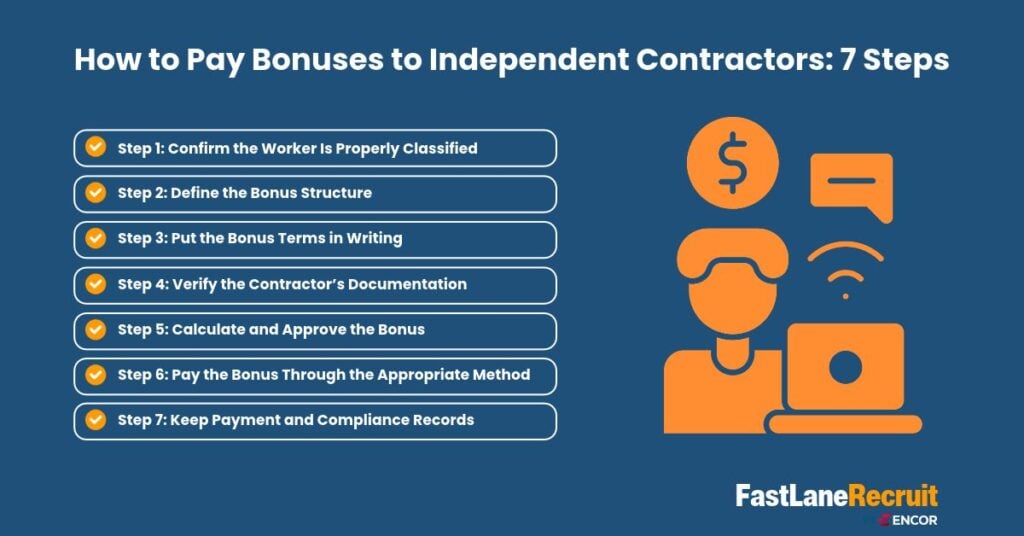
Step 1: Confirm the Worker Is Properly Classified
Before approving a bonus, review whether the individual is genuinely operating as an independent contractor.
Consider:
- Who controls how the work is performed?
- Does the contractor operate an independent business?
- Who determines the working methods?
- Does the contractor have an opportunity for profit or loss?
- How permanent is the relationship?
- Is the contractor providing services to other clients?
- Is the work integrated into the company’s operations?
Classification tests differ by jurisdiction.
For example, the U.S. Department of Labor announced a proposed rule in February 2026 that would use an economic-reality analysis, emphasizing the nature and degree of control and the worker’s opportunity for profit or loss as core factors. The proposal was not presented as a universal global classification standard.
Decision point: If the actual relationship increasingly resembles employment, review the classification before introducing employee-like compensation practices.
Step 2: Define the Bonus Structure
Decide exactly why the contractor is receiving the additional payment.
Common structures include:
| Bonus structure | Example |
| Performance bonus | Payment for achieving agreed KPIs |
| Milestone bonus | Payment after completing a defined project stage |
| Completion bonus | Payment after successful project delivery |
| Sales incentive | Payment based on qualifying sales |
| Quality incentive | Payment tied to measurable quality standards |
| Discretionary payment | Additional amount awarded at the client’s discretion, where legally and contractually appropriate |
The structure should be connected to deliverables, outcomes, or commercial objectives, rather than automatically replicating an employee compensation program.
Step 3: Put the Bonus Terms in Writing
A verbal agreement can create uncertainty.
A contractor agreement or written amendment should identify:
- Bonus amount or calculation method
- Eligibility requirements
- Performance or milestone criteria
- Measurement period
- Approval process
- Payment date or payment window
- Currency
- Invoicing requirements, where applicable
- Treatment if the project is terminated
- Applicable tax and withholding responsibilities
- Any conditions that must be satisfied before payment
For example:
The contractor will be eligible for an additional payment of [amount] upon successful completion of [defined milestone], subject to verification of the agreed deliverables.
The exact wording should be adapted to the applicable jurisdiction and commercial relationship.
Step 4: Verify the Contractor’s Documentation
Before making the payment, confirm that the business has the necessary contractor information.
Depending on the jurisdiction, this may include:
- Legal name
- Business or tax identification number
- Business registration details
- Tax forms or certificates
- Bank/payment details
- Invoice
- Contractor agreement
- Supporting performance documentation
For U.S. payers, the IRS generally requires businesses to obtain a contractor’s Form W-9 when applicable and use Form 1099-NEC for reportable nonemployee compensation. For tax years beginning after 2025, the IRS’s updated instructions state that the reporting threshold for certain information returns increased to $2,000.
These U.S. requirements should not be applied automatically to contractors in other countries.
Step 5: Calculate and Approve the Bonus
Before payment, verify that the contractor has satisfied the agreed criteria.
A simple approval checklist can include:
| Check | Question |
| Eligibility | Did the contractor satisfy the bonus conditions? |
| Amount | Is the calculation correct? |
| Documentation | Is the supporting record complete? |
| Contract | Does the payment follow the written agreement? |
| Tax | Have applicable tax obligations been reviewed? |
| Currency | Is the agreed payment currency being used? |
| Approval | Has the appropriate person authorized payment? |
This creates an audit trail and reduces disputes over how the bonus was calculated.
Step 6: Pay the Bonus Through the Appropriate Method
The bonus can generally be processed through the same contractor payment workflow used for regular compensation, provided that the method complies with the applicable agreement and local requirements.
Common options include:
- Bank transfer
- International wire transfer
- Approved payment platform
- Business-to-business payment
- Other locally permitted payment methods
For international contractors, consider:
- Currency conversion
- Transfer fees
- Payment timing
- Local banking requirements
- Foreign exchange exposure
- Tax documentation
- Applicable withholding
The goal is to make the additional payment traceable and consistent with the contractor’s contractual terms.
Step 7: Keep Payment and Compliance Records
Maintain records showing:
- The contractor agreement
- Bonus terms
- Performance or milestone evidence
- Approval
- Invoice or payment request
- Payment confirmation
- Tax documentation
- Applicable reporting records
Good documentation helps demonstrate that the payment was commercially justified and processed according to the agreed relationship.
How Should Independent Contractor Bonuses Be Taxed?
There is no universal tax treatment for independent contractor bonuses.
In many jurisdictions, an additional payment for services forms part of the contractor’s business income. However, the payer’s withholding and reporting obligations can vary significantly depending on:
- Contractor location
- Payer location
- Where services are performed
- Tax residency
- Type of entity receiving payment
- Applicable tax treaty
- Local tax legislation
U.S. example
For U.S. contractors, the IRS generally treats payments for services to independent contractors as nonemployee compensation rather than employee wages. Contractors are generally responsible for their own income and self-employment tax obligations.
For foreign contractors, additional rules may apply. For example, certain U.S.-source payments to foreign persons can be subject to withholding under IRC Section 1441, with a statutory rate of 30% in applicable circumstances unless an exemption or reduced treaty rate applies. The actual tax treatment depends on the facts, including where services are performed and the relevant documentation.
Important: A U.S. tax rule should not be assumed to apply to contractors working in Malaysia, Singapore, India, the UK, or another jurisdiction. International contractor payments require country-specific analysis.
Also Read: International Independent Contractor: How US Companies Hire Global Talent Legally
Can Paying a Contractor a Bonus Cause Misclassification?
The bonus itself does not automatically make someone an employee.
The greater concern is whether the bonus is part of a broader relationship that resembles employment.
For example, businesses should review the relationship if they are:
- Directing the contractor’s daily working methods
- Requiring employee-style working hours
- Providing extensive ongoing supervision
- Restricting the contractor from working with other clients
- Providing employee benefits
- Integrating the contractor into the business like an employee
- Paying recurring compensation that resembles wages
- Treating the contractor as part of the company’s permanent workforce
The U.S. Department of Labor’s current 2026 rulemaking emphasizes that the actual practices between the parties can be more relevant than what a contract theoretically says.
Contractor bonus vs employee bonus
| Independent contractor | Employee |
| Compensation is generally based on the commercial agreement | Compensation is governed by employment terms |
| Contractor typically operates an independent business | Employee works within an employment relationship |
| Payment may be tied to deliverables or performance | Bonus may form part of an employee compensation program |
| Contractor generally handles their own applicable taxes | Employer generally has payroll and withholding responsibilities |
| Classification depends on the actual relationship | Employment protections and obligations generally apply |
The distinction is jurisdiction-specific, so businesses should not rely on the label alone.
How to Structure a Contractor Bonus Agreement
A clear bonus clause should remove ambiguity before the payment becomes due.
Key elements to include
1. Eligibility
Define who qualifies for the bonus.
2. Performance criteria
Specify the measurable result, milestone, or deliverable.
3. Calculation
State whether the bonus is a fixed amount, percentage, commission, or another calculation.
4. Measurement period
Identify the period during which performance will be assessed.
5. Payment timing
Specify when the payment becomes due.
6. Documentation
Explain what evidence will be used to confirm eligibility.
7. Tax responsibility
State which party is responsible for applicable taxes or withholding, subject to mandatory local law.
8. Termination conditions
Explain what happens if the contract ends before the bonus criteria are met.
Clear terms can reduce payment disputes and make contractor management easier.
Common Mistakes When Paying Independent Contractor Bonuses
Treating a contractor bonus exactly like an employee bonus
Employee compensation systems and contractor arrangements are not interchangeable.
Paying without written criteria
Undefined performance conditions can create disputes over whether the contractor earned the payment.
Ignoring worker classification
A bonus should not distract from the bigger question: Is the worker correctly classified?
Applying domestic tax rules to an overseas contractor
International contractor payments can involve different reporting, withholding, and tax requirements.
Failing to keep supporting records
Businesses should maintain evidence showing why the payment was made and how the amount was calculated.
Assuming a contract label determines classification
A signed contractor agreement does not by itself establish independent contractor status. The actual relationship can be more important than the label.
When Should You Use an EOR Instead of an Independent Contractor?
Sometimes the question is not “How do I pay this contractor a bonus?”
It is:
“Should this person still be a contractor?”
An EOR may be worth considering when a business needs to engage someone as an employee in a country where it does not have its own local entity.
An EOR structure can be relevant when:
- The worker is functioning like a full-time employee
- The business needs ongoing employment rather than project-based services
- Employee payroll and statutory compliance are required
- The business wants to hire internationally without establishing a local entity
- The company needs localized employment administration
- The relationship has become too complex to manage as a contractor arrangement
The decision should be based on the actual working relationship, business requirements, and local employment rules.
Independent Contractor or EOR: Which Structure Fits?
| Consideration | Independent Contractor | EOR Employee |
| Nature of work | Independent/project-based | Employment relationship |
| Business control | Contractor generally retains independence | Employer directs work within employment framework |
| Compensation | Contractual fees and agreed incentives | Salary plus applicable employee compensation |
| Payroll | Contractor payment process | Employment payroll |
| Benefits | Generally not employee benefits | Applicable statutory and contractual benefits |
| Local entity | Usually not required for the contractor relationship, subject to local rules | EOR can employ the worker without the client establishing its own entity |
| Compliance | Contractor classification and payment compliance | Employment, payroll and statutory compliance |
| Best suited for | Genuine independent business relationships | Businesses needing an employee structure |
The right structure depends on the facts. An EOR should not be used simply to label an individual as an employee or contractor; it is an employment model that should match the underlying relationship and local requirements.
How FastLaneRecruit Can Help
Managing international contractors becomes more complex when a business has to coordinate contracts, payments, documentation, classification considerations, and country-specific requirements.
FastLaneRecruit supports businesses with independent contractor services and Employer of Record solutions, helping companies choose an appropriate way to engage international talent.
Our support can help businesses with:
- Independent contractor engagement
- Contractor management
- International hiring
- Contractor payment administration
- EOR employment solutions
- Payroll and statutory processes
- Country-specific employment considerations
- International workforce expansion
If a contractor arrangement remains appropriate, FastLaneRecruit can support the contractor engagement process.
If the relationship requires an employment structure, our EOR service can provide a route to employing talent internationally without requiring the business to establish its own local entity, subject to the applicable country requirements.
Why Businesses Choose FastLaneRecruit
One Partner for Contractor and EOR Needs
Businesses can evaluate contractor and employment structures within the same international workforce strategy rather than managing separate providers for every engagement model.
International Coverage
FastLaneRecruit operates across: Malaysia, Singapore, Hong Kong, China, India, Philippines, Taiwan, Vietnam, Australia, United Kingdom, Switzerland, UAE, Saudi Arabia, Qatar
Compliance-Focused Support
International hiring involves more than transferring money. Businesses need to consider worker classification, contracts, payroll, tax-related processes, statutory requirements, and local employment rules.
FastLaneRecruit helps businesses navigate these requirements according to the engagement structure and country involved.
Flexible International Expansion
Whether a company needs to engage an independent contractor for a defined project or employ international talent through an EOR, the appropriate structure can depend on the nature of the relationship and the company’s expansion plans.
Need Help Managing International Contractors or Employees?
Paying a contractor a bonus is only one part of international workforce management. The bigger consideration is whether your contractor arrangement, payment process, documentation, and worker classification are appropriate for the country and relationship.
FastLaneRecruit can help you assess the appropriate engagement model and support your international workforce through independent contractor services or Employer of Record solutions.
Talk to FastLaneRecruit about your international hiring needs and find the right way to engage, pay, and manage your global workforce.
Book a Free Consultation with an Expert.
Frequently Asked Questions
Can you pay a bonus to an independent contractor?
Yes. A business can generally agree to pay additional compensation to an independent contractor. The payment should be structured and documented consistently with the contractor relationship and applicable local requirements.
How do you pay bonuses to independent contractors?
Define the bonus criteria, document the terms, verify eligibility, calculate the amount, process the payment through an appropriate contractor payment method, and retain supporting records.
Are independent contractor bonuses taxable?
Generally, payments for services can form part of the contractor’s taxable income, but the specific treatment depends on the contractor’s jurisdiction, tax status, payer location, and applicable laws.
Should a contractor bonus be included in the contract?
Yes. Putting the bonus terms in the contractor agreement or a written amendment can clarify eligibility, calculation, payment timing, and other conditions.
Can paying a contractor a bonus cause misclassification?
A bonus alone does not automatically create an employment relationship. However, businesses should review the overall relationship because classification generally depends on the actual circumstances, including control and economic dependence, rather than simply the payment method or contract label.
Can I pay an overseas contractor a bonus?
Potentially, yes, but international payments require additional consideration. Businesses should review the contractor’s location, where services are performed, tax residency, applicable withholding rules, currency, payment method, and reporting obligations.
Should I use an EOR instead of an independent contractor?
An EOR may be appropriate when the individual should be employed rather than engaged as an independent business. This can be particularly relevant when the worker has an ongoing, employee-like relationship with the business or when the company needs to employ someone internationally without establishing its own local entity.
Can FastLaneRecruit help with both contractors and employees?
Yes. FastLaneRecruit supports businesses with independent contractor services as well as EOR solutions, allowing companies to evaluate the appropriate engagement structure as their international workforce develops.