
Hiring contractors in the Philippines can give businesses access to skilled talent without immediately establishing a local entity. But the real challenge is not finding a contractor—it is structuring the relationship correctly.
Before making the first payment, businesses need to determine whether the worker is genuinely an independent contractor, establish clear contractual terms, understand applicable tax and compliance responsibilities, and choose a payment process that works for both parties.
For companies planning to build a longer-term team, there is another important decision: should the worker remain an independent contractor, or should the business hire them as an employee through an Employer of Record (EOR)?
This guide explains how to hire and pay contractors in the Philippines, the key compliance considerations, and when an EOR may be a better option.
Content Outline
Key Summary
Contractors can be a flexible way to access Philippine talent
Independent contractors can be suitable for project-based work, specialized assignments, short-term engagements, or situations where the business needs flexibility without immediately establishing a Philippine entity.
Classification should come before the contract
Calling someone a “contractor” does not by itself make the relationship an independent-contractor arrangement. Philippine authorities and courts examine the actual relationship, including factors under the Four-Fold Test, with the right of control being particularly important.
A contractor agreement should reflect genuine independence
The agreement should clearly establish the scope of services, deliverables, fees, payment schedule, intellectual property, confidentiality, termination provisions, and the parties’ respective responsibilities.
Contractors have their own tax and registration responsibilities
Self-employed individuals and professionals in the Philippines may have BIR registration and filing obligations. The applicable tax treatment depends on the contractor’s circumstances and registration status.
EOR can be more appropriate when the relationship looks like employment
If the business needs an individual to work as an ongoing member of the team under substantial company direction and control, an employee arrangement may be more appropriate than continuing to treat the person as an independent contractor.
An EOR allows the business to employ workers in the Philippines without establishing its own local entity, while the EOR manages the local employment and payroll framework.
How to Hire Contractors in the Philippines
A compliant contractor engagement starts before the candidate signs an agreement.
Businesses should work through the following process.
1. Determine Whether a Contractor Is the Right Engagement Model
Start with the work itself, rather than the worker’s title.
A contractor may be appropriate when:
- The engagement is project-based or outcome-focused.
- The contractor provides specialized expertise.
- The contractor operates independently.
- The contractor controls how the services are performed.
- The relationship is based on a defined service or deliverable.
- The business does not need to manage the individual like a regular employee.
An employee arrangement may be more appropriate when the business needs:
- Ongoing employment
- Regular working hours
- Close supervision
- Integration into internal teams
- Company-controlled processes
- Employee benefits and statutory protections
- Long-term employment
Key decision: Do not structure a contractor arrangement simply because it appears faster or less expensive. The actual working relationship should support the classification.
2. Define the Scope of Work and Deliverables
A contractor agreement should describe what the contractor is engaged to deliver, rather than simply reproducing an employee job description.
Define:
- Services to be provided
- Deliverables
- Project milestones
- Deadlines
- Quality requirements
- Acceptance criteria
- Communication expectations
- Payment terms
- Expenses and reimbursable costs
- Intellectual property ownership
- Confidentiality obligations
A clear scope reduces disputes and helps maintain a genuine service-provider relationship.
3. Source and Evaluate Contractors
Businesses can source Philippine contractors through professional networks, referrals, recruitment channels, online platforms, or specialized hiring providers.
Evaluate candidates based on:
- Relevant experience
- Technical or professional qualifications
- Portfolio or previous work
- References
- Availability
- Communication skills
- Proposed fees
- Ability to work independently
For regulated professions, verify applicable licenses or credentials before engagement.
4. Verify Contractor Information
Before signing, collect appropriate documentation and business information.
Depending on the engagement, this may include:
- Full legal name
- Address
- Tax Identification Number (TIN), where applicable
- BIR registration details or Certificate of Registration
- Business registration information, where applicable
- Bank/payment details
- Professional licenses, where required
- Tax forms required by the hiring company’s jurisdiction
BIR guidance provides registration requirements for self-employed individuals engaged in business or the practice of a profession.
Also Read: Hire Independent Contractors in the Philippines Without Employment Complexity
5. Sign a Written Contractor Agreement
A written agreement should establish the commercial relationship before services begin.
At minimum, address:
| Contract Element | What to Define |
| Scope of work | Services, deliverables and responsibilities |
| Fees | Rate, currency and payment basis |
| Payment schedule | Milestones, invoices and due dates |
| Term | Start date, project period or renewal |
| Independent status | Nature of the service relationship |
| IP ownership | Ownership and permitted use of work product |
| Confidentiality | Protection of business information |
| Data protection | Handling of personal and confidential data |
| Termination | Notice, breach and completion provisions |
| Dispute resolution | Applicable process and governing law |
The agreement should match the actual working relationship. A contract cannot eliminate misclassification risk if day-to-day practices indicate an employment relationship.
Independent Contractor vs Employee in the Philippines
This is one of the most important decisions when hiring contractors in the Philippines.
The Philippine Supreme Court uses the Four-Fold Test when determining whether an employer-employee relationship exists. The factors include selection and engagement, payment of wages, power of dismissal, and the employer’s control over the worker’s conduct, including the means and methods of accomplishing the work. The control factor is particularly significant.
| Factor | Independent Contractor | Employee |
| Relationship | Service relationship | Employment relationship |
| Work focus | Deliverables/results | Ongoing role and duties |
| Control | Greater independence over methods | Employer directs work |
| Payment | Contractual fees/invoices | Wages or salary |
| Benefits | Not automatically employee benefits | Statutory/employment benefits may apply |
| Working arrangement | Generally more flexible | Employer-defined structure |
| Management | Contractor manages how services are delivered | Employer manages the employment relationship |
| Compliance | Contractor classification and tax obligations | Employment, payroll and statutory obligations |
Important: The distinction depends on the substance of the relationship, not simply the wording of the contract.
What Is the Four-Fold Test for Contractors in the Philippines?
The Four-Fold Test considers four main elements:
- Selection and engagement — who selected and engaged the worker.
- Payment of wages — how compensation is provided.
- Power of dismissal — who has the authority to terminate the relationship.
- Control — whether the company controls the means and methods by which the work is performed.
The Supreme Court has repeatedly identified control over the means and methods of work as a particularly important factor.
What Does This Mean for Employers?
A company can establish expected results, deadlines, quality standards, and business requirements without automatically creating an employment relationship.
However, businesses should carefully review arrangements where they:
- Require fixed employee-like schedules
- Closely control daily work methods
- Integrate the worker into employee systems and processes
- Provide ongoing employee-style supervision
- Treat the contractor like regular staff
- Provide employment benefits as though the worker were an employee
The more an arrangement resembles employment in practice, the greater the need for a proper classification review.
Also Read: Hiring Contractors vs Employees: How to Determine Worker Classification Correctly
What Are the Risks of Contractor Misclassification?
Misclassification occurs when a worker is treated as an independent contractor even though the actual relationship has characteristics of employment.
Potential consequences can include:
- Employment-related claims
- Back pay or benefits exposure
- Tax and contribution issues
- Regulatory penalties
- Contract disputes
- Reclassification costs
- Administrative burden
- Reputational and operational risk
The Philippine Supreme Court has emphasized that, when employment status is disputed, the employer bears the burden of establishing that the worker is an independent contractor rather than a regular employee.
How to Reduce Misclassification Risk
Businesses should:
- Assess classification before hiring.
- Base the engagement on genuine services or deliverables.
- Document the contractor’s independence.
- Avoid unnecessary employee-like control.
- Keep contractual and operational practices aligned.
- Review the arrangement if the contractor’s role changes.
- Consider EOR employment when the relationship becomes employee-like.
How to Pay Contractors in the Philippines
Once the contractor relationship is established, businesses should create a documented payment process.
Common Contractor Payment Structures
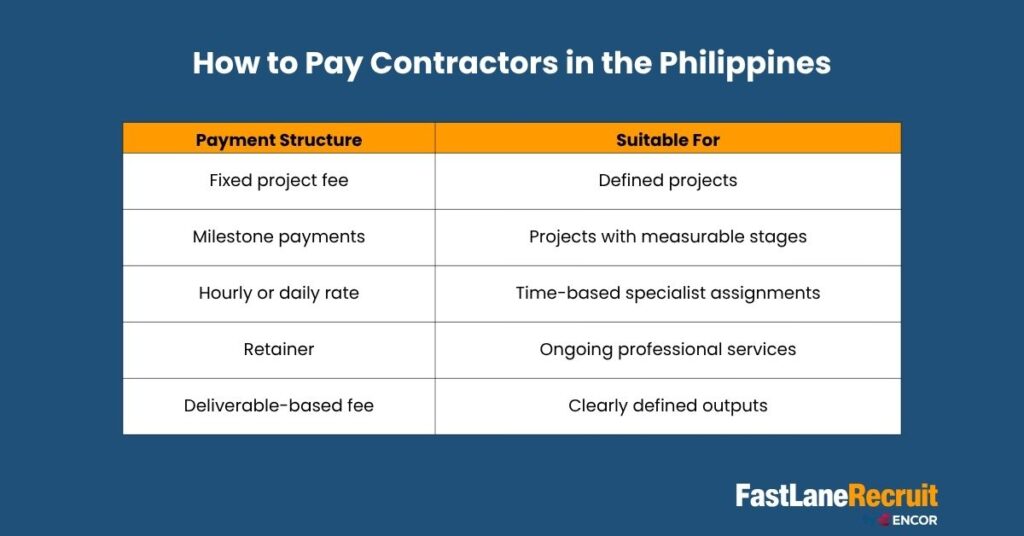
| Payment Structure | Suitable For |
| Fixed project fee | Defined projects |
| Milestone payments | Projects with measurable stages |
| Hourly or daily rate | Time-based specialist assignments |
| Retainer | Ongoing professional services |
| Deliverable-based fee | Clearly defined outputs |
For independent contractors, the payment arrangement should be consistent with the service agreement.
Contractor Payment Checklist
Before releasing payment, confirm:
- The agreed fee
- Approved deliverables
- Invoice or payment documentation
- Payment currency
- Payment date
- Bank/payment details
- Applicable withholding requirements
- Required tax documentation
- Payment records for accounting
For companies paying contractors internationally, the tax treatment can also depend on the payer’s country.
For example, U.S. businesses may need to obtain appropriate foreign-status documentation. The IRS states that Form W-8BEN is used by eligible foreign individuals to establish foreign status and, where applicable, claim treaty benefits. The correct form depends on the payment and circumstances.
Do not assume that one tax form or withholding rule applies to every international contractor. The contractor’s status, where services are performed, the payer’s jurisdiction, and applicable tax rules all matter.
What Taxes Do Independent Contractors Pay in the Philippines?
Independent contractors who operate as self-employed individuals or professionals generally have their own tax registration and filing responsibilities.
The BIR states that self-employed individuals engaged in business or the practice of a profession must register with the BIR in accordance with applicable registration requirements.
The 8% Income Tax Option
For qualifying self-employed individuals and professionals whose gross sales/receipts and other non-operating income do not exceed the applicable PHP 3 million VAT threshold, Philippine tax rules provide an option to use an 8% income tax rate on the relevant amount of gross sales or receipts above PHP 250,000, instead of the graduated income tax rates and percentage tax, subject to the applicable requirements.
This is a contractor-side tax consideration, not a universal rule that every contractor or foreign company must use.
Because tax treatment can vary based on registration, income level, payer, and business structure, companies should obtain appropriate Philippine tax advice for their specific arrangement.
Do Foreign Companies Need a Philippine Entity to Hire Contractors?
Not necessarily.
A foreign business may engage a genuine independent contractor in the Philippines without establishing its own Philippine entity. However, the absence of a local entity does not remove the need to assess worker classification, contractual requirements, tax considerations, payment processes, and potential local obligations.
Businesses should therefore distinguish between:
Hiring a genuine independent contractor
and
Hiring an employee without establishing the appropriate local employment structure.
When the business needs an employee rather than an independent service provider, an EOR can provide an alternative to immediately establishing a local entity.
Contractor vs EOR: Which Is Right for Your Business?
The right model depends on the nature and duration of the work.
| Consideration | Independent Contractor | EOR |
| Best for | Independent/project-based services | Ongoing employment |
| Local entity required by client | Generally no | Generally no |
| Worker classification | Contractor | Employee |
| Day-to-day work direction | Contractor maintains independence | Client manages day-to-day work |
| Payroll | Contractor payment process | EOR-managed payroll |
| Employee benefits | Not generally applicable as employee benefits | Applicable employment benefits/statutory requirements |
| Best for long-term team member | May not be appropriate | Often more suitable |
| Misclassification concern | Important | Employment structure addresses employee engagement |
| Scalability | Useful for independent services | Useful for building an international workforce |
When Should You Use an Independent Contractor?
Consider a contractor when:
- The work is genuinely independent.
- The engagement is project-based.
- The worker provides specialized services.
- The contractor controls how the work is performed.
- You need short-term or flexible support.
When Should You Consider an EOR?
An EOR may be more appropriate when:
- You want to hire someone as an employee.
- The role is ongoing and business-critical.
- You need regular employee management.
- The worker is integrated into your organization.
- You want local payroll and employment administration handled.
- You want to hire in the Philippines without immediately establishing your own entity.
The key decision is not simply contractor vs EOR based on cost. It is whether the actual working relationship is an independent service relationship or an employment relationship.
How FastLaneRecruit Can Help
Hiring internationally becomes more complicated when businesses have to manage worker classification, contracts, onboarding, payments, payroll, statutory requirements, and local employment rules at the same time.
FastLaneRecruit supports businesses that need a practical way to engage international talent while choosing the appropriate workforce model.
Contractor Services
For genuine independent contractor engagements, FastLaneRecruit can support businesses with contractor management processes designed to simplify international engagements.
Support can include:
- Contractor onboarding
- Contract and documentation support
- Contractor payment administration
- Compliance-focused processes
- Ongoing contractor management
- Guidance when the engagement structure changes
Employer of Record Services
When a worker should be employed rather than engaged as an independent contractor, FastLaneRecruit’s EOR service provides a way to employ talent in the Philippines without requiring the client to establish its own local entity.
With an EOR structure, FastLaneRecruit can support areas such as:
- Local employment contracts
- Payroll administration
- Statutory employment requirements
- Employee onboarding
- Benefits administration
- Employment compliance support
- Ongoing HR administration
This allows the client to focus on managing the employee’s work while FastLaneRecruit manages the local employment framework.
Why Businesses Choose FastLaneRecruit
Businesses expanding internationally need more than a way to send payments. They need a workforce partner that understands the difference between contractor engagement and employment.
One Partner for Multiple Workforce Models
Businesses can work with FastLaneRecruit for both independent contractor services and EOR employment, making it easier to adjust the workforce model as business needs change.
Support for International Expansion
FastLaneRecruit operates across: Malaysia, Singapore, Hong Kong, China, India, Philippines, Taiwan, Vietnam, Australia, United Kingdom, Switzerland, UAE, Saudi Arabia, Qatar
This gives businesses a broader framework for building distributed teams across multiple markets.
Contractor-to-Employee Flexibility
A contractor engagement may start as a short-term project. If the relationship becomes a long-term role requiring employee status, businesses can reassess the structure rather than continuing with an unsuitable contractor arrangement.
That flexibility can be especially valuable for companies testing a new market before making a larger hiring commitment.
Contractor Hiring Checklist for the Philippines
Before engaging a contractor, use this checklist:
Before Hiring
- Determine whether the role genuinely fits an independent contractor model.
- Review the applicable classification rules.
- Define project scope and deliverables.
- Set the contractor’s fee and payment schedule.
- Verify relevant contractor information.
- Review tax and documentation requirements.
Before Signing
- Prepare a written service agreement.
- Define deliverables and acceptance criteria.
- Establish payment terms.
- Address intellectual property.
- Include confidentiality and data protection provisions.
- Define termination and dispute provisions.
- Ensure the contract reflects the actual relationship.
During the Engagement
- Keep payment and invoice records.
- Maintain appropriate documentation.
- Avoid unnecessary employee-like control.
- Review classification if the role changes.
- Reassess the model if the contractor becomes a core, ongoing team member.
Hire Contractors in the Philippines With Greater Confidence
Hiring contractors in the Philippines can be an effective way to access specialized talent and expand internationally—but the engagement should be structured around the actual relationship, not simply the desire to hire quickly.
If the worker is genuinely independent, FastLaneRecruit can help simplify contractor management and international payments. If the role is better suited to employment, an EOR structure can provide a more appropriate path without requiring you to establish your own Philippine entity.
Need help deciding between a contractor and an EOR?
Talk to FastLaneRecruit about your hiring plans and find the workforce model that fits your business.
Explore FastLaneRecruit EOR and Contractor Services
Hire. Manage. Expand globally with greater confidence. Contact us today!
Frequently Asked Questions About Hiring Contractors in the Philippines
How do I hire contractors in the Philippines?
Start by determining whether the work genuinely fits an independent contractor arrangement. Define the scope and deliverables, source and evaluate candidates, verify relevant documentation, sign a service agreement, establish payment procedures, and maintain records throughout the engagement.
Can a foreign company hire a contractor in the Philippines?
Yes. A foreign company can engage a genuine independent contractor in the Philippines without necessarily establishing a local entity. However, the company should assess classification, contractual, tax, payment, and other applicable compliance requirements before proceeding.
How much does it cost to hire a contractor in the Philippines?
There is no single standard contractor rate. Fees vary by profession, experience, specialization, project scope, market demand, and payment structure. Businesses should establish compensation based on the contractor’s services and deliverables rather than treating contractor fees as equivalent to an employee salary.
Do independent contractors in the Philippines pay their own taxes?
Generally, a genuine self-employed contractor is responsible for their own applicable tax registration and filing obligations. BIR requirements depend on the individual’s status, income, registration, and circumstances.)
Do contractors need to register with the BIR?
Self-employed individuals engaged in business or the practice of a profession generally have BIR registration obligations. The exact requirements depend on the contractor’s circumstances.
What is the Four-Fold Test in the Philippines?
The Four-Fold Test considers selection and engagement, payment of wages, the power of dismissal, and control over the worker’s conduct and means and methods of work. Philippine jurisprudence places particular importance on the control factor when determining whether an employment relationship exists.
Can I manage a contractor like an employee?
Businesses should be careful about imposing employee-like control over a contractor. A contractor arrangement should reflect genuine independence. If the business needs to direct the worker’s methods, schedule, and ongoing employment relationship in an employee-like manner, an employment model may be more appropriate.
When should I switch from a contractor to an employee?
Consider reassessing the arrangement when the role becomes ongoing, the worker becomes deeply integrated into the organization, the business needs substantial control over how work is performed, or the worker’s responsibilities resemble those of regular employees.
An EOR can be an option when a business wants to employ the worker in the Philippines without immediately establishing its own local entity.
Can FastLaneRecruit help me hire contractors in the Philippines?
Yes. FastLaneRecruit can support businesses with international contractor services and can also provide EOR solutions when the appropriate structure is employment rather than independent contracting.
Can FastLaneRecruit hire employees in the Philippines through an EOR?
Yes. FastLaneRecruit’s EOR service enables businesses to employ talent in supported markets without requiring the client to establish its own local entity, while FastLaneRecruit manages the local employment framework.