
Hiring independent contractors can give businesses access to specialized talent without committing to a traditional employment arrangement. When that talent is based in another country, however, the hiring process involves more than finding the right person and agreeing on a rate.
Businesses need to consider worker classification, local requirements, contracts, tax documentation, payments, intellectual property, and ongoing compliance. A contractor who is treated like an employee can also create misclassification risks, even when the contract calls the person an “independent contractor.”
This guide explains how to hire independent contractors, with a particular focus on hiring foreign independent contractors. It also explains when a contractor arrangement may be appropriate, when an Employer of Record (EOR) may be a better fit, and how FastLaneRecruit can support businesses hiring across international markets.
Content Outline
Key Summary
Confirm Contractor Status Before Hiring
Do not assume someone is an independent contractor simply because they work remotely, invoice your company, or have a contractor agreement. Classification generally depends on the actual working relationship, including factors such as control, independence, financial risk, and the nature of the engagement.
Foreign Contractor Hiring Requires Local Consideration
Hiring an independent contractor abroad can involve different rules for classification, tax, documentation, contracts, and payments depending on the country where the contractor works.
Use a Clear Contractor Agreement
A written agreement should define the scope of work, deliverables, payment terms, confidentiality, intellectual property, termination, and other relevant responsibilities.
Monitor the Relationship After Hiring
Classification is not necessarily a one-time decision. A contractor relationship can change over time, particularly when a project becomes an ongoing role or the business begins controlling how the work is performed. UK guidance, for example, advises businesses to keep employment status under review as the relationship develops.
Know When an EOR May Be More Appropriate
If the role is effectively an employee position, an EOR can provide an employment structure in a country where your business may not have its own local entity. The decision should be based on the actual nature of the role rather than simply on cost or convenience.
What Is an Independent Contractor?
An independent contractor is generally a self-employed individual or business that provides services to another company without being employed by that company.
Unlike an employee, a genuine independent contractor typically operates with greater independence over how the work is performed and may take responsibility for their own business expenses, taxes, tools, and commercial risk. However, the exact legal definition varies by jurisdiction.
For example, the IRS considers behavioral control, financial control, and the overall relationship when determining whether a worker is an employee or independent contractor.
UK guidance similarly distinguishes self-employed contractors from employees and notes that employment status can have different implications under tax and employment law.
Independent Contractor vs Employee
| Factor | Independent Contractor | Employee |
| Relationship | Provides services as an independent business | Works within an employment relationship |
| Control | Generally greater control over how work is performed | Employer generally has greater control |
| Payment | Often invoices for services | Usually receives payroll wages or salary |
| Benefits | Generally not entitled to employee benefits from the client | May receive statutory and contractual benefits |
| Work structure | Often project- or deliverable-based | Often ongoing and integrated into the organization |
| Business risk | May carry greater financial/business risk | Employer generally carries more business risk |
| Tax treatment | Often responsible for own tax obligations, subject to local rules | Employer may have withholding and payroll obligations |
Important: The label in the contract is not enough. The substance of the working relationship matters. The IRS explicitly states that a contract describing someone as an independent contractor does not by itself determine their status.
Also Read: Freelancer Vs. Contractor
When Should You Hire an Independent Contractor?
Independent contractors can be useful when a business needs expertise or capacity without creating a traditional employment relationship.
Common situations include:
Short-Term or Project-Based Work
Contractors can be suitable for defined projects with specific deliverables, milestones, or end dates.
Specialized Expertise
Businesses may engage contractors for skills such as:
- Software development
- Design
- Marketing
- Translation
- Consulting
- Finance
- Technical implementation
- Professional services
Temporary Capacity
A contractor may help a business manage a temporary increase in workload without creating a permanent position.
Access to International Talent
Hiring foreign independent contractors can give businesses access to specialized professionals in markets where they do not maintain a local entity.
However, the business should determine whether the proposed relationship genuinely qualifies as independent contracting before proceeding.
How to Hire Independent Contractors: Step-by-Step
A compliant hiring process should begin before the contractor starts work.
1. Define the Scope of Work
Start by identifying exactly what the contractor will deliver.
Clarify:
- Project objectives
- Deliverables
- Milestones
- Expected timeline
- Required expertise
- Acceptance criteria
- Communication expectations
- Payment structure
A deliverable-focused scope can help establish a clear commercial relationship, although the scope alone does not determine legal classification.
2. Find and Evaluate Contractors
Assess candidates based on their:
- Relevant experience
- Technical or professional qualifications
- Portfolio
- Previous projects
- References
- Availability
- Location
- Business registration, where applicable
- Ability to operate independently
For foreign contractors, consider whether they are legally able to provide services from their location and whether any local requirements apply.
3. Determine Whether the Worker Is Really an Independent Contractor
This is one of the most important steps.
Ask:
- Who controls how the work is performed?
- Who determines working methods?
- Who supplies equipment?
- Can the worker work for other clients?
- Can the worker make a profit or loss?
- Who carries financial risk?
- Is the engagement project-based or indefinite?
- Is the worker integrated into the company’s organization?
- Does the business provide employee-type benefits?
The IRS groups classification considerations into behavioral control, financial control, and the type of relationship.
Australia’s Fair Work Ombudsman likewise identifies factors including the practical reality of the relationship, tools and equipment, ability to delegate, working hours, and expectation of continuing work.
4. Check the Rules in the Contractor’s Country
Hiring foreign independent contractors means the laws of the contractor’s location may become relevant.
Depending on the country, consider:
- Contractor classification
- Tax obligations
- Registration requirements
- Invoicing rules
- Withholding requirements
- Social contributions
- Intellectual property
- Data protection
- Local contractual requirements
- Immigration or work authorization where relevant
Do not assume that a contractor model permitted in one country will automatically work in another.
5. Prepare a Compliant Contractor Agreement
A strong independent contractor agreement should clearly establish the commercial relationship.
Depending on the engagement, it may address:
- Parties to the agreement
- Scope of services
- Deliverables
- Project dates
- Fees and currency
- Payment schedule
- Invoicing
- Expenses
- Intellectual property ownership
- Confidentiality
- Data protection
- Representations and warranties
- Termination
- Dispute resolution
- Applicable law
The agreement should reflect the actual relationship rather than simply using contractor terminology.
6. Collect the Required Documentation
Documentation depends on the country and engagement.
For example, U.S. businesses may have specific federal tax reporting requirements, while foreign contractor engagements may require different documentation. The IRS states that businesses must determine the appropriate tax treatment after establishing the worker’s classification.
For international hiring, businesses may need to collect information such as:
- Legal name
- Address
- Identification documents
- Tax identification information
- Business registration details, where applicable
- Relevant tax forms
- Bank/payment details
- Signed contractor agreement
7. Establish a Payment Process
Agree on payment terms before work begins.
Define:
- Payment amount or rate
- Currency
- Payment frequency
- Invoice requirements
- Payment deadlines
- Reimbursable expenses
- Payment method
- Applicable taxes or withholding
- Exchange-rate treatment, where relevant
For international contractors, payment administration can become more complicated as the number of countries and contractors increases.
8. Onboard the Contractor Without Creating an Employment Relationship
Contractors still need effective onboarding.
Provide:
- Project information
- Deliverables
- Access to necessary systems
- Security requirements
- Communication channels
- Key contacts
- Deadlines
- Approval procedures
At the same time, businesses should avoid unnecessarily imposing employee-style controls that could conflict with the intended contractor relationship.
9. Review the Relationship Regularly
The relationship should remain consistent with the original classification.
For example, a contractor may become increasingly integrated into the business, work exclusively for one company, follow fixed schedules, receive extensive direction, or perform an ongoing core role.
These changes may require the business to reassess whether contractor status remains appropriate.
How to Hire Foreign Independent Contractors
Hiring foreign independent contractors can expand access to international talent, but cross-border engagements require additional planning.
What to Check Before Hiring a Foreign Contractor
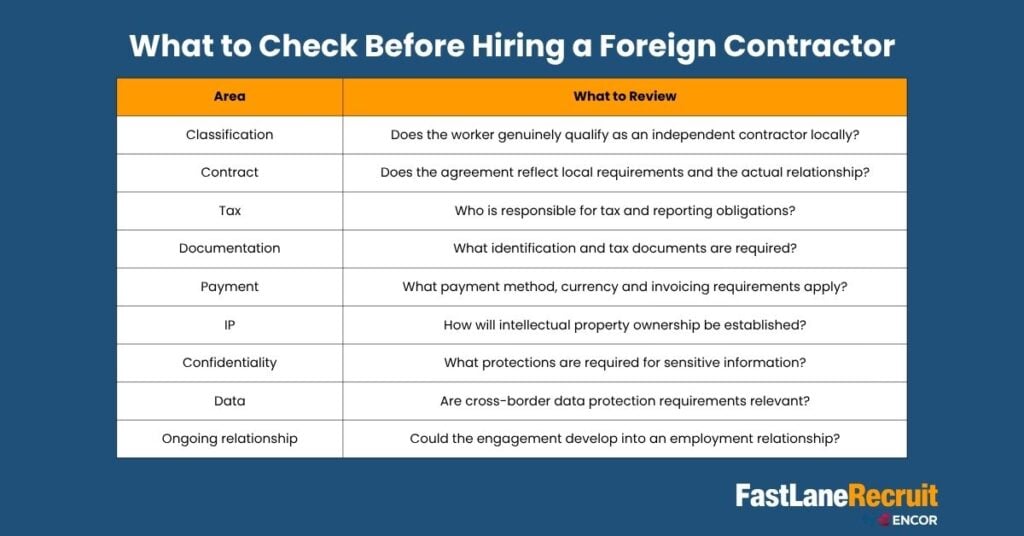
| Area | What to Review |
| Classification | Does the worker genuinely qualify as an independent contractor locally? |
| Contract | Does the agreement reflect local requirements and the actual relationship? |
| Tax | Who is responsible for tax and reporting obligations? |
| Documentation | What identification and tax documents are required? |
| Payment | What payment method, currency and invoicing requirements apply? |
| IP | How will intellectual property ownership be established? |
| Confidentiality | What protections are required for sensitive information? |
| Data | Are cross-border data protection requirements relevant? |
| Ongoing relationship | Could the engagement develop into an employment relationship? |
The exact requirements should be assessed based on the contractor’s country and the facts of the engagement.
Foreign Independent Contractor Compliance: What Businesses Need to Know
There is no single global contractor rule.
A contractor who qualifies as self-employed in one jurisdiction may not automatically receive the same classification elsewhere. For example, UK guidance notes that employment status depends on the actual circumstances of the relationship, while Australia applies its own statutory framework and factors.
This makes local assessment particularly important when hiring across multiple countries.
Common Compliance Risks
Worker Misclassification
A business may classify a worker as a contractor even though the actual relationship resembles employment.
This can lead to potential tax, employment, benefit, or penalty exposure depending on the jurisdiction.
Incorrect Tax Documentation
Using the wrong tax form or failing to meet local reporting requirements can create administrative and financial problems.
Weak Contracts
A generic contract may fail to address country-specific requirements or accurately reflect how the parties actually work together.
Employee-Like Control
Managing a contractor in the same way as an employee can undermine the intended independent relationship.
Failure to Reassess
A relationship that begins as a genuine project-based contractor engagement may evolve into an ongoing employment-like role.
How to Avoid Independent Contractor Misclassification
Misclassification is one of the most important risks businesses should address when hiring contractors internationally.
The key principle is simple:
Classify the relationship based on the actual working arrangement, not merely the title used in the contract.
The IRS considers the degree of control and independence across behavioral, financial, and relationship factors. Similarly, Australia’s Fair Work Ombudsman states that the practical reality and true nature of the relationship should be considered when determining whether someone is a contractor or employee.
Practical Risk-Reduction Steps
- Assess classification before engagement.
- Document the reasons for the classification.
- Use a clear contractor agreement.
- Structure work around services and deliverables where appropriate.
- Preserve genuine contractor independence.
- Follow local tax and documentation requirements.
- Review long-running engagements periodically.
- Reassess the relationship when responsibilities change.
If the facts point toward employment, continuing to label the worker a contractor may increase rather than reduce risk.
Independent Contractor vs EOR: Which Model Should You Use?
The decision should start with the nature of the work, not the service provider.
An independent contractor model may be appropriate when the worker genuinely operates independently and the engagement is structured as a service relationship.
An EOR may be more appropriate when the worker should be employed and the business needs an employment structure in a country where it does not have its own entity.
Contractor vs EOR
| Consideration | Independent Contractor | Employer of Record |
| Worker status | Independent contractor | Employee |
| Relationship | Service relationship | Employment relationship |
| Best suited for | Genuine independent/project-based work | Ongoing employment |
| Payroll | Contractor invoicing/payment structure | Employee payroll |
| Benefits | Generally not employee benefits | Applicable employment benefits |
| Employment protections | Generally different from employees | Applicable employee protections |
| Local employment infrastructure | May still require country-specific compliance | EOR provides employment infrastructure |
| Main consideration | Genuine contractor classification | Appropriate employment structure |
An EOR should not be used simply to relabel a contractor arrangement. The appropriate model depends on the actual relationship and applicable local requirements.
When Should You Choose EOR Instead of an Independent Contractor?
Consider an EOR when the role increasingly resembles employment.
Potential indicators include:
- The role is long-term and ongoing.
- The worker performs an integral function within the business.
- The company controls how, when, and where the work is performed.
- The worker is integrated into the company’s organizational structure.
- The business wants to provide employee benefits.
- The business needs an employment structure in a country where it does not have a local entity.
- Contractor classification is uncertain or difficult to sustain under local rules.
For U.S. classification, the IRS emphasizes that the actual degree of control and independence matters rather than simply the worker’s title or payment method.
The same principle applies internationally: employment status should be assessed under the relevant jurisdiction’s rules.
Can You Start With a Contractor and Later Move to EOR?
Yes, a business may change its engagement model when the underlying business relationship changes or when employment becomes the more appropriate structure.
For example, a company might initially engage a specialist for a defined project. If the role later becomes a permanent position with ongoing responsibilities and employee-like management, the business should reassess the engagement.
The important point is not to wait until a compliance problem forces the change.
Signs It May Be Time to Reassess
- The project has become an indefinite role.
- The contractor works primarily or exclusively for the business.
- The company controls working hours and methods.
- The contractor is managed like an employee.
- The role has become a core ongoing position.
- The company wants to provide employment benefits.
- Local rules make the contractor structure difficult to maintain.
Hiring Foreign Independent Contractors Across Multiple Countries
FastLaneRecruit supports businesses managing international workforce requirements across: Malaysia, Singapore, Hong Kong, China, India, Philippines, Taiwan, Vietnam, Australia, United Kingdom, Switzerland, UAE, Saudi Arabia, Qatar.
Because contractor and employment rules differ by jurisdiction, businesses expanding across these markets should assess each engagement based on its specific country, role, and working relationship.
For businesses that need flexibility, contractor services can support appropriate independent contractor engagements. Where the role is better structured as employment, FastLaneRecruit’s EOR services can provide an alternative employment model.
Why Businesses Choose FastLaneRecruit
International hiring becomes more complicated when businesses have to coordinate multiple countries, worker types, contracts, payments, and compliance requirements.
FastLaneRecruit helps businesses navigate international workforce needs through independent contractor and Employer of Record services.
Support for Independent Contractor Engagements
For genuine contractor relationships, businesses can use contractor services to help manage the administrative and compliance requirements associated with international contractor engagements.
EOR for International Employees
When the role is better suited to employment, FastLaneRecruit’s EOR service can help businesses hire employees in supported countries without requiring the business to establish its own local entity for that employment relationship.
One Partner Across Multiple Markets
Businesses expanding across Asia Pacific, Europe, and the Middle East & Africa can work with one international workforce partner across supported markets.
A Practical Approach to Workforce Decisions
FastLaneRecruit focuses on helping businesses determine the appropriate engagement structure rather than treating every international worker as either a contractor or an employee by default.
How FastLaneRecruit Can Help
Whether you are hiring one international specialist or expanding across several markets, the right engagement model depends on the worker, role, country, and intended relationship.
FastLaneRecruit can support businesses with:
- Independent contractor services
- International contractor engagements
- Contractor management support
- Employer of Record services
- International employee hiring
- Cross-border workforce administration
Not Sure Whether to Use a Contractor or EOR?
Start with the role.
If the worker is genuinely independent and providing services as a contractor:
An independent contractor structure may be appropriate.
If the worker will function as an employee:
An EOR structure may be more suitable, particularly where your business does not have a local entity.
If the classification is unclear:
Review the relationship and applicable country requirements before the engagement begins.
Hire International Talent With the Right Engagement Model
Hiring internationally does not have to mean choosing between speed and compliance.
The first step is understanding what the working relationship actually requires. If the engagement genuinely calls for an independent contractor, a properly structured contractor arrangement can provide flexibility. If the role is fundamentally an employment relationship, an EOR can provide an employment structure without requiring your business to establish its own local entity in the country.
FastLaneRecruit can help you evaluate and manage international workforce arrangements across supported markets.
Ready to Hire International Talent?
Talk to FastLaneRecruit about your contractor or EOR requirements and find the right approach for your next international hire.
Book a Free Consultation with an Expert.
Frequently Asked Questions
How do I hire an independent contractor?
Start by defining the scope of work, finding and vetting candidates, assessing worker classification, checking local requirements, preparing a contractor agreement, collecting required documentation, establishing payment terms, and onboarding the contractor. Classification and compliance requirements vary by country.
How do I hire foreign independent contractors?
Hiring foreign independent contractors requires additional consideration of the contractor’s country, including classification rules, tax obligations, documentation, contracts, payment requirements, and other applicable regulations.
Can I hire an independent contractor without a local entity?
It may be possible, but the answer depends on the country, nature of the engagement, and applicable legal and tax requirements. Businesses should assess the local rules before engaging a foreign contractor.
What should an independent contractor agreement include?
A contractor agreement commonly covers the scope of services, deliverables, payment terms, intellectual property, confidentiality, expenses, termination, dispute resolution, and applicable law. Country-specific requirements should also be considered.
How do I know if someone is an independent contractor or employee?
Look at the actual relationship rather than the contract label. Factors can include control over the work, financial risk, tools and equipment, ability to work for other clients, permanence, integration into the business, and other jurisdiction-specific factors. The IRS, for example, evaluates behavioral control, financial control, and the type of relationship.
What are the risks of hiring foreign independent contractors?
Potential risks include worker misclassification, incorrect tax treatment, inadequate contracts, payment and documentation issues, intellectual property problems, and failure to comply with local requirements.
Can an independent contractor work for multiple companies?
A genuine independent contractor may work with multiple clients, although the ability to do so is only one factor in assessing status. The overall relationship and applicable local rules must be considered. HMRC, for example, identifies working for multiple clients as one factor that may indicate a person is operating their own business.
When should I use an EOR instead of an independent contractor?
An EOR may be appropriate when the worker should be an employee, particularly for an ongoing role that is managed and integrated like employment. An EOR can provide an employment structure in a country where the business does not have its own local entity.
Can FastLaneRecruit help with both contractors and employees?
Yes. FastLaneRecruit supports businesses with both independent contractor services and Employer of Record services, allowing businesses to consider the engagement model that best fits the worker and business requirements.