A Complete Guide for Global Employers
Expanding your team internationally can unlock new growth opportunities, and the Philippines is one of the top destinations for global hiring today. If you’re wondering how to hire employees in the Philippines, you’re in the right place. Many international companies, from startups to large enterprises, are building remote teams here thanks to the country’s skilled workforce, strong English proficiency, and globally aligned work culture.
In this guide, we’ll walk you through how to hire employees, step by step, including legal requirements, costs, hiring options, and practical tips to help you stay compliant and competitive.
Content Outline
Key Summary
Benefits of Hiring in the Philippines
The Philippines offers high English proficiency, cultural alignment, a growing talent pool in tech, finance, customer support, and creative roles, along with adaptability and strategic timezone advantages.
Choose the Right Hiring Model
Decide between setting up a local entity, using an Employer of Record (EOR), or hiring independent contractors, each with its own benefits, costs, and compliance considerations.
Step-by-Step Hiring Process
Follow structured steps: identify hiring needs, ensure compliance, create job descriptions, source and screen candidates, conduct background checks, make offers, and onboard employees efficiently.
Best Talent Sourcing Channels
Leverage job boards (JobStreet, Kalibrr, LinkedIn), recruitment agencies, and professional networks to reach a broad and specialized talent pool in the Philippines.
Compliance and Legal Considerations
Adhere to labor laws and statutory requirements, including payroll contributions (SSS, PhilHealth, Pag-IBIG), 13th-month pay, public holidays, and proper employment contracts to avoid penalties.
Common Compliance Risks to Avoid
Avoid misclassifying employees as contractors, incorrect payroll, neglecting statutory benefits, poor termination processes, and permanent establishment issues by documenting processes and using HR solutions like EORs.
FastLaneRecruit EOR for Malaysia Expansion
While the Philippines is ideal for customer support and operations, Malaysia offers a strategic offshore hiring option. FastLaneRecruit’s EOR service helps hire in Malaysia compliantly, manage payroll and benefits, and scale across Southeast Asia.
Why Hire Employees in the Philippines?
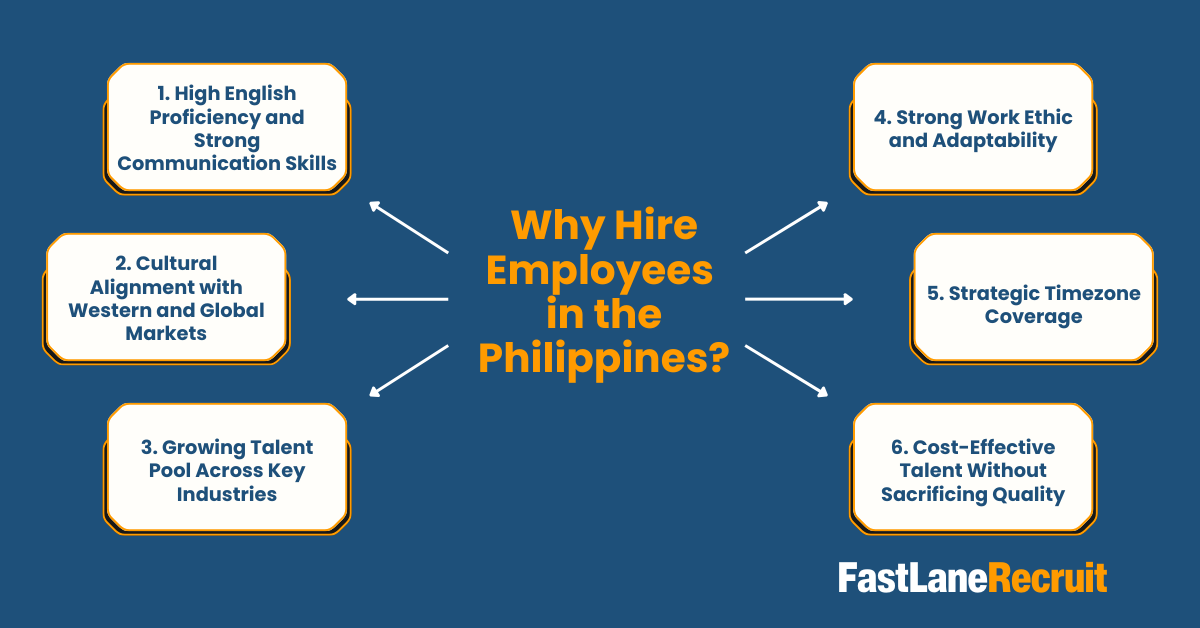
The Philippines has become one of the top destinations for global hiring, and for good reason. Companies from around the world, especially in the U.S., Europe, and Asia, are increasingly building remote or hybrid teams here. Here’s why:
1. High English Proficiency and Strong Communication Skills
English is one of the official languages of the Philippines, and most professionals are fluent in both written and spoken English. This makes communication seamless for international teams, reduces language barriers, and ensures that your global operations run smoothly.
2. Cultural Alignment with Western and Global Markets
Filipino professionals often have cultural familiarity with Western business practices, workplace etiquette, and customer service expectations. This alignment makes them an ideal fit for companies looking to maintain a consistent global brand experience.
3. Growing Talent Pool Across Key Industries
The Philippines has a rapidly expanding workforce in areas such as:
- Technology and IT development – software engineers, developers, data analysts
- Customer support and contact centers – multilingual support teams for global clients
- Finance and accounting – skilled accountants, financial analysts, and bookkeeping professionals
- Creative roles – designers, writers, digital marketers, and content creators
This diversity allows businesses to hire for a wide range of roles without compromising on quality.
4. Strong Work Ethic and Adaptability
Filipino employees are known for their diligence, flexibility, and dedication to their work. They are highly adaptable, which makes it easier for companies to onboard them into different workflows, processes, and technologies quickly.
Also Read: Top 15 Medical Billing Companies in the Philippines
5. Strategic Timezone Coverage
The Philippines is strategically located in the APAC region, offering a timezone advantage for international businesses. Companies can leverage Filipino employees to provide support and services across both APAC and Western markets without significant overlap issues.
6. Cost-Effective Talent Without Sacrificing Quality
While not the cheapest labor market in the region, the Philippines offers a strong balance of affordability and high-quality work. This makes it ideal for businesses aiming to scale efficiently while maintaining professional standards.
Bottom Line: For companies looking to grow their global workforce, the Philippines offers an attractive combination of skilled talent, English proficiency, cultural compatibility, and operational efficiency. Whether you need customer support, tech experts, or creative professionals, the Philippines provides a reliable and scalable solution for international hiring.
Hiring Options: How to Hire Employees in the Philippines
Before diving into the hiring process, you’ll need to choose the right employment model.
Comparison of Hiring Options
| Hiring Method | Best For | Pros | Considerations |
| Set Up Local Entity | Long-term expansion | Full control, direct hiring | Time-consuming, high setup cost |
| Employer of Record (EOR) | Fast market entry | Quick, compliant hiring without entity | Service fees apply |
| Independent Contractors | Short-term projects | Flexible, faster onboarding | Misclassification risks |
1. Set Up a Local Entity
To hire directly, companies must register with:
- Securities and Exchange Commission (SEC)
- Bureau of Internal Revenue (BIR)
- Social Security System (SSS), PhilHealth, Pag-IBIG
This option provides full control but can take 4–6 months and requires significant investment.
2. Use an Employer of Record (EOR)
An EOR allows you to hire employees legally without setting up a company locally. They handle:
- Payroll and tax compliance
- Employment contracts
- Statutory benefits
You manage the employee’s daily responsibilities, while the EOR ensures compliance with Philippine labor laws.
Note: Not all EORs operate in the Philippines. Some companies use workforce management platforms to achieve similar compliance support.
3. Hire Independent Contractors
Suitable for project-based work, but comes with high misclassification risk if the role resembles full-time employment.
Step-by-Step: How to Hire Employees in the Philippines
Hiring employees in the Philippines can be straightforward if you follow a structured process. Here’s a step-by-step guide to help global companies recruit efficiently, stay compliant, and onboard top talent successfully.
Step 1: Identify Hiring Needs
Before posting jobs, it’s important to understand exactly what your organization requires. Ask yourself:
- Which roles are critical for business growth?
- What skills and experience are necessary for each role?
- Are there gaps in your current team that need immediate attention?
- How will the new hire fit into your company culture and long-term goals?
Clearly defining these needs ensures you hire the right person for the right role and prevents costly hiring mistakes.
Step 2: Ensure Legal Compliance
Hiring in the Philippines comes with local regulations that must be followed:
- If you plan to hire directly, register your company with the Securities and Exchange Commission (SEC) and the Bureau of Internal Revenue (BIR).
- Register employees with SSS, PhilHealth, and Pag-IBIG Fund to meet statutory benefits obligations.
- If you want to avoid setting up a local entity, consider partnering with an Employer of Record (EOR), who handles compliance, payroll, and benefits on your behalf.
Ensuring compliance protects your business from legal risks and fines.
Also Read: Top 10 Software Outsourcing Companies in the Philippines
Step 3: Create Detailed Job Descriptions
Well-written job descriptions attract the right candidates and set expectations clearly. Include:
- Job title and key responsibilities
- Required skills, experience, and qualifications
- Salary range, benefits, and working conditions
- Reporting lines and team structure
- Company values and culture highlights
A clear and professional job description increases your chances of attracting qualified candidates who align with your business goals.
Step 4: Source Candidates
Once your job description is ready, start searching for talent. Popular sourcing methods include:
- Online job boards – JobStreet, Kalibrr, LinkedIn, Indeed Philippines
- Local recruitment agencies – helpful for specialized roles or faster hiring
- Professional networks – industry groups, forums, and alumni networks
Pro tip: Highlight competitive benefits like flexible work arrangements, health coverage, and growth opportunities. Filipino professionals often value these perks as much as salary.
Step 5: Screen Candidates
Filtering applicants is key to identifying the best talent. Screening typically includes:
- Reviewing resumes and application documents for accuracy
- Conducting phone or video interviews
- Administering skills assessments or practical tests
Effective screening reduces the time spent on unsuitable candidates and ensures only qualified professionals move forward.
Step 6: Conduct Background Checks
Before making an offer, verify a candidate’s credentials and history. Standard background checks include:
- Employment verification
- Education and professional qualification checks
- Reference checks
- Criminal record and credit history (if relevant)
Thorough checks help mitigate risks and ensure you’re hiring trustworthy and qualified talent.
Step 7: Make the Job Offer
Once you’ve selected the right candidate, prepare a formal offer letter. Include:
- Job title, salary, and benefits
- Work schedule and probation period (if applicable)
- Terms and conditions of employment
- Contingencies for successful completion of background checks
Be prepared to negotiate, but remain clear about your organization’s policies and limitations.
Step 8: Onboard the Employee
A structured onboarding process ensures compliance and helps new hires become productive quickly. Proper onboarding improves employee engagement, reduces turnover, and sets the stage for long-term success. For a detailed onboarding process, please find it in the later section (Onboarding Employees in the Philippines).
Key Takeaway: Following these eight steps, identifying needs, ensuring compliance, sourcing and screening candidates, making offers, and onboarding employees, allows international companies to hire efficiently in the Philippines while staying compliant and competitive.
Where to Find Employees in the Philippines
Finding the right talent in the Philippines requires understanding where job seekers are looking and which channels best match your hiring needs. Global employers can source employees through multiple channels, each offering unique advantages.
Popular Hiring Channels
| Channel | Examples | Best For |
| Job Boards | JobStreet, Kalibrr, LinkedIn | Broad talent reach, from entry-level to senior professionals |
| Recruitment Agencies | Local staffing firms | Faster hiring, specialized talent, and support navigating local hiring regulations |
| Professional Networks | Industry groups, alumni forums | Highly specialized roles or niche skill sets |
1. Job Boards
Job boards are among the most effective ways to reach a large pool of Filipino professionals. Platforms like JobStreet, Kalibrr, LinkedIn, and Indeed Philippines allow you to post job openings and attract candidates across various industries, from tech to customer support.
Tips for job board recruiting:
- Craft clear and detailed job descriptions with responsibilities, skills, and benefits
- Highlight perks such as flexible work arrangements, health coverage, career development opportunities, and company culture
- Use targeted keywords for SEO so your posting ranks higher in searches
2. Recruitment Agencies
Local recruitment agencies can streamline your hiring process, especially for mid-to-senior-level roles or specialized positions. Agencies understand the Philippine job market, can pre-screen candidates, and help with compliance, salary expectations, and contract negotiations.
Advantages of working with agencies:
- Faster time-to-hire with access to a curated candidate pool
- Guidance on local labor laws, statutory benefits, and employment contracts
- Reduced administrative burden, allowing your HR team to focus on strategic tasks
Note: Agencies typically charge a fee, often a percentage of the hired employee’s salary or a flat placement fee.
Also Read: Top 15 International Payroll Services in the Philippines
3. Professional Networks
Professional networks include industry associations, alumni groups, online forums, and social media communities. These channels are ideal for sourcing highly skilled or niche talent that may not actively search for jobs on boards.
Tips for leveraging networks:
- Engage with local professional groups on LinkedIn or Facebook
- Attend industry webinars and virtual career events to connect with potential candidates
- Encourage employee referrals to tap into trusted networks
Pro Tip for Global Employers
Filipino professionals often consider more than just salary when evaluating a job. To attract top talent, emphasize benefits, work-life balance, healthcare coverage, career growth, and flexible working options. Companies that highlight these perks stand out and gain a competitive edge in the Philippine labor market.
Legal Requirements and Compliance
To hire employees in the Philippines, employers must comply with local labor laws.
Key Government Agencies
- Department of Labor and Employment (DOLE)
- Bureau of Internal Revenue (BIR)
- Social Security System (SSS)
- PhilHealth
- Pag-IBIG Fund
Employment Contract Essentials
- Job role and responsibilities
- Salary and benefits
- Working hours
- Probation period (up to 6 months)
- Termination terms
Salary, Taxes, and Employment Costs
Understanding costs is critical when planning how to hire employees.
| Component | Details |
| Base Salary | Depends on role and experience |
| SSS Contribution | ~9.5% employer share |
| PhilHealth | Shared contribution (~5%) |
| Pag-IBIG | ~2% contribution |
| 13th Month Pay | Mandatory (8.33% of annual salary) |
Key Insight: Even though statutory contributions are moderate, 13th-month pay is mandatory, so always include it in your budget planning.
Employee Benefits and Working Conditions
Standard Benefits
- 13th-month salary (mandatory)
- Service Incentive Leave (minimum 5 days annually)
- Maternity leave (105 days)
- Paternity leave (7 days)
- Public holidays (varies yearly)
Working Hours
- 8 hours per day
- Overtime pay: 125%–200% depending on conditions
Also Read: Top 15 IT Companies in the Philippines
Onboarding Employees in the Philippines
Onboarding is a critical step in the hiring process. A structured and well-planned onboarding program ensures that new hires understand their role, comply with local regulations, and feel welcomed into the company culture. Proper onboarding not only improves employee engagement and retention but also helps global employers avoid compliance issues.
Onboarding Checklist for Employers
- Collect Required Documents
Before starting employment, gather all essential documents from the new hire, including:- Tax Identification Number (TIN)
- Social Security System (SSS) number
- Government-issued ID (e.g., passport, driver’s license)
- Academic credentials and previous employment records, if applicable
- Tip: Keep copies of all documents in secure digital or physical files to comply with local data protection laws.
- Issue a Clear Employment Contract
Provide a written employment contract outlining:- Job title and responsibilities
- Salary, allowances, and benefits
- Working hours and probation period
- Terms for leave, termination, and dispute resolution
- A well-documented contract protects both the employer and employee and reduces the risk of misunderstandings.
- Set Up Payroll and Benefits
Ensure all payroll systems are operational from the first day. This includes:- Calculating salary with statutory deductions (SSS, PhilHealth, Pag-IBIG)
- Providing access to benefits such as health insurance, leave entitlements, and retirement contributions
- Setting up direct deposit or bank transfers for salary payments
- Tip: Using a payroll or workforce management platform can simplify these tasks, especially for international employers.
- Provide Training and Orientation
Conduct onboarding sessions to familiarize new hires with:- Company culture, values, and mission
- Role-specific tasks and performance expectations
- Internal tools, systems, and communication channels
- Consider bilingual documentation or training materials if necessary, even though English is widely spoken in the Philippines.
- Align Expectations and Communication
Set clear expectations for performance, reporting structures, and workflows. Encourage open communication and provide support channels, such as HR contacts or mentorship programs.
Tip: Regular check-ins during the first few weeks help employees feel supported and improve long-term engagement.
Why Structured Onboarding Matters
- Compliance: Ensures all legal and regulatory requirements are met from day one.
- Employee Engagement: Helps new hires feel confident, informed, and valued.
- Retention: Employees with a positive onboarding experience are more likely to stay long-term.
- Productivity: Reduces the learning curve, enabling new hires to contribute effectively sooner.
Common Compliance Risks to Avoid When Hiring in the Philippines
Hiring employees in the Philippines comes with specific legal and regulatory requirements. Global employers must understand and mitigate common compliance risks to avoid fines, penalties, or legal disputes.
Here are the most important risks to watch for:
1. Misclassifying Employees as Contractors
One of the most frequent mistakes is treating an employee as an independent contractor. Misclassification occurs when a worker is managed like a full-time employee but legally labeled as a contractor.
Risks of misclassification include:
- Back taxes and unpaid statutory benefits
- Legal penalties and fines
- Reputational damage for the company
- Employee disputes or claims
Tip: Clearly distinguish contractors from employees in contracts, define roles carefully, and monitor hours and reporting lines.
2. Incorrect Payroll Contributions
Employers in the Philippines must make mandatory contributions for every employee, including:
- Social Security System (SSS) – ~9.5% employer share
- PhilHealth – ~2–4% shared contribution
- Pag-IBIG Fund – ~2% employer contribution
Failure to calculate and remit contributions accurately can result in fines, interest charges, and audits by Philippine authorities.
Tip: Use payroll software or a local payroll service to ensure correct deductions and timely submissions.
3. Ignoring Statutory Benefits
Filipino employees are entitled to various benefits, such as:
- 13th-month pay (mandatory)
- Service Incentive Leave (minimum 5 days annually)
- Maternity and paternity leave
- Public holidays and special non-working days
Neglecting these benefits can create compliance violations, employee dissatisfaction, and legal disputes.
Tip: Include all statutory benefits in employment contracts and payroll planning.
Also Read: Top 30 Business Consulting Firms in the Philippines
4. Poor Termination Processes
Termination of employment in the Philippines must follow legal procedures outlined in the Labor Code of the Philippines, including:
- Just or authorized causes for termination
- Written notice issued at least 30 days in advance
- Opportunity for the employee to respond
- Proper calculation of severance or final pay
Ignoring these requirements can result in legal claims and significant financial penalties.
Tip: Establish clear termination policies and keep documentation of all notices and employee responses.
5. Permanent Establishment Risks
Foreign companies must be cautious about creating a permanent establishment (PE) in the Philippines. A PE occurs when a company has a fixed location or generates revenue locally, triggering corporate tax obligations.
Scenarios that may create PE include:
- Sending employees to perform work regularly in the Philippines
- Engaging contractors who perform business-critical functions locally
- Maintaining an office or other fixed business premises
Overlooking PE risks can lead to unexpected tax liabilities, fines, and audits.
Tip: Work with tax advisors or use an EOR service to reduce PE exposure while hiring remotely.
Pro Tip for Global Employers
Document processes clearly, maintain accurate payroll and HR records, and regularly audit compliance procedures. Using platforms or services like FastLaneRecruit’s EOR can help ensure legal compliance, manage payroll, and reduce the risk of misclassification or PE issues.
Expert Tips for Global Employers
Hiring employees in the Philippines or anywhere internationally requires more than just posting a job and waiting for applications. Global employers need strategic planning, awareness of compliance requirements, and scalable solutions to succeed. Here are some expert tips to guide you:
1. Use Structured Hiring Workflows to Reduce Risk
Develop a clear, step-by-step hiring process that covers job postings, candidate screening, interviews, background checks, and offer management. Structured workflows help ensure consistency, minimize human errors, and reduce compliance risks. Using standardized evaluation criteria also helps in selecting the best candidates while maintaining fairness and transparency.
2. Offer Competitive Benefits Beyond Minimum Requirements
Filipino professionals value more than just salary. In addition to statutory benefits, consider offering:
- Health insurance or wellness programs
- Flexible work arrangements or remote options
- Professional development opportunities
- Career growth paths and mentorship programs
Offering competitive perks not only attracts top talent but also improves retention and employee satisfaction.
3. Stay Updated on Local Labor Law Changes
Labor laws in the Philippines evolve regularly, affecting contracts, statutory benefits, termination procedures, and payroll compliance. Global employers should monitor updates from DOLE, BIR, SSS, PhilHealth, and Pag-IBIG to avoid costly fines and legal disputes. Partnering with local HR experts or using an Employer of Record (EOR) can simplify compliance and keep you informed of regulatory changes.
4. Align HR and Finance Teams for Payroll Compliance
Coordinating HR and finance ensures accurate payroll processing, timely contributions, and compliance with tax regulations. Misaligned teams can lead to missed deadlines, incorrect deductions, or legal liabilities. Consider automating payroll processes or leveraging platforms like FastLaneRecruit’s EOR, which handles payroll, taxes, and statutory benefits efficiently.
5. Consider Scalable Hiring Solutions Early
If your company plans to expand across Southeast Asia, think about scalable hiring strategies from the start. Tools like EORs, workforce management platforms, and recruitment agencies help accelerate market entry, simplify compliance, and reduce administrative overhead, making it easier to hire in multiple countries, including the Philippines and Malaysia.
Pro Tip: Combining structured workflows, competitive benefits, compliance vigilance, HR-finance alignment, and scalable solutions positions your company for long-term success in the Philippines and beyond.
Also Read: Top 20 Virtual Assistants (VA) Companies In The Philippines
Malaysia: A Smart Offshore Hiring Option with FastLaneRecruit’s EOR
While the Philippines remains a popular destination for roles such as customer support, creative services, and operations, Malaysia is an increasingly strategic choice for offshore hiring, particularly for technology, finance, and regional HQ positions. Its strong digital infrastructure, competitive talent pool, and English-proficient workforce make it ideal for companies looking to expand efficiently in Southeast Asia.
FastLaneRecruit’s Employer of Record (EOR) service in Malaysia takes the complexity out of global hiring. With our EOR solution, companies can quickly and compliantly hire talent without establishing a local entity, enabling you to focus on growth and operations rather than administrative hurdles.
What FastLaneRecruit’s EOR Offers in Malaysia
- Local Compliance and Legal Expertise – FastLaneRecruit ensures that employment contracts, statutory benefits, payroll, and tax obligations comply fully with Malaysian labor laws, reducing the risk of non-compliance.
- Efficient Payroll Management – Automate salary disbursements, deductions, and statutory contributions for employees, ensuring timely and accurate payments every cycle.
- Full Onboarding Support – From document collection and employment contracts to orientation and system setup, FastLaneRecruit streamlines onboarding for both remote and in-country employees.
- Global Benefits Administration – Manage healthcare, social security, leave entitlements, and other employee benefits seamlessly, giving your team confidence in their local support.
- Scalable Hiring Across Southeast Asia – Easily expand your workforce, enabling a regional presence without establishing multiple legal entities.
Benefits of a Dual-Country Offshore Strategy
A combined approach across the Philippines and Malaysia allows companies to optimize both talent and operational efficiency:
- Leverage the Philippines for customer support and operations – Tap into a highly skilled, English-speaking workforce for front-line roles and back-office operations.
- Use Malaysia for tech, finance, and specialized roles – Access a growing pool of IT, fintech, and regional management professionals.
- Cover multiple time zones and markets – Enable seamless collaboration across APAC and Western regions.
- Reduce administrative burden – FastLaneRecruit’s EOR handles payroll, taxes, benefits, and compliance, so your internal teams can focus on strategic business objectives.
- Test and scale new markets quickly – Expand regionally without the time, cost, and risk of establishing multiple legal entities.
Key Takeaway: Partnering with FastLaneRecruit’s EOR solution in Malaysia allows global companies to build a compliant, high-performing, and scalable offshore workforce. By combining operations in the Philippines and Malaysia, you gain access to diverse talent pools, streamline HR processes, and strengthen your regional presence across Southeast Asia.
Also Read: Singapore Companies Hire Remote Employees from Malaysia
Conclusion
Understanding how to hire employees in the Philippines is essential for global expansion. From choosing the right hiring model to managing compliance and onboarding, each step plays a key role in building a successful international team.
While the Philippines offers a strong, reliable talent pool, Malaysia is a smart complement for offshore hiring. Partnering with FastLaneRecruit’s EOR in Malaysia allows you to scale your workforce quickly, compliantly, and efficiently so you can focus on growing your business.
Ready to Hire in Malaysia with Ease?
Expanding your team internationally doesn’t have to be complicated. With FastLaneRecruit’s Employer of Record (EOR) service, you can hire top talent in Malaysia without setting up a local entity, while staying fully compliant with Malaysian labor laws.
Here’s how we make hiring in Malaysia simple:
- Handle payroll, taxes, and statutory benefits automatically
- Onboard employees quickly and efficiently
- Reduce administrative burden and compliance risks
- Scale your Malaysian team fast and seamlessly
Take the first step towards building your workforce in Malaysia today.
[Book a Free Consultation with FastLaneRecruit] – and start hiring smarter, faster, and worry-free.