Expanding your recruitment operations into Malaysia can access a skilled, diverse workforce and reduce operational costs. However, hiring recruitment teams in the country requires more than just posting jobs and conducting interviews. Malaysia has a strong and well-defined legal framework that covers employment contracts, labor rights, payroll, work permits, and compliance obligations, which every employer must follow.
Understanding these regulations is crucial to building a recruitment team that not only performs effectively but also operates within the law. In this guide, we break down Malaysia’s employment laws, compliance requirements, and best practices specifically for recruitment teams, helping businesses hire, onboard, and manage talent smoothly and legally.
Content Outline
Key Summary
Written Employment Contracts Are Essential
Ensure every recruiting coordinator and HR employee has a clear, written contract specifying work hours, probation, salary, benefits, and termination clauses to stay compliant.
Adhere to Working Hours & Overtime Rules
Recruitment teams must follow statutory limits (40–48 hours/week). Overtime must be calculated accurately, especially for coordinators handling global time zones.
Implement Anti-Discrimination & Harassment Policies
Maintain fair hiring practices and a safe workplace. Avoid bias based on gender, race, religion, or union membership for all recruiting coordinators and HR staff.
Ensure Accurate Payroll & Statutory Contributions
Automate payroll for EPF, SOCSO, EIS, taxes, bonuses, allowances, and overtime. Example: calculate gross/net salary for recruiting coordinators to ensure compliance.
Proper Onboarding & Training
Orient new hires on labor laws, internal HR workflows, ethical recruitment, and compliance processes to set recruiting coordinators up for success.
Use an Employer of Record (EOR) for Foreign Staff
Partnering with an EOR like FastLaneRecruit simplifies visas, work permits, payroll, and compliance for foreign recruiting coordinators.
Conduct Regular Audits & Stay Updated
Review payroll, contracts, leave records, and HR policies regularly. Keep up with updates to the Employment Act, immigration laws, and PDPA for continuous compliance.
Why Malaysia is an Attractive Destination for Recruitment Teams
Malaysia has become a go-to hub for companies looking to build recruitment teams that can support regional or global operations. Several factors make it particularly appealing including:
1. Skilled Workforce for HR & Recruitment
Malaysia boasts a highly capable workforce with strong expertise in human resources, recruitment, payroll, and talent management. Many professionals have experience working in multinational environments, which means they understand global hiring standards. Additionally, a high level of English proficiency among professionals ensures smooth communication between Malaysian teams and international offices. This makes Malaysia an ideal place to set up recruitment operations that interact with teams across the world.
2. Cost-Effective Operations
Compared to many Western countries, labor costs in Malaysia are relatively lower, allowing companies to establish fully operational recruitment teams without overspending. This cost efficiency does not compromise quality, Malaysian HR professionals deliver results on par with international standards, making it possible to scale your recruitment operations while keeping budgets under control.
3. Stable Business & Legal Environment
Malaysia offers a predictable and business-friendly environment. Clear labor laws, structured employment regulations, and investor-friendly policies reduce risks for companies setting up local recruitment teams. This stability ensures that HR operations, from hiring to payroll management, run smoothly and legally, giving companies confidence in their expansion plans.
4. Cultural Diversity and Adaptability
Malaysia is a multicultural country, home to Malays, Chinese, Indians, and various indigenous groups. This diversity benefits recruitment teams by fostering inclusivity, open-mindedness, and adaptability, qualities essential when sourcing talent from different regions and backgrounds. Recruitment professionals in Malaysia are often skilled at understanding cultural nuances, which helps improve candidate engagement and strengthens employer branding on a global scale.
5. Strategic Location in Southeast Asia
Malaysia’s location at the heart of Southeast Asia makes it a strategic base for managing recruitment across the region. Excellent connectivity to neighboring countries, combined with a robust infrastructure, allows recruitment teams to coordinate efficiently across time zones and markets, supporting regional hiring needs effectively.
By combining a talented workforce, cost-efficiency, stable legal frameworks, cultural diversity, and strategic geography, Malaysia provides an ideal environment for companies looking to establish recruitment teams that can operate locally and globally.
Also Read: Outsource Payroll Specialist Teams: A Guide for Global Employers
Recruitment Team Hiring Process in Malaysia
Building a recruitment team in Malaysia requires balancing efficiency with compliance. Companies must follow local labor laws while implementing hiring practices that attract the right talent. Here’s a step-by-step guide to the process:
1. Job Posting & Candidate Sourcing
To find the best candidates, recruitment teams use a mix of online and offline channels:
- Online Job Portals: Popular platforms like JobStreet, LinkedIn, WOBB, SlingApp, and Adnexio are widely used to post vacancies and reach a large pool of candidates.
- Local Compliance Requirement: Malaysia’s national employment portal, MyFutureJobs, requires that any job position be posted for at least 30 days before hiring expatriates. This ensures local candidates have an opportunity to apply.
- Alternative Channels: For specialized roles, consider advertising in trade publications, industry-specific job boards, or engaging recruitment agencies to tap into niche talent pools.
2. Screening & Interviewing
After receiving applications, companies must carefully evaluate candidates while staying compliant with local regulations:
- Background Checks: Employers can conduct checks but must comply with Malaysia’s Personal Data Protection Act (PDPA) to protect candidate privacy.
- Interview Process: Interviews should assess candidates’ skills, experience, and cultural fit within the organization. Avoid questions related to gender, race, religion, or other discriminatory factors, as these are prohibited under Malaysian law.
- Assessment Tests: Depending on the role, companies may include technical tests, psychometric assessments, or task-based evaluations to ensure the candidate has the required competencies.
3. Employment Contracts
A written employment contract is mandatory for any employee hired for more than one month. The contract must clearly outline:
- Work Hours & Days: Define standard working hours, rest days, and overtime rules.
- Probation Period: Specify the probation duration, typically 3–6 months, and the evaluation process.
- Salary, Benefits & Allowances: Include monthly salary, performance bonuses, insurance, retirement contributions, and any other allowances.
- Termination Clauses & Notice Periods: Clearly state conditions for resignation, termination, and notice periods in line with the Employment Act 1955.
Tip: Using a clear, written contract helps prevent misunderstandings, ensures compliance with Malaysian labor laws, and protects both the employer and employee.
4. Onboarding & Integration
Once the contract is signed, focus on onboarding: introduce new hires to the team, provide training, and explain company policies and procedures. Effective onboarding increases engagement and retention, helping your recruitment team perform at its best.
Employment Laws Specific to Recruitment Teams in Malaysia
Recruitment teams play a pivotal role in hiring, HR management, and employee engagement. To operate effectively, they must adhere to Malaysia’s labor laws and regulations. Understanding these laws ensures legal compliance, protects the company from penalties, and helps maintain a fair, safe, and professional workplace.
Also Read: Why Malaysia Stands Out for Payroll and HR Shared Services
1. Employment Act 1955
The Employment Act 1955 is Malaysia’s primary legislation for employment matters. It sets minimum standards for employee rights and employer obligations and applies to most employees earning RM4,000 or less per month, although some sections apply to higher-paid workers as well.
Key Provisions Relevant to Recruitment Teams:
- Wages & Salary:
- Minimum wage rates are enforced, with regional variations. Employers must pay salaries on time, usually monthly.
- Unauthorized deductions from wages are prohibited unless permitted by law (e.g., EPF, SOCSO contributions).
- Probation & Contracts:
- Employment contracts must be in writing for employees hired for more than one month.
- Contracts should clearly specify job title, salary, working hours, benefits, probation period, and termination clauses.
- Termination & Notice Periods:
- Employers must provide proper notice before termination. For example:
- Less than 2 years of service → at least 4 weeks’ notice
- 2–5 years → 6 weeks’ notice
- Over 5 years → 8 weeks’ notice
- Retrenchment or dismissal due to misconduct must follow due process.
- Employers must provide proper notice before termination. For example:
- Statutory Benefits:
- Contributions to the Employees Provident Fund (EPF) and Social Security Organization (SOCSO) are mandatory.
- Employment Insurance System (EIS) contributions provide financial assistance if employees lose their jobs.
Recruitment Team Tip: Always maintain proper documentation for contracts, performance evaluations, and disciplinary actions to ensure compliance with the Act.
2. Working Hours & Overtime
Malaysian labor law regulates working hours, rest periods, and overtime pay, which is especially important for recruitment teams handling multiple time zones.
- Standard Hours:
- Normal workweek is 40–48 hours, typically 8 hours per day, Monday to Friday.
- Employees are entitled to 1 rest day per week.
- Overtime Rules:
- Work beyond standard hours qualifies for overtime pay.
- Overtime rates:
- Weekdays → 1.5× hourly rate
- Rest days → 2× hourly rate
- Public holidays → 3× hourly rate
- Shift & Global Operations Consideration:
- Recruitment teams managing international hiring may need staggered shifts. Employers must ensure all extra hours are fairly compensated.
- Flexible scheduling can comply with the law while supporting global operations.
Practical Tip: Use timesheets or HR management software to track working hours accurately, especially if your recruitment team works in multiple time zones.
3. Leave Entitlements
Recruitment teams must be aware of statutory leave obligations to avoid disputes and ensure employee satisfaction.
- Annual Leave:
- Minimum entitlement depends on tenure:
- Less than 2 years → 8 days/year
- 2–5 years → 12 days/year
- Over 5 years → 16 days/year
- Contracts can offer additional leave as company policy.
- Minimum entitlement depends on tenure:
- Sick Leave & Medical Benefits:
- Statutory sick leave: 14–22 days per year depending on length of service.
- Employees may also receive medical benefits (e.g., company insurance).
- Maternity Leave:
- Female employees are entitled to 98 days of paid maternity leave under the Employment Act.
- Medical benefits and hospital allowances may also apply depending on company policy.
- Paternity & Parental Leave:
- Male employees may be entitled to 3–7 days of paternity leave, depending on employer policy.
- Leave for childcare or dependents is encouraged but not strictly mandated.
- Public Holidays & Replacement Days:
- Employees must receive official public holidays (federal and state level).
- If a public holiday falls on a rest day, a replacement day off is usually provided.
Recruitment Team Tip: Clearly define leave policies in contracts and HR manuals, and ensure leave requests are processed fairly and consistently.
Also Read: How to Hire Payroll Specialists in Malaysia
4. Anti-Discrimination & Harassment Policies
Recruitment teams are on the frontline of hiring and workplace management. Compliance with anti-discrimination laws is critical.
- Prohibited Discrimination:
- Recruitment decisions cannot be based on:
- Race, religion, or ethnicity
- Gender or marital status
- Age or disability
- Union membership or political affiliation
- Recruitment decisions cannot be based on:
- Harassment-Free Workplace:
- Companies must implement policies to prevent sexual harassment, bullying, or any form of workplace abuse.
- Employees must have clear reporting channels, and complaints must be investigated promptly.
- Inclusive Recruitment Practices:
- Job postings should focus only on skills, experience, and qualifications relevant to the role.
- Interview questions must avoid personal topics unrelated to job performance.
Recruitment Team Tip: Conduct regular compliance training for recruitment and HR teams. Document all hiring decisions and interview notes to avoid potential disputes.
5. Employment Contracts & Documentation
Employment contracts are not just formalities; they are legal safeguards. For recruitment teams:
- Mandatory Written Contracts:
- Required for employees working more than one month.
- Should include:
- Work hours & shifts
- Probation period
- Salary, bonuses, and benefits
- Termination and notice clauses
- Additional Considerations for Foreign Employees:
- Contracts must comply with immigration laws and work permit requirements.
- Include clauses for repatriation, visa obligations, and statutory benefits.
- Record-Keeping:
- Maintain personnel files, payroll records, and HR documentation for at least 7 years as per legal guidelines.
6. Payroll Compliance & Statutory Contributions
Recruitment teams overseeing payroll must ensure all contributions and deductions are accurate:
- EPF (Employees Provident Fund):
- Employer contribution: 12–13% of salary
- Employee contribution: 11% of salary
- SOCSO (Social Security Organization):
- Provides injury and disability coverage
- Employer and employee contributions vary based on salary
- EIS (Employment Insurance System):
- Provides financial aid during unemployment
- Contributions are mandatory for all eligible employees
- Income Tax Withholding:
- Monthly Tax Deduction (MTD) must be applied for resident employees
- Non-resident employees have different tax rates
Recruitment Team Tip: Partner with payroll software or local EOR providers to ensure compliance with all statutory contributions, especially when managing a mix of local and foreign hires.
7. Key Takeaways for Recruitment Teams
- Always have written employment contracts to prevent disputes.
- Ensure working hours and overtime comply with statutory limits, especially for global teams.
- Implement and document anti-discrimination and harassment policies.
- Track leave entitlements accurately to ensure fairness and legal compliance.
- Maintain proper payroll, tax, and social security contributions for all employees.
- Provide training for HR and recruitment staff on local labor laws and compliance best practices.
Following these employment laws not only avoids legal penalties but also builds trust, professionalism, and employee satisfaction within recruitment teams.
Also Read: Why Outsourcing HRIS Administration Is a Smart Move for Global Companies
Payroll, Statutory Contributions & Compliance for Recruitment Teams in Malaysia
Recruitment teams in Malaysia are often responsible not only for hiring but also for managing payroll, statutory contributions, and HR compliance. Ensuring accuracy and adherence to regulations is critical to avoid penalties, maintain employee trust, and support smooth business operations. Here’s a detailed breakdown:
1. Employee Registration
Before payroll processing can begin, all employees, local and foreign, must be properly registered with relevant statutory authorities.
- EPF (Employees Provident Fund):
- Mandatory retirement savings plan for Malaysian employees.
- Employers must register all employees with the EPF and make monthly contributions:
- Employee contribution: 11% of salary
- Employer contribution: 12–13% of salary (varies by employee age)
- SOCSO (Social Security Organization):
- Provides coverage for workplace injuries, disability, and certain illnesses.
- Registration is mandatory for all employees earning below RM4,000/month (and recommended for all others).
- Contributions are shared between employer and employee, calculated based on wages.
- EIS (Employment Insurance System):
- Provides short-term financial assistance in case of unemployment.
- Mandatory contributions:
- Employer: 0.2% of monthly wages
- Employee: 0.2% of monthly wages
Recruitment Team Tip: Keep an updated master list of all employees with their EPF, SOCSO, and EIS registration numbers. This will help in audits and ensure compliance.
2. Payroll Processing
Accurate payroll processing is essential for maintaining employee satisfaction and legal compliance.
- Salary Computation:
- Include basic salary, allowances, overtime, commissions, and bonuses.
- Overtime calculations must follow the Employment Act rules:
- Weekdays → 1.5× hourly rate
- Rest days → 2× hourly rate
- Public holidays → 3× hourly rate
- Allowances & Benefits:
- Medical allowance, transport allowance, housing allowance, and other perks must be clearly documented and included in payroll calculations.
- Payroll Frequency:
- Salaries are typically paid monthly. Some companies may offer biweekly or semi-monthly payments, but consistent scheduling is required.
Recruitment Team Tip: Use reliable payroll software that can automate statutory contributions, overtime, leave adjustments, and tax deductions to reduce errors.
3. Tax Withholding
Malaysia follows a Monthly Tax Deduction (MTD) system, where employers deduct personal income tax from employees’ salaries and remit it to the Inland Revenue Board of Malaysia (IRBM).
- Resident Employees:
- Tax rates are progressive from 0% to 30% depending on income.
- Employers must calculate MTD deductions each month and provide Form EA at year-end showing total earnings and tax withheld.
- Non-Resident Employees:
- Taxed at a flat rate of 30% on income derived from Malaysia.
- Employers must withhold and remit the tax according to IRBM guidelines.
Recruitment Team Tip: Ensure timely MTD remittance to avoid penalties. Keep accurate records of all employee tax deductions and payments.
Also Read: How to Hire HRIS Administrators in Malaysia
4. Statutory Reporting
Recruitment teams are also responsible for reporting contributions and payroll data to relevant authorities.
- EPF Reporting:
- Monthly employer and employee contributions must be submitted online via EPF i-Akaun.
- SOCSO Reporting:
- Monthly contributions must be reported through the SOCSO e-Caruman system.
- Income Tax Reporting:
- MTD reports submitted monthly
- Year-end Form EA provided to employees and IRBM
Recruitment Team Tip: Maintain digital records of all submissions, contribution slips, and receipts. This is crucial for audits or inspections by the Ministry of Human Resources.
5. Work Permits & Visas for Foreign Employees
Recruitment teams hiring foreign staff must also ensure compliance with Malaysian immigration regulations.
- Employment Pass (EP): For professionals, managers, and executives. Categories based on salary and experience.
- Temporary Employment Pass (PLKS): For foreign workers in manufacturing, services, plantation, or construction sectors.
- Professional Visit Pass (PVP): Short-term contracts for foreign experts or consultants.
- Dependent Passes (DP) & Long-Term Social Visit Pass (LTSVP): May allow limited work rights for spouses or dependents.
Employer Responsibilities:
- Apply for permits and visas before employment begins.
- Ensure contracts and work conditions comply with visa requirements.
- Maintain copies of all permits, approvals, and renewals.
Recruitment Team Tip: Partner with a legal advisor or EOR provider to navigate foreign work visa compliance efficiently.
6. Best Practices for Compliance & Payroll Management
- Maintain detailed employee records including salary, contributions, tax, leave, and work permits.
- Schedule regular payroll audits to verify accuracy and compliance.
- Automate calculations for EPF, SOCSO, EIS, and MTD using trusted payroll software.
- Update HR policies whenever laws or regulations change.
- Ensure recruitment teams are trained on payroll rules, taxation, and foreign employee requirements.
Key Insight: Proper payroll and statutory compliance protect your company from penalties, create transparency, and enhance employee trust, especially critical for recruitment teams supporting multi-location or global operations.
Hiring Foreign HR & Recruitment Professionals in Malaysia
Employing expatriate HR or recruitment staff in Malaysia is more complex than hiring local talent. Companies must comply with immigration laws, labor regulations, and reporting requirements to avoid fines or visa issues. Here’s a detailed breakdown of what to consider:
1. Quota Approval
- What It Is: Malaysia enforces a quota system that limits the number of foreign workers a company can hire in specific sectors or roles, including HR and recruitment.
- How It Works:
- Companies must apply to the Ministry of Human Resources (MOHR) or relevant authority to obtain quota approval.
- Approval ensures that hiring foreign staff does not negatively impact local employment opportunities.
- Tip: Plan the application early, as approval can take several weeks. Keep records of quota approvals for audit purposes.
2. Work Permit & Visa Requirements
Foreign HR professionals must hold a valid work permit or visa. The type of pass depends on the employee’s role, salary, and duration of stay:
- Employment Pass (EP):
- For professionals, managers, and executives earning above RM5,000–15,000 per month.
- Three categories based on salary and experience.
- Valid for 1–5 years and renewable.
- Professional Visit Pass (PVP):
- For short-term projects or consultancy work, typically less than 12 months.
- Often used when hiring specialized HR consultants.
- Residence Pass-Talent (RP-T):
- Designed for highly skilled foreign professionals in key sectors.
- Can include HR and talent acquisition specialists in tech, finance, or global operations roles.
Tip: Ensure that visa duration aligns with contract terms and role responsibilities. Early application prevents onboarding delays.
Also Read: How Outsourcing HR Operations Can Streamline Business Efficiency
3. Medical & Security Screening
Foreign hires must undergo health and security checks before being allowed to work:
- Medical Screening:
- Conducted at government-approved clinics or hospitals.
- Confirms that the candidate is free from contagious diseases.
- Security Clearance:
- May involve verification of criminal records from the home country or Malaysia.
- Ensures the foreign employee poses no security risk to the company or nation.
Tip: Coordinate medical and security screening early, as delays can postpone onboarding. Maintain copies of certificates in employee files.
4. Employment Contract Compliance
Expatriate HR staff must receive a written employment contract that aligns with Malaysian labor laws:
- Essential Components:
- Job title and scope of duties
- Work hours, including provisions for overtime if applicable
- Salary, allowances, and benefits (including accommodation, transport, or relocation if provided)
- Probationary period and confirmation process
- Termination clauses and notice periods
- Compliance with EPF, SOCSO, and other statutory contributions (if applicable to the expatriate)
Tip: Clearly specify visa and work permit obligations within the contract to ensure legal clarity and prevent disputes.
5. Reporting & Compliance Obligations
Employers must continuously report on foreign HR hires to relevant authorities:
- Immigration Department:
- Updates on visa status, renewals, and terminations.
- Notify the department promptly if employment is terminated before visa expiry.
- Ministry of Human Resources (MOHR):
- Maintain records of foreign HR employees as part of quota compliance.
- Report any changes in role, salary, or contract terms.
- Internal HR Records:
- Maintain a dedicated folder with work permit, passport, medical, and security documents.
- Ensure payroll processing aligns with statutory contributions and visa obligations.
Tip: Regular internal audits help ensure compliance with immigration and labor laws, preventing fines or visa revocation.
6. Best Practices for Hiring Expat HR & Recruitment Professionals
- Plan Ahead: Start visa, quota, and security approval processes before extending offers.
- Use an EOR or Legal Partner: Employer of Record (EOR) services can simplify hiring foreign HR professionals while ensuring compliance.
- Integrate Compliance in Payroll: Align salary and benefits with statutory rules and visa requirements.
- Document Everything: Maintain contracts, approvals, and reports to ensure a smooth audit trail.
- Cultural Integration: Expat HR staff should be introduced to local HR practices, labor laws, and organizational culture to improve team collaboration.
Also Read: How to Build an Offshore HR Administration Team in Malaysia
Onboarding Recruitment Teams in Malaysia
Onboarding is a critical step for recruitment teams, ensuring they understand local labor laws, internal HR processes, and organizational culture. Proper onboarding improves productivity, compliance, and employee retention. Here’s a detailed guide:
1. Pre-employment Formalities
Before a new HR or recruitment team member starts:
- Verify Qualifications:
- Confirm educational certificates, professional credentials, and relevant experience.
- Ensure alignment with the role requirements and Malaysian labor regulations.
- Check Employment Contracts:
- Contracts must comply with the Employment Act 1955 and include work hours, salary, probation, benefits, and termination clauses.
- Ensure expatriate employees have clauses covering visa, work permit, and statutory compliance.
- Work Permits & Visas:
- For foreign hires, verify that Employment Pass (EP), Professional Visit Pass (PVP), or Residence Pass-Talent (RP-T) is approved and valid.
- Maintain copies for internal HR records and statutory reporting.
Tip: Completing all formalities before the first day prevents compliance issues and delays in payroll processing.
2. Orientation & Policies
Introduce new hires to company standards, policies, and local compliance requirements:
- Company Policies & Culture:
- Provide an overview of organizational values, mission, and HR ethics.
- Clarify reporting lines, team structure, and communication channels.
- Statutory Obligations:
- Review compliance with Employment Act 1955, EPF, SOCSO, EIS, and tax withholding (MTD).
- Emphasize anti-discrimination, anti-harassment, and ethical recruitment practices.
- Internal Workflows:
- Guide new team members through recruitment workflows, applicant tracking systems, and HR management platforms.
- Explain documentation standards, record-keeping, and audit procedures.
Tip: Providing an onboarding handbook or digital resource can serve as a reference for ongoing compliance and HR best practices.
3. Training & Skill Development
Proper training ensures recruitment teams operate efficiently and compliantly:
- Compliance Training:
- Train on local labor laws, statutory contributions, tax regulations, and hiring restrictions for foreign workers.
- Include data protection training under Personal Data Protection Act (PDPA) to ensure safe handling of candidate information.
- Recruitment Systems & Tools:
- Provide hands-on training for applicant tracking systems, HR software, payroll tools, and internal reporting dashboards.
- Demonstrate processes for job postings, candidate screening, and interview scheduling.
- Ethical Recruitment Practices:
- Train on non-discriminatory hiring practices, cultural sensitivity, and fair candidate evaluation techniques.
- Emphasize confidentiality, transparency, and compliance in all HR operations.
Tip: Regular refresher sessions ensure recruitment teams stay updated with evolving labor laws and internal policies.
4. Integration & Support
A structured integration process helps new hires adapt and perform effectively:
- Buddy or Mentorship Programs:
- Assign experienced HR staff as guides to support new hires during the first few months.
- Regular Check-ins:
- Schedule weekly or monthly meetings to monitor performance, address challenges, and provide feedback.
- Discuss workflow improvements, compliance concerns, and career development opportunities.
- Performance Tracking:
- Set clear goals and KPIs for recruitment team members, including metrics like time-to-fill positions, candidate satisfaction, and compliance adherence.
- Continuous Support:
- Maintain open communication channels for guidance on complex cases, legal queries, or policy clarifications.
- Encourage team collaboration and knowledge sharing to strengthen compliance culture.
Tip: A well-structured onboarding and integration process reduces errors, ensures legal compliance, and sets recruitment teams up for long-term success.
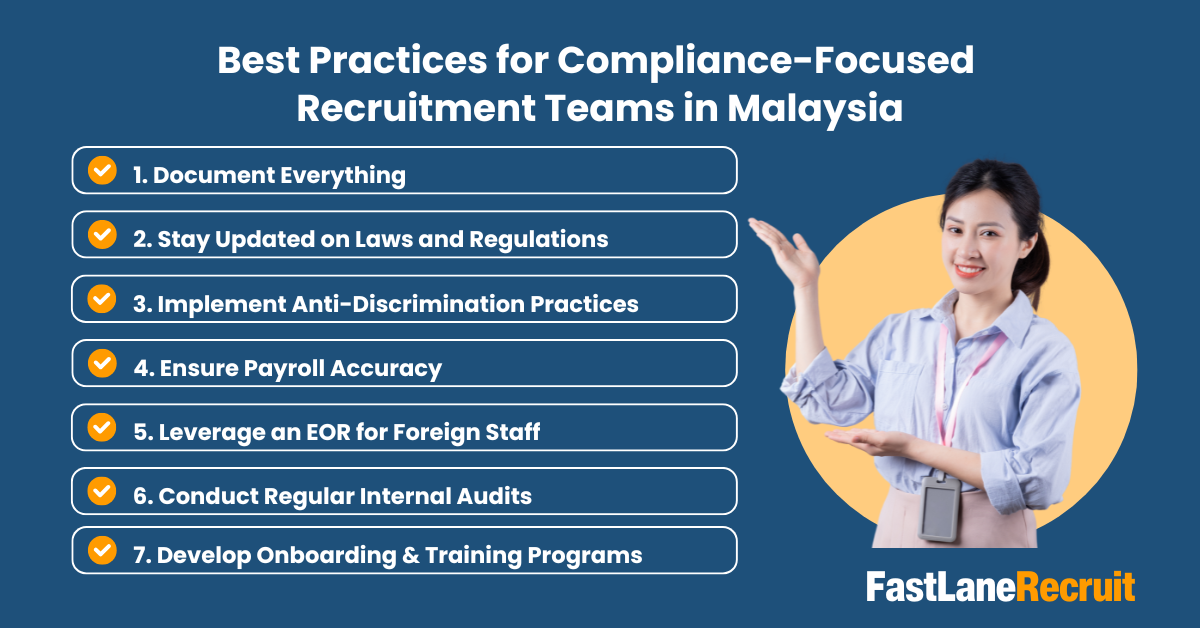
Best Practices for Compliance-Focused Recruitment Teams in Malaysia
Recruitment teams in Malaysia must balance efficiency with strict adherence to labor laws, payroll requirements, and ethical hiring standards. Following these best practices ensures that your team operates legally, transparently, and effectively while minimizing risks.
1. Document Everything
Maintain thorough records of all HR-related activities, including:
- Employment Contracts: Keep signed copies for all employees, detailing work hours, probation period, salary, benefits, and termination clauses.
- Policies & Procedures: Document internal HR policies, anti-discrimination protocols, and recruitment workflows.
- Payroll & Benefits: Record all salary payments, overtime, bonuses, allowances, and statutory contributions.
- Performance & Training Records: Track employee evaluations, disciplinary actions, and professional development initiatives.
Tip: Proper documentation protects the company during audits, inspections, or legal disputes.
2. Stay Updated on Laws and Regulations
Employment and immigration laws in Malaysia are periodically updated. Compliance-focused teams should:
- Monitor amendments to the Employment Act 1955, Industrial Relations Act 1967, and Personal Data Protection Act (PDPA).
- Track changes to immigration policies, visa categories, and work permit requirements for foreign staff.
- Subscribe to updates from government agencies such as the Ministry of Human Resources (MOHR) and the Immigration Department of Malaysia.
Tip: Regular legal updates help prevent inadvertent non-compliance that could lead to fines or operational delays.
Also Read: Labour Law, Payroll & Compliance in Malaysia for HR Administrators
3. Implement Anti-Discrimination Practices
Recruitment teams must ensure fair and inclusive hiring processes:
- Avoid questions that could discriminate based on race, religion, gender, age, or union membership.
- Train HR staff on recognizing bias, promoting diversity, and fostering an inclusive workplace culture.
- Develop internal policies that define acceptable behavior, reporting mechanisms, and consequences for violations.
Tip: A diverse and inclusive team improves workplace harmony and helps attract top talent from multiple backgrounds.
4. Ensure Payroll Accuracy
Accurate payroll processing is essential for compliance and employee satisfaction:
- Automate payroll calculations for EPF (Employees Provident Fund), SOCSO (Social Security Organization), EIS (Employment Insurance System), and income taxes.
- Include overtime, bonuses, allowances, and deductions in payroll processing.
- Conduct periodic checks to verify that statutory contributions match government requirements.
Tip: Accurate and timely payroll avoids penalties and ensures employee trust in your HR practices.
Example: Salary Calculation for a Recruitment Coordinator in Malaysia
Employee Details:
- Monthly Basic Salary: RM 3,500
- Overtime: 5 hours in a month at 1.5× hourly rate
- Monthly Allowance: RM 300 (transportation)
- Bonus: RM 500 (performance bonus)
Step 1: Calculate EPF Contribution
- Employee contribution (11%): RM 3,500 × 11% = RM 385
- Employer contribution (13% for employees under 60): RM 3,500 × 13% = RM 455
Step 2: Calculate SOCSO Contribution
- Based on SOCSO table for monthly salary of RM 3,500: Employee = RM 41.25, Employer = RM 86.35
Step 3: Calculate EIS Contribution
- EIS contribution is 0.2% for employee and 0.2% for employer:
- Employee: RM 3,500 × 0.2% = RM 7
- Employer: RM 3,500 × 0.2% = RM 7
Step 4: Calculate Overtime Pay
- Hourly rate = RM 3,500 ÷ 208 hours (standard 40-hour workweek × 52 weeks ÷ 12 months) ≈ RM 16.83/hour
- Overtime rate = 1.5 × 16.83 ≈ RM 25.25/hour
- Total overtime pay: 5 × 25.25 ≈ RM 126.25
Step 5: Total Monthly Salary
- Basic salary: RM 3,500
- Overtime: RM 126.25
- Allowances: RM 300
- Bonus: RM 500
- Gross Salary: 3,500 + 126.25 + 300 + 500 = RM 4,426.25
Step 6: Deduct Statutory Contributions
- EPF: 385
- SOCSO: 41.25
- EIS: 7
- Total Deductions: 385 + 41.25 + 7 = RM 433.25
Step 7: Net Salary
- Gross salary – deductions = 4,426.25 – 433.25 = RM 3,993
Step 8: Employer Cost
- Basic salary: RM 3,500
- Employer EPF: 455
- Employer SOCSO: 86.35
- Employer EIS: 7
- Total Employer Cost: 3,500 + 455 + 86.35 + 7 = RM 4,048.35
5. Leverage an EOR for Foreign Staff
For expatriate recruitment or HR professionals:
- Partner with an Employer of Record (EOR) to handle visas, work permits, employment contracts, and compliance reporting.
- EORs simplify legal processes, reduce administrative burden, and mitigate risks associated with employing foreign talent.
Tip: Using an EOR allows your recruitment team to scale quickly without worrying about local entity setup or regulatory compliance.
6. Conduct Regular Internal Audits
Frequent audits help maintain compliance and identify gaps:
- Review payroll, contracts, leave records, and recruitment documentation.
- Ensure all HR processes align with Employment Act requirements and internal policies.
- Address any inconsistencies promptly to prevent legal or financial repercussions.
Tip: Set up quarterly or bi-annual audits as part of a proactive compliance strategy.
7. Develop Onboarding & Training Programs
A well-structured onboarding and training program ensures your team operates consistently and ethically:
- Include legal compliance training covering labor laws, anti-discrimination policies, and workplace safety.
- Train recruitment staff on ethical hiring practices, candidate privacy, and data protection (PDPA).
- Provide guidance on recruitment tools, interview techniques, and HR workflows.
- Conduct refresher sessions to keep teams updated on policy changes or procedural updates.
Tip: Consistent onboarding and training help reduce errors, improve team efficiency, and reinforce a compliance-focused culture.
Following these best practices allows recruitment teams in Malaysia to operate effectively, maintain legal compliance, and create a fair, transparent, and ethical work environment.
Also Read: Why Malaysia Is a Prime Destination for Offshore HR Administrators
Using an Employer of Record (EOR) for Recruitment Teams in Malaysia
Expanding or establishing a recruitment team in Malaysia can be complex due to labor laws, statutory requirements, and immigration regulations. Partnering with an Employer of Record (EOR) offers a practical solution, allowing companies to hire and manage HR and recruitment professionals without establishing a legal entity in Malaysia.
1. Simplified Compliance & HR Administration
An EOR acts as the legal employer while your company retains control over day-to-day operations:
- Local Labor Law Compliance:
- Ensures all recruitment team members are employed in line with the Employment Act 1955 and related labor laws.
- Handles employment contracts, probation periods, working hours, leave entitlements, and termination procedures.
- Payroll & Benefits Management:
- Calculates and disburses salaries, overtime, bonuses, and allowances accurately.
- Manages statutory contributions such as EPF, SOCSO, and EIS, ensuring reporting to the respective authorities is timely and accurate.
- Tax & Reporting Compliance:
- Withholds employee income tax via the Monthly Tax Deduction (MTD) system.
- Submits statutory reports to government agencies like the Inland Revenue Board (IRBM).
2. Managing Visas and Work Permits for Foreign Staff
Hiring expatriate recruitment professionals involves additional legal obligations. An EOR simplifies this process:
- Facilitates the application and renewal of Employment Pass (EP), Professional Visit Pass (PVP), or Residence Pass-Talent (RP-T).
- Ensures all foreign employees complete mandatory medical examinations, security checks, and immigration reporting.
- Maintains full documentation for audit and compliance purposes.
Tip: Using an EOR removes the administrative burden of immigration management, allowing your team to focus on recruitment strategy.
3. Risk Mitigation & Operational Efficiency
Partnering with an EOR reduces business risks associated with non-compliance or mismanagement of HR functions:
- Ensures adherence to labor laws, anti-discrimination regulations, and workplace safety requirements.
- Minimizes the risk of penalties for payroll errors, tax non-compliance, or improper contracts.
- Provides structured HR processes and standardized documentation for audits and internal checks.
- Cost Optimization:
- Eliminates the need to establish a legal entity in Malaysia.
- Reduces overhead by outsourcing payroll, compliance, and HR administration.
- Offers predictable pricing for managing a recruitment team, regardless of team size or location.
4. Flexibility for Scaling Recruitment Teams
EOR solutions enable companies to scale recruitment operations quickly and efficiently:
- Quickly hire full-time, part-time, or contract HR and recruitment staff without lengthy administrative procedures.
- Adjust team size based on seasonal hiring needs, project demands, or global expansion.
- Easily onboard talent across multiple locations in Malaysia while maintaining centralized control.
5. FastLaneRecruit’s EOR Advantage
FastLaneRecruit offers a specialized EOR service tailored for recruitment teams and HR operations:
- Comprehensive Compliance: FastLaneRecruit handles contracts, statutory reporting, payroll, taxes, and local labor law adherence, so you can focus on building your recruitment strategy.
- Seamless Expat Hiring: They manage work permits, visas, and immigration reporting for foreign recruitment professionals, ensuring smooth onboarding.
- Scalable Solutions: Whether you need one recruiter or a full recruitment team, FastLaneRecruit provides flexible solutions to scale your operations in Malaysia.
- Operational Efficiency & Cost Savings: By outsourcing administrative and compliance tasks, your company can reduce operational costs and mitigate risks associated with running a local HR team.
- Expert Support: FastLaneRecruit’s team of HR and legal specialists guides you through local regulations, ensuring your recruitment teams operate legally, efficiently, and effectively.
Tip: Leveraging an EOR like FastLaneRecruit is particularly beneficial for companies entering the Malaysian market for the first time or looking to expand recruitment operations without the complexity of setting up a local entity.
Conclusion
Building a recruitment team in Malaysia requires careful attention to employment laws, compliance, and HR best practices. Whether hiring local or foreign talent, companies must ensure contracts, payroll, leave policies, and anti-discrimination measures are fully compliant. Leveraging an Employer of Record (EOR) can simplify compliance, reduce operational risks, and help businesses scale their recruitment capabilities efficiently.
Simplify Recruitment Compliance with FastLaneRecruit’s EOR Services
Managing payroll, visas, and labor law compliance for recruitment teams in Malaysia can be complex, especially when hiring recruiting coordinators or other HR professionals. FastLaneRecruit’s Employer of Record (EOR) services provides a seamless solution, allowing your business to expand confidently and compliantly.
Why Choose FastLaneRecruit’s EOR?
- Full Compliance Management: We handle local labor laws, statutory contributions (EPF, SOCSO, EIS), taxes, and employment contracts to ensure your recruiting coordinators and HR staff remain fully compliant.
- Payroll & Benefits Administration: Accurate salary calculations, allowances, bonuses, and overtime management are all streamlined through our platform.
- Visa & Work Permit Handling: We manage Employment Passes, Professional Visit Passes, and other visas for foreign recruiting coordinators.
- Scalable & Flexible Solutions: Whether you’re hiring one recruiting coordinator or building an entire regional recruitment team, our EOR model allows you to scale efficiently while reducing operational risks.
- Risk Mitigation & Operational Efficiency: Avoid compliance pitfalls and save time with a trusted partner who understands Malaysian employment laws and recruitment best practices.
Take the Next Step
Let FastLaneRecruit simplify your HR and recruitment operations in Malaysia. Focus on growing your business while we manage employment compliance, payroll, and administrative complexities for your recruiting coordinators and recruitment team.
Get in Touch with FastLaneRecruit Today to learn how our EOR services can help you build a compliant, high-performing recruitment team in Malaysia.