Expanding your business into Malaysia opens access to a skilled, multilingual workforce and a growing market. Hiring HRIS administrators isn’t just about finding the right talent; it’s about navigating payroll, statutory contributions, and local compliance requirements.
For HR and tech teams, understanding Malaysia’s employment landscape ensures smooth operations, secure employee data, and compliance with labour laws. This guide provides a practical overview of payroll and compliance for HRIS administrators, along with actionable tips and examples.
Content Outline
Key Summary
Hiring Requirements in Malaysia
Ensure legal eligibility, work permit approvals, employment contracts, and sector-specific compliance when recruiting HRIS administrators.
Payroll Setup & Salary Calculations
Establish consistent payroll cycles, calculate salaries accurately, and account for allowances, overtime, and statutory contributions.
Mandatory Statutory Deductions
EPF, SOCSO, EIS, and PCB contributions must be applied correctly; payroll automation helps prevent errors.
Payslip & Record-Keeping
Generate detailed payslips and maintain payroll records for at least six years to ensure transparency and simplify audits.
Common Payroll Mistakes
Avoid late contributions, missing payslips, misclassified employees, and incorrect taxation through automation and audits.
Leveraging Technology for Compliance
Modern HRIS and payroll software automate deductions, track legal updates, and generate reports to ensure compliance.
Using EOR for Offshore HRIS Teams
Employer of Record solutions like FastLaneRecruit let companies hire Malaysian HRIS administrators efficiently while managing payroll and compliance.
Hiring Requirements in Malaysia for HRIS Administrators
Recruiting HRIS administrators involves more than posting a job and offering a salary. HR teams must navigate legal registration, statutory contributions, work permits, employment contracts, and industry-specific regulations.
Legal Eligibility to Hire
Local Companies
Companies with a Malaysian entity must register with the Companies Commission of Malaysia (SSM). Requirements include:
- At least one resident director
- A registered business address in Malaysia
- Compliance with paid-up capital requirements
Once registered, HR teams can hire and manage HRIS administrators while ensuring compliance.
Foreign Companies Without a Local Entity
For foreign businesses, setting up a Malaysian entity can be costly. An Employer of Record (EOR) like FastLaneRecruit acts as the legal employer, handling payroll, statutory contributions, and compliance.
HR Tip: Using an EOR accelerates onboarding while ensuring legal compliance.
Also Read: How to Build an Offshore HR Administration Team in Malaysia
Work Permits & Employment Passes
Foreign HRIS administrators require valid work passes from the Expatriate Services Division (ESD). Common passes include:
- Employment Pass (EP): Professionals earning RM5,000+ per month
- Temporary Employment Pass: Short-term projects
- Professional Visit Pass: Consultants or specialists
HR Tip: Maintain accurate documentation including contracts, salary details, and qualifications to avoid delays.
Mandatory Statutory Contributions
HRIS administrators play a key role in ensuring payroll accuracy and compliance. One of their critical responsibilities is to calculate, remit, and reconcile statutory contributions correctly. These contributions protect employees, comply with Malaysian law, and avoid penalties.
| Statutory Body | Contribution Type | Employer Rate | Employee Rate | Notes |
| EPF (KWSP) | Retirement savings | 12–13% | 11% | Mandatory for all employees; ensures retirement security. The employer must deduct the employee’s share from monthly salary and remit both contributions to KWSP on time. |
| SOCSO (PERKESO) | Workplace injury & invalidity protection | ~1.75% | 0.5% | Mandatory for employees earning < RM5,000/month. Provides coverage for workplace injuries, invalidity, and occupational diseases. Rates vary depending on salary bracket. |
| EIS (Employment Insurance System) | Employment insurance | 0.2% | 0.2% | Supports retrenchment benefits and retraining programs. Both employer and employee contribute equally. |
| LHDN (PCB) | Monthly income tax deduction | Based on salary | N/A | Must be submitted via the LHDN e-PCB system. Accurate tax calculations are crucial to avoid penalties and interest charges. |
HR Tip: Use payroll software to automate contribution calculations, generate reminders for monthly remittances, and reconcile records regularly. Accurate statutory contributions prevent fines, reduce audit risks, and maintain employee trust.
Example Calculation
Employee Details:
- Gross monthly salary: RM4,500
- Monthly transport allowance: RM300
- Overtime: RM200
Step 1: Calculate EPF Contributions
Employer Contribution (12%):
12% × 4,500 = RM540
Employee Contribution (11%):
11% × 4,500 = RM495
Total EPF = Employer (RM540) + Employee (RM495) = RM1,035
Step 2: Calculate SOCSO Contributions
Employer Contribution (~1.75%):
1.75% × 4,500 ≈ RM79
Employee Contribution (0.5%):
0.5% × 4,500 = RM23
Total SOCSO = Employer (RM79) + Employee (RM23) = RM102
Step 3: Calculate EIS Contributions
Employer Contribution (0.2%):
0.2% × 4,500 = RM9
Employee Contribution (0.2%):
0.2% × 4,500 = RM9
Total EIS = Employer (RM9) + Employee (RM9) = RM18
Step 4: Calculate PCB (Monthly Income Tax)
- Use the LHDN e-PCB system for accuracy.
- Example: For RM4,500 gross salary + RM300 allowance + RM200 overtime = RM5,000 total earnings.
- Estimated PCB = RM150 (actual depends on tax reliefs and deductions).
Step 5: Determine Net Salary
Gross Salary + Allowances + Overtime:
4,500 + 300 + 200 = RM5,000
Total Employee Deductions:
- EPF: RM495
- SOCSO: RM23
- EIS: RM9
- PCB: RM150
Total Deductions: 495 + 23 + 9 + 150 = RM677
Net Salary to Employee:
5,000 – 677 = RM4,323
Step 6: Employer Remittance
HRIS administrators must remit the following to statutory bodies:
- EPF: RM540 (employer) + RM495 (employee) → KWSP
- SOCSO: RM79 (employer) + RM23 (employee) → PERKESO
- EIS: RM9 (employer) + RM9 (employee) → EIS
- PCB: RM150 → LHDN via e-PCB
HR Tip: Automate these calculations using payroll software to reduce errors and ensure timely remittance. Reconcile all contributions monthly to avoid penalties.
Employment Contracts & Labour Law Compliance
A well-drafted employment contract is the backbone of compliance and employee management. HRIS administrators should ensure contracts clearly cover:
- Working hours: Maximum of 48 hours/week under the Employment Act 1955.
- Overtime compensation: Employees must be paid for hours exceeding normal working hours at statutory rates.
- Leave entitlements: Include annual leave, sick leave, public holidays, and any additional company leave policies.
- Probation and termination clauses: Clearly state the probation duration, performance expectations, notice periods, and severance conditions.
- Maternity and parental protections: Comply with statutory leave and benefits for eligible employees.
HR Tip: Clearly written and communicated contracts reduce disputes, build employee trust, and simplify compliance management. Always have contracts reviewed by legal or HR experts familiar with Malaysian labor laws.
Also Read: HR Administrator Salary Guide 2025
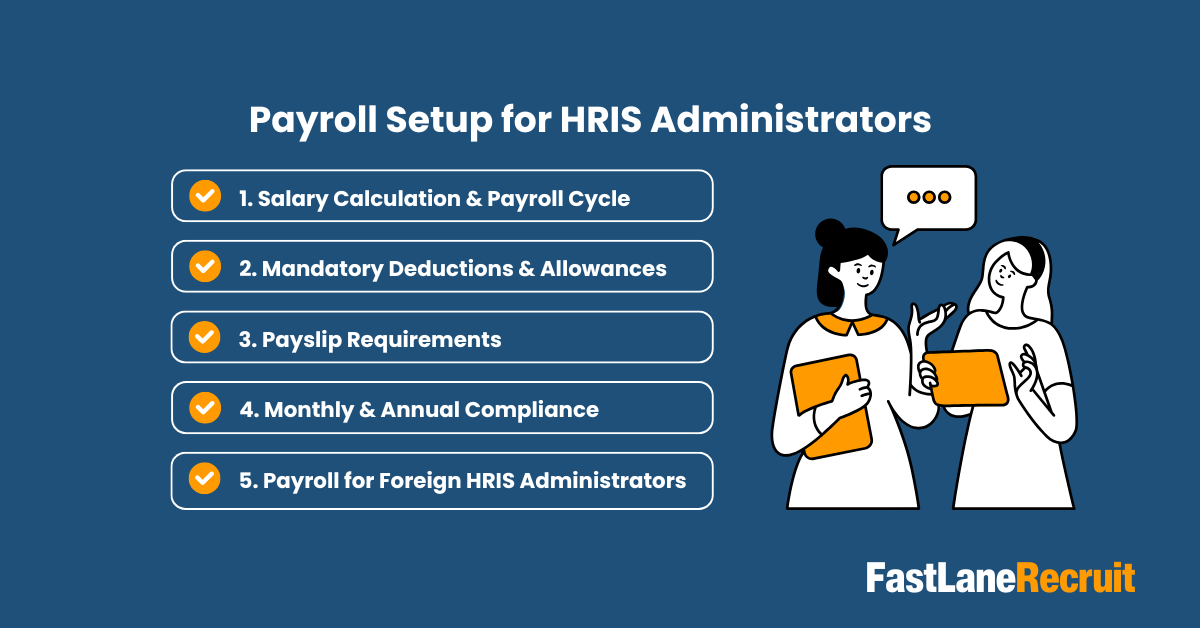
Payroll Setup for HRIS Administrators
Payroll management for HRIS administrators is multi-step and requires meticulous attention to detail. It includes salary calculations, statutory deductions, allowances, and reporting.
1. Salary Calculation & Payroll Cycle
- Most companies in Malaysia use monthly payroll cycles. Salaries must be paid no later than seven days after the wage period ends.
- Choose a consistent calculation method:
- 26-Day Work Month: Calculates monthly pay based on 26 working days, excluding weekends and public holidays.
- Calendar Month: Uses all days in the month for salary computation.
- HR Tip: Document your calculation method in payroll policy for transparency and reference during audits.
2. Mandatory Deductions & Allowances
- Include all statutory deductions (EPF, SOCSO, EIS, PCB) for each employee.
- Factor in allowances such as:
- Housing or accommodation allowance
- Transportation/fuel allowance
- Overtime payments
- Performance bonuses or commissions
- HR Tip: Use HRIS and payroll software to automate these calculations to avoid errors and ensure compliance.
3. Payslip Requirements
- Payslips must show:
- Gross salary and allowances
- Statutory deductions (EPF, SOCSO, EIS)
- PCB deductions
- Overtime, bonuses, or commissions
- Net pay
- Payroll records must be maintained for at least six years, as required by law.
- HR Tip: Digitize payslips and payroll records for secure storage and quick retrieval for audits or employee inquiries.
4. Monthly & Annual Compliance
- Monthly: Remit statutory contributions (EPF, SOCSO, EIS) by the 15th of the following month. Submit PCB deductions via the e-PCB system.
- Annual: Submit:
- Form E: Employer declaration summarizing total remuneration paid
- Form EA: Individual employee income and deduction statements for tax filing
- HR Tip: Maintain a compliance calendar to track monthly and annual deadlines and avoid late submissions.
5. Payroll for Foreign HRIS Administrators
- Foreign employees staying less than 182 days in Malaysia are taxed at a flat 30% rate on income earned locally.
- SOCSO and EIS contributions are generally exempt for short-term foreign employees unless stated otherwise.
- Payroll must align with the employment pass conditions, including salary and benefits.
- HR Tip: Track foreign employee residency carefully and document employment pass details to avoid fines or audit issues.
Common Payroll Mistakes for HRIS Administrators
HRIS administrators are responsible for managing payroll systems, calculating statutory contributions, and ensuring compliance. Even small mistakes in payroll can lead to fines, employee dissatisfaction, or audits. Below are common payroll mistakes HRIS administrators should watch out for and how to prevent them.
1. Late or Incorrect Statutory Contributions
What Can Happen:
- Delayed EPF, SOCSO, or EIS remittances can trigger fines, interest penalties, and even regulatory scrutiny.
- Miscalculating contributions may cause discrepancies between payroll records and statutory requirements.
How HRIS Administrators Can Avoid It:
- Use payroll software to automate contribution calculations.
- Schedule automatic reminders for monthly remittance deadlines (typically by the 15th of the following month).
- Reconcile contributions monthly to ensure all payments match statutory requirements.
Example: An HRIS administrator delayed EPF payments for two employees, leading to penalties of RM500. Automation and reminders could have prevented this.
2. Missing or Inaccurate Payslips
What Can Happen:
- Employees may be confused or lose trust if payslips are missing, incomplete, or inaccurate.
- Violates the Employment Act 1955, which mandates itemized payslips.
How HRIS Administrators Can Avoid It:
- Standardize payslip issuance for every payroll cycle.
- Include all components: gross salary, allowances, statutory deductions (EPF, SOCSO, EIS), PCB, overtime, bonuses, and net pay.
- Use digital HRIS systems to generate and store payslips securely.
3. Misclassifying Employees
What Can Happen:
- Incorrectly classifying contractors, interns, temporary staff, or full-time employees can lead to wrong deductions, contribution errors, and tax issues.
How HRIS Administrators Can Avoid It:
- Maintain a clear employee classification system in the HRIS.
- Verify employment status against Malaysian labor laws.
- Regularly review classifications when contracts or roles change.
4. Applying Incorrect Tax Rates for Foreign Employees
What Can Happen:
- Foreign employees staying less than 182 days in Malaysia must be taxed at a 30% flat rate.
- Using resident rates for short-term foreign staff can lead to back taxes, fines, and audits.
How HRIS Administrators Can Avoid It:
- Track foreign employees’ residency status accurately in the HRIS.
- Align payroll deductions with employment pass conditions.
- Automate tax calculations for foreign employees.
Example: A six-month expatriate was taxed using resident rates, triggering an audit. HRIS automation could have prevented this by tracking days worked.
Also Read: Why Malaysia Is a Prime Destination for Offshore HR Administrators
5. Errors in Final Termination Payments
What Can Happen:
- Miscalculating accrued leave, bonuses, or notice periods can result in disputes or legal claims.
How HRIS Administrators Can Avoid It:
- Use the HRIS to calculate final payouts automatically.
- Follow detailed offboarding checklists covering all final entitlements.
- Cross-check contracts and statutory requirements before processing.
6. Missing Annual Reporting Deadlines
What Can Happen:
- Late submission of Form E (employer declaration) or Form EA (employee tax statements) can result in fines, audits, and reputational risks.
How HRIS Administrators Can Avoid It:
- Maintain a compliance calendar for all statutory deadlines.
- Assign clear responsibility to HRIS or payroll staff.
- Verify employee data before annual filings.
7. Poor Record-Keeping
What Can Happen:
- Incomplete or inaccessible payroll records complicate audits, employee queries, and statutory reporting.
How HRIS Administrators Can Avoid It:
- Keep digital payroll records, payslips, and contribution receipts for at least six years.
- Use a centralized HRIS system to store and retrieve records securely.
- Conduct regular internal audits to ensure data integrity.
HR Tip for HRIS Administrators:
Automate payroll processes, standardize calculations, and perform regular audits. Combining technology with skilled HRIS oversight minimizes errors, ensures compliance, and builds employee trust.
Leveraging Technology for Compliance
For HRIS administrators, managing payroll and compliance manually can be time-consuming and error-prone. Modern HRIS and payroll software offers tools to simplify processes, reduce mistakes, and ensure statutory compliance in Malaysia.
Key Ways Technology Supports Compliance
- Automate Statutory Deductions
- HRIS software can automatically calculate EPF, SOCSO, EIS, and PCB contributions for each employee.
- Reduces human error and ensures all deductions are accurate and remitted on time.
- Example: Instead of manually calculating EPF each month, the HRIS updates contributions automatically based on gross salary.
- Update Rates and Regulations Automatically
- Malaysian labor laws, minimum wage, statutory contribution rates, and tax rules can change frequently.
- Payroll software automatically reflects these updates, so HRIS administrators don’t have to manually track changes.
- This ensures compliance and prevents costly mistakes.
- Generate Payslips and Store Records Securely
- HRIS systems generate itemized digital payslips showing gross salary, deductions, allowances, overtime, and net pay.
- Payslips and payroll records are stored securely for at least six years, making audits and employee inquiries fast and straightforward.
- Integrate Payroll with Attendance, Leave, and Benefits
- Linking payroll with attendance and leave management ensures accurate overtime, leave deductions, and benefit calculations.
- Integration reduces duplicated work, ensures data consistency, and improves reporting efficiency.
- Run Internal Audits and Generate Reports
- HRIS software can produce compliance reports, track discrepancies, and highlight missed contributions or payroll errors.
- Internal audits become easier, allowing HRIS administrators to proactively resolve issues before they escalate.
HR Tip: Automation alone is not enough. Combine technology with well-trained HRIS and finance staff to review payroll, monitor compliance, and interpret audit reports. Human oversight ensures reliable, consistent payroll management.
Best Practices for Hiring HR Teams
When building or expanding HR teams in Malaysia, especially for HRIS administration, following best practices ensures smooth payroll management and compliance:
Partner with Local Experts or EOR Providers
- Engage local payroll or HR experts, or use an Employer of Record (EOR) like FastLaneRecruit.
- They guide compliance with Malaysian labor laws, statutory contributions, and payroll regulations, helping avoid costly mistakes.
Automate Payroll and Payslip Processes
- Use HRIS and payroll software to calculate deductions, generate payslips, and store records.
- Automation ensures accuracy, consistency, and saves HR teams significant time.
Maintain a Compliance Calendar
- Track monthly and annual statutory deadlines, such as EPF/SOCSO/EIS remittance and Form E/EA submissions.
- A clear calendar prevents missed deadlines and reduces penalties.
Conduct Internal Audits Regularly
- Periodically review payroll data, contribution records, and employee classifications.
- Regular audits identify errors early, preventing regulatory fines and improving payroll accuracy.
Also Read: Labour Law, Payroll & Compliance in Malaysia for HR Administrators
Train HR and Finance Teams on Legal Updates
- Malaysian labor laws and payroll regulations change regularly.
- Continuous training ensures HR teams apply the correct rates and comply with statutory obligations.
Keep Meticulous Payroll Records
- Store payroll records, payslips, and contribution receipts digitally for at least six years.
- Well-maintained records simplify audits, employee queries, and statutory reporting.
Standardize Processes to Reduce Errors
- Develop clear payroll and HRIS processes for onboarding, payroll calculations, deductions, and offboarding.
- Standardization reduces errors, ensures consistency, and improves overall efficiency of HR operations.
HR Tip: By combining technology, structured processes, and ongoing training, HRIS administrators can maintain error-free payroll, full compliance, and a trustworthy HR system, freeing time to focus on strategic initiatives like talent management and employee engagement.
Why EOR is Ideal for Hiring Offshore HRIS Administrators in Malaysia
Expanding your HR operations to Malaysia can give your business access to a skilled, multilingual workforce, especially HRIS administrators who are experienced in managing payroll, HR technology, and compliance. However, setting up a local legal entity in Malaysia can be time-consuming, expensive, and administratively complex.
An Employer of Record (EOR) service, such as FastLaneRecruit, provides a smart alternative. By acting as the legal employer in Malaysia, an EOR allows companies to hire local HRIS administrators quickly, manage payroll and compliance, and scale teams without the need to establish a local company.
Key Benefits of Using an EOR for HRIS Administrators
Hire Malaysian HRIS Administrators Without Setting Up a Local Entity
- FastLaneRecruit becomes the official employer on record, handling all legal responsibilities.
- Your business can legally hire HRIS professionals immediately without registering a Malaysian company or managing local corporate compliance.
- Saves months of paperwork and reduces upfront costs associated with entity setup.
Manage Payroll, Statutory Contributions, and Benefits Seamlessly
- The EOR handles salary disbursement, EPF, SOCSO, EIS contributions, and PCB tax deductions.
- Payroll is accurate, timely, and compliant with Malaysian labor laws.
- Employee benefits, leave management, and statutory entitlements are fully managed by the EOR, reducing administrative burden for your HR team.
Scale Teams Flexibly Without Long-Term Commitments
- EORs allow you to hire on-demand, making it easy to expand or reduce your HRIS team based on business needs.
- Avoids the financial and operational commitment of maintaining a local entity, especially useful for pilot projects or seasonal workforce changes.
Focus on Business Growth While Compliance is Handled
- With the EOR managing all legal and administrative obligations, your internal team can focus on strategic tasks like onboarding, system implementation, and HR process optimization.
- Ensures that compliance, payroll, and statutory filings are always handled correctly, mitigating risk of fines or penalties.
Real-World Example
Company: Singapore-based tech startup
Scenario: Needed two HRIS administrators to manage payroll systems, HRIS implementation, and employee data management in Malaysia.
Challenge: Setting up a local legal entity would have taken months and required compliance with statutory contributions, tax filings, and labor regulations.
Solution: The company partnered with FastLaneRecruit as their EOR.
Results:
- HRIS administrators were onboarded within weeks.
- Payroll, statutory deductions (EPF, SOCSO, EIS, PCB), and benefits were fully managed by FastLaneRecruit.
- The company’s internal HR team focused immediately on onboarding, system configuration, and optimizing HR processes.
- Compliance risks were fully mitigated, saving time and administrative effort.
HRIS Tip: Using an EOR is particularly advantageous for foreign companies entering Malaysia for the first time or scaling teams rapidly. It allows businesses to leverage local talent efficiently while staying fully compliant with Malaysian labor laws.
Also Read: How to Pay International Employees
Conclusion
Payroll compliance in Malaysia is manageable with the right guidance, tools, and partners. By understanding statutory obligations, leveraging technology, and following best practices, you can ensure accurate, timely payroll for HRIS administrators while building employee trust.
FastLaneRecruit’s EOR service simplifies offshore HRIS hiring, allowing your team to focus on talent management and HR system optimization without compliance headaches.
Simplify Hiring and Payroll Compliance in Malaysia with FastLaneRecruit
- Hire Malaysian HRIS administrators without a local entity
- Manage payroll, statutory contributions, and benefits seamlessly
- Scale your team efficiently
- Stay fully compliant with labor laws and tax regulations
Get Started Today:
Onboard Malaysian HRIS administrators quickly, efficiently, and worry-free. Book a free demo with FastLaneRecruit and expand your HR team with confidence.