Malaysia continues to be a top destination for international hiring in Southeast Asia, offering multilingual talent, cost-effective employment, and a structured regulatory framework. For Accounts Payable (AP) Officers or finance teams expanding into Malaysia in 2026, understanding local payroll processes, statutory contributions, and compliance obligations is essential.
This guide provides a step-by-step overview for hiring AP officers while ensuring payroll accuracy, statutory compliance, and employee satisfaction.
Content Outline
Key Summary
Hiring & Legal Compliance
Understand Malaysia’s hiring requirements: register with SSM, secure work permits for foreign staff, and issue compliant employment contracts under the Employment Act 1955.
Employer of Record (EOR) Advantage
EOR providers like FastLaneRecruit allow companies to hire employees legally without setting up a local entity while managing all statutory obligations.
Payroll & Statutory Contributions
Employers must contribute to EPF (12–13%), SOCSO (~1.75%), EIS (0.2%), and HRDF (1% for eligible sectors). Automate contributions to avoid fines and ensure accuracy.
Income Tax & PCB Deductions
Employers must withhold monthly income tax (PCB) based on salary and deductions, filing through LHDN by the 15th of the following month to stay compliant.
Payslips, Payroll Cycle & Recordkeeping
Maintain monthly payroll cycles, issue detailed payslips, and keep payroll records for at least six years to meet legal and audit requirements.
Common Payroll Mistakes & Risk Mitigation
Avoid late contributions, missing payslips, misclassifications, and incorrect non-resident tax rates. Use payroll automation and internal audits to minimize errors.
Best Practices for AP & HR Teams
Partner with local experts or EORs, automate payroll, maintain compliance calendars, train teams on updates, keep detailed records, and communicate transparently with employees.
Hiring Requirements in Malaysia
Legal Eligibility & Entity Options
- Local Entity Setup: Required for companies establishing operations in Malaysia. Must register with the Companies Commission of Malaysia (SSM), appoint at least one resident director, and meet paid-up capital requirements.
- Employer of Record (EOR): For companies without a local entity, an EOR provider allows you to hire employees legally while the EOR handles compliance, payroll, and statutory obligations.
Work Permits & Employment Passes
- Foreign AP Officers require Employment Pass (EP), usually for managerial, technical, or professional roles earning ≥RM5,000/month.
- Temporary permits, such as Professional Visit Pass or Short-Term Employment Pass, may apply depending on role and duration.
Employment Contracts & Labour Law Compliance
- Written contracts are mandatory, especially for employees earning ≤RM4,000 under the Employment Act 1955.
- Key obligations:
- Max 48 hours/week
- Overtime pay ≥1.5x hourly rate
- Minimum 11 public holidays/year
- 8–16 days annual leave & 14–22 days sick leave
- Maternity leave: 60 consecutive days for first five children
Also Read: Offshore Vs Local: Accountants 2025 Salary Benchmark Report (Australia Vs Malaysia Edition)
Sector-Specific Compliance
- Regulated industries may require additional permits:
- Education → Ministry of Education registration
- Construction → CIDB license
- Oil & Gas → PETRONAS safety & competency certifications
Payroll Setup, Statutory Contributions & Taxation
Employer Registration
Register with the following statutory bodies within 7 days of hiring your first employee:
| Statutory Body | Purpose | Employer Contribution (2026) |
| KWSP / EPF | Retirement savings | 12–13% of salary |
| SOCSO | Workplace injury & invalidity | ~1.75% (employees <RM5,000) |
| EIS | Employment insurance | 0.2% of salary |
| LHDN | Monthly tax deduction (PCB) | Based on salary bracket |
| HRDF | Training levy (if applicable) | 1% of salary for certain sectors |
Monthly Contributions & Calculations
When paying employees in Malaysia, employers must make monthly statutory contributions to several government-mandated schemes. These contributions protect employees and ensure compliance with local labour laws. Let’s break them down in simple terms:
Employees Provident Fund (EPF / KWSP)
- Purpose: Retirement savings for employees.
- Contribution Rates:
- Employer: 12–13% of the employee’s monthly salary
- Employee: 11% of their monthly salary
- How It Works: Every month, the employer deducts the employee’s 11% contribution from their salary and adds the employer portion. The total is deposited into the EPF account.
- Why It Matters: Timely and accurate EPF contributions ensure employees have retirement savings and prevent fines from the EPF authority.
Social Security Organisation (SOCSO / PERKESO)
- Purpose: Provides social security protection for workplace injuries and invalidity.
- Contribution Rates:
- Employer: Varies depending on employee’s monthly salary and category (usually ~1.75%)
- Employee: 0.5% of monthly salary
- How It Works: Contributions are calculated based on salary and submitted monthly to SOCSO.
- Why It Matters: Covers employees in case of accidents or injuries at work. Failure to contribute can lead to fines or legal action.
Employment Insurance System (EIS)
- Purpose: Protects employees against job loss and provides retraining support.
- Contribution Rates: Both employer and employee contribute 0.2% of the monthly salary.
- How It Works: Contributions are small but mandatory. They go into a government-managed fund that supports retrenched workers.
- Why It Matters: Helps employees transition in case of layoffs and shows your company’s compliance with employment regulations.
Also Read: Building a High-Performing Offshore Accounting Team in Malaysia (Singapore Edition)
Human Resources Development Fund (HRDF)
- Purpose: Provides funding for employee training and skills development.
- Applicability: Employers with 10 or more Malaysian staff in the manufacturing, services, or mining sectors must contribute 1% of payroll.
- How It Works: Employers pay the HRDF levy monthly. This fund can later be used to subsidize approved training programs for employees.
- Why It Matters: Encourages workforce upskilling and compliance with Malaysia’s training regulations. Non-payment can result in penalties.
Tips for Employers
- Calculating these contributions manually can be complex and error-prone, especially with multiple employees or foreign staff.
- Solution: Use approved payroll software or partner with an Employer of Record (EOR) service. These tools automatically calculate contributions, generate payslips, and submit payments on time, minimizing the risk of fines or audits.
Income Tax Deduction at Source (PCB)
- Employers must withhold monthly income tax from employees’ salaries.
- Calculation factors: salary, tax reliefs, EPF contributions.
- Deadline: 15th of the following month via LHDN e-filing system.
- Penalty for late or incorrect filing: 10–100% of tax owed; severe cases → criminal charges.
Payroll Cycle, Payslip & Record-Keeping
- Payroll cycle: Monthly (industry standard)
- Payslip requirements: Gross pay, allowances, deductions (EPF, SOCSO, EIS), PCB, net pay
- Record retention: Minimum 6 years, per Employment Act 1955
- Best practice: Use cloud-based payroll software with automated payslips and backups
Payroll Compliance Risks & Common Mistakes
| Common Mistake | Risk | How to Avoid |
| Late contributions | EPF/SOCSO fines, interest | Automate payroll & set reminders |
| Missing or incomplete payslips | Regulatory inspection, employee dissatisfaction | Standardize payslip issuance |
| Misclassification of employees | Incorrect deductions & tax errors | Define employment status clearly |
| Ignoring non-resident tax rules | Audit penalties | Track residency & apply correct tax rate |
| Incorrect final payments | Disputes on leave, bonus, notice | Use detailed offboarding checklists |
| Missing annual filings | Form E / EA penalties | Set internal deadlines, assign responsibility |
| Poor record maintenance | Audit complications | Maintain digital records 6+ years |
Foreign vs Local Employee Payroll Considerations
- Non-resident foreign employees (<182 days in Malaysia): Flat 30% withholding tax
- SOCSO/EIS exemptions: Usually exempt for foreign employees unless permanent residents
- Work permit compliance: Payroll must align with Employment Pass conditions
Best Practices & Checklists for AP Teams
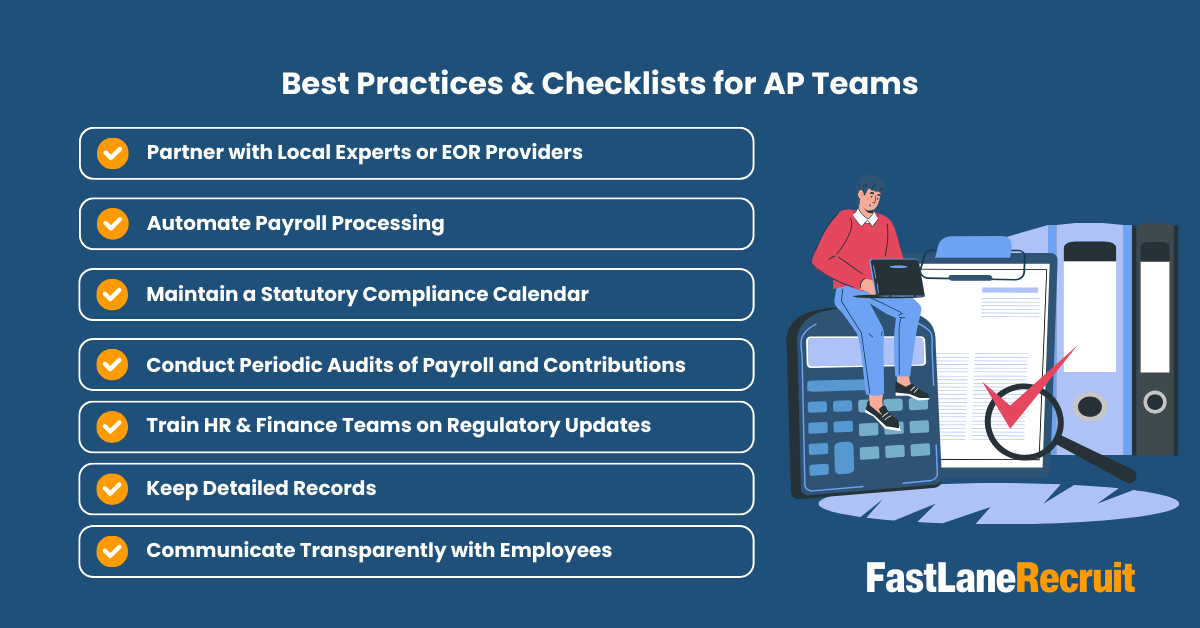
Managing payroll and statutory contributions in Malaysia can be complex, especially for foreign companies or growing teams. Following best practices helps ensure compliance, avoid fines, and maintain employee trust. Here’s a detailed guide for Accounts Payable (AP) and HR teams:
Partner with Local Experts or EOR Providers
- Why: Local experts and Employer of Record (EOR) services have in-depth knowledge of Malaysia’s employment laws, payroll rules, and statutory contributions.
- Benefit: Reduces the risk of miscalculations, late submissions, or non-compliance penalties.
- Tip: Even if your company has an HR or finance team, partnering with an EOR can save time and prevent costly mistakes.
Also Read: Building a High-Performing Offshore Accounting Team in Malaysia (Hong Kong Edition)
Automate Payroll Processing
- What to Do: Use payroll software to calculate statutory deductions (EPF, SOCSO, EIS, PCB) and generate accurate payslips.
- Why: Manual calculations increase the risk of errors, which can lead to fines or employee disputes.
- Tip: Choose software that is compliant with Malaysian regulations and updates automatically for rate changes.
Maintain a Statutory Compliance Calendar
- Why: Payroll in Malaysia involves multiple monthly and annual deadlines for contributions and tax filings.
- How: Track due dates for:
- EPF, SOCSO, EIS contributions (monthly by the 15th)
- PCB (monthly tax deduction submissions)
- Annual filings like Form E (employer declaration) and Form EA (employee tax statements)
- Benefit: Prevents late payments and ensures your company avoids penalties or interest charges.
Conduct Periodic Audits of Payroll and Contributions
- Why: Regular audits identify errors, misclassifications, or missing contributions before they escalate into compliance issues.
- How: Review payroll records, contribution calculations, and remittance receipts every quarter.
- Tip: Consider engaging an external auditor for an unbiased review.
Train HR & Finance Teams on Regulatory Updates
- Why: Malaysian payroll regulations, contribution rates, and tax rules can change frequently.
- How: Provide ongoing training sessions, share updates from statutory bodies, and ensure your team is aware of new obligations.
- Benefit: Keeps your payroll processes compliant and avoids accidental penalties.
Keep Detailed Records
- What to Record: Payslips, remittance receipts, tax filings, employment contracts, leave records, and contribution confirmations.
- How Long: Legally required to keep records for at least six years.
- Benefit: Accurate records simplify audits, resolve disputes quickly, and demonstrate compliance to authorities.
Also Read: Building a High-Performing Offshore Accounting Team in Malaysia (Australia Edition)
Communicate Transparently with Employees
- Why: Transparency builds trust and reduces confusion about salaries, benefits, and deductions.
- How: Provide clear payslips showing gross salary, statutory deductions, allowances, and net pay.
- Tip: Educate employees on how EPF, SOCSO, and EIS contributions benefit them personally.
FastLaneRecruit EOR: Simplifying Payroll & Compliance
FastLaneRecruit offers a turnkey Employer of Record (EOR) solution in Malaysia, allowing businesses to hire Accounts Payable Officers and finance teams without establishing a local entity. Key benefits include:
- Full Legal Compliance: FastLaneRecruit manages EPF, SOCSO, EIS, PCB, and HRDF contributions accurately and on time.
- Payroll Automation: Seamless monthly payroll processing and payslip generation.
- Flexible Hiring: Quickly onboard employees without long-term entity commitments.
- Dedicated Local Expertise: Navigate work permits, employment contracts, and sector-specific compliance with ease.
- Reduced Risk: Avoid fines, audits, and payroll mistakes while maintaining employee trust.
Partnering with FastLaneRecruit ensures your AP team can focus on financial operations while all local payroll and statutory responsibilities are handled professionally.
Summary & Actionable Takeaways
- Malaysia offers cost-effective, skilled, and multilingual talent, ideal for AP and finance roles
- Compliance with Employment Act 1955, EPF, SOCSO, EIS, PCB, and HRDF is mandatory
- Automated payroll systems and EOR solutions significantly reduce risk
- Avoid common mistakes: late contributions, missing payslips, misclassification, incorrect tax treatment
- Maintain detailed records for 6+ years and track monthly & annual obligations
- Prioritize transparent communication and fair payroll practices to build trust and retention
Also Read: Types Of Accounting Services That Can Be Outsourced
Conclusion
Hiring Accounts Payable Officers in Malaysia in 2026 involves more than recruitment; it requires a deep understanding of payroll processes, statutory contributions, and compliance obligations. Companies that leverage FastLaneRecruit’s EOR service can bypass the complexities of entity setup, automate payroll, and ensure full compliance with Malaysian employment laws.
By prioritizing accurate, timely, and transparent payroll practices, organizations safeguard against regulatory penalties, protect employee trust, and create a solid foundation for growth. Using an EOR provider like FastLaneRecruit allows businesses to scale efficiently, focus on strategic objectives, and maintain operational excellence in Malaysia.
Ready to Simplify Payroll and Compliance in Malaysia?
Take the complexity out of hiring and payroll with FastLaneRecruit’s EOR service. From accurate EPF, SOCSO, EIS, PCB, and HRDF contributions to seamless payroll automation, we handle all statutory obligations so your team can focus on what matters most: growing your business.
- Hire quickly without a local entity
- Stay fully compliant with Malaysian regulations
- Automate payroll and payslip generation
- Leverage local expertise for work permits and contracts
- Minimize risk, fines, and audit issues
Start onboarding your Accounts Payable officers and finance teams with confidence today.