Why Understanding Employee Benefits in Malaysia Matters
In Malaysia’s competitive hiring landscape, offering the right employee benefits can make all the difference in attracting and retaining top talent. Whether you’re hiring local staff or expanding your workforce remotely, it’s essential to understand the statutory requirements under the Employment Act 1955, as well as market-driven supplemental perks that give you an edge.
This guide by FastLaneRecruit helps employers navigate both mandatory benefits like EPF, SOCSO, EIS, and optional incentives such as flexible leave, bonuses, and insurance, ensuring compliance and competitiveness in Malaysia.
Also Read: Advantages of Payroll Outsourcing in Malaysia
Content Outline
Key Summary
Understanding Mandatory Statutory Benefits Is Crucial
Employers in Malaysia must comply with the Employment Act 1955 by providing statutory benefits such as EPF, SOCSO, EIS contributions, maternity and paternity leave, sick leave, annual leave, public holidays, and overtime pay. Compliance not only avoids legal penalties but also builds trust and credibility with employees.
Supplemental Benefits Enhance Talent Attraction and Retention
Beyond legal requirements, offering additional perks like private health insurance, flexible working arrangements, performance bonuses, and wellness programs helps employers differentiate themselves in a competitive market and improve employee satisfaction and loyalty.
Clear Communication and Proper Documentation Ensure Compliance
Employers must maintain accurate records of contracts, payslips, leave applications, and contribution receipts. Transparent communication about benefits helps manage employee expectations and reduces disputes.
Staying Updated on Labor Law Amendments Is Essential
Malaysian labor laws evolve regularly. Employers should monitor updates from official government sources such as the Ministry of Human Resources to remain compliant and adapt benefits packages accordingly.
Partnering with Local Experts Simplifies Hiring and Benefits Management
Navigating Malaysia’s employment laws can be complex, especially for foreign companies. Working with trusted partners like FastLaneRecruit ensures seamless onboarding, payroll management, statutory contributions, and compliance, allowing you to focus on business growth.
Also Read: Fixed-Term Employment Contracts: Pros and Cons for Employers
Statutory Employee Benefits in Malaysia
Under Malaysian labor law, employers are required to provide several statutory benefits to employees. These benefits ensure social protection and fair working conditions for all workers.
Here’s a breakdown of key statutory benefits:
| Benefit | Description | Governing Body / Act |
| EPF (Employees Provident Fund) | A mandatory retirement savings scheme where employers contribute a minimum of 12%-13% of monthly salary, while employees contribute 11%. | KWSP/EPF |
| SOCSO (Social Security) | Covers employees against workplace injuries, accidents, and certain diseases. Employers contribute based on the employee’s salary bracket. | PERKESO/SOCSO |
| EIS (Employment Insurance System) | Supports workers who have lost their jobs involuntarily with job search assistance and temporary income support. | PERKESO – EIS |
| Annual Leave | Employees are entitled to paid leave based on years of service: 8 days (less than 2 years), 12 days (2–5 years), 16 days (5+ years). | Employment Act 1955, Section 60E |
| Sick Leave | Minimum 14–22 days per year depending on tenure. Hospitalisation allows for up to 60 days (including sick leave). | Employment Act 1955, Section 60F |
| Maternity Leave | Female employees are entitled to 98 consecutive days of paid maternity leave. | Employment Act 1955, Section 37 |
| Paternity Leave | Starting Jan 2023, 7 days paid paternity leave for married male employees (limited to 5 confinements). | Budget 2023 Update |
| Public Holidays | 11 paid public holidays annually, including National Day, the King’s Birthday, and others designated by the employer. | Employment Act 1955, Section 60D |
| Overtime Pay | Employees earning ≤ RM4,000/month are eligible. Overtime is paid at 1.5x–3x regular pay depending on timing and type of day. | Employment Act 1955, Section 60A |
| Termination Benefits | Employees with ≥12 months of service are entitled to compensation based on years of tenure if terminated without misconduct. | Employment Act 1955, Section 60J |
Supplemental (Non-Statutory) Employee Benefits in Malaysia
While statutory benefits are legally required, today’s job seekers in Malaysia also expect supplemental perks that support their well-being and improve work-life balance. These non-mandatory benefits often determine how attractive your company is compared to competitors.
Here are the most common supplemental benefits offered by Malaysian employers:
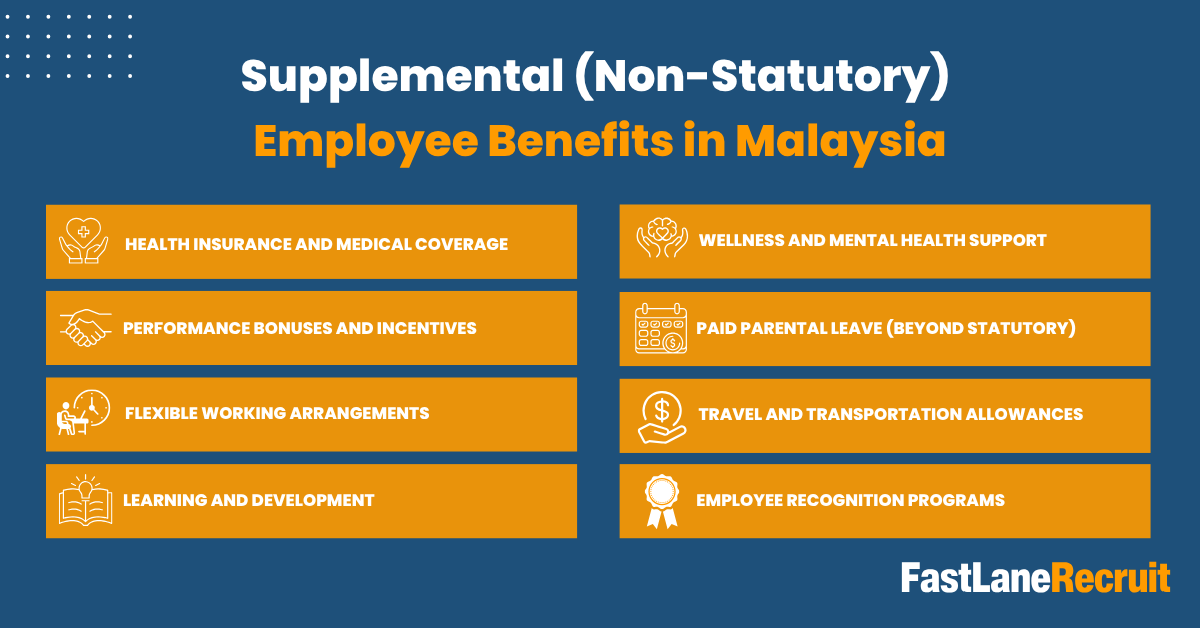
1. Health Insurance and Medical Coverage
Although SOCSO provides basic medical protection, many employers offer private health insurance that includes outpatient care, dental, vision, and hospitalization coverage. This is especially important for attracting skilled professionals and managerial-level talent.
FastLaneRecruit Insight: Employers offering extended family medical coverage tend to retain talent longer.
2. Performance Bonuses and Incentives
Performance-based bonuses, 13th-month salaries, or annual incentives are common across many sectors. These rewards drive motivation and help employers differentiate themselves in a competitive market.
Also Read: What Is Global Employment Outsourcing?
3. Flexible Working Arrangements
Post-pandemic, hybrid and remote working options have become expected, especially among knowledge workers. Offering flexible hours, telecommuting, or work-from-home stipends can attract younger talent and reduce overhead.
4. Learning and Development
Upskilling programs, training reimbursements, or subscriptions to e-learning platforms are highly valued. Many companies also sponsor certifications, especially in IT, accounting, and marketing.
5. Wellness and Mental Health Support
Wellness initiatives such as gym subsidies, mental health days, counselling sessions, and even company-wide wellness programs are on the rise.
6. Paid Parental Leave (Beyond Statutory)
Progressive employers may extend maternity or paternity leave beyond legal minimums or offer childcare support, which appeals to working parents.
7. Travel and Transportation Allowances
Monthly fuel, car, or public transport allowances are common, especially in urban areas like Kuala Lumpur and Penang. Some employers also provide parking reimbursement.
8. Employee Recognition Programs
Digital badges, long-service awards, and employee-of-the-month schemes are low-cost, high-impact methods to improve morale.
Why These Matter
Non-statutory benefits are not just perks, they’re strategic tools for building employer brand, reducing turnover, and enhancing productivity. Candidates increasingly evaluate total compensation, not just base salary.
Also Read: Hiring an Offshore Development Team in 2025
How to Stay Compliant with Malaysian Employment Laws
Compliance with Malaysian labor laws is not optional, it’s essential for avoiding penalties, maintaining your reputation, and fostering trust with your employees. Here’s how you can ensure your hiring and HR practices remain aligned with local regulations.
Understand the Employment Act 1955
The Employment Act 1955 governs key aspects of employment for workers in Peninsular Malaysia and Labuan earning less than RM4,000 per month. It outlines minimum standards for:
- Working hours and rest days
- Overtime pay
- Paid holidays and leave entitlements
- Termination and layoff benefits
- Employment of women and children
You can access the full act via the Ministry of Human Resources (MOHR).
Register with Statutory Bodies
Employers are legally required to register their company and employees with the following institutions:
| Statutory Body | Purpose | Website |
| EPF (KWSP) | Provident fund for retirement savings | kwsp.gov.my |
| SOCSO (PERKESO) | Employment injury and disability protection | perkeso.gov.my |
| EIS (under SOCSO) | Income replacement for retrenched employees | perkeso.gov.my |
| LHDN (Inland Revenue Board) | Income tax compliance | hasil.gov.my |
Each body has its own registration and monthly contribution process. Late or inaccurate reporting can result in penalties or audits.
Stay Updated on Amendments
Labor laws in Malaysia evolve regularly. For example, recent amendments have adjusted:
- Minimum wage thresholds
- Maternity leave entitlements (from 60 to 98 days)
- Overtime eligibility
- Anti-discrimination clauses
Staying informed via government sources or legal advisories ensures you’re not caught off-guard by new regulations.
Maintain Proper Documentation
Keep accurate records of:
- Employment contracts
- Payslips and salary transfers
- Leave applications
- Contribution receipts for EPF, SOCSO, and EIS
These serve as legal proof and are essential in the event of labor disputes or audits.
Engage HR and Payroll Experts
For small businesses or foreign companies hiring in Malaysia, local HR practices can be complex and challenging. Partnering with a recruitment agency like FastLaneRecruit can ensure compliance while streamlining hiring and onboarding processes.
Also Read: 4 Types of Employment Contracts in Malaysia Recruitment
Why Employee Benefits Matter for Hiring in Malaysia
In Malaysia’s competitive talent landscape, offering legally compliant employee benefits isn’t just a regulatory requirement; it’s a crucial part of your employer value proposition (EVP). Benefits can influence whether top candidates accept your offer and how long they stay with your company.
1. Attracting Top Talent in a Candidate-Driven Market
Job seekers today are more informed and selective. Offering benefits that exceed statutory minimums, such as additional annual leave, wellness programs, or remote work flexibility, can give your company an edge.
According to the TalentCorp Critical Occupations List, sectors like IT, engineering, and healthcare are especially competitive. Enhanced benefits help attract skilled professionals in these fields.
2. Reducing Turnover and Improving Retention
Competitive benefits play a significant role in employee satisfaction. For example:
- EPF and SOCSO contributions ensure financial and health security
- Paid medical and annual leave help reduce burnout
- Maternity and paternity leave support work-life balance
Employees are more likely to stay with a company that supports their long-term well-being.
3. Building a Compliant and Trustworthy Employer Brand
Being compliant with statutory benefits like EPF, SOCSO, and EIS signals that your company is responsible and credible. This builds trust, not just with employees, but also with government agencies, business partners, and future recruits.
For example, failure to remit contributions to SOCSO or EPF can lead to legal action, which damages brand reputation and deters talent.
4. Supporting Business Growth
Long-term business growth relies on a stable, engaged workforce. When employees feel secure and valued, they are more productive, innovative, and loyal. Robust benefits act as a foundation for building this kind of workforce culture.
Also Read: Why EPF, SOCSO, and EIS Are Essential for Malaysia Payroll
How FastLaneRecruit Can Help You Hire Compliantly in Malaysia
Hiring in Malaysia can be a complex process, especially if you’re expanding from abroad or navigating local employment regulations for the first time. That’s where FastLaneRecruit comes in.
We simplify hiring by helping companies onboard Malaysian talent while ensuring full compliance with statutory employment laws.
1. End-to-End Hiring and Onboarding Support
Whether you’re hiring remote workers, part-timers, or full-time employees, FastLaneRecruit handles the entire recruitment lifecycle:
- Job scoping and salary benchmarking
- Talent sourcing, screening, and interviews
- Offer letter preparation and employment contract compliance
- Onboarding aligned with Malaysian labor law
We make sure your employment practices comply with the Employment Act 1955 and other relevant regulations.
2. Statutory Benefit Administration (EPF, SOCSO, EIS)
FastLaneRecruit ensures your payroll and benefits obligations are fully met, including:
- EPF (Employees Provident Fund): We guide contribution setup and monthly submissions to KWSP
- SOCSO: We manage registration and monthly reporting to PERKESO
- EIS (Employment Insurance System): We help meet EIS contribution requirements and support employees with claims if needed
Our team ensures timely and accurate filings, so you avoid penalties and maintain good standing with Malaysian authorities.
3. Leave and Compliance Management
From maternity leave and public holidays to medical leave tracking, we provide tools and advice to help you administer benefits in accordance with Malaysian law. We also stay up to date on policy changes from Jabatan Tenaga Kerja and other government bodies, so you don’t have to.
4. Scalability and Flexibility
Whether you’re hiring one specialist or building a full Malaysian team, our solutions scale with your business needs. You can hire through:
- Your own local entity, or
- FastLaneRecruit’s Employer of Record (EOR) model — ideal for businesses without a Malaysian company setup
Also Read: Employment Law in Malaysia
Conclusion: Build a Compliant and Agile Workforce in Malaysia with FastLaneRecruit
Understanding Malaysian employee benefits and statutory requirements is critical to building a compliant, engaged, and productive workforce. From EPF, SOCSO, and EIS contributions to maternity leave, paid time off, and public holiday entitlements, employers must stay informed and act responsibly.
With FastLaneRecruit, you gain a trusted partner who simplifies local hiring, ensures compliance with government laws, and supports your HR processes end-to-end. Whether you’re a startup or a multinational expanding into Malaysia, we provide scalable solutions to help you hire the right talent, legally and efficiently.
Looking to hire in Malaysia?
FastLaneRecruit can help you stay compliant and competitive. Get in touch today to explore our recruitment and EOR services.