

Hiring independent contractors gives businesses access to specialized skills without immediately building a permanent employee structure. But as contractor relationships become longer-term or expand across borders, businesses often face a practical question: How can you provide meaningful benefits without creating unnecessary compliance or worker-classification risks?
The answer depends on how the worker is engaged, where they work, what benefits you want to provide, and whether the relationship is genuinely independent.
For U.S. businesses, the term “1099 employee” is commonly used in searches, but a person receiving Form 1099-NEC for nonemployee compensation is generally treated as an independent contractor rather than an employee. The IRS looks at the actual working relationship, including behavioral control, financial control, and the type of relationship, not simply the label used in a contract.
For international contractors, the analysis becomes even more important because local classification, tax, social protection, and employment rules can differ by country.
Content Outline
Key Summary
1099 Workers Are Generally Independent Contractors
A worker who receives a Form 1099-NEC is generally treated as a nonemployee, such as an independent contractor, rather than a traditional employee. While “1099 employee” is a common search term, businesses should determine worker status based on the actual working relationship, not simply the tax form or contract label.
Contractors Can Receive Certain Benefits and Perks
Businesses may be able to provide contractor benefits, such as professional development, equipment allowances, expense reimbursements, or certain health-related support. The appropriate arrangement depends on the benefit, contractor agreement, tax treatment, and applicable laws.
Benefits Do Not Automatically Make a Contractor an Employee
Providing a benefit does not automatically change an independent contractor’s status. However, employee-type benefits can be one factor considered when assessing the overall relationship between the business and worker. The IRS recommends looking at factors such as behavioral control, financial control, and the type of relationship when determining whether someone is an employee or independent contractor.
International Contractor Benefits Vary by Country
There is no universal benefits package for international contractors. Tax rules, worker classification, social insurance, insurance requirements, and employment regulations can differ significantly between countries. A benefit arrangement that may be appropriate in one market may not be suitable in another.
Consultant vs Contractor Depends on the Work and Relationship
A consultant typically provides specialized advice, expertise, strategy, or recommendations, while a contractor generally provides defined services, deliverables, or project-based work. Both can operate independently, and neither title alone determines legal worker classification.
When a Contractor Relationship Starts Looking Like Employment, Review the Model
If a contractor becomes a long-term, integrated member of the team and the business exercises substantial control over how the work is performed, the existing engagement should be reviewed. For eligible international workers who need to be employed, an Employer of Record (EOR) can provide an alternative employment structure without requiring the business to immediately establish its own local entity.
FastLaneRecruit Supports Contractor and EOR Hiring
FastLaneRecruit supports businesses with contractor and EOR solutions across multiple international markets. Whether you need to engage genuine independent contractors or employ international workers through an EOR, We can help you evaluate the appropriate workforce model as your business expands.
What Are Contractor Benefits?
Contractor benefits are compensation-related perks, allowances, services, or other forms of support that a business provides or makes available to an independent contractor in addition to the contractor’s agreed fees.
Unlike employee benefits, contractor benefits are not automatically governed by an employer’s standard employee benefits package.
Depending on the engagement and jurisdiction, businesses may consider:
- Health or medical insurance arrangements
- Dental or vision coverage
- Professional development allowances
- Equipment or technology allowances
- Travel and expense reimbursement
- Wellness programs
- Communication or internet allowances
- Performance-based incentives
- Retirement or savings-related support
- Paid project-related expenses
- Access to selected corporate discounts or resources
The important point is that a benefit should not be offered simply because it is available to employees. Businesses should first determine whether the contractor arrangement permits the benefit and whether providing it could affect the classification analysis.
Can You Offer Benefits to 1099 Contractors?
Yes, a business may be able to provide certain benefits, perks, reimbursements, or other forms of support to an independent contractor. However, a 1099 contractor is not automatically entitled to the same employee benefits as a W-2 employee.
The distinction matters because independent-contractor status is based on the actual relationship between the parties.
The IRS considers factors including:
- Behavioral control — who controls what the worker does and how the work is performed?
- Financial control — who controls the business aspects of the relationship, such as expenses, tools, payment structure, and opportunity for profit or loss?
- Type of relationship — what does the contract say, how permanent is the relationship, and are employee-type benefits provided?
There is no single factor that automatically determines classification.
Why “1099 Employee Benefits” Can Be Misleading
The phrase “1099 employee benefits” is widely used in online searches, but it combines two different concepts.
A Form 1099-NEC is generally used to report nonemployee compensation. The recipient may be an independent contractor or another nonemployee service provider. By contrast, employees are generally reported through Form W-2.
For content and workforce planning purposes, “1099 contractor benefits” or “independent contractor benefits” is more precise.
What Benefits Can You Offer Independent Contractors?
The appropriate approach depends on the contractor’s location, the nature of the benefit, and the terms of the engagement.
1. Health and Medical Support
Health coverage is one of the most common concerns for independent professionals.
Depending on the country and arrangement, businesses may consider:
- A contractor-specific insurance arrangement
- A health-related allowance or stipend
- Reimbursement arrangements where legally appropriate
- Access to voluntary insurance products
- Individual coverage purchased by the contractor
The company should confirm whether the proposed arrangement is legally and tax appropriate before making it part of the contractor relationship.
2. Professional Development
Professional development can be particularly relevant when the contractor is engaged for specialized expertise.
Possible support may include:
- Training allowances
- Certification costs
- Professional memberships
- Industry conferences
- Skills-development resources
These benefits can support contractor performance without necessarily replicating a conventional employee benefits package.
3. Equipment and Work-Related Expenses
A business may agree to cover legitimate expenses required to complete the contracted work.
Examples include:
- Required software
- Work equipment
- Business travel
- Client-site expenses
- Project-specific materials
- Internet or communication costs
The agreement should clearly establish which expenses are covered and how reimbursement works.
4. Incentives and Performance-Based Payments
Businesses can structure contractor compensation around agreed deliverables or outcomes.
Examples include:
- Project completion payments
- Milestone payments
- Performance incentives
- Referral fees
- Commission structures
The payment model should match the commercial nature of the engagement and applicable local rules.
5. Retirement and Financial Support
Contractors generally arrange their own retirement and financial planning. In some circumstances, a business may provide financial support or access to relevant arrangements, but tax treatment and eligibility can vary significantly by jurisdiction.
For international contractors, do not assume that a U.S.-style retirement or benefits structure can simply be replicated overseas.
Contractor Benefits vs Employee Benefits
The biggest difference is not simply the number of benefits offered. It is the underlying employment relationship.
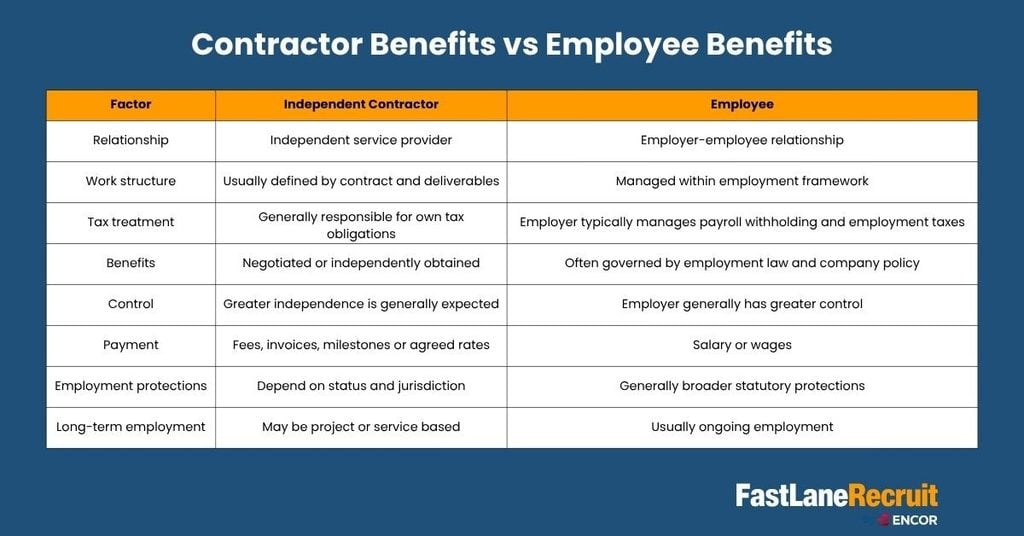
| Factor | Independent Contractor | Employee |
| Relationship | Independent service provider | Employer-employee relationship |
| Work structure | Usually defined by contract and deliverables | Managed within employment framework |
| Tax treatment | Generally responsible for own tax obligations | Employer typically manages payroll withholding and employment taxes |
| Benefits | Negotiated or independently obtained | Often governed by employment law and company policy |
| Control | Greater independence is generally expected | Employer generally has greater control |
| Payment | Fees, invoices, milestones or agreed rates | Salary or wages |
| Employment protections | Depend on status and jurisdiction | Generally broader statutory protections |
| Long-term employment | May be project or service based | Usually ongoing employment |
For U.S. federal tax purposes, the IRS emphasizes the actual degree of control and independence rather than simply whether the worker is paid hourly, part-time, full-time, or under a particular contract label.
Also Read: Hiring Contractors vs Employees: How to Determine Worker Classification Correctly
Consultant vs Contractor: What’s the Difference?
“Consultant” and “contractor” are often used interchangeably in business conversations, and neither term by itself determines legal worker status.
A consultant typically provides specialized advice, analysis, strategy, or recommendations.
A contractor typically provides defined services, executes specific deliverables, or supplies specialized capacity for a project.
| Factor | Consultant | Contractor |
| Primary role | Advice, strategy, expertise | Execution, delivery, specialized services |
| Typical output | Recommendations, assessments, strategy | Defined tasks, deliverables or project outcomes |
| Engagement | Often advisory | Often project or service based |
| Management | Generally operates independently | Generally operates independently |
| Legal status | May be an independent contractor | May be an independent contractor |
| Benefits | Usually not automatically employee benefits | Usually not automatically employee benefits |
The terminology is less important than the actual working relationship. A company should not assume that calling someone a “consultant” rather than a “contractor” changes their legal classification.
How to Offer Benefits Without Increasing Misclassification Risk
Providing benefits to a contractor does not automatically turn that person into an employee. However, employee-type benefits can form part of the broader evidence considered when determining the nature of the relationship.
Businesses should therefore assess the complete engagement rather than relying on a single contract clause.
1. Define the Scope of Work
Clearly establish:
- Services provided
- Deliverables
- Milestones
- Fees
- Payment schedule
- Project responsibilities
- Expected outcomes
2. Preserve Contractor Independence
Where the relationship is intended to be independent, the operating model should reflect that independence.
Consider:
- How much control the company exercises
- Who determines how work is performed
- Whether the contractor can serve other clients
- Who provides equipment and tools
- How expenses are handled
- Whether the contractor bears meaningful business risk
3. Separate Contractor Perks From Employee Benefits
Instead of automatically placing contractors into an employee benefits program, determine whether the proposed support is appropriate for the contractor relationship.
For example:
Better approach:
“Company will reimburse approved project-related travel expenses.”
Rather than automatically providing an employee-style package without considering whether it is appropriate for the contractor structure.
4. Document the Arrangement
The agreement should clearly establish:
- Independent-contractor status
- Scope of services
- Compensation
- Expense policy
- Confidentiality
- Intellectual property
- Termination
- Governing law
- Applicable benefit or allowance arrangements
A contract label alone does not determine worker status. The actual relationship matters.
Also Read: Understanding Employee Benefits
How to Offer Benefits to International Contractors
International contractor arrangements require another layer of analysis because the rules governing employment status, taxation, social contributions, insurance, and benefits vary by country.
Before offering benefits to an international contractor, businesses should consider:
Worker classification
Determine whether the individual genuinely qualifies as an independent contractor under the relevant local framework.
Local tax obligations
Assess whether payments, reimbursements, allowances, or benefits create tax obligations for either party.
Social protection
Check whether local social insurance, pension, health insurance, or other statutory requirements apply.
Benefit availability
A benefit available to employees in one country may not be available or tax-efficient for an independent contractor in another.
Permanent establishment and other business risks
International hiring can create broader tax and corporate considerations depending on the worker’s activities, authority, location, and relationship with the business.
International contractor management should therefore be assessed country by country rather than applying one global benefits policy to every worker.
When Should You Consider an EOR Instead of a Contractor?
An independent contractor model can work well when the person is genuinely operating as an independent business or service provider.
However, an EOR may be worth considering when the business needs to employ someone internationally but does not have its own local entity in that country.
Consider an EOR when:
- You need to hire an international worker as an employee.
- The worker is becoming a long-term, core member of your team.
- The role requires substantial company direction and integration.
- You want to provide locally appropriate employee benefits.
- You need localized employment contracts and payroll.
- You do not want to establish and maintain your own entity.
- You are concerned that the contractor arrangement no longer reflects the actual working relationship.
- You are expanding into a new market before deciding whether to establish a local entity.
Contractor vs EOR: Which Model Fits?
| Business situation | Contractor model | EOR model |
| Defined independent project | Often suitable | May be unnecessary |
| Genuine independent professional | Often suitable | May be unnecessary |
| Long-term core team member | Review classification carefully | May be more appropriate |
| Need employee benefits | Limited/contract-specific | Local employee benefits can be structured |
| Hiring without a local entity | Depends on local rules | EOR can provide an employment structure |
| Local payroll and employment administration | Contractor manages own obligations where applicable | EOR manages employment administration |
| Expanding internationally | Can work for genuine contractors | Useful for international employees |
| Relationship increasingly resembles employment | Higher classification concern | Consider employee/EOR structure |
The choice should depend on the actual working relationship, country, business objective, and compliance requirements rather than simply the cost or convenience of one model.
When Is a Contractor No Longer the Right Engagement Model?
Watch for changes in the relationship rather than focusing only on the contract title.
A contractor arrangement deserves review when:
- The worker works primarily or exclusively for your business.
- Your company determines their working hours and methods.
- The person is deeply integrated into your organizational structure.
- The role is an ongoing and essential part of the business.
- The worker receives employee-like benefits.
- The company supplies most of the tools and resources.
- The business exercises significant day-to-day control.
- The contractor relationship has become effectively permanent.
These factors do not automatically establish employee status. They are signals that the relationship should be reviewed under the applicable rules. The IRS specifically advises businesses to consider the complete relationship rather than relying on one factor.
How FastLaneRecruit Can Support Contractor and EOR Hiring
Managing an international workforce becomes more complicated when contractor relationships span multiple jurisdictions.
FastLaneRecruit can support businesses with contractor and EOR solutions designed around their international hiring requirements.
Contractor Support
For businesses using a genuine independent-contractor model, FastLaneRecruit can help streamline international contractor engagement and management.
This can be useful when businesses need to:
- Engage specialized international talent
- Expand contractor hiring into new markets
- Manage cross-border workforce requirements
- Structure contractor engagements more efficiently
- Reduce administrative complexity
EOR Support
When an international worker should be employed rather than engaged as an independent contractor, an EOR can provide an alternative to establishing a local entity.
FastLaneRecruit can support international employment across:
- Malaysia
- Singapore
- Hong Kong
- China
- India
- Philippines
- Taiwan
- Vietnam
- Australia
- United Kingdom
- Switzerland
- UAE
- Saudi Arabia
- Qatar
With an EOR structure, businesses can focus on managing the employee’s day-to-day work while the employment administration is handled through the appropriate local employment framework.
Why Businesses Choose FastLaneRecruit
International hiring is not simply about finding someone in another country. Businesses also need to determine how that person should be engaged.
FastLaneRecruit helps businesses evaluate the practical difference between:
Contractor → EOR → Local entity
so they can select an approach that matches their workforce needs.
Businesses work with FastLaneRecruit when they need support with:
- International hiring
- Contractor engagement
- Employer of Record services
- Local employment administration
- Payroll coordination
- Employee benefits
- Cross-border workforce expansion
- Hiring without immediately establishing a local entity
The right model depends on the worker, country, role, and relationship. FastLaneRecruit can help businesses assess the appropriate path rather than treating every international worker as the same type of engagement.
Build the Right Workforce Structure With FastLaneRecruit
The question is not simply “Can we give contractors benefits?”
The more important question is:
“Does our current workforce model still match the way this person actually works?”
For genuine independent contractors, a carefully structured contractor arrangement may be appropriate. When an international worker needs to be employed, receive locally appropriate benefits, and work within an employment relationship, an EOR may provide a more suitable structure.
FastLaneRecruit can help you navigate contractor and EOR hiring across key markets in Asia Pacific, Europe, and the Middle East, so you can build an international workforce without treating every worker engagement the same way.
Need help deciding between a contractor and EOR model? Talk to FastLaneRecruit about your international hiring requirements and find the right workforce structure for your next hire.
Frequently Asked Questions About Contractor Benefits
Can 1099 contractors receive benefits?
A company may be able to provide certain benefits, allowances, or perks to independent contractors, depending on the arrangement and applicable laws. However, 1099 contractors are not automatically entitled to the same statutory or employer-sponsored benefits as employees.
What benefits can you offer a 1099 contractor?
Potential arrangements can include health-related support, professional development, equipment allowances, expense reimbursement, incentives, and other negotiated benefits. Tax and legal treatment can vary, so the specific benefit should be reviewed before implementation.
Does giving a contractor benefits make them an employee?
Not automatically. Worker classification depends on the overall relationship. However, employee-type benefits can be one factor considered as part of the classification analysis.
Can international contractors receive health insurance?
Potentially, but the appropriate structure depends on the contractor’s country, insurance availability, tax treatment, and worker classification. Businesses should not assume that an employee health plan can simply be extended to an overseas contractor.
What is the difference between a consultant and a contractor?
A consultant typically provides advice, strategy, or specialized expertise, while a contractor often performs defined services or delivers specific project outcomes. Both may operate as independent contractors depending on the circumstances.
When should I use an EOR instead of a contractor?
Consider reviewing an EOR structure when the worker is functioning more like an employee, when you need locally compliant employment and benefits, or when you want to hire internationally without establishing your own entity.
Can an EOR provide benefits to international employees?
An EOR can facilitate locally appropriate employee benefits as part of an employment arrangement, subject to the laws and practices of the relevant country.
Is an EOR better than hiring an international contractor?
There is no universal answer. A genuine independent contractor and an international employee serve different business purposes. The appropriate model depends on the nature of the work, degree of control, duration, country, benefits requirements, and compliance considerations.
What happens if an international contractor is misclassified?
Potential consequences vary by country and can include back taxes, social contributions, employment-related liabilities, penalties, or other regulatory consequences. Businesses should assess classification before and during the engagement rather than relying solely on a contractor agreement.