Step-by-Step Guide for Global Employers
Thinking about building an offshore system administration team? Malaysia offers strong tech talent, great English proficiency, advanced infrastructure, and cost-efficient hiring, making it a top choice for offshore infrastructure and system administration teams.
But to make your offshore team truly successful, you’ll need a thoughtful setup and careful planning to overcome challenges such as time zone differences, compliance requirements, and cultural differences. This guide provides a structured approach to building and managing offshore system administration teams in Malaysia. Whether you hire directly or through an Employer of Record (EOR) like FastLaneRecruit, these strategies will help you maximize productivity, ensure compliance, and maintain operational excellence.
Content Outline
Key Summary
Malaysia Offers Strong IT Talent
Malaysia provides skilled system administrators with expertise in servers, networks, cloud, and security, supported by English proficiency and modern tech infrastructure.
Cost-Effective Scaling
Hiring system administrators in Malaysia offers significant cost advantages, allowing global employers to expand IT operations without compromising quality.
The Benefits Extend Beyond Just Payroll Processing
Employers must navigate Malaysian laws covering contracts, minimum wage, work permits, and statutory contributions like EPF, SOCSO, and EIS.
Structure and Communication Are Critical
Clear roles, strong onboarding, defined communication channels, and consistent documentation ensure offshore teams operate smoothly and avoid misunderstandings.
Addressing Common Offshore Challenges
Issues like time zone gaps, inconsistent practices, and cultural differences can be solved with SOPs, asynchronous tools, and proactive team-building.
EOR Model Simplifies Operations
Using an Employer of Record like FastLaneRecruit helps global companies hire legally in Malaysia without setting up a local entity, while managing payroll and compliance.
FastLaneRecruit Enables Fast, Compliant Hiring
FastLaneRecruit streamlines onboarding, handles statutory obligations, and frees companies to focus on IT performance, security, and uptime, not administration.
Why Malaysia Is an Ideal Destination for Offshore System Administration
1. High-Quality IT Talent Pool
Malaysia produces thousands of IT and computer science graduates annually, many specializing in system administration, network engineering, and cybersecurity. These professionals are skilled in managing Linux/Windows servers, cloud platforms, virtualization, and enterprise IT systems. Strong English proficiency ensures smooth communication with global teams.
2. Cost Advantages
Compared to North America or Europe, Malaysia offers competitive salaries for system administrators. This cost efficiency allows companies to scale infrastructure support teams without compromising quality, freeing budget for advanced tools, training, or additional hires.
3. Strong Infrastructure
Cities like Kuala Lumpur, Penang, and Johor Bahru are equipped with reliable internet connectivity, modern office spaces, and thriving tech ecosystems. This ensures offshore system administration teams can operate seamlessly, with access to modern IT tools and best practices.
Also Read: Top 15 Business Consulting Firms in Australia
4. Regulatory Clarity and Compliance
Malaysia’s employment laws are transparent, covering working hours, leave entitlements, and statutory contributions such as EPF, SOCSO, and EIS. For foreign companies, compliance can be complex. Partnering with an EOR like FastLaneRecruit simplifies payroll, taxes, and statutory obligations, ensuring your offshore team is legally employed and fully compliant.
Step-by-Step Guide to Building and Managing Offshore System Administration Teams in Malaysia
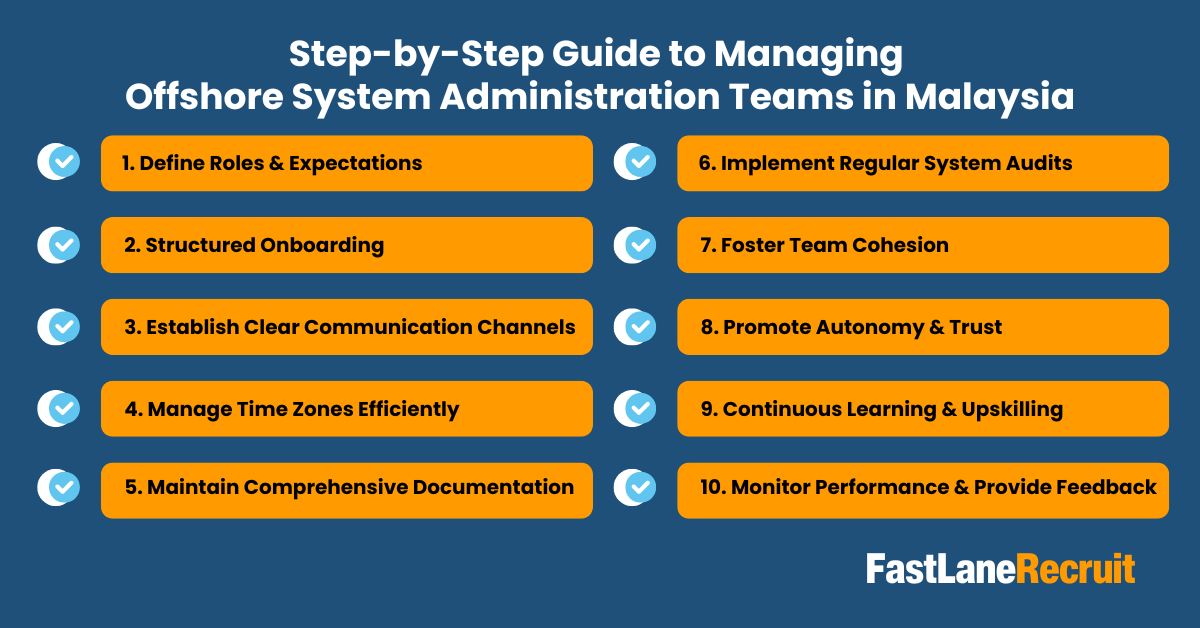
1. Define Roles & Expectations
Start by clearly listing what each system administrator is responsible for, such as server monitoring, patch management, backups, network maintenance, and security compliance.When everyone understands their duties, there is less room for confusion or duplicated effort.
You should also define reporting lines, escalation paths during urgent issues, and what success looks like for each role.
Why it matters: Clear expectations help offshore teams work confidently and reduce unnecessary back-and-forth.
Tip: Use shared platforms like Confluence, Google Docs, or Notion to store job responsibilities, workflows, and escalation guidelines.
2. Structured Onboarding
A strong onboarding process helps offshore system administrators integrate faster. Introduce them to your IT tools, workflow management systems, security policies, and system architecture.
Provide access to essential resources like:
- System diagrams
- Standard operating procedures
- Incident escalation frameworks
- Compliance and security requirements
Why it matters: Clear onboarding ensures offshore teams understand your environment from day one, reducing errors and speeding productivity.
Tip: Virtual workshops, recorded walkthroughs, or short onsite visits can help build rapport early.
3. Establish Clear Communication Channels
System administration tasks often involve urgent issues that require quick communication. Set up tools and rules for different communication needs.
Use:
- Slack / Microsoft Teams for quick updates
- Zoom / Google Meet for troubleshooting meetings
- Jira / ServiceNow for ticketing and task tracking
Define response-time expectations so your offshore team knows how quickly they should reply during critical situations.
Why it matters: Clear communication reduces downtime, improves collaboration, and ensures faster issue resolution.
Tip: Balance real-time communication with asynchronous updates so teams aren’t overwhelmed.
4. Manage Time Zones Efficiently
Working across time zones can be challenging for incident response and change management. To avoid delays, schedule important meetings during overlapping hours so both teams can participate.
For everything else, use asynchronous tools like Loom, where team members can record explanations or walkthroughs that others can view anytime.
Why it matters: Managing time zones properly keeps workflows smooth and minimizes bottlenecks.
Tip: Tools like WorldTimeBuddy help visualize overlapping working hours and allow for fair scheduling across global teams.
5. Maintain Comprehensive Documentation
Documentation is essential in system administration, especially in distributed teams. Create a central, well-organized repository for:
- System configurations
- Network diagrams
- Backup procedures
- Security policies
- Troubleshooting guides
Assign an owner to review and update documents regularly so everything stays accurate and current.
Why it matters: Good documentation speeds up onboarding, reduces downtime, and ensures consistent practices across all team members.
Tip: Documentation is a lifesaver during emergencies, especially when a key team member is unavailable.
6. Implement Regular System Audits
Routine system audits help ensure IT environments remain secure, compliant, and performance-optimized.
Audits should cover:
- Server health
- Patch levels
- Backup integrity
- Vulnerability checks
- System performance
Automate alerts and monitoring to catch issues early before they escalate into outages.
Why it matters: Regular audits reduce risks and maintain system stability, especially when teams work remotely.
Tip: Tools like Nagios, Zabbix, and Splunk can automate monitoring and alert you to issues in real time.
7. Foster Team Cohesion
Offshore teams perform better when they feel connected. Encourage casual interactions, celebrate small wins, and create intentional opportunities for non-work conversations.
Examples include:
- Virtual coffee chats
- Birthday shoutouts
- Team milestone celebrations
- Fun Slack channels (pets, hobbies, games)
Why it matters: Strong relationships build trust and make collaboration smoother during high-pressure situations.
Tip: Tools like Donut in Slack automatically pair team members for informal conversations.
8. Promote Autonomy & Trust
Empower your offshore administrators to own their tasks, whether it’s resolving an incident or managing an upgrade. Avoid micromanaging and let them demonstrate their expertise.
Set up clear outcomes and trust them to deliver.
Why it matters: Autonomy boosts motivation, improves performance, and encourages proactive problem-solving.
Tip: Provide support when needed, but allow your team space to make decisions confidently.
9. Continuous Learning & Upskilling
System administration practices and tools evolve rapidly. Encourage your team to stay up to date with:
- Cloud certifications (AWS, Azure, Google Cloud)
- Cybersecurity courses
- Automation and scripting tools
- Industry best practices
Consider offering learning allowances or time for skill development.
Why it matters: Upskilled teams are more capable, adaptable, and better equipped to handle modern IT challenges.
Tip: Regular training sessions help offshore teams stay future-ready and aligned with your company’s standards.
10. Monitor Performance & Provide Feedback
Set clear KPIs to measure the team’s effectiveness, such as:
- System uptime
- Patch compliance rate
- Average resolution time
- Ticket closure rate
- Audit pass rate
Conduct regular retrospectives to review what’s working and what needs improvement. Schedule regular one-on-ones to support personal growth and resolve issues early.
Why it matters: Data-driven performance management keeps the team aligned and continuously improving.
Tip: Use performance analytics to spot bottlenecks, refine workflows, and recognize top performers.
Common Challenges and How to Overcome Them
When building and managing an offshore system administration team in Malaysia, global employers may encounter several recurring operational and cultural challenges. These issues are common in distributed IT operations, but with the right strategies, they can be anticipated and effectively managed.Below is a deeper look at each challenge and practical solutions.
1. Communication Breakdowns
The Challenge:
System administration often involves urgent tasks such as server outages, patching, or incident response. Misunderstandings, whether due to language differences, unclear instructions, or lack of real-time communication, can delay resolution and impact uptime.
How to Overcome It:
- Establish structured communication protocols, such as daily check-ins for operational work and weekly status meetings for planning and alignment.
- Use video calls (Zoom, Microsoft Teams) for complex troubleshooting where visual demonstrations help clarify issues faster.
- Document all decisions, incident reports, and system changes in shared platforms like Confluence or Notion to ensure transparency.
Example: If a Malaysian administrator misinterprets a firewall rule update, a quick video call with screen sharing can resolve the issue immediately and prevent hours of downtime.
2. Inconsistent Practices
The Challenge:
System administrators may come from different backgrounds and follow varying standards for patching, monitoring, or documentation. This inconsistency can lead to vulnerabilities, inefficiencies, or duplicated work.
How to Overcome It:
- Define clear IT policies and standard operating procedures (SOPs) for tasks such as backup schedules, patch management, and incident escalation.
- Conduct regular audits to ensure compliance with these standards.
- Use automated monitoring tools (e.g., Nagios, Zabbix, Splunk) to enforce consistency and detect deviations early.
Example: If one administrator applies patches weekly while another does so monthly, automated compliance checks can flag the inconsistency and prompt corrective action.
Also Read: Top 20 Collaboration Tools in Australia
3. Time Zone Delays
The Challenge:
Global teams often span multiple time zones, which can slow down approvals, escalations, or incident responses. A delay of even a few hours can be critical in system administration.
How to Overcome It:
- Schedule overlapping-hour meetings for critical updates and decision-making.
- Use asynchronous tools like Loom (video updates), Jira (ticket tracking), or GitHub comments for tasks that don’t require immediate responses.
- Plan ahead for daylight savings changes that may temporarily shift overlapping hours.
Example: If your headquarters is in Europe and your offshore team is in Malaysia, overlapping hours may be limited. By relying on asynchronous updates, incidents can be logged and addressed without waiting for live approvals.
4. Cultural & Team Conflicts
The Challenge:
Differences in communication styles, decision-making approaches, or workplace norms can cause friction. For example, some team members may hesitate to voice disagreement, leading to unresolved issues.
How to Overcome It:
- Offer intercultural training to raise awareness of local norms and expectations.
- Encourage transparency and open feedback in all discussions.
- Organize team-building activities, virtual meetups, or small celebrations to strengthen relationships and trust.
Example: A Malaysian administrator may avoid challenging a decision in a group meeting. Providing anonymous feedback channels or one-on-one sessions ensures concerns are heard and addressed constructively.
5. Maintaining Agility
The Challenge:
System administration requires rapid responses to evolving threats, outages, or compliance changes. Offshore teams may struggle to pivot quickly if workflows are rigid or communication is slow.
How to Overcome It:
- Implement Agile practices such as Scrum or Kanban to structure IT operations with flexibility.
- Conduct regular retrospectives to reflect on challenges, identify bottlenecks, and adjust workflows.
- Continuously iterate processes to improve efficiency and responsiveness.
Example: If a new security vulnerability is discovered, Agile practices allow the Malaysian team to reprioritize tasks, patch systems immediately, and document changes without disrupting other ongoing work.
Compliance & Legal Considerations in Malaysia
When building an offshore system administration team in Malaysia, compliance with local employment laws and regulations is not optional – it’s essential. Employers must ensure that contracts, payroll, and statutory contributions align with Malaysian legal requirements. Failure to comply can result in fines, legal disputes, or reputational damage. Below are the key areas every global employer should understand.
1. Employment Act 1955
What It Covers:
The Employment Act 1955 is the cornerstone of Malaysian labor law. It governs working hours, rest days, overtime pay, annual leave, sick leave, termination procedures, and general employee protections.
Why It Matters for Offshore Teams:
System administrators often work irregular hours due to the nature of IT operations. Employers must ensure that contracts reflect statutory limits on working hours and provide fair compensation for overtime. Termination clauses must also comply with the Act to protect both employer and employee.
Example: If a system administrator is required to work beyond the statutory 48 hours per week without proper overtime pay, the employer could face penalties. Aligning contracts with the Act ensures fairness and legal protection.
2. Statutory Contributions
What Employers Must Provide:
Employers in Malaysia are legally required to contribute to several statutory schemes:
- Employees Provident Fund (EPF): A retirement savings plan for employees.
- Social Security Organisation (SOCSO): Provides coverage for workplace injuries, disabilities, and medical benefits.
- Employment Insurance System (EIS): Offers unemployment benefits and re-employment support.
Why It Matters for Offshore Teams:
System administrators are critical to IT infrastructure, and statutory contributions provide them with financial security and protection. For foreign companies, calculating and remitting these contributions correctly can be complex.
Example: If an employer fails to pay SOCSO contributions for a Malaysian system administrator, they could face fines and legal action. Partnering with an EOR like FastLaneRecruit ensures all contributions are handled accurately and on time.
3. Minimum Wage
Current Requirement:
As of August 2025, the national minimum wage in Malaysia is RM1,700 per month for eligible employees.
Also Read: Top 20 Accounting BPO Providers in Australia
Why It Matters for Offshore Teams:
Employers must ensure that salaries meet or exceed this threshold. Even if system administrators are hired on a freelance or contract basis, paying below the minimum wage could be considered illegal employment.
Example: If a company hires a Malaysian administrator at RM1,500 per month, it would violate wage laws. Using an EOR guarantees compliance with minimum wage requirements while still allowing flexibility in contract structuring.
4. Work Permits for Foreign Nationals
What’s Required:
Foreign employees must obtain valid employment passes or work permits before starting work in Malaysia. Working without a permit is illegal and can result in fines, deportation, or reputational damage for the employer.
Why It Matters for Offshore Teams:
Global companies may want to relocate foreign system administrators to Malaysia for specific projects. Navigating immigration paperwork can be complex and time-consuming.
Example: If a European system administrator is hired to work onsite in Kuala Lumpur, the employer must secure the appropriate work permit. FastLaneRecruit manages applications, renewals, and compliance documentation, ensuring the employee is legally authorized to work.
Key Takeaway
Compliance in Malaysia involves more than just payroll; it covers employment contracts, statutory contributions, minimum wage, and work permits. For companies without a local entity, managing these requirements independently can be overwhelming. Partnering with an Employer-of-Record (EOR) like FastLaneRecruit simplifies the process, ensuring your offshore system administration team is legally employed, fully compliant, and protected under Malaysian law.
Hiring Model Comparison
| Hiring Model | Entity Needed | Compliance Burden | Speed to Hire | Best For |
| Direct Hire | Yes | High | Slow | Large enterprises with long-term plans |
| Freelancers | No | Low | Fast | Short-term or task-based work |
| Outsourcing Vendors | No | Medium | Medium | Project-based IT support |
| EOR (FastLaneRecruit) | No | Low | Fastest | Building long-term Malaysian IT administration teams |
How an EOR Simplifies Compliance
For global companies, navigating Malaysia’s employment laws, payroll requirements, and statutory contributions can be complex and resource-intensive. An Employer of Record (EOR) like FastLaneRecruit removes this burden by acting as the legal employer on your behalf, while you retain full operational control of your offshore system administration team. This ensures that compliance is handled seamlessly, allowing you to focus on productivity, infrastructure management, and business growth.
Partnering with FastLaneRecruit ensures:
Payroll and Statutory Contributions Are Handled Correctly
Managing payroll in Malaysia involves more than just paying salaries – it requires accurate calculation of statutory contributions such as EPF, SOCSO, and EIS. Mistakes can lead to fines or employee dissatisfaction.
How FastLaneRecruit Helps:
- Processes payroll accurately and on time.
- Automatically calculates and remits statutory contributions.
- Ensures compliance with Malaysian tax laws and reporting requirements.
Example: If a system administrator receives a salary adjustment or bonus, FastLaneRecruit ensures the correct deductions and contributions are applied, saving HR teams time and reducing risk.
Employment Contracts Comply with Local Laws
Employment contracts must align with the Employment Act 1955 and other Malaysian labor regulations. This includes clauses on working hours, leave entitlements, termination procedures, and employee protections.
How FastLaneRecruit Helps:
- Drafts and manages contracts that meet Malaysian legal standards.
- Ensures terms are transparent and enforceable.
- Protects both employer and employee by avoiding disputes.
Example: If your offshore administrator is required to work overtime, FastLaneRecruit ensures the contract includes proper compensation terms, keeping you compliant and fair.
Work Permits for Foreign Nationals Are Managed
Hiring foreign system administrators in Malaysia requires valid work permits or employment passes. Navigating immigration paperwork can be complex and time-sensitive.
How FastLaneRecruit Helps:
- Handles all work permit applications, renewals, and compliance documentation.
- Ensures foreign employees are legally authorized to work in Malaysia.
- Reduces administrative overhead and risk of penalties.
Example: If you relocate a European system administrator to Kuala Lumpur, FastLaneRecruit manages the entire permit process, allowing the employee to start work without delays.
Minimum Wage Requirements Are Met Automatically
Malaysia enforces a minimum wage of RM1,700 per month (as of August 2025). Employers must ensure salaries meet or exceed this threshold to avoid legal issues.
How FastLaneRecruit Helps:
- Guarantees all salaries comply with minimum wage laws.
- Provides flexibility in structuring contracts while maintaining compliance.
- Protects employers from accidental violations.
Example: If you hire a junior administrator at entry-level pay, FastLaneRecruit ensures the salary meets legal requirements, avoiding fines or disputes.
By partnering with FastLaneRecruit, global companies eliminate the complexity of managing payroll, contracts, statutory contributions, and work permits in Malaysia. Compliance is handled centrally and professionally, allowing you to focus on building a high-performing offshore system administration team that operates like an in-house unit without the administrative burden.
Also Read: Top 20 EOR Services in Australia
How FastLaneRecruit’s EOR Service Can Help
Managing offshore system administration teams in Malaysia can be highly rewarding, but it also comes with legal, administrative, and compliance responsibilities that can be overwhelming for companies without a local presence. FastLaneRecruit’s Employer of Record (EOR) service provides a streamlined solution by acting as the legal employer on your behalf. This means your company retains full operational control over day-to-day IT operations, while FastLaneRecruit ensures compliance, payroll accuracy, and statutory obligations are fully met.
This allows your offshore system administration team to function like an in-house unit, focused on uptime, infrastructure security, and IT performance, without the administrative burden.
Simplified Hiring Without a Local Entity
Setting up a legal entity in Malaysia can take months and requires significant investment. With FastLaneRecruit, you can bypass this process entirely.
How It Helps:
- Hire Malaysian system administrators quickly and compliantly without establishing a local company.
- Scale your team at speed to meet project demands.
- Reduce administrative overhead and focus on building technical capacity.
Example: A US-based enterprise needing immediate server monitoring support can onboard Malaysian administrators through FastLaneRecruit in days, avoiding delays tied to incorporation.
Compliance and Payroll Management
Payroll in Malaysia involves statutory contributions such as EPF, SOCSO, and EIS, along with income tax filings and statutory reporting. Errors in these areas can lead to fines or employee dissatisfaction.
How It Helps:
- FastLaneRecruit manages payroll processing end-to-end.
- Ensures EPF, SOCSO, and EIS contributions are calculated and remitted correctly.
- Handles tax filings and compliance reporting, reducing risk and administrative workload.
Example: If a system administrator receives a salary increase or bonus, FastLaneRecruit automatically adjusts payroll and contributions, ensuring accuracy and compliance.
Also Read: Top 15 Recruitment Agencies in Australia
Focus on Productivity and Team Management
With compliance, payroll, and legal obligations managed by FastLaneRecruit, your leadership team can concentrate on what matters most, managing IT operations and ensuring system reliability.
How It Helps:
- Frees managers from administrative tasks.
- Allows focus on uptime, infrastructure security, and incident response.
- Ensures offshore administrators operate as seamlessly as in-house staff.
Example: Instead of worrying about payroll deadlines, your IT managers can dedicate time to monitoring server health, conducting audits, and improving system resilience.
Why Choose FastLaneRecruit
- Fast and flexible hiring: Quickly onboard Malaysian system administrators without delays.
- Full compliance with local laws: Employment contracts, payroll, and statutory contributions are handled correctly.
- Cost-effective scaling: Access Malaysia’s talent pool without the expense of setting up a local entity.
- Streamlined HR and payroll: Administrative tasks are managed professionally, reducing risk and freeing resources.
FastLaneRecruit’s EOR service transforms offshore hiring from a complex, compliance-heavy process into a streamlined and efficient solution. By handling the legal and administrative foundation, FastLaneRecruit enables your company to focus entirely on building a high-performing system administration team in Malaysia, scaling quickly, staying compliant, and maintaining operational excellence.
Conclusion
Building an offshore system administration team in Malaysia requires clear roles, strong communication, compliance awareness, and a culture of continuous improvement. With FastLaneRecruit’s EOR service, you can hire skilled administrators, ensure compliance, and focus on managing IT operations effectively.
Contact FastLaneRecruit today to start building your offshore system administration team in Malaysia.
Hire an Offshore System Administration Team in Malaysia with FastLaneRecruit
If you are planning to build or expand a system administration team in Malaysia, the most efficient and compliant route is through an EOR model. FastLaneRecruit enables you to hire skilled Malaysian administrators without setting up a local entity, while we manage payroll, taxes, statutory contributions, and compliance.
Your team maintains full operational control of day-to-day IT operations, while FastLaneRecruit handles the legal and administrative foundation.
Build your offshore system administration team with confidence, scale at speed, and maintain compliance from day one. Get started with FastLaneRecruit.