Expanding into mainland China can open significant opportunities for international businesses, from accessing specialised talent to strengthening regional operations. However, building a local workforce involves more than finding the right candidates. Employers must also navigate China’s employment regulations, payroll administration, individual income tax, social insurance and ongoing HR responsibilities.
Establishing a Wholly Foreign-Owned Enterprise (WFOE) can provide a company with its own local operating structure, but the incorporation process and ongoing administration may not be practical for businesses that only need an initial team or want to enter the market gradually.
A China Employer of Record (EOR) offers an alternative employment arrangement. Through an EOR, a local employing entity hires employees on behalf of a foreign company and manages agreed employment administration, while the client retains responsibility for directing the employee’s day-to-day work.
With FastLaneRecruit’s China EOR services, businesses can explore a structured way to hire and manage employees in mainland China without immediately establishing their own local employing entity. From employment contracts and payroll to statutory contributions and HR administration, We help simplify the employment process so businesses can focus on their operations and expansion plans.
Content Outline
Key Summary
Hire in China Without Establishing Your Own Entity
A China Employer of Record provides a route for eligible foreign businesses to employ local talent through an established local employment structure without immediately incorporating their own Chinese entity.
Manage Employment and Payroll Requirements
China EOR services can coordinate employment contracts, monthly payroll, Individual Income Tax (IIT), social insurance, housing provident fund contributions and ongoing HR administration.
Understand China’s Employment Regulations
Employers must consider local labour requirements, statutory benefits, working hours, leave entitlements and termination procedures. Some requirements and contribution rates vary by city.
Compare EOR and WFOE Before Expanding
An EOR may suit businesses hiring an initial team or testing the market. Establishing a WFOE may be more appropriate for companies planning substantial, long-term operations or requiring their own local corporate infrastructure.
Choose an EOR Provider With a Clear Legal Structure
Before engaging a China EOR provider, understand which local entity employs the worker, which employment structure applies, what authorisations are required and how responsibilities are allocated.
What Is an Employer of Record in China?
A China Employer of Record (EOR) is a local employment service arrangement through which a third-party organisation formally employs workers on behalf of a foreign company.
Instead of establishing its own Chinese employing entity, the foreign company engages an EOR provider to manage the agreed legal employment and administrative responsibilities. The foreign company continues to direct the employee’s daily activities, business priorities and performance, subject to the agreed employment arrangement and applicable local requirements.
A China EOR typically supports:
- Employment contracts: Preparing and administering locally appropriate employment agreements.
- Employee onboarding: Coordinating employment documentation and registration procedures.
- Payroll processing: Calculating salaries, deductions and employer contributions.
- Individual Income Tax: Managing applicable payroll tax withholding and reporting.
- Social insurance: Coordinating mandatory social insurance contributions.
- Housing provident fund: Managing applicable housing fund contributions.
- HR administration: Supporting employee records, leave administration and employment changes.
- Employee offboarding: Coordinating termination procedures and final employment payments.
How Does a China EOR Employment Arrangement Work?
The arrangement generally involves three parties:
| Party | Main responsibilities |
| EOR provider | Acts as the local employing entity under the agreed structure and manages the contracted employment administration. |
| Foreign client company | Directs day-to-day work, assigns responsibilities, manages business priorities and evaluates performance. |
| Employee | Performs the agreed duties and receives salary and employment entitlements under the local employment arrangement. |
For example, a Singapore-based technology company wants to hire a software engineer in Shanghai but does not have a registered Chinese entity. Rather than immediately establishing a WFOE, the company can explore a China EOR arrangement through which the local employment contract and agreed payroll administration are managed by an EOR provider.
The foreign company manages the engineer’s technical work and project deliverables, while the EOR handles the employment administration specified in the service agreement.
Important: EOR is a commercial service term, not a separate statutory employment category under Chinese law. The actual employment structure, contracting entity, applicable authorisations and working arrangements must be assessed. Labour dispatch is one regulated structure that may be relevant to certain proposals, but it should not automatically be assumed that every China EOR arrangement is labour dispatch.
Can Foreign Companies Hire Employees in China Without a Local Entity?
Yes, foreign businesses can explore employment arrangements through a qualified local employment service provider without immediately establishing their own Chinese employing entity.
However, a foreign company generally cannot simply sign a standard mainland China employment contract as though it were a locally registered employer. The employment relationship must be structured through an appropriate local arrangement.
A China EOR can help address this requirement by providing the local employment framework and administering the agreed employment responsibilities.
When Is a China EOR Suitable?
A China EOR may be worth considering when a business:
- Wants to hire its first employee in mainland China.
- Needs local sales, marketing, engineering or customer support personnel.
- Wants to test demand before establishing a permanent business presence.
- Needs to recruit employees while evaluating a future WFOE setup.
- Wants to reduce the administrative workload of managing local employment independently.
- Plans to build a small or distributed workforce across international markets.
What Should Foreign Employers Consider?
Using an EOR does not automatically remove every legal obligation associated with operating in China.
Businesses should assess:
- Whether the employee’s role and working arrangement fit the proposed employment structure.
- Whether the EOR’s local entity is appropriately registered and authorised.
- Whether the foreign company’s activities could create separate corporate tax or permanent establishment considerations.
- Whether employees will handle sensitive commercial information or intellectual property.
- Whether additional registrations, licences or work permits are required.
An EOR is an employment solution, not a substitute for every form of company registration, business licence or regulatory approval.
What Employment Responsibilities Does a China EOR Handle?
China’s employment framework involves several interconnected requirements. Employers need to consider these obligations throughout the employment lifecycle, from contract preparation and onboarding to monthly payroll and employee termination.
FastLaneRecruit’s China EOR services help businesses manage the agreed employment and payroll administration through a local employment structure.
1. Employment Contracts and Employee Onboarding
Under China’s Labour Contract Law, employment relationships generally require written labour contracts. These agreements should clearly establish the employment terms and the rights and responsibilities of the parties.
Important contract details include:
- Employer and employee identification.
- Contract duration and employment commencement date.
- Job responsibilities and work location.
- Working hours, rest days and leave arrangements.
- Salary, payment arrangements and remuneration.
- Social insurance and housing provident fund obligations.
- Occupational safety and working conditions.
- Confidentiality and other applicable employment provisions.
China recognises fixed-term, open-ended and task-based employment contracts. Probationary periods are also subject to statutory limits based on the duration of the employment contract.
How FastLaneRecruit Helps
We support the preparation and administration of employment contracts aligned with the applicable local employment requirements. Our team also coordinates onboarding documentation and the agreed employment setup so businesses can organise their China workforce more efficiently.
2. Payroll Processing and Individual Income Tax (IIT)
Payroll administration in China involves more than transferring an employee’s monthly salary. Employers must account for applicable deductions, individual income tax withholding, statutory contributions and payroll reporting.
China applies a progressive Individual Income Tax system to employment income. The applicable tax calculation depends on the employee’s taxable income, eligibility for deductions and tax residency status.
Key payroll responsibilities include:
- Calculating monthly gross and net salaries.
- Applying applicable employee deductions.
- Withholding and remitting Individual Income Tax.
- Recording employer statutory contributions.
- Preparing payslips and payroll records.
- Coordinating salary disbursements.
- Maintaining appropriate payroll documentation.
How FastLaneRecruit Helps
We manage agreed payroll processing, IIT administration and salary-related employment records to help businesses maintain an organised payroll process and meet applicable reporting requirements.
3. Social Insurance and Housing Provident Fund Contributions
China’s social insurance system generally covers five insurance categories:
| Contribution | Purpose |
| Basic pension insurance | Provides retirement-related benefits. |
| Basic medical insurance | Supports eligible medical expenses. |
| Unemployment insurance | Provides benefits to eligible individuals who become unemployed. |
| Work injury insurance | Covers qualifying employment-related injuries and occupational risks. |
| Maternity insurance | Provides maternity-related statutory benefits. |
In addition to social insurance, employers and employees are generally required to contribute to the Housing Provident Fund under applicable regulations.
Contribution rates and calculation bases can vary depending on the city, local authority requirements, employee salary and applicable contribution limits.
For example, Shanghai, Beijing, Shenzhen and Guangzhou may have different contribution arrangements and annual adjustment schedules.
Businesses should therefore avoid applying a single national contribution percentage when estimating their total employment costs.
How FastLaneRecruit Helps
We coordinate applicable social insurance and housing provident fund administration as part of our China EOR services, helping businesses account for statutory employment costs and maintain the required payroll processes.
4. Working Hours, Overtime and Leave Entitlements
Employers must also account for China’s working-hour regulations and statutory employee entitlements.
Under the standard working-hour system, the general framework is:
| Employment requirement | General statutory position |
| Standard working hours | 8 hours per day and 40 hours per week |
| Weekly rest | At least one rest day per week |
| Overtime on working days | Generally at least 150% of normal hourly wages |
| Overtime on rest days | Generally at least 200% if compensatory rest cannot be arranged |
| Overtime on statutory holidays | Generally at least 300% of normal wages |
| Paid annual leave | 5, 10 or 15 days based on cumulative working years, subject to eligibility |
Alternative working-hour systems may be available for certain positions, subject to the relevant approval requirements.
China’s statutory public holidays are also adjusted through annual government announcements. Employers should use the applicable calendar for the relevant year rather than relying on a fixed holiday schedule.
How FastLaneRecruit Helps
We support the administration of agreed employee entitlements, payroll calculations and employment records to help businesses manage their workforce according to applicable local requirements.
5. Employee Termination and Offboarding
Ending an employment relationship in China requires careful attention to the Labour Contract Law.
Employers cannot assume that employment can be terminated simply by providing a standard notice period. The permitted grounds, procedures, notice requirements, consultation obligations and economic compensation depend on the circumstances.
Relevant considerations include:
- Whether the termination is initiated by the employee or employer.
- Whether the employment contract has expired.
- Whether a statutory termination ground applies.
- Whether notice or payment in lieu is required.
- Whether economic compensation is payable.
- Whether outstanding salary, leave and other entitlements must be settled.
- Whether the employee’s social insurance and other employment records need updating.
How FastLaneRecruit Helps
We coordinate agreed offboarding administration and employment documentation, helping businesses understand the applicable procedures and organise the employee exit process.
China Employment Compliance: Important Regulations Foreign Employers Should Know
Before hiring employees in mainland China, foreign businesses should understand the main laws and regulatory requirements governing local employment.
| Regulation / requirement | What businesses need to understand |
| PRC Labour Law | Establishes the general framework for labour rights, working conditions, wages and employment protection. |
| PRC Labour Contract Law | Governs employment contracts, probation, contract changes and termination. |
| PRC Social Insurance Law | Establishes the social insurance framework and related contribution obligations. |
| Individual Income Tax Law | Governs individual income tax calculations, withholding and reporting. |
| Housing Provident Fund regulations | Govern applicable employer and employee housing fund contributions. |
| Foreign employment regulations | Govern work permits and the employment of eligible foreign nationals in China. |
Is Labour Dispatch the Same as China EOR?
No. Although the terms are sometimes used together in the international employment industry, they are not interchangeable.
Labour dispatch is a specifically regulated employment arrangement under Chinese law. It requires the relevant labour dispatch operating permit and is generally restricted to temporary, auxiliary or substitute positions. Under the general rules, dispatched workers must also remain within the applicable 10% workforce limit at the receiving unit.
An EOR is a broader commercial service description. The legal structure behind a proposed arrangement must be examined rather than relying on the EOR label alone.
Before engaging a provider, businesses should request:
- The full legal name of the entity signing the employment contract.
- The entity’s Unified Social Credit Code.
- Details of the relevant operating licences or registrations.
- Confirmation of whether labour dispatch is being used.
- A clear explanation of who manages employment decisions and statutory obligations.
- Consistency between the employment contract and the commercial service agreement.
These checks are important when selecting a China Employer of Record provider, particularly for permanent or core operational positions.
How Much Does a China Employer of Record Cost?
The cost of hiring employees through a China EOR depends on more than the provider’s monthly service fee.
Businesses should consider the employee’s salary, employer social insurance contributions, housing provident fund, statutory benefits and EOR administration charges when preparing their employment budget.
What Determines China EOR Costs?
| Cost component | What it covers |
| Employee gross salary | Agreed monthly or annual employee remuneration. |
| Employer social insurance | Applicable employer contributions to the five social insurance categories. |
| Housing provident fund | Applicable employer housing fund contributions. |
| EOR service fee | Charges for employment administration and agreed support services. |
| Employee benefits | Additional benefits included in the employment arrangement. |
| Additional employment costs | Eligible reimbursements, overtime, termination compensation and other applicable expenses. |
What Is FastLaneRecruit’s China EOR Pricing?
FastLaneRecruit’s published China EOR service pricing starts from USD 259 per employee per month.
The published service scope includes:
- Employment contract administration.
- Monthly payroll processing.
- Social insurance and housing fund administration.
- Individual Income Tax compliance.
- HR and regulatory support.
Employee salary, statutory employer contributions, benefits and other applicable employment expenses should be budgeted separately from the EOR service fee.
For companies hiring multiple employees or planning regional expansion, customised pricing can be discussed according to headcount, employment requirements and service scope.
Professional recommendation: Request an itemised quotation before selecting a provider. Comparing EOR companies based only on their monthly service fees may overlook significant differences in statutory costs, benefits, termination charges and administrative coverage.
Also Read: Hire Top Chinese Talent for Your Businesses in China
China EOR vs. WFOE: Which Employment Model Is Right for Your Business?
Choosing between a China Employer of Record and establishing a Wholly Foreign-Owned Enterprise depends on the company’s long-term business strategy, hiring requirements and operational plans.
Both arrangements can support employment in mainland China, but they provide different levels of corporate control and administrative responsibility.
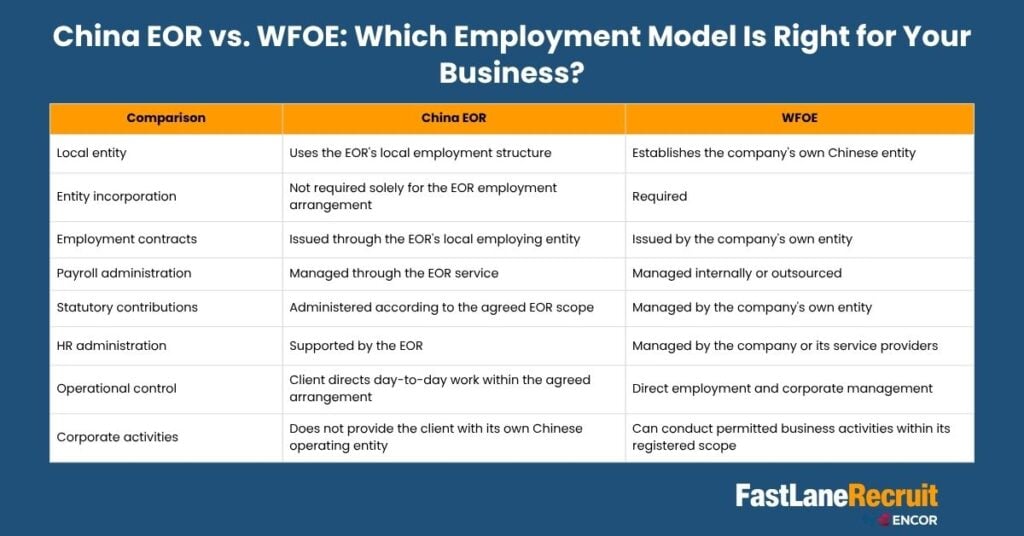
| Comparison | China EOR | WFOE |
| Local entity | Uses the EOR’s local employment structure | Establishes the company’s own Chinese entity |
| Entity incorporation | Not required solely for the EOR employment arrangement | Required |
| Employment contracts | Issued through the EOR’s local employing entity | Issued by the company’s own entity |
| Payroll administration | Managed through the EOR service | Managed internally or outsourced |
| Statutory contributions | Administered according to the agreed EOR scope | Managed by the company’s own entity |
| HR administration | Supported by the EOR | Managed by the company or its service providers |
| Operational control | Client directs day-to-day work within the agreed arrangement | Direct employment and corporate management |
| Corporate activities | Does not provide the client with its own Chinese operating entity | Can conduct permitted business activities within its registered scope |
| Best suited for | Initial hiring, smaller teams and market testing | Long-term operations and a substantial local presence |
When Should You Choose a China EOR?
A China EOR may be more appropriate if your business:
- Needs to hire one or a few employees.
- Wants to establish an initial workforce quickly.
- Is testing the Chinese market before making a larger investment.
- Wants to reduce the administrative workload associated with direct employment.
- Does not currently require its own local corporate infrastructure.
When Should You Establish a WFOE?
A WFOE may be more suitable if your company:
- Plans to build a substantial and permanent Chinese workforce.
- Needs its own local legal entity to conduct business.
- Intends to sign local customer or supplier contracts through a Chinese entity.
- Requires direct corporate control over local operations and infrastructure.
- Needs a structure to support long-term commercial activities in China.
The right decision: If your immediate priority is employing talent in mainland China without establishing a local entity, a China EOR may offer a practical starting point. If your expansion strategy requires independent local business operations, establishing a WFOE deserves closer consideration.
Businesses should also assess tax, intellectual property, commercial licensing and permanent establishment considerations before choosing an employment structure.
How to Choose the Right China Employer of Record Provider
Choosing a China EOR provider requires more than comparing service fees and onboarding promises. Businesses should understand the provider’s local employment structure, compliance capabilities and responsibility for ongoing employee administration.
Consider these factors before entering an agreement.
1. Verify the Local Employing Entity
Confirm the registered Chinese entity that will sign the employment contract and become the employer under the proposed arrangement.
Ask for its registered legal name, Unified Social Credit Code and relevant authorisations.
2. Understand the Employment Structure
Determine whether the proposed arrangement involves direct employment by the provider, labour dispatch or another legally recognised service structure.
If labour dispatch is involved, verify the relevant permit, position eligibility and applicable workforce restrictions.
3. Review Payroll and Statutory Contribution Management
Ask how the provider calculates payroll, handles IIT, processes social insurance and administers housing provident fund contributions.
A reliable provider should be able to explain the calculation basis and provide clear payroll documentation.
4. Understand Termination and Employee Liability
Review how termination requests, statutory compensation, outstanding salary and other employee entitlements are handled.
Confirm which party makes employment decisions and how costs are allocated under the service agreement.
5. Evaluate Regional Employment Support
If your business plans to hire in multiple markets, consider whether the provider can support consistent employment administration across those countries.
Working with one regional EOR partner may simplify coordination between HR, payroll and management teams.
Also Read: Global EOR Providers Compared: How to Choose the Right Partner
Why Businesses Choose FastLaneRecruit
International hiring involves coordinating local employment requirements, payroll processes and HR administration while keeping business operations on track.
FastLaneRecruit supports businesses looking to expand their workforce internationally through Employer of Record services across selected markets.
Local Employment Expertise
We support employment administration through local employment structures, helping businesses navigate country-specific contracts, payroll and statutory requirements.
China EOR and Payroll Support
Our China EOR service helps businesses manage employment contracts, payroll processing, IIT administration, social insurance and housing provident fund contributions through our China employment structure.
Simplified Market Entry
We provide an alternative to immediately establishing a separate local employing entity solely to hire employees, helping businesses assess their market-entry requirements before making a larger commitment.
Dedicated HR and Payroll Support
We support the agreed employment administration throughout the employee lifecycle, including onboarding, payroll coordination, employment documentation and offboarding.
Transparent Pricing
Our China EOR pricing starts from USD 259 per employee per month, with customised quotations available for different headcounts and employment requirements.
One Partner for Regional Expansion
FastLaneRecruit operates across multiple international markets, allowing businesses to explore employment solutions for teams in different countries through one regional service provider.
FastLaneRecruit’s Global EOR Coverage
Expanding into China may be only one part of a broader international growth strategy. As businesses develop regional teams, managing multiple employment providers can increase administrative complexity.
FastLaneRecruit provides Employer of Record services across selected markets in Asia Pacific, Europe, and the Middle East & Africa.
FastLaneRecruit operates in
- Asia Pacific: Malaysia, Singapore, Hong Kong, China, India, Philippines, Taiwan, Vietnam, Australia,
- Europe: United Kingdom, Switzerland
- Middle East & Africa: UAE, Saudi Arabia, Qatar
With coverage across 14 markets, FastLaneRecruit helps businesses explore international employment arrangements while coordinating employment documentation, payroll, statutory contributions and HR administration according to the requirements of each jurisdiction.
Whether you are hiring your first employee in China or building a workforce across several countries, our team can help assess the employment structure and support required for your expansion plans.
Ready to Hire Employees in Mainland China?
Building a team in China does not necessarily mean establishing your own local entity from the beginning. With an appropriate China Employer of Record arrangement, foreign businesses can explore local hiring while having agreed employment administration managed through a local provider.
FastLaneRecruit helps businesses navigate China employment contracts, payroll, individual income tax, social insurance and ongoing HR administration through our China EOR services.
Whether you are hiring your first employee, expanding an existing international team or evaluating a wider Asia-Pacific strategy, our team can help you understand the available employment options and associated requirements.
Speak with FastLaneRecruit about your China hiring plans and receive a tailored EOR quotation.
Book a Free Consultation with Our EOR Specialist.
Frequently Asked Questions About China Employer of Record Services
What is a China Employer of Record (EOR)?
A China Employer of Record is a local employment service arrangement through which a third-party organisation formally employs workers on behalf of a foreign company. The EOR manages agreed employment responsibilities, such as contracts, payroll, tax administration and statutory contributions, while the client company directs the employee’s day-to-day work.
Can a foreign company hire employees in China without setting up a local entity?
Yes. A foreign company can explore hiring through an appropriate local employment arrangement, such as a China EOR, without immediately establishing its own Chinese employing entity. The provider’s legal structure and applicable authorisations should be checked before employment begins.
Is using an Employer of Record legal in China?
China does not recognise EOR as a separate statutory employment category. The legality and suitability of an arrangement depend on its actual structure, the local employing entity, applicable licences and how the employment relationship operates. Labour dispatch, where used, is subject to specific licensing and role restrictions.
How much does a China EOR service cost?
China EOR costs generally include the provider’s service fee, employee salary, employer social insurance, housing provident fund contributions and other applicable employment expenses.
FastLaneRecruit’s published China EOR service fee starts from USD 259 per employee per month. Businesses can request a customised quotation based on their hiring requirements and service scope.
What does a China EOR handle for foreign employers?
Depending on the agreed service scope, a China EOR can manage employment contracts, employee onboarding, payroll processing, IIT administration, social insurance, housing provident fund contributions, HR documentation and employee offboarding.
What social insurance contributions are required for employees in China?
China’s social insurance system generally covers pension, medical, unemployment, work injury and maternity insurance. Employers and employees also generally contribute to the Housing Provident Fund. Contribution rates, salary bases and applicable arrangements vary by location and employee circumstances.
Can a China EOR hire foreign nationals?
Foreign nationals may be employed in China if they meet the applicable work authorisation requirements. Depending on the circumstances, this involves a Foreigner’s Work Permit, appropriate visa and residence documentation. An EOR arrangement does not automatically grant immigration or work authorisation.
What is the difference between China EOR and WFOE?
A China EOR allows a foreign business to employ workers through a local provider’s employment structure without establishing its own local employing entity. A WFOE is the company’s own Chinese entity, which can employ staff directly and conduct permitted business activities within its registered scope.
How long does it take to hire an employee through a China EOR?
The timeline depends on the employment structure, employee documentation, city-specific registration requirements and the complexity of the role. An EOR may reduce the time associated with incorporating a new entity, but businesses should obtain a confirmed onboarding timeline from their provider before setting a start date.
Can a company transfer employees from a China EOR to its own WFOE later?
A transition may be possible after the company establishes an appropriate local entity. However, the change must be assessed against employment contracts, employee consent where required, service continuity, statutory entitlements, payroll and tax arrangements. It should not be treated as an automatic transfer.
Does a China EOR eliminate all employment compliance risks?
No. An EOR can manage agreed local employment responsibilities, but it does not automatically eliminate every employment, tax, immigration, corporate or regulatory risk for the client company. Businesses should assess their activities, the provider’s legal structure and the responsibilities retained under the service agreement.
Can FastLaneRecruit support hiring outside mainland China?
Yes. FastLaneRecruit provides EOR services across selected markets in Asia Pacific, Europe, and the Middle East & Africa, including Malaysia, Singapore, Hong Kong, China, India, Philippines, Taiwan, Vietnam, Australia, the United Kingdom, Switzerland, UAE, Saudi Arabia and Qatar. Businesses can discuss their target countries and workforce requirements with our team.