Hiring employees internationally can open access to new talent and markets, but the employment infrastructure behind each hire matters just as much as recruitment. Businesses need compliant contracts, payroll, statutory contributions, benefits, tax administration, and ongoing HR support in every country where they employ people.
Lano vs Remote is therefore more than a feature comparison. Both platforms offer global employment solutions, but their service models, pricing structures, payroll approaches, and country coverage can differ.
This guide compares Lano vs Remote across EOR services, pricing, payroll, contractor management, integrations, compliance, and business use cases. It also explains what companies should evaluate when neither a broad global platform nor a particular provider fully matches their regional hiring requirements.
Content Outline
Key Summary
Lano and Remote Both Support International Hiring
Both providers offer Employer of Record services that allow companies to employ workers in countries where they do not have their own local entity. Lano says its EOR network supports more than 170 countries, while Remote provides global employment services across a broad international footprint.
Their EOR Delivery Models Differ
Lano states that its EOR service works through a network of local EOR partners. The local partner becomes the legal employer while Lano coordinates the service through its platform. Remote’s comparison material describes its model as a direct-entity approach in its supported markets. The exact operating model and entity structure should still be confirmed for the country where you plan to hire.
Pricing Is Only One Part of the Decision
Lano currently lists EOR pricing from €499 per employee per month. Remote’s current standard EOR price is US$699 per employee per month, although Remote also offers commercial arrangements through order forms that may include discounts.
Prices can change and may vary according to country, volume, contract terms, benefits, and additional services. A direct comparison should therefore use a like-for-like quotation.
Payroll and Workforce Structure Matter
Lano places significant emphasis on global payroll consolidation, local payroll partners, international payments, and centralized payroll data. Remote positions its platform around unified global employment, including EOR, payroll, and contractor services.
Lano vs Remote at a Glance
| Category | Lano | Remote |
| EOR | Yes | Yes |
| EOR coverage | 170+ countries stated by Lano | Broad global coverage |
| EOR model | Local EOR partner network | Direct-entity model in supported markets |
| EOR starting price | From €499/employee/month | US$699/employee/month standard price |
| Global payroll | Yes | Yes |
| Payroll consolidation | Strong focus | Available through global payroll offering |
| Contractor management | Yes | Yes |
| International payments | Yes | Yes |
| HRIS integrations | Available | Available |
| Benefits | Available | Available |
| Compliance support | Local partner network | In-house/global employment infrastructure |
| Best evaluation point | Payroll, EOR and partner-network model | EOR, payroll and unified employment platform |
Pricing and service features should be verified against the latest provider quotation before purchase. Lano’s published pricing and Remote’s current standard EOR pricing were checked in September 2026.
What Is the Difference Between Lano and Remote?
The most important difference is not simply the number of features. It is how each platform delivers global employment services.
Lano: EOR Through a Local Partner Network
Lano describes its EOR solution as a network-based model. Through its EOR partners, businesses can hire employees in countries where they do not have a legal entity. Lano and its local partner handle employment administration, including compliant contracts, payroll, and local requirements.
This model can be particularly relevant to businesses that want a centralized platform while accessing local employment infrastructure.
Remote: Unified Global Employment Platform
Remote provides EOR services alongside global payroll and contractor solutions. Its comparison material describes a direct-entity approach in supported markets, designed to reduce the number of operational handoffs involved in international employment.
For buyers, the key question is not simply which model sounds better. It is which operating model provides the appropriate legal, payroll, compliance, and support structure in the specific countries where you intend to hire.
Also Read: What Is an Employer of Record (EOR)?
Lano vs Remote: Key Differences
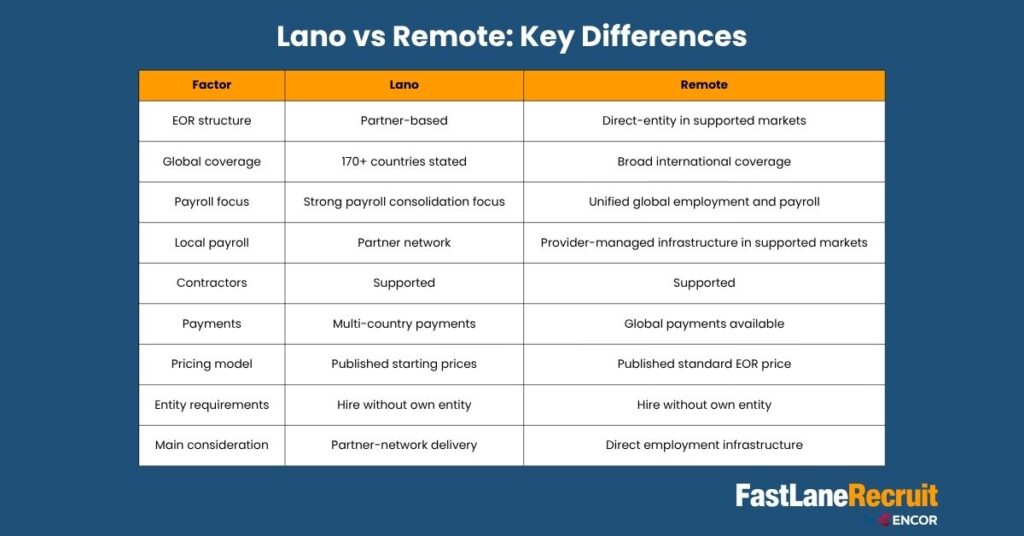
| Factor | Lano | Remote |
| EOR structure | Partner-based | Direct-entity in supported markets |
| Global coverage | 170+ countries stated | Broad international coverage |
| Payroll focus | Strong payroll consolidation focus | Unified global employment and payroll |
| Local payroll | Partner network | Provider-managed infrastructure in supported markets |
| Contractors | Supported | Supported |
| Payments | Multi-country payments | Global payments available |
| Pricing model | Published starting prices | Published standard EOR price |
| Entity requirements | Hire without own entity | Hire without own entity |
| Main consideration | Partner-network delivery | Direct employment infrastructure |
The table is a starting point rather than a substitute for country-level due diligence. EOR structures, benefits, payroll processes, and employment requirements can vary by jurisdiction.
Lano vs Remote Pricing
Pricing is one of the most common considerations when comparing EOR providers, but the lowest advertised monthly fee does not necessarily represent the lowest total cost.
Lano EOR Pricing
Lano currently lists its EOR service from €499 per employee per month. It also publishes separate starting prices for payroll consolidation, multi-country payroll, and contractor management.
Lano’s current published starting prices include:
| Service | Published starting price |
| EOR | From €499/employee/month |
| Payroll consolidation | From €3/employee/month |
| Multi-country payroll | From €19/employee/month |
| Contractor management | From €19/contractor/month |
These are starting prices, not necessarily the final price for every country or workforce configuration.
Remote EOR Pricing
Remote currently states that its standard EOR price is US$699 per employee per month. It also offers commercial arrangements through order forms, which may include discounts depending on the agreement.
How to Compare EOR Costs Properly
When requesting an EOR quotation, compare the total cost, not just the headline monthly fee.
Consider:
- EOR management fee
- Employee salary
- Statutory contributions
- Benefits
- Insurance
- Payroll administration
- Visa and immigration support
- Currency conversion
- Payment fees
- Onboarding costs
- Offboarding or termination costs
- Additional HR services
Best practice: Request a 12-month total-cost quotation based on the same employee, salary, country, benefits, and service requirements.
Lano vs Remote: EOR Features
Employer of Record
Both providers offer EOR services for companies that need to employ people without establishing their own local entity.
The EOR generally becomes the legal employer, while the client continues directing the employee’s day-to-day work. Lano explicitly describes this arrangement through its local EOR partners.
Payroll
Payroll is a major distinction in the broader service offering.
Lano emphasizes payroll consolidation and centralized payroll data, including the ability to work with existing payroll providers.
Remote positions its payroll offering within a broader global employment platform.
When evaluating either provider, confirm:
- Payroll frequency
- Payroll cut-off dates
- Local statutory calculations
- Tax withholding
- Social security contributions
- Payslips
- Year-end reporting
- Payroll correction procedures
Contractor Management
Both Lano and Remote support international contractor management.
Lano currently lists contractor management from €19 per contractor per month, while Remote’s comparison page lists contractor management at US$29 per contractor per month.
Contractor classification should still be assessed independently because a worker’s actual relationship with the business can determine whether contractor or employee treatment is appropriate.
Employee Benefits
Benefits can vary significantly between countries.
Before signing an EOR agreement, ask:
- Which statutory benefits are included?
- Which benefits are optional?
- Can benefits be customized?
- Who manages enrollment?
- What happens when an employee changes location?
- Are benefit costs included in the quoted EOR fee?
HRIS and Finance Integrations
Both platforms provide integrations with HR, finance, and workforce-management systems.
Lano highlights integrations with HRIS and finance tools, while Remote’s comparison material references integrations including Workday, HiBob, NetSuite, and BambooHR.
The important question is not simply whether an integration exists. Ask whether it supports the workflow you actually need, including:
- Employee data synchronization
- Payroll data
- New-hire onboarding
- Salary changes
- Offboarding
- Finance reporting
- API access
Lano vs Remote for Global Expansion
The right choice can change depending on how your company is expanding.
Hiring Without a Local Entity
If you are hiring your first employee in a country, an EOR can provide an employment structure without requiring your business to immediately establish its own subsidiary.
Both Lano and Remote support this type of international hiring.
Managing Multiple Existing Entities
If your company already owns subsidiaries, payroll consolidation becomes an important consideration.
Lano specifically promotes payroll consolidation, allowing businesses to bring together payroll data from multiple providers through a centralized platform.
Building a Mixed Workforce
International teams can include:
- Full-time employees
- Contractors
- EOR employees
- Employees of owned subsidiaries
When comparing providers, check whether the platform can support your workforce structure without forcing every worker into the same employment model.
Lano vs Remote: Which Should Your Business Consider?
There is no universal EOR choice for every company. Your decision should reflect your countries, workforce structure, existing entities, budget, and operational requirements.
Lano May Be Relevant If You Prioritize
- Global payroll consolidation
- A partner-network EOR model
- Centralized payroll information
- International payments
- Existing payroll-provider integration
- Published starting prices
Lano states that its EOR network covers more than 170 countries and that businesses can use existing payroll providers with its payroll consolidation service.
Remote May Be Relevant If You Prioritize
- EOR and global employment services through one platform
- Direct-entity EOR infrastructure in supported markets
- Global payroll
- Contractor management
- HRIS integrations
- A unified employment platform
Remote describes its platform as supporting EOR, direct payroll, and contractor workflows, with direct entities in its supported EOR markets.
What If You Need Strong Regional EOR Support?
A global platform is not automatically the right operational fit for every market.
If your hiring plans are concentrated across Asia Pacific, Europe, and the Middle East & Africa, evaluate whether your EOR provider has the appropriate local infrastructure and employment expertise in each target country.
This is where a regional EOR partner can be worth considering alongside large global platforms.
Why Businesses Choose FastLaneRecruit
FastLaneRecruit provides EOR and global employment solutions across Malaysia, Singapore, Hong Kong, China, India, Philippines, Taiwan, Vietnam, Australia, United Kingdom, Switzerland, UAE, Saudi Arabia, Qatar.
Local Employment Infrastructure
Our EOR model allows businesses to hire eligible employees in supported countries without establishing their own local employing entity.
Regional Compliance Expertise
Employment laws, payroll rules, statutory contributions, benefits, and employment processes differ from one country to another. Our teams support country-specific employment administration and compliance requirements.
Payroll and Statutory Administration
We can support employment contracts, payroll administration, statutory contributions, benefits coordination, and other employment processes according to the requirements of the relevant country.
Faster Market Entry
An EOR can help businesses hire their first employee or build a small team in a new market before deciding whether establishing a permanent local entity makes commercial sense.
Transparent Pricing
FastLaneRecruit focuses on clear pricing and service scope so businesses can understand their expected EOR costs before proceeding.
One Partner Across Multiple Markets
For companies expanding across several regional markets, working with one EOR partner can simplify coordination across employment, payroll, onboarding, and compliance processes.
FastLaneRecruit EOR Coverage
Our EOR services currently cover:
| Region | Countries |
| Asia Pacific | Malaysia, Singapore, Hong Kong, China, India, Philippines, Taiwan, Vietnam, Australia |
| Europe | United Kingdom, Switzerland |
| Middle East & Africa | UAE, Saudi Arabia, Qatar |
Country availability and the appropriate employment structure should always be confirmed for the specific role and hiring situation.
How FastLaneRecruit EOR Works
Step 1: Identify Your Hiring Need
Tell us where you plan to hire, the number of employees, and your intended employment structure.
Step 2: Confirm Country Requirements
We assess the relevant employment framework, payroll requirements, benefits, statutory obligations, and onboarding requirements.
Step 3: Prepare the Employment Contract
FastLaneRecruit prepares the locally appropriate employment documentation.
Step 4: Onboard the Employee
We coordinate the employment onboarding process and required documentation.
Step 5: Manage Payroll and Employment Administration
We support payroll, statutory contributions, benefits, and other applicable employment administration.
Step 6: Provide Ongoing Compliance Support
As employment requirements evolve, our team helps manage the ongoing employment lifecycle in accordance with applicable local requirements.
Questions to Ask Before Choosing an EOR
Before selecting Lano, Remote, FastLaneRecruit, or another EOR provider, ask:
- Who is the legal employer in my target country?
- Does the provider own the local entity or use an EOR partner?
- What is included in the monthly EOR fee?
- Are statutory contributions included?
- Which employee benefits are mandatory?
- What additional costs could apply?
- How are payroll errors handled?
- What is the employee onboarding timeline?
- How are terminations managed?
- Can employees later transfer to our own local entity?
- What HRIS and accounting integrations are available?
- Who handles country-specific compliance questions?
These questions can reveal differences that a basic pricing comparison may not show.
Also Read: 10 Best Employer of Record (EOR) Services To Consider in 2026
Choose the Right EOR for Your Global Hiring Plans
Lano vs Remote is ultimately a comparison of more than monthly fees. The right EOR should provide the employment structure, country coverage, payroll administration, compliance support, and operational model your business actually needs.
If your expansion plans include Malaysia, Singapore, Hong Kong, China, India, Philippines, Taiwan, Vietnam, Australia, the UK, Switzerland, UAE, Saudi Arabia, or Qatar, FastLaneRecruit can help you evaluate an EOR structure for your target market.
Rather than committing to a provider based only on a published price or country count, speak with our team about your employees, target countries, payroll requirements, and expansion plans.
Ready to Hire Internationally Without Setting Up a Local Entity?
Talk to FastLaneRecruit about your EOR requirements and get a tailored solution for your international workforce.
Book a Free Consultation with an Expert
Frequently Asked Questions About Lano vs Remote
Is Lano cheaper than Remote?
Lano currently advertises EOR pricing from €499 per employee per month, while Remote lists a standard EOR price of US$699 per employee per month. However, the currencies, country-specific costs, benefits, commercial discounts, and service scope differ, so these figures should not be treated as a direct final-cost comparison.
What is the main difference between Lano and Remote?
One key difference is their EOR delivery model. Lano states that it works with a network of local EOR partners, while Remote describes a direct-entity model in its supported markets.
Does Lano offer EOR services?
Yes. Lano offers EOR services for hiring employees in countries where a business does not have its own legal entity. Lano states that its partner network supports more than 170 countries.
Does Remote offer EOR services?
Yes. Remote offers Employer of Record services as part of its global employment platform. Its current standard EOR price is listed as US$699 per employee per month.
Can Lano and Remote manage contractors?
Yes. Both platforms offer contractor management. Published pricing should be checked against the latest provider information because pricing and service scope can change.
Which EOR is best for a company hiring in Asia?
The appropriate provider depends on the specific country, workforce structure, employment model, pricing, local support, and compliance requirements. Companies hiring across Asia should verify the provider’s actual employment infrastructure in each target market rather than relying only on global country-count claims.
Can I hire internationally without setting up a local company?
In many situations, yes. An EOR can provide a local employment structure where your company does not have its own legal entity, subject to the laws and requirements of the relevant country.
What should I compare besides EOR pricing?
Compare the legal-employer structure, country coverage, payroll process, statutory compliance, benefits, onboarding, termination procedures, contractor support, integrations, customer support, and total cost of ownership.