Hiring employees internationally without establishing a local entity can simplify global expansion, but choosing the right Employer of Record (EOR) provider requires more than comparing monthly fees.
Oyster vs Remote is a common comparison for businesses evaluating global employment platforms. Both provide EOR services, payroll support, contractor solutions, compliance assistance, and tools for managing international teams. However, they differ in areas such as country coverage, entity infrastructure, pricing, platform capabilities, and service approach.
This guide compares Oyster vs Remote across the factors that matter most when choosing an EOR, including pricing, global hiring, payroll, compliance, employee benefits, contractor management, and support.
Content Outline
Key Summary
Oyster and Remote Both Support Global Employment
Both providers offer EOR services that allow businesses to hire employees in countries where they may not have their own legal entity.
Oyster Has Broader Published Country Coverage
Oyster currently promotes hiring and compliant employment in 180+ countries, while Remote’s current EOR pricing page states that its EOR service supports hiring in 90+ countries. Country availability should still be checked for the specific position and employment arrangement before signing.
Both List EOR Pricing at $699 per Employee per Month
Oyster currently lists EOR pricing starting at $699 per employee per month, while Remote lists its standard EOR price at $699 per employee per month. Actual employment costs can vary based on country, benefits, statutory costs, and other requirements.
Entity Structure Matters
Remote states that it owns the legal entities used for its EOR service. Oyster states that its global employment solution uses a combination of owned entities and trusted partners. For businesses comparing EORs, the entity model is worth evaluating alongside price and country coverage.
The Cheapest EOR Is Not Always the Lowest-Cost Option
A useful comparison should consider the full cost of employment, including EOR fees, statutory employer costs, benefits, payroll, FX, deposits, onboarding, offboarding, and country-specific requirements.
The Right EOR Depends on Your Expansion Strategy
The best choice depends on where you are hiring, how many employees you plan to employ, your compliance requirements, workforce structure, budget, and the level of local support you need.
Oyster vs Remote: Quick Comparison
| Factor | Oyster | Remote |
| EOR | Yes | Yes |
| EOR starting price | $699/employee/month | $699/employee/month |
| Published EOR coverage | 180+ countries | 90+ countries |
| Contractor management | Yes | Yes |
| Global payroll | Yes | Yes |
| Benefits | Available | Available |
| Local compliance support | Yes | Yes |
| Entity model | Owned entities + partners | Owned entities |
| Employee management | Yes | Yes |
| Best evaluated for | Broad country coverage and global employment | Owned-entity infrastructure and integrated global employment |
Pricing and coverage can change. You should verify availability and commercial terms for their specific hiring countries.
What Is the Difference Between Oyster and Remote?
The core difference is not simply price. Both platforms provide EOR services, but their approaches to country coverage, infrastructure, technology, workforce management, and support can differ.
Oyster
Oyster positions itself as a global employment platform with EOR, contractor, payroll, benefits, and HR support. It currently promotes employment coverage in 180+ countries and emphasizes automated global hiring, localized employment information, compliance, and employee experience.
Remote
Remote provides EOR, global payroll, contractor management, benefits, and other global employment services. Its current EOR offering states that companies can hire employees in 90+ countries without establishing a local entity. Remote also emphasizes its owned-entity infrastructure and integrated employment workflows.
What This Means for Employers
The better provider depends on what matters most to your business.
If country coverage is your primary concern, Oyster’s published 180+ country coverage may be attractive.
If owned-entity infrastructure and centralized employment administration are priorities, Remote may deserve closer consideration.
However, neither factor should be evaluated in isolation. Businesses should verify the actual employment model, compliance responsibility, support structure, and costs in each country they plan to hire.
Oyster vs Remote: EOR Services
An Employer of Record becomes the legal employer of your international employee while your company retains responsibility for the employee’s day-to-day work.
A typical EOR service can cover:
- Employment contracts
- Local onboarding
- Payroll processing
- Statutory deductions
- Employer contributions
- Employee benefits
- Leave administration
- Employment compliance
- Tax-related administration
- Offboarding and termination processes
Both Oyster and Remote provide EOR services designed to help companies hire internationally without establishing their own local entity.
What to Compare Before Choosing an EOR
Don’t stop at the question, “Does this provider offer EOR?”
Ask:
- Who is the legal employer?
- Does the provider own the local entity or use a partner?
- Who handles payroll and statutory filings?
- Who manages employment contracts?
- How are benefits administered?
- Who handles termination and severance?
- What happens if local employment law changes?
- What support is available for employees?
- What additional fees apply?
- How quickly can employees be onboarded?
These questions reveal differences that a basic feature comparison can miss.
Also Read: 10 Best Employer of Record (EOR) Services To Consider in 2026
Oyster vs Remote: Pricing Comparison
Pricing is one of the most important Oyster vs Remote search queries, but headline EOR prices do not represent the entire cost of employing someone internationally.
Oyster EOR Pricing
Oyster currently lists its Employer of Record service from $699 per employee per month. It also lists Global Contractors at $29 per contractor per month and provides other global employment services.
Remote EOR Pricing
Remote currently lists its EOR service at $699 per employee per month. Its pricing page states that this includes hiring in 90+ countries, onboarding support, local payroll, compliance safeguards, localized benefits, and HR support.
Oyster vs Remote: Price at a Glance
| Cost factor | Oyster | Remote |
| EOR starting price | $699/employee/month | $699/employee/month |
| Contractor starting price | $29/contractor/month | $29/contractor/month |
| EOR onboarding | Included in standard offering | No platform/onboarding/setup fee stated |
| Benefits | May vary by plan/country | Included within EOR offering, subject to country |
| Additional services | May apply | May apply depending on service |
| Local statutory costs | Additional | Additional |
Published pricing should be treated as a starting point rather than a final employment cost. Benefits, statutory employer costs, currency conversion, country-specific requirements, and additional services can affect the total cost.
What Is the Total Cost of an EOR?
A better calculation is:
EOR fee + gross salary + employer taxes/contributions + benefits + mandatory insurance + other country-specific employment costs
Before signing an agreement, ask for a complete cost breakdown rather than comparing only the monthly platform fee.
Oyster vs Remote: Country Coverage
Country availability can determine whether an EOR is actually useful for your expansion plan.
Oyster currently advertises employment in 180+ countries, while Remote’s current EOR pricing information states coverage in 90+ countries.
However, broad coverage does not automatically mean that one provider is better.
Check Country-Level Coverage
Before choosing an EOR, confirm:
- Whether the exact country is supported
- Whether your specific employee type is supported
- The legal employment structure
- Local payroll requirements
- Statutory benefits
- Visa and work-permit requirements
- Termination rules
- Required employment documentation
- Local support availability
Country coverage should always be evaluated against your actual expansion roadmap.
Oyster vs Remote: Entity Model
The EOR’s legal infrastructure can affect compliance, control, and the way employment is administered.
Remote states that it owns the legal entities used for its EOR services. Oyster describes its global employment model as using owned entities and trusted partners.
Why Does Entity Ownership Matter?
An owned-entity model can provide greater direct control over the employment infrastructure.
A partner-supported model can provide broader geographic reach but may introduce another party into the employment chain.
Neither structure should automatically be treated as universally better.
Instead, ask:
- Who is the legal employer?
- Who controls the employment entity?
- Who is responsible for local compliance?
- Is a third-party partner involved?
- Who handles employee disputes?
- Who processes payroll?
- Who is responsible for statutory filings?
- How are employment records maintained?
The answers can be more important than the headline provider name.
Oyster vs Remote: Payroll and Benefits
Payroll is a critical part of EOR because international employees must generally be paid according to local requirements.
Oyster Payroll
Oyster provides payroll and employment administration alongside its EOR offering. Its current country availability information also lists payroll as a separate product for companies managing their own entities.
Remote Payroll
Remote provides EOR payroll as part of its employment service and also offers Global Payroll for businesses that already have legal entities abroad. Its current pricing information lists Global Payroll separately from EOR.
Benefits Administration
Benefits can include:
- Health insurance
- Statutory benefits
- Pension or retirement contributions
- Paid leave
- Supplemental benefits
- Country-specific allowances
The exact benefits available depend on the employment country and plan.
Important: Compare the benefits actually available to your employees rather than simply comparing whether “benefits” are listed as a feature.
Oyster vs Remote: Contractor Management
A business with a mixed workforce may need both employees and independent contractors.
Both Oyster and Remote provide contractor management options. Oyster currently lists Global Contractors at $29 per contractor per month, while Remote lists Contractor Management at $29 per contractor per month.
Contractor management can include:
- Contract creation
- Contractor onboarding
- Invoice management
- Payments
- Documentation
- Compliance support
- Contractor classification tools
EOR vs Contractor Management
An EOR is generally appropriate when the worker should be employed as an employee.
Contractor management is designed for genuine independent contractors.
Businesses should not choose a contractor arrangement simply because it is cheaper. Worker classification depends on the actual working relationship and applicable local law.
Oyster vs Remote: Compliance
International hiring creates compliance obligations that can vary substantially by country.
A strong EOR should help manage:
- Local employment contracts
- Payroll taxes
- Employer contributions
- Statutory benefits
- Leave requirements
- Working-time rules
- Employment documentation
- Termination procedures
- Regulatory changes
Remote emphasizes compliance safeguards, local employment support, and legal monitoring within its EOR offering.
Oyster emphasizes compliant onboarding, localized employment intelligence, contracts, payroll, and employee benefits across its global platform.
What Businesses Should Verify
Don’t rely solely on the provider’s general compliance claims.
Ask for:
- Country-specific compliance documentation
- Employment contract examples
- Details of the legal employer
- Liability and indemnity terms
- Termination procedures
- Data protection requirements
- Local payroll responsibilities
This is especially important when hiring in countries with complex employment regulations.
Oyster vs Remote: Which Is Better for Your Business?
There is no universal winner.
The right EOR depends on your workforce, countries, budget, and risk profile.
Oyster May Suit Businesses That:
- Need broad published country coverage
- Want EOR and contractor management in one platform
- Prioritize global employment tools
- Need support for distributed teams
- Value employment intelligence and localized hiring information
Oyster currently promotes employment in 180+ countries and emphasizes automated global hiring and localized compliance support.
Remote May Suit Businesses That:
- Prioritize an owned-entity EOR model
- Want centralized global employment workflows
- Need EOR, payroll, and contractor services
- Value transparent published pricing
- Want integrated employee lifecycle tools
Remote currently publishes $699 per employee per month for EOR and states that its EOR service covers 90+ countries.
Oyster vs Remote: Key Differences
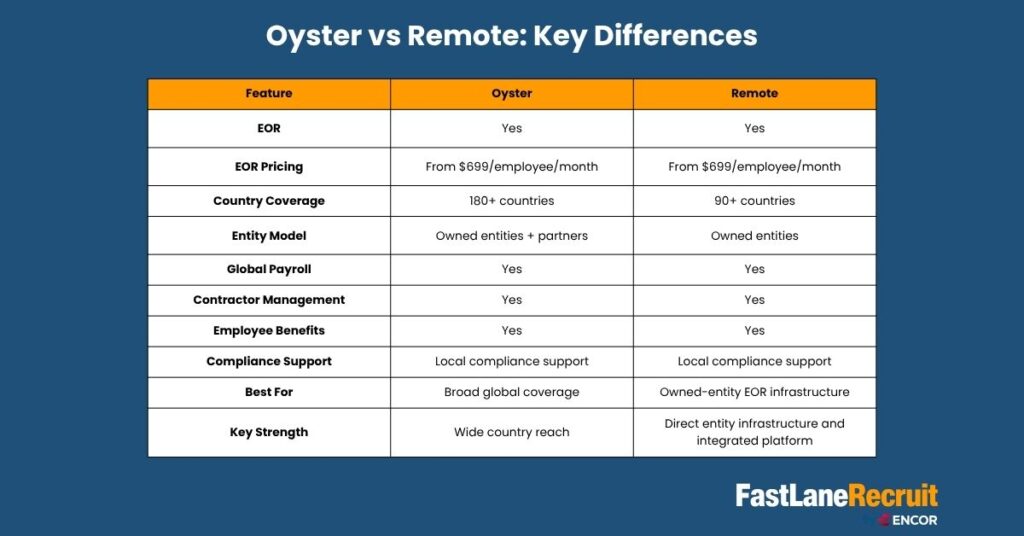
| Feature | Oyster | Remote |
| EOR | Yes | Yes |
| EOR Pricing | From $699/employee/month | From $699/employee/month |
| Country Coverage | 180+ countries | 90+ countries |
| Entity Model | Owned entities + partners | Owned entities |
| Global Payroll | Yes | Yes |
| Contractor Management | Yes | Yes |
| Employee Benefits | Yes | Yes |
| Compliance Support | Local compliance support | Local compliance support |
| Best For | Broad global coverage | Owned-entity EOR infrastructure |
| Key Strength | Wide country reach | Direct entity infrastructure and integrated platform |
Consider FastLaneRecruit If:
- Your expansion focuses on Asia-Pacific, Europe, or the Middle East
- You want EOR support across multiple markets
- You need local hiring and payroll assistance
- You want to hire without establishing a local entity
- You need support with employment compliance
- You want one partner for hiring, payroll, and workforce administration
- You are comparing EOR providers based on country-specific requirements rather than headline pricing
Why Businesses Choose FastLaneRecruit
Choosing an EOR is ultimately about more than software. Businesses need a partner that can help them navigate local employment, payroll, compliance, hiring, and workforce administration.
FastLaneRecruit provides EOR and global employment support across: Malaysia, Singapore, Hong Kong, China, India, Philippines, Taiwan, Vietnam, Australia, United Kingdom, Switzerland, UAE, Saudi Arabia, Qatar.
Hire Without Establishing a Local Entity
An EOR can allow businesses to enter a new market without immediately establishing their own subsidiary.
This can be useful when you want to:
- Test a new market
- Hire your first employee abroad
- Build a small international team
- Expand faster
- Reduce administrative complexity
- Avoid setting up a local entity before validating demand
Local Employment and Payroll Support
FastLaneRecruit can help manage key employment administration so your business can focus on managing the employee’s day-to-day work.
Depending on the country and engagement, EOR support can cover:
- Employee onboarding
- Employment contracts
- Payroll
- Statutory contributions
- Benefits administration
- Leave administration
- Employment compliance
- Offboarding
Support Your Global Expansion
Instead of selecting an EOR solely because it has the lowest advertised monthly fee, businesses should consider whether the provider can support their current hiring needs and future expansion plans.
FastLaneRecruit can support businesses expanding across multiple markets, giving employers a single partner for international employment administration.
How to Choose the Right EOR
Use this checklist before selecting an EOR provider.
| Evaluation Factor | What to Ask |
| Country coverage | Can I hire in every target market? |
| Entity model | Who is the legal employer? |
| Compliance | Who handles local employment compliance? |
| Payroll | Who calculates and processes payroll? |
| Benefits | What statutory and supplemental benefits are available? |
| Pricing | What is included in the monthly fee? |
| Additional costs | Are there FX, setup, benefits, or termination charges? |
| Support | Who handles employee and employer questions? |
| Onboarding | How quickly can employees be onboarded? |
| Offboarding | Who manages termination and severance requirements? |
| Scalability | Can the provider support expansion into additional countries? |
The Best EOR Is the One That Fits Your Hiring Model
Before choosing between Oyster, Remote, FastLaneRecruit, or another provider, identify:
Where you hire → who you hire → how many people you hire → how quickly you need them onboarded → what compliance support you need → your total employment cost.
That framework will produce a more useful decision than comparing monthly EOR fees alone.
Make Global Hiring Easier With FastLaneRecruit
Comparing Oyster vs Remote is a useful starting point, but the best EOR decision ultimately depends on your hiring countries, workforce structure, compliance requirements, and expansion goals.
If you are planning to hire internationally without establishing a local entity, FastLaneRecruit can help you manage employment, payroll, compliance, and workforce administration across multiple markets.
Ready to explore your hiring options?
Book a Free Consultation with a FastLaneRecruit EOR Expert to discuss your target country, hiring requirements, and the most suitable employment approach for your business.
Frequently Asked Questions About Oyster vs Remote
Is Oyster better than Remote?
Neither is universally better. Oyster may be attractive for businesses prioritizing broad country coverage and global employment tools, while Remote may appeal to companies prioritizing owned-entity infrastructure and integrated employment administration. The right choice depends on your target countries, workforce, and requirements.
Is Oyster cheaper than Remote?
Their currently published EOR starting prices are both $699 per employee per month. However, total employment costs can differ because statutory contributions, benefits, country-specific costs, FX, and additional services may affect the final invoice.
What is the difference between Oyster and Remote?
Both provide EOR, payroll, contractor, and global employment services. Key differences include published country coverage, entity infrastructure, platform approach, and specific service capabilities.
How many countries does Oyster support?
Oyster currently advertises employment in 180+ countries. Country availability can vary by product and employment arrangement, so businesses should confirm their specific hiring country before signing.
How many countries does Remote support?
Remote’s current EOR pricing information states that its EOR service supports hiring in 90+ countries.
Does Oyster manage payroll?
Yes. Oyster provides payroll as part of its global employment offering and also provides a separate payroll product for companies managing their own entities.
Does Remote provide payroll?
Yes. Remote provides payroll within its EOR offering and also offers Global Payroll for companies that already have legal entities abroad.
Can an EOR hire employees without a local entity?
Yes. One of the primary purposes of an EOR is to enable a business to employ workers in a country where the business does not have its own local legal entity.
What should I compare besides EOR pricing?
Compare country coverage, entity structure, compliance responsibility, payroll, benefits, onboarding, offboarding, support, FX costs, statutory requirements, and scalability.
Is FastLaneRecruit an alternative to Oyster and Remote?
Yes. FastLaneRecruit provides EOR and global employment support across selected markets in Asia-Pacific, Europe, and the Middle East, including Malaysia, Singapore, Hong Kong, China, India, Philippines, Taiwan, Vietnam, Australia, the United Kingdom, Switzerland, UAE, Saudi Arabia, and Qatar.