Managing payroll is one of the most critical yet complex functions in any business. It’s not just about paying salaries; it involves calculations, statutory contributions, tax compliance, reporting, and meeting strict deadlines. As businesses grow, the payroll process becomes more time-consuming, error-prone, and administratively burdensome.
This is where payroll outsourcing comes in. By delegating payroll operations to a specialised provider, companies can ensure accurate, timely, and fully compliant payroll processing without straining internal resources. Outsourcing payroll doesn’t just simplify administrative tasks; it also provides access to expertise, advanced technology, and strategic insights that can benefit the entire organisation.
In Malaysia, payroll outsourcing is particularly valuable due to the country’s detailed statutory requirements, multi-tiered contribution schemes (EPF, SOCSO, EIS), and tax obligations. Whether you are a growing SME, a multinational corporation, or a company employing foreign staff, outsourcing payroll can reduce compliance risks, improve employee satisfaction, and free your team to focus on strategic business growth.
In this article, we’ll explore what payroll outsourcing is, how it works in Malaysia, the key advantages it offers, and why an Employer of Record (EOR) strategy can be the smartest way for hiring Malaysian payroll talents.
Content Outline
Key Summary
Simplify Payroll Operations
Outsourcing handles salary calculations, deductions, and statutory contributions, reducing internal administrative burdens.
Ensure Regulatory Compliance
Expert providers stay updated on Malaysian laws (EPF, SOCSO, EIS, PCB, HRD Corp) to prevent penalties and audits.
Save Time and Resources
Free HR and finance teams from repetitive tasks, allowing focus on strategic initiatives like talent development and business growth.
Improve Accuracy and Reduce Errors
Automated systems and expert checks minimize mistakes in payroll, ensuring employees are paid correctly and on time.
Strengthen Data Security
Outsourced providers implement robust security, PDPA compliance, and encrypted systems to protect sensitive employee information.
Scale Payroll Seamlessly
Flexible solutions accommodate growing teams, multiple departments, foreign staff, and multi-entity operations without adding internal resources.
Enhance Employee Satisfaction
Timely, accurate payroll, digital payslips, and self-service portals boost trust, transparency, and workplace morale.
What Is Payroll Outsourcing?
Payroll outsourcing is when a company hands over its payroll responsibilities to a specialised external provider instead of managing them in-house.
In a typical business, payroll involves much more than just paying salaries. It includes calculations, compliance, reporting, and strict deadlines. Managing all of this internally can quickly become time-consuming and complex, especially as your business grows.
This is where payroll outsourcing services come in. A professional provider takes care of the entire payroll process on your behalf, ensuring everything is accurate, compliant, and completed on time.
What Does a Payroll Provider Handle?
When you choose outsourced payroll, the provider typically manages:
- Salary calculations (gross-to-net)
This includes computing basic salary, bonuses, allowances, overtime, and deductions to ensure employees are paid correctly. - Statutory contributions
Calculating and submitting mandatory contributions such as EPF, SOCSO, and EIS in accordance with Malaysian regulations. - Tax filings and compliance
Handling monthly tax deductions (PCB) and ensuring accurate submissions to LHDN. - Payslip generation and reporting
Preparing detailed payslips and maintaining payroll records for reporting and audit purposes.
What Additional Services Are Included in Malaysia?
In Malaysia, payroll outsourcing often goes beyond basic payroll processing. Many providers also offer:
- HRD Corp levy management
Calculating and submitting required employer training levies. - Leave and attendance integration
Syncing employee leave, absences, and working hours with payroll calculations. - Year-end reporting
Preparing statutory documents such as EA forms and Borang E for tax reporting.
Why Do Businesses Choose Payroll Outsourcing?
Instead of dealing with complex calculations, changing regulations, and tight deadlines internally, businesses use payroll outsourcing solutions to simplify the entire process.
In simple terms, payroll outsourcing allows you to:
- Ensure accuracy in every payroll cycle
- Stay compliant with local laws and regulations
- Protect sensitive employee data
- Reduce administrative workload for your team
A Simple Way to Think About It
Think of payroll outsourcing as having a dedicated team of experts handling one of the most critical parts of your business, so you don’t have to. You stay in control, but without the stress of managing payroll yourself.
Also Read: Payroll Specialist Salary Guide 2026
Why Malaysia? A Strategic Hub for Payroll Outsourcing
Malaysia has become a preferred destination for companies expanding into Asia due to its strong balance of cost efficiency, talent, and regulatory clarity.
1. Business-Friendly Environment
Malaysia offers a stable regulatory framework that supports foreign investment and simplifies compliance requirements.
2. Skilled and Cost-Effective Workforce
Businesses benefit from a highly educated, English-speaking workforce at competitive salary levels.
3. Structured Payroll Ecosystem
Clear statutory systems such as EPF, SOCSO, and LHDN make payroll outsourcing structured and predictable.
4. Strategic Regional Location
Malaysia serves as an ideal base for companies expanding across Southeast Asia.
When combined with payroll outsourcing services, businesses can enter and scale in Malaysia with significantly reduced operational risk.
When Should You Consider Payroll Outsourcing?
Payroll outsourcing becomes particularly valuable when:
- Your workforce is growing rapidly
- Payroll processes are becoming more complex
- You are hiring foreign employees
- You operate across multiple entities or countries
- Your HR team is spending excessive time on administrative tasks
If payroll is consuming internal resources or creating compliance risks, it is time to consider a payroll outsource strategy.
Challenges of Managing Payroll In-House
Managing payroll internally can present several challenges:
1. Compliance Complexity
Malaysia’s payroll regulations are detailed and frequently updated, increasing the risk of non-compliance.
2. Time and Resource Intensive
Payroll requires ongoing calculations, filings, and reporting that can strain HR and finance teams.
3. Risk of Errors and Penalties
Manual processes increase the likelihood of inaccuracies, which can lead to financial penalties and employee dissatisfaction.
4. Data Security Concerns
Payroll data is highly sensitive and requires strong protection measures that are costly to maintain in-house.
5. Business Continuity Risks
Payroll operations may be disrupted by staff turnover or absence.
6. Impact on Employee Trust
Inaccurate or delayed payroll can damage employee confidence and organisational credibility.
In-House Payroll vs Outsourced Payroll
| Feature | In-House Payroll | Outsourced Payroll |
| Compliance | Requires internal expertise | Managed by specialists |
| Cost | High fixed costs | Scalable pricing |
| Accuracy | Prone to errors | High accuracy |
| Security | Internal risks | Advanced protection |
| Scalability | Limited | Highly flexible |
Also Read: How to Hire Payroll Specialists in Malaysia
Key Advantages of Payroll Outsourcing in Malaysia
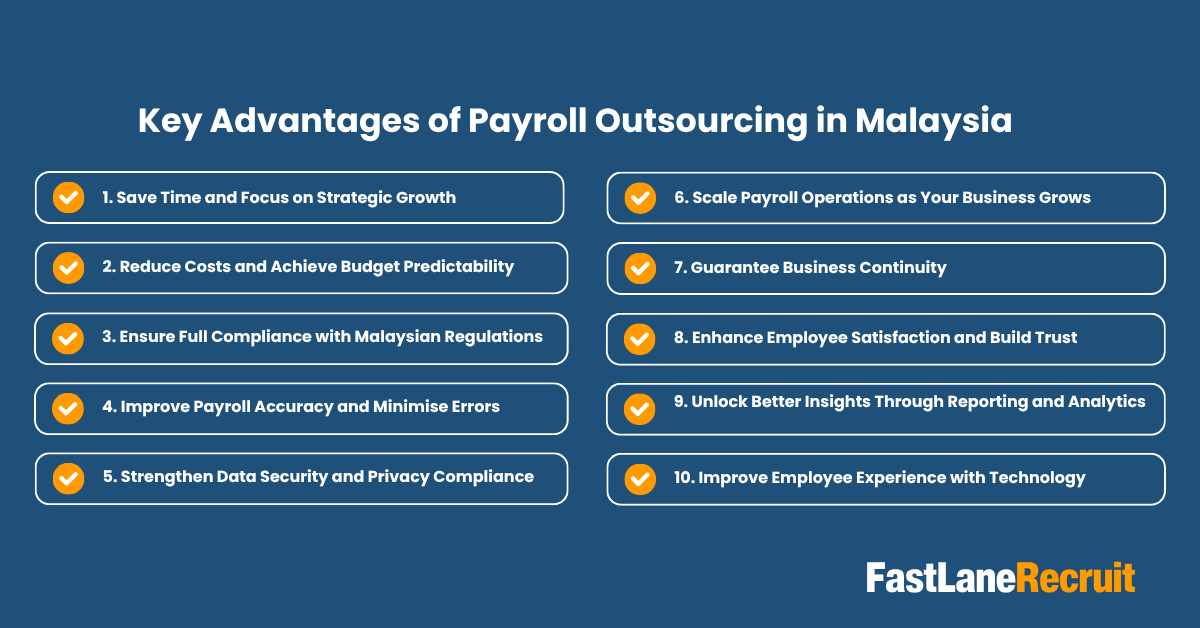
1. Save Time and Focus on Strategic Growth
Payroll management is highly repetitive, involving tasks such as calculating salaries, handling overtime, preparing payslips, and submitting statutory contributions.
Outsourcing payroll frees up your HR and finance teams from these operational tasks. This allows them to focus on activities that drive business growth, such as talent acquisition, employee engagement, training programs, and process improvement.
Example:
A mid-sized tech company with 150 employees used to spend 3–4 days every month running payroll. After outsourcing, HR could focus on recruitment campaigns and performance management initiatives, improving overall workforce productivity.
2. Reduce Costs and Achieve Budget Predictability
Maintaining an in-house payroll team is expensive. Costs include:
- Salaries for payroll staff
- Payroll software licensing and IT infrastructure
- Ongoing training for compliance updates
- Financial risk from errors and penalties
Payroll outsourcing converts these unpredictable and variable costs into a predictable monthly fee. Providers often offer scalable pricing depending on employee headcount, helping you budget accurately.
Example:
A manufacturing firm with seasonal employees avoided hiring additional payroll staff during peak periods, instead paying a flexible service fee that adjusted with workforce size. This reduced payroll-related overhead by over 25%.
3. Ensure Full Compliance with Malaysian Regulations
Malaysia’s payroll environment is complex, covering EPF, SOCSO, EIS, PCB, HRD Corp levies, and the Employment Act 2022 amendments. Compliance is not optional, mistakes can result in fines, audits, or legal penalties.
Payroll outsourcing providers stay updated on all regulatory changes, automatically adjusting calculations to reflect new rules.
Example:
Following the EPF update for foreign employees effective October 2025, an MNC outsourced payroll to ensure correct deductions and timely contributions, avoiding penalties and ensuring all statutory filings were accurate.
4. Improve Payroll Accuracy and Minimise Errors
Manual payroll calculations are prone to mistakes, from miscalculating overtime to incorrect deductions for taxes and statutory contributions. Errors can lead to employee dissatisfaction and regulatory penalties.
Dedicated payroll specialists use automated systems and checks to ensure each payroll cycle is accurate.
Example:
A retail chain with multiple outlets implemented outsourced payroll. Overtime, bonuses, and deductions for hundreds of employees were calculated automatically, reducing errors from 5–7% to less than 0.5%.
5. Strengthen Data Security and Privacy Compliance
Payroll data is highly sensitive, including salaries, bank accounts, tax IDs, and personal employee information.
Outsourced payroll providers implement advanced security measures such as:
- Data encryption
- Role-based access control
- Secure cloud storage
- PDPA compliance for employee data
Example:
Instead of storing payroll spreadsheets locally on computers or USB drives, a company’s payroll data was migrated to a secure cloud platform, protecting against internal and external threats.
6. Scale Payroll Operations as Your Business Grows
Growing companies face increasing payroll complexity, from managing more employees to handling multiple departments, locations, and pay structures.
Payroll outsourcing allows seamless scalability without needing additional HR resources or IT systems.
Example:
A tech startup grew from 50 to 300 employees in one year. Their outsourced payroll provider scaled the service effortlessly, handling new hires, multiple salary structures, and updated statutory contributions.
7. Guarantee Business Continuity
In-house payroll is often dependent on specific staff members. If they are sick, on leave, or resign, payroll processing can be disrupted, risking late payments.
Outsourced payroll providers ensure consistent processing every month, regardless of internal staffing changes.
Example:
When an HR manager resigned unexpectedly, a mid-sized company’s payroll continued smoothly because the outsourced provider had a dedicated team managing the process. Employees were paid on time, maintaining trust and avoiding dissatisfaction.
8. Enhance Employee Satisfaction and Build Trust
Employees rely on timely and accurate salary payments. Mistakes or delays can reduce morale, trust, and engagement.
Outsourced payroll services ensure employees are paid correctly and on time, improving workplace satisfaction and retention.
Example:
A retail company provided employees with digital payslips and self-service access to payroll records. Staff could verify their pay anytime, reducing payroll-related queries and improving trust in the employer.
9. Unlock Better Insights Through Reporting and Analytics
Modern payroll platforms offer advanced reporting capabilities. You can access detailed insights on:
- Total payroll costs
- Statutory contributions and tax liabilities
- Benefits usage and overtime patterns
- Department-wise labor cost allocation
These insights support strategic decisions, such as budget planning, workforce optimisation, and cost control.
Example:
A regional manufacturing company used payroll analytics to identify high overtime costs in one factory. Management implemented scheduling changes that reduced unnecessary overtime while maintaining productivity.
Also Read: Outsource Payroll Specialist Teams: A Guide for Global Employers
10. Improve Employee Experience with Technology
Many outsourced payroll providers offer digital tools that improve accessibility and transparency:
- Employee self-service portals
- Online payslips
- Leave and claims management
- Integration with HR systems
Example:
A Malaysian SME adopted an outsourced payroll platform that allowed employees to view payslips, request leave, and track benefits in real-time on their mobile phones. This reduced HR administrative queries by 40% and improved overall employee engagement.
Payroll outsourcing in Malaysia is more than a cost-saving measure. It ensures:
- Compliance with statutory regulations
- Accurate and timely payroll processing
- Enhanced security of sensitive employee data
- Access to analytics for better business decisions
- Flexibility to scale operations as the company grows
For companies of any size, especially growing businesses, those with foreign employees, or multi-entity operations, outsourcing payroll is a strategic way to reduce operational complexity, free internal resources, and improve both compliance and employee satisfaction.
How Payroll Outsourcing Works
Payroll outsourcing is more than simply paying your employees; it is a comprehensive, end-to-end solution that ensures accuracy, compliance, and efficiency while reducing the administrative burden on your HR team. Here’s what a typical outsourced payroll process includes:
1. Employee Records Management
A payroll provider maintains secure and accurate records for every employee. This includes personal details, employment contracts, banking information, tax identification numbers, leave balances, and attendance records.
Why it matters: Centralised records reduce errors, simplify reporting, and ensure compliance with Malaysia’s PDPA (Personal Data Protection Act).
Example: For a company with multiple offices, the payroll provider consolidates employee information across locations into a single platform, making it easier to calculate salaries, track leave, and generate reports for all staff.
2. Gross-to-Net Salary Calculations
Payroll specialists calculate each employee’s gross pay, including base salary, overtime, bonuses, allowances, and commissions, then deduct statutory contributions and taxes to determine the net pay.
Why it matters: Manual calculations can easily lead to errors, especially for large workforces or employees with complex pay structures. Outsourcing ensures accuracy and consistency in every payroll cycle.
Example: A retail chain with seasonal workers and commission-based sales employees relies on an outsourced provider to accurately compute irregular payments every month, ensuring employees are paid the right amount on time.
3. Statutory Compliance and Filing
Outsourced payroll providers manage all statutory obligations, including:
- EPF (Employees Provident Fund) contributions
- SOCSO (Social Security Organization) and EIS (Employment Insurance System) contributions
- PCB (Monthly tax deductions) and LHDN filings
- HRD Corp levy submissions (if applicable)
Why it matters: Malaysia’s regulations are complex and constantly updated. Missing deadlines or miscalculating contributions can result in penalties, audits, or legal risks.
Example: Following the 2025 update mandating EPF contributions for foreign employees, an MNC outsourced payroll to ensure all deductions were correctly applied for both local and foreign staff.
Also Read: Building a High-Performing Offshore HR and Payroll Management Team in Malaysia (Hong Kong Edition)
4. Payslip Generation
Modern payroll providers automate payslip creation and distribution, making it easy for employees to access their salary information digitally. Payslips typically include a detailed breakdown of gross pay, deductions, and net salary.
Why it matters: Automated payslips reduce HR queries, improve transparency, and give employees confidence that their pay is accurate.
Example: Employees in a Malaysian manufacturing company can log into a secure portal to view and download their payslips, check leave balances, and verify overtime, without contacting HR directly.
5. Year-End Reporting
Payroll outsourcing includes preparing all statutory year-end reports, such as:
- EA forms for employee tax reporting
- Annual EPF and SOCSO reconciliations
- Summary reports for LHDN submissions
Why it matters: Year-end reporting is critical for tax compliance and audit readiness. Outsourced providers ensure all filings are accurate and submitted on time, reducing the risk of penalties.
Example: A mid-sized service company relies on the provider to generate EA forms for 200 employees automatically, saving weeks of manual work and avoiding errors in tax filings.
6. Optional Additional Services
Some providers also offer value-added features such as:
- Leave and attendance integration with payroll
- Automated overtime and bonus calculations
- Multi-country payroll management for companies with regional operations
- Detailed payroll analytics for cost control and decision-making
Example: A regional company with offices in Malaysia, Singapore, and Thailand uses a single outsourced payroll provider to manage multi-country compliance, consolidate reporting, and provide insights for regional HR strategy.
Summary
Payroll outsourcing is a full-service solution that goes beyond simply paying employees. By combining accurate salary calculations, statutory compliance, secure record-keeping, automated payslips, and comprehensive reporting, it allows businesses to:
- Reduce operational complexity
- Avoid compliance risks
- Improve employee satisfaction
- Gain actionable insights for strategic decision-making
In short, outsourcing payroll transforms a time-consuming administrative task into a streamlined, reliable, and compliant process, freeing your internal team to focus on business growth.
Real-World Use Cases of Payroll Outsourcing in Malaysia
Payroll outsourcing is not just a theoretical solution, it’s applied by many organisations across different industries in Malaysia to improve efficiency, compliance, and employee satisfaction. Below are some practical examples of how businesses benefit:
1. Retail and Seasonal Businesses
Retail and hospitality companies often experience dramatic fluctuations in staffing, especially during peak seasons like Hari Raya, Chinese New Year, or year-end sales periods. Hiring temporary or contract staff adds complexity to payroll management, making manual processing prone to errors and delays.
How payroll outsourcing helps:
- Accurately calculate salaries, overtime, and bonuses for both permanent and temporary staff
- Manage statutory contributions (EPF, SOCSO, EIS) for seasonal employees
- Scale payroll operations up or down without hiring additional in-house staff
Example: A large retail chain in Kuala Lumpur with multiple outlets during the festive season relies on a payroll provider to manage hundreds of temporary staff. This ensures all employees are paid on time and all statutory submissions are completed without overloading the HR team.
2. Manufacturing Companies with Foreign Workers
Manufacturing companies in Malaysia often employ foreign workers, which introduces additional statutory requirements. Recent regulatory updates, such as mandatory EPF contributions for foreign employees (effective October 2025), have increased the complexity of payroll management.
How payroll outsourcing helps:
- Ensure accurate calculation of contributions for foreign employees according to the latest regulations
- Reduce compliance risks and avoid potential penalties
- Integrate foreign worker payroll into the overall system seamlessly
Example: A manufacturing plant in Selangor employs over 300 foreign workers. By outsourcing payroll, the company ensures EPF contributions, SOCSO, and EIS deductions are correctly applied, maintaining compliance and avoiding disruptions to payroll cycles.
Also Read: Building a High-Performing Offshore HR and Payroll Management Team in Malaysia (Singapore Edition)
3. Multinational Corporations (MNCs)
MNCs operating in Malaysia may also have offices in multiple countries, each with its own payroll and tax regulations. Managing payroll in-house across jurisdictions can be highly complex, time-consuming, and error-prone.
How payroll outsourcing helps:
- Centralise payroll processing across countries through a single platform
- Maintain consistent compliance with local labour laws and statutory contributions
- Generate consolidated reports for regional finance and HR teams
Example: An MNC headquartered in Kuala Lumpur with operations in Singapore, Indonesia, and Thailand uses an outsourced provider to manage payroll for all locations. This ensures compliance in every jurisdiction, reduces administrative overhead, and provides unified reporting for the regional management team.
4. Multi-Entity Organisations
Some companies operate multiple subsidiaries or legal entities, each with different payroll structures, benefits, and compliance requirements. Managing payroll separately for each entity can lead to duplication of work, errors, and higher administrative costs.
How payroll outsourcing helps:
- Consolidate payroll operations under a single provider while maintaining entity-level compliance
- Standardise payroll processes and reporting across subsidiaries
- Simplify audits, statutory reporting, and HR operations
Example: A Malaysian conglomerate with five SSM-registered subsidiaries across property, logistics, and financial services consolidates payroll under a single provider. The provider ensures accurate processing for each entity, compliance with statutory obligations, and consistent reporting, all while reducing administrative overhead at the group level.
Summary
From seasonal retailers to large MNCs and multi-entity corporations, payroll outsourcing in Malaysia provides a flexible, accurate, and compliant solution to complex payroll challenges. Businesses can scale payroll operations, ensure statutory compliance, and free internal teams to focus on growth and strategic priorities, while employees enjoy timely and accurate salaries.
How to Choose the Right Payroll Outsourcing Provider
Selecting the right payroll outsourcing service is essential for long-term success.
1. Local Compliance Expertise
Ensure the provider has in-depth knowledge of Malaysian regulations.
2. Advanced Technology
Look for cloud-based systems with automation and integration capabilities.
3. Strong Data Security
Confirm compliance with PDPA and implementation of robust security protocols.
4. Dedicated Support
Choose a provider with responsive service and proactive compliance updates.
5. Proven Track Record
Work with providers that have experience supporting businesses similar to yours.
Also Read: Comprehensive Guide to Payroll Management in Malaysia
Payroll Outsourcing and EOR: The Smartest Expansion Strategy
For international companies looking to enter the Malaysian market, simply outsourcing payroll is not enough. To legally hire payroll specialists in Malaysia without establishing a local entity, you need an Employer of Record (EOR) solution.
An EOR acts as the legal employer of your staff in Malaysia while you retain full control over day-to-day operations. When combined with payroll outsourcing services, it provides a seamless way to expand your workforce efficiently, compliantly, and without the administrative burden of setting up a local company.
How FastLaneRecruit’s EOR Works for Your Business
- Hire Malaysian Payroll Specialists Quickly and Legally
- The EOR assumes the legal responsibilities of employment, allowing you to onboard local talent immediately.
- You avoid the time, cost, and complexity of registering a Malaysian entity.
- Run Compliant Payroll Operations
- Payroll is handled by experts who calculate salaries, manage deductions, and generate payslips in line with Malaysian regulations.
- Employees are paid accurately and on time, maintaining trust and engagement.
- Manage Taxes and Statutory Contributions
- The EOR ensures all mandatory contributions, including EPF, SOCSO, EIS, HRD Corp levies, and PCB (income tax), are submitted correctly and on time.
- Compliance with the latest labour laws and statutory updates is guaranteed, reducing the risk of fines or penalties.
- Scale and Expand Efficiently
- Whether you’re hiring 5 or 500 employees, EOR provides a flexible and scalable solution.
- Expansion into Malaysia or other SEA markets becomes faster and less resource-intensive, letting your company focus on growth instead of administrative hurdles.
In short, this approach lets you expand into Malaysia efficiently, compliantly, and with minimal risk, while keeping your internal team focused on strategic business objectives.
Conclusion
As payroll complexity increases, outsourcing becomes a strategic necessity.
Payroll outsourcing helps businesses:
- Maintain compliance
- Reduce operational costs
- Improve accuracy and efficiency
- Scale across markets.
Ready to Hire Malaysian Payroll Specialists with Ease?
Expand into Malaysia without the hassle of setting up a local entity. With FastLaneRecruit’s EOR, you can:
- Onboard qualified Malaysian payroll specialists quickly and legally
- Ensure compliant payroll operations with EPF, SOCSO, EIS, HRD Corp, and PCB are fully managed
- Scale your workforce efficiently as your business grows in Malaysia or across SEA
Take the next step in your expansion strategy. Partner with FastLaneRecruit today to hire locally, stay compliant, and focus on growing your business. Get Started with FastLaneRecruit EOR!