Expanding your team internationally can be exciting but it also comes with challenges: navigating foreign legal entities, managing complex payroll, and ensuring compliance with local labor laws in every new country. This is where Employer of Record (EOR) services can make a difference.
Whether you’re a startup testing new markets or an established company scaling internationally, an Employer of Record (EOR) gives you a faster, safer, and more cost-effective way to hire talent anywhere in the world, without setting up a local entity.
In this guide, we’ll break down everything you need to know about EORs, how they work, when to use them, and why countries like Malaysia are becoming top destinations for global hiring.
Content Outline
Key Summary
What an EOR Does
An Employer of Record legally hires employees on your behalf while you manage daily work, tasks, and performance.
Full-Service Support
EOR services cover payroll, taxes, benefits, onboarding, compliance, and offboarding, making global employment seamless.
Why Companies Use EORs
Firms use EORs to expand quickly, access international talent, stay compliant, reduce costs, and scale teams flexibly.
When to Use an EOR
Ideal for entering new markets, testing regions, hiring remote staff, converting contractors, or retaining employees relocating abroad.
EOR vs PEO vs Entity Setup
EOR: no local entity, fast and flexible. PEO: co-employment, requires local entity. Entity setup: full control, high cost, long-term commitment.
Risks to Manage
Potential issues include being deemed the actual employer, compliance gaps, tax risks, IP concerns, and visa limitations, mitigated through contracts and due diligence.
Malaysia as a Hiring Hub
Malaysia offers skilled talent, strong English proficiency, competitive salaries, favorable business policies, and strategic APAC time zone alignment.
What Is an Employer of Record (EOR)?
An Employer of Record (EOR) is a third-party provider that legally employs workers on behalf of your company in another country.
While the EOR becomes the official legal employer, you still:
- Manage the employee’s daily work
- Assign tasks and projects
- Oversee performance and growth
Meanwhile, the EOR handles:
- Payroll and salary payments
- Tax filings and statutory contributions
- Employment contracts
- Benefits and insurance
- Compliance with local labor laws
In short:
You manage the work. The EOR manages the employment.
Also Read: Top 10 Reasons to Use an Employer of Record (EOR)
How Employer of Record Services Work
An EOR model typically involves three parties:
1. Your Company (Client)
- Sources and selects talent
- Manages day-to-day responsibilities
- Controls performance and compensation decisions
2. The EOR Provider
- Acts as the legal employer
- Issues compliant employment contracts
- Handles payroll, taxes, and benefits
- Ensures local labor law compliance
3. The Employee
- Works directly with your team
- Receives salary and benefits from the EOR
This structure allows you to hire globally without setting up a foreign entity, saving months of setup time and high costs.
What Do Employer of Record Services Include?
Most employer of record services provide end-to-end support across the entire employee lifecycle, from hiring to exit, so you don’t have to manage complex employment processes in each country.
Here’s a closer look at what’s typically included:
Global Payroll Management
Managing payroll across different countries can be complicated due to varying currencies, tax systems, and payment regulations.
An EOR handles:
- Salary payments in the employee’s local currency
- Payslip generation and payroll reporting
- Accurate deductions for taxes and social contributions
- Timely payments in line with local requirements
This ensures employees are paid correctly and on time, without you needing to understand local payroll systems.
Employment Law Compliance
Every country has its own labor laws, which can change frequently and vary significantly.
An EOR ensures:
- Employment contracts comply with local regulations
- Working hours, leave entitlements, and termination rules are followed
- Your company avoids legal risks, penalties, or disputes
This is one of the most critical aspects of employer of record services.
Onboarding and Contract Management
Hiring internationally involves more than just offering a job.
The EOR manages:
- Drafting legally compliant employment contracts
- Collecting required documentation
- Setting up employees in local systems
- Ensuring smooth and compliant onboarding
This helps new hires start quickly and without administrative delays.
Also Read: Hiring Globally: PEO, EOR, and Global Talent
Benefits Administration
Employee benefits vary widely across countries and are often legally required.
An EOR handles:
- Health insurance and medical benefits
- Paid leave and public holiday entitlements
- Pension or retirement contributions
- Additional perks depending on local standards
This ensures employees receive competitive and compliant benefits packages.
Tax and Statutory Contributions
Employers are required to make various contributions depending on the country.
The EOR manages:
- Income tax withholding
- Social security contributions
- Mandatory government schemes (e.g., pensions, insurance)
- Filing and reporting to local authorities
This reduces the risk of errors, penalties, or compliance issues.
Offboarding and Termination Handling
Ending employment in another country can be legally sensitive and complex.
An EOR ensures:
- Proper notice periods are followed
- Severance pay (if required) is calculated correctly
- Final payments and documentation are handled properly
- Terminations comply with local labor laws
This protects your company from legal disputes and reputational risk.
Why This Matters
Without an EOR, you would need to:
- Set up a local entity in each country
- Hire local HR, legal, and finance teams
- Manage payroll, compliance, and employee administration yourself
This is time-consuming, expensive, and risky.
By using employer of record services, you can:
- Centralize all employment operations
- Reduce administrative burden
- Ensure full compliance across multiple countries
- Focus on growing your business instead of managing complexity
Why Companies Use Employer of Record Services
As global hiring becomes more common, many companies are turning to employer of record services to simplify international expansion. Instead of dealing with complex legal, tax, and HR requirements in multiple countries, an EOR provides a faster and more efficient solution.
Here are the key reasons why companies choose this model:
1. Expand Globally Without Setting Up an Entity
Traditionally, hiring in another country requires setting up a local legal entity. This process can take 3–6 months (or longer) and involves:
- Business registration
- Legal and tax setup
- Local compliance approvals
It also comes with high upfront and ongoing costs.
With an EOR, you can:
- Hire employees in new markets within days
- Skip the incorporation process entirely
- Enter and test markets with minimal risk
This makes it an ideal solution for companies exploring international expansion without long-term commitment.
Also Read: Incorporation vs EoR in Malaysia
2. Hire International Talent Easily
The best talent is no longer limited by geography. However, hiring internationally can be complicated due to local employment laws and administrative requirements.
Employer of record services make it easy to:
- Hire employees in different countries without relocation
- Access highly skilled global talent pools
- Build diverse and specialized teams
This is especially valuable in competitive industries like tech, finance, and digital services where talent shortages are common.
3. Stay Fully Compliant
Each country has its own employment laws, tax regulations, and statutory requirements. Failing to comply can result in:
- Fines and penalties
- Legal disputes
- Reputational damage
An EOR helps reduce these risks by ensuring:
- Employment contracts are legally compliant
- Payroll and tax filings are accurate and timely
- Labor laws (working hours, leave, termination) are followed
This gives companies peace of mind when hiring across borders.
4. Reduce Costs
Expanding internationally can be expensive if you go the traditional route.
Using employer of record services helps you avoid:
- Entity setup and maintenance costs
- Legal and accounting fees in multiple countries
- Hiring local HR and payroll teams
- Infrastructure and operational overhead
Instead, you pay a predictable fee, making it easier to manage budgets and scale efficiently.
5. Scale Faster and More Flexibly
Business needs can change quickly, especially in new markets.
With an EOR, you can:
- Start with one employee and scale up as needed
- Quickly enter or exit a market
- Adjust team size based on business demand
This flexibility allows companies to grow without being locked into long-term commitments or complex structures.
6. Support Remote and Distributed Teams
Remote work has become the norm for many organizations, but managing a distributed workforce across multiple countries can be challenging.
Employer of record services enable you to:
- Build remote or hybrid teams across different regions
- Support employees working from their home countries
- Maintain compliance regardless of where your team is located
This is especially useful for companies adopting a remote-first strategy or managing global teams.
Why This Matters
In today’s fast-moving global economy, companies need to be agile, compliant, and cost-efficient.
Employer of record services provide a practical solution by:
- Removing barriers to international hiring
- Reducing risk and complexity
- Enabling faster global growth
They allow you to focus on building your team and scaling your business, without getting slowed down by administrative challenges.
Also Read: Employer of Record vs. Staffing Agency
When Should You Use an Employer of Record?
Employer of record services are not just for large multinational companies, they’re especially useful for startups, SMEs, and fast-growing businesses that want to expand globally without taking on unnecessary risk.
If you’re unsure whether an EOR is right for you, here are the most common scenarios where it makes the most sense:
1. Enter a New Market Quickly
If you want to hire in a new country, setting up a legal entity can significantly delay your plans.
With an EOR, you can:
- Hire employees in days instead of months
- Start operations immediately
- Avoid lengthy incorporation and regulatory processes
This is ideal when speed is critical, such as launching a new product, setting up a sales presence, or responding to market demand.
2. Test a Country Before Long-Term Investment
Expanding into a new market always comes with uncertainty.
An EOR allows you to:
- Test the market with a small team
- Evaluate business potential before committing
- Exit easily if the market doesn’t perform as expected
This “test-first” approach helps reduce financial and operational risk.
3. Hire Remote Employees Globally
As remote work becomes more common, companies are no longer limited to hiring within their home country.
However, hiring internationally comes with legal and compliance challenges.
An EOR makes it easy to:
- Hire talent from anywhere in the world
- Support fully remote or distributed teams
- Ensure compliance regardless of employee location
This is especially useful for companies building global teams across multiple regions.
4. Convert Contractors into Full-Time Employees
Many companies start by hiring freelancers or contractors in other countries. However, this can create risks such as worker misclassification, which may lead to fines or backdated tax liabilities.
Using an EOR, you can:
- Transition contractors into full-time employees compliantly
- Provide proper benefits and job security
- Reduce legal and tax risks
This is a smart move when you want to retain top talent and build a more stable workforce.
5. Retain Employees Relocating Abroad
Sometimes, valuable employees choose to move to another country for personal reasons.
Without an EOR, you may have to:
- Let the employee go
- Or go through the complex process of setting up a local entity
An EOR allows you to:
- Continue employing the individual legally in their new location
- Maintain team continuity and reduce turnover
- Support employee flexibility and satisfaction
6. Manage Short-Term or Project-Based Hiring
If you need talent for a specific project or a limited period, setting up a legal entity is often not practical.
An EOR enables you to:
- Hire quickly for short-term needs
- Scale teams up or down based on project demands
- Avoid long-term administrative commitments
Why This Matters
Global expansion doesn’t have to be all-or-nothing.
If you’re unsure about committing to a new market, an EOR offers a low-risk, flexible entry strategy that allows you to:
- Move quickly
- Stay compliant
- Control costs
- Adapt as your business evolves
Also Read: How to Switch Your EOR Provider
Employer of Record vs PEO vs Entity Setup
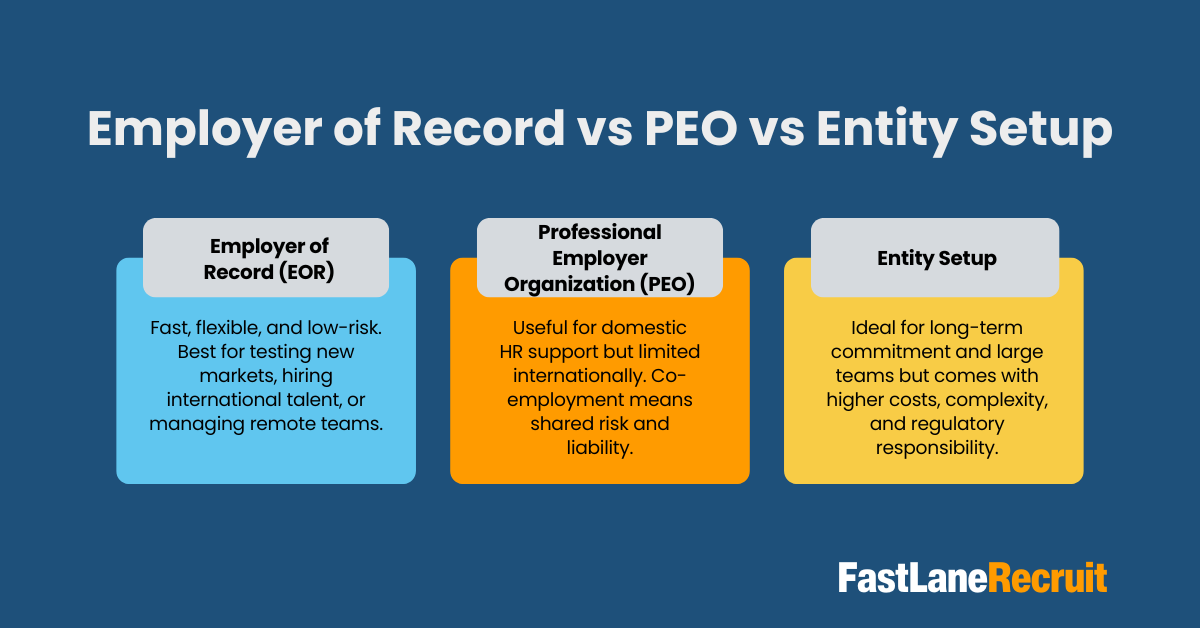
When expanding your business globally, it’s important to understand the differences between an Employer of Record (EOR), a Professional Employer Organization (PEO), and setting up your own legal entity. Each option has its advantages, costs, and ideal use cases.
1. Employer of Record (EOR)
An EOR is a third-party provider that becomes the legal employer of your staff in another country, while you continue to manage their daily work.
Key points:
- No local entity required: You don’t need to register a company in the country where your employee works.
- Legal employer: The EOR handles employment contracts, payroll, taxes, statutory benefits, and compliance with local labor laws.
- Best for international hiring: Ideal for quickly entering new markets or hiring remote employees abroad without administrative overhead.
- Flexible and fast: You can hire one employee or an entire team in days, instead of months.
2. Professional Employer Organization (PEO)
A PEO creates a co-employment arrangement, meaning both your company and the PEO share responsibilities for your employees.
Key points:
- Requires a local entity: Your business must already have a legal presence in the country or state.
- Shared employment responsibility: Payroll, taxes, and HR tasks are managed jointly, but you still carry some liability for compliance issues.
- Mainly for domestic HR outsourcing: Best for companies looking to streamline HR processes within their home country rather than international expansion.
- Good for established operations: PEOs are helpful when you want HR support but already have a stable, local workforce.
3. Entity Setup (Opening a Local Company)
Setting up your own legal entity means your business becomes the direct employer, taking full responsibility for compliance, taxes, and local employment regulations.
Key points:
- Full control: You have complete authority over contracts, payroll, HR policies, and benefits.
- High cost and complexity: Incorporation fees, legal compliance, accounting, and ongoing HR administration can be significant.
- Suitable for long-term, large-scale expansion: Best for companies planning to hire multiple employees or establish a permanent presence in the country.
- Time-consuming: Can take 3–6 months (or more) depending on local regulations.
Bottom Line
- EOR: Fast, flexible, and low-risk. Best for testing new markets, hiring international talent, or managing remote teams.
- PEO: Useful for domestic HR support but limited internationally. Co-employment means shared risk and liability.
- Entity Setup: Ideal for long-term commitment and large teams but comes with higher costs, complexity, and regulatory responsibility.
In short: If speed, flexibility, and global reach are your priorities, an EOR is usually the best option.
| Feature / Option | EOR (Employer of Record) | PEO (Professional Employer Organization) | Entity Setup (Local Company) |
| Local entity required? | No | Yes | Yes |
| Legal employer | EOR is the legal employer | Shared (co-employment) | Your company is the legal employer |
| Compliance responsibility | EOR handles all local employment laws, taxes, and benefits | Shared between you and PEO | Your company handles everything |
| Best for | International hiring, remote teams, fast market entry | Domestic HR outsourcing | Long-term, large-scale expansion |
| Speed of setup | Days | Weeks | Months |
| Cost | Moderate | Moderate | High |
| Control over employees | You manage daily work; EOR manages employment | Shared | Full control |
| Risk | Low | Shared risk | High (full responsibility) |
Key Risks to Be Aware Of And How to Avoid Them
Employer of Record services make global hiring much easier, but there are some important risks you should manage to protect your business. Here’s what to watch out for, along with practical tips to prevent or fix them:
1. Being Deemed the Actual Employer
- What can happen: If your company directs work, sets schedules, or makes key HR decisions without clear boundaries, local authorities might treat your company as the legal employer. This could lead to taxes, penalties, or employment law liability.
- How to avoid/fix:
- Clearly define the division of responsibilities in contracts with your EOR.
- Keep a documented workflow showing that the EOR handles payroll, benefits, and compliance.
- Regularly review local employment laws to ensure your practices don’t blur the line.
2. Compliance Gaps
- What can happen: Not all EOR providers have the same level of local expertise. Missing tax filings, incorrect employment contracts, or insufficient benefits can cause fines, lawsuits, or reputational damage.
- How to avoid/fix:
- Vet your EOR carefully: check local licenses, references, and compliance track record.
- Include contractual obligations for compliance monitoring and audits.
- Periodically review EOR performance and request proof of filings and regulatory adherence.
3. Permanent Establishment (PE) Risk
- What can happen: Hiring employees in another country may create a taxable presence, depending on their role and authority. This could trigger corporate tax liabilities in that country.
- How to avoid/fix:
- Limit employee authority for contract-signing or financial decisions.
- Consult tax advisors before hiring in a new market.
- Structure roles to avoid activities that could create PE.
4. Intellectual Property (IP) & Confidentiality Risks
- What can happen: If contracts don’t clearly define ownership of IP or obligations around sensitive information, you could lose control of company assets or face legal disputes.
- How to avoid/fix:
- Include explicit IP assignment clauses in contracts.
- Define confidentiality obligations and post-employment restrictions.
- Regularly review contracts to ensure they comply with local laws.
5. Immigration & Visa Limitations
- What can happen: Not all EORs can sponsor visas for foreign employees. Attempting to hire without the proper authorization can lead to fines or legal penalties.
- How to avoid/fix:
- Confirm visa sponsorship capabilities before hiring international talent.
- Work with an immigration expert if employees require work permits.
- Keep documentation of visa approvals and employment eligibility verification.
Tip: Always have a formal risk review before entering a new market. Combining a trusted EOR with local legal and tax advice helps minimize risks while enabling smooth global hiring.
Also Read: 7 Strategic Benefits of Using an EOR for Talent Acquisition
Best Practices for Successfully Using Employer of Record (EOR) Services
Using an Employer of Record can simplify global hiring, but maximizing its benefits requires careful planning. Follow these expert-backed best practices to ensure smooth operations and minimize risk:
1. Choose a Reputable EOR Partner
- Why it matters: Your EOR is legally responsible for your employees, so their reliability directly affects your business.
- What to look for:
- Strong local presence: They should have a legal entity or partnership in the countries you plan to hire in.
- Proven compliance track record: Check references, licenses, and history of regulatory adherence.
- Transparent pricing: Ensure all fees, including payroll, benefits, and administrative costs, are clearly outlined.
- Support capabilities: Confirm they offer assistance for onboarding, offboarding, and HR-related inquiries.
2. Clearly Define Roles and Responsibilities
- Why it matters: Miscommunication between your company and the EOR can lead to legal complications or being deemed the actual employer.
- How to implement:
- Draft detailed agreements specifying which party handles payroll, benefits, taxes, contracts, and compliance.
- Document who manages daily tasks, performance evaluations, and reporting to ensure clarity.
- Review agreements periodically to adapt to evolving business needs or local laws.
3. Conduct Regular Compliance Checks
- Why it matters: Even a trusted EOR can make mistakes, and local laws may change frequently.
- What to check:
- Payroll accuracy: Ensure employees are paid correctly and on time in local currency.
- Tax filings: Confirm all statutory deductions, social security contributions, and filings are up to date.
- Employment contracts: Verify that contracts comply with local labor laws and include mandatory benefits.
- Benefits administration: Check that health insurance, pensions, and leave policies meet local requirements.
4. Protect Your Business Interests
- Why it matters: Your intellectual property, sensitive data, and business strategies are valuable assets.
- How to safeguard:
- Include clear IP ownership clauses in employee contracts to protect work created during employment.
- Add confidentiality agreements to prevent unauthorized sharing of sensitive information.
- Ensure data protection compliance with local and international regulations, such as GDPR.
- Consider post-employment clauses to prevent poaching or misuse of company assets.
5. Ask the Right Questions Before Partnering
- Why it matters: The right questions help you evaluate whether the EOR can meet your company’s specific needs.
- Key questions to ask:
- Do they have a legal entity in the country or region?
- Are they licensed where required by local authorities?
- How do they ensure compliance with employment, tax, and labor laws?
- Who is responsible for termination liabilities and severance costs?
- Do they provide platform tools or reporting to track employee status, payroll, and compliance easily?
Tip: Treat the EOR as a strategic partner, not just an administrative service. Regular communication, clear documentation, and proactive monitoring will ensure you get the full benefits of global hiring while minimizing risk.
Also Read: The Pros and Cons of Employers of Record
How Much Do Employer of Record (EOR) Services Cost?
The cost of using an Employer of Record can vary depending on several key factors, but most providers offer predictable, per-employee pricing. Understanding the components that drive cost can help you plan your budget effectively.
1. Country of Employment
- Local labor laws, tax regulations, and social security requirements differ widely between countries.
- Countries with stricter employment regulations or higher compliance costs often result in higher EOR fees.
- For example, hiring in Western Europe or Japan is typically more expensive than in parts of Southeast Asia due to local benefits mandates and tax structures.
2. Employee Salary Level
- EOR fees are often calculated as a percentage of the employee’s gross salary or as a flat monthly fee.
- Higher-salary positions may incur higher fees, as payroll management, tax withholding, and benefits administration can be more complex.
3. Benefits Package
- The scope of benefits provided by the EOR will impact pricing.
- Standard packages typically include health insurance, retirement contributions, and statutory leave.
- Expanded packages with additional perks, such as wellness programs, extra vacation, or specialized insurance, may increase costs.
4. Scope of Services
- Basic EOR services typically include payroll, employment contracts, and compliance management.
- More comprehensive packages might include onboarding support, performance tracking, HR reporting, visa sponsorship, or contractor management.
- The broader the service coverage, the higher the monthly fee.
5. Fee Structure
- Most EOR providers charge a predictable monthly fee per employee, making it easy to forecast costs as your team grows.
- Some providers may offer volume discounts for larger teams or multi-country deployments.
- Transparent pricing allows you to scale your global workforce without unexpected expenses.
Tip: When budgeting for EOR services, always compare the cost of using an EOR with the alternative, setting up a local legal entity. Establishing your own entity can take months and cost tens of thousands of dollars per country, whereas an EOR allows you to hire legally in days with minimal upfront costs.
Why Malaysia Is an Ideal Choice for Global Hiring
If your company is looking to expand in Asia, Malaysia stands out as one of the most strategic destinations for building a global workforce. Several factors make it particularly attractive for international companies:
1. Highly Skilled Workforce
Malaysia has a growing pool of professionals with expertise in technology, finance, digital marketing, and engineering. This talent is capable of supporting both local operations and regional business functions.
2. Strong English Proficiency
English is widely spoken and used as the language of business, which makes communication with global teams and clients seamless.
3. Competitive Salary Levels
Compared with neighboring markets such as Hong Kong, Singapore, or Japan, Malaysia offers competitive compensation for high-quality talent. This allows companies to access skilled employees at a lower cost without compromising quality.
4. Supportive Business Environment
Malaysia’s government actively encourages foreign investment and provides incentives for businesses entering the market. Policies around taxation, employment, and foreign ownership are generally favorable for international companies.
5. Time Zone Alignment
Located in the heart of Southeast Asia, Malaysia’s time zone aligns well with APAC markets, making collaboration across the region efficient and convenient.
Overall, Malaysia offers the ideal balance of cost, talent quality, and accessibility, making it a smart choice for companies looking to scale their operations in Asia.
Also Read: EOR Services: A Game Changer for Startup Growth
How Employer of Record Services Simplify Hiring in Malaysia
Setting up a local legal entity in Malaysia can be complex and time-consuming, often taking several months to complete. Employer of record (EOR) services provide a faster, simpler alternative:
- Hire Malaysian Talent Quickly: Onboard skilled employees in days instead of months.
- Ensure Compliance with Local Laws: EOR providers manage employment contracts, statutory benefits, and labor law requirements to avoid regulatory issues.
- Simplify Payroll Management: Handle monthly payroll, EPF (Employees Provident Fund), and SOCSO (Social Security Organization) contributions seamlessly.
- Scale Your Team Efficiently: Add new employees without building a local HR, legal, or finance team.
By using an EOR, companies can expand into Malaysia safely, efficiently, and with minimal administrative burden.
Why Choose FastLaneRecruit for Employer of Record Services
FastLaneRecruit helps global companies hire and scale teams in high-growth markets like Malaysia. Our EOR solution is designed to make the process simple and compliant while giving you access to top-tier talent.
With FastLaneRecruit, you benefit from:
- Fast Onboarding of International Talent: Reduce delays in hiring and start building your team immediately.
- Full Compliance with Local Regulations: All employment, tax, and social security obligations are managed accurately.
- End-to-End Payroll and HR Management: Payroll, benefits, and HR administration are handled entirely by our team.
- Access to Skilled Malaysian Professionals: Connect with qualified talent across industries such as tech, finance, and digital.
- Dedicated Regional Expertise: Receive guidance and support from experts familiar with Malaysia’s labor and business environment.
FastLaneRecruit not only helps you hire employees but also supports the creation of a scalable, high-performing team that can grow with your global operations.
Conclusion
Expanding globally doesn’t have to be complicated or risky. Employer of Record (EOR) services provide a practical, efficient solution for companies looking to hire international talent without the burden of setting up local entities. By managing payroll, compliance, benefits, and legal obligations, EORs let you focus on growing your business, scaling teams, and accessing top talent worldwide.
For companies eyeing strategic markets like Malaysia, EOR services allow rapid hiring, legal compliance, and operational efficiency, all while reducing costs and administrative complexity. Choosing the right EOR partner, like FastLaneRecruit, ensures a seamless global hiring experience and empowers your business to expand with confidence and agility.
Ready to Hire Globally Without the Hassle?
If you’re planning to expand internationally or build a team in Malaysia, employer of record services can help you move faster with less risk.
Talk to FastLaneRecruit today and discover how we can support your global hiring strategy.