

When global tech firms consider scaling their DevOps capabilities, traditional offshoring hubs such as Eastern Europe or Latin America often top the list. But another destination is quietly making waves: Malaysia. With a confluence of digital infrastructure investment, multilingual talent, strategic time zone alignment, and supportive government policies, Malaysia is emerging as a go-to for offshore DevOps engineering.
This article explores:
- Whether DevOps can truly work with offshore teams
- Why Malaysia is uniquely suited for offshore DevOps
- Key advantages, best practices, and pitfalls to avoid
- How FastLaneRecruit’s EOR service helps global companies hire Malaysian DevOps engineers compliantly
Let’s dive into the details.
Content Outline
Key Summary
Offshore DevOps Is Feasible With Structure
Running DevOps with offshore teams works when supported by clear processes, structured communication, and modern tooling. Challenges like time-zone differences, cultural alignment, and scope clarity can be mitigated with disciplined practices.
Malaysia Offers a Strategic Offshore Advantage
Malaysia provides cost-effective, English-proficient, and tech-skilled talent. Its strategic location in APAC, robust digital infrastructure, and supportive government initiatives make it a rising offshore DevOps hub.
Cost Efficiency Without Compromising Quality
Hiring Malaysian DevOps engineers can reduce labor costs by 30–50% compared to Western markets, while maintaining high standards in CI/CD, cloud management, and software quality.
Best Practices Maximize Offshore Success
Onboard culture early, define ownership clearly, design overlapping sync windows, adopt mature DevOps tooling, maintain documentation, and implement continuous retrospectives to ensure efficiency and alignment.
Malaysia Compared to Other Offshoring Hubs
Malaysia balances affordability, high infrastructure maturity, moderate time-zone overlap, and strong English proficiency. Compared to India, Philippines, Eastern Europe, or Latin America, it offers a stable, lower-risk environment for global DevOps operations.
FastLaneRecruit’s EOR Service Simplifies Offshore Hiring
With FastLaneRecruit as your EOR, you can hire Malaysian DevOps engineers quickly and legally — no local entity required. We handle payroll, compliance, and onboarding, so your team can focus on what matters: building, shipping, and scaling DevOps operations.
Can You Run DevOps with an Offshore Team?
Short answer: yes, but with discipline and thoughtful structures.
DevOps is all about breaking down silos between development and operations. It emphasizes collaboration, automation, and continuous feedback to deliver better software, faster.
When you add offshore teams into the mix, such as engineers working remotely from Malaysia, it introduces new dimensions of coordination. While this setup can seem complex, it’s absolutely possible with the right systems, mindset, and tools.
Let’s look at the key challenges and how successful companies overcome them.
Also Read: Top Professional SEO Services in the US
Common Challenges and How to Overcome Them
| Challenge | What It Means | How to Handle It (Tips & Best Practices) |
| Communication Gaps | Offshore teams may not share the same first language or communication style, which can lead to misunderstandings or delayed responses. | Establish structured communication routines. Use tools like Slack or Microsoft Teams for daily chat, and video calls for weekly syncs. Create detailed documentation and use project trackers like Jira or ClickUp to keep everyone aligned. |
| Time-Zone Mismatches | Different time zones can slow down feedback loops, especially if a U.S. team needs approvals from an Asia-based team during non-working hours. | Design 2–4 hours of overlapping work time for real-time collaboration. You can also adopt a “follow-the-sun” model, where your Malaysia DevOps engineers continue work while your U.S. team is offline, ensuring 24-hour progress. |
| Cultural & Expectation Misalignment | Differences in work culture (e.g., communication style, hierarchy, decision-making speed) can create friction. | Invest in cultural onboarding. Encourage your offshore engineers to join company-wide meetings, social chats, or virtual events. Some companies even do “culture buddy” pairings, assigning one local and one offshore teammate to foster rapport. |
| Quality Drift | Without consistent standards, remote teams might interpret requirements differently, leading to inconsistent code or testing results. | Create clear coding standards and CI/CD guidelines. Use version control (Git), code reviews (GitHub, Bitbucket), and automated testing pipelines to ensure consistent quality across regions. Schedule retrospectives to continuously improve workflows. |
| Scope Creep & Handoff Confusion | When tasks are distributed across continents, ownership boundaries can blur, leading to duplicate work or missed responsibilities. | Define clear SLAs (Service Level Agreements), RACI charts (Responsible, Accountable, Consulted, Informed), and handoff procedures. Tools like Asana, Notion, or Confluence help keep documentation transparent. |
How Offshore DevOps Actually Works — Example in Action
Imagine a U.S.-based SaaS company that needs to accelerate software releases but can’t scale locally due to high costs. They hire a DevOps team in Malaysia through an Employer of Record (EOR) like FastLaneRecruit.
Here’s how they operate:
- Shared Pipelines, Continuous Integration (CI/CD):
The U.S. development team pushes code to GitHub at the end of their day. Overnight, the Malaysian DevOps team runs automated tests, deploys to staging, and monitors system health.
By the time the U.S. team starts the next morning, results and feedback are ready, with no downtime.
- 24/7 Monitoring and Infrastructure Management:
Malaysian engineers handle infrastructure provisioning, cloud cost optimization, and incident response during U.S. off-hours. This ensures round-the-clock uptime and faster incident resolution.
- Collaborative Communication and Documentation:
Both teams share the same Jira board and Slack channels. Updates, commits, and retrospectives are logged so that no information is lost. This “follow-the-sun” workflow boosts productivity while maintaining quality control.
Why It Works When Done Right
Offshore DevOps works because it aligns with the very principles DevOps was built on: automation, iteration, and transparency.
When you combine these with structured management and modern communication tools, you can achieve:
- Faster release cycles – since work continues across time zones
- Improved code quality – via shared pipelines and consistent testing
- Lower operational costs – offshore engineers often cost 40–60% less than local hires
- Access to diverse expertise – different regions bring unique strengths (for instance, Malaysia’s engineers are often strong in cloud technologies and cybersecurity)
Also Read: How to Successfully Outsource Data Engineering
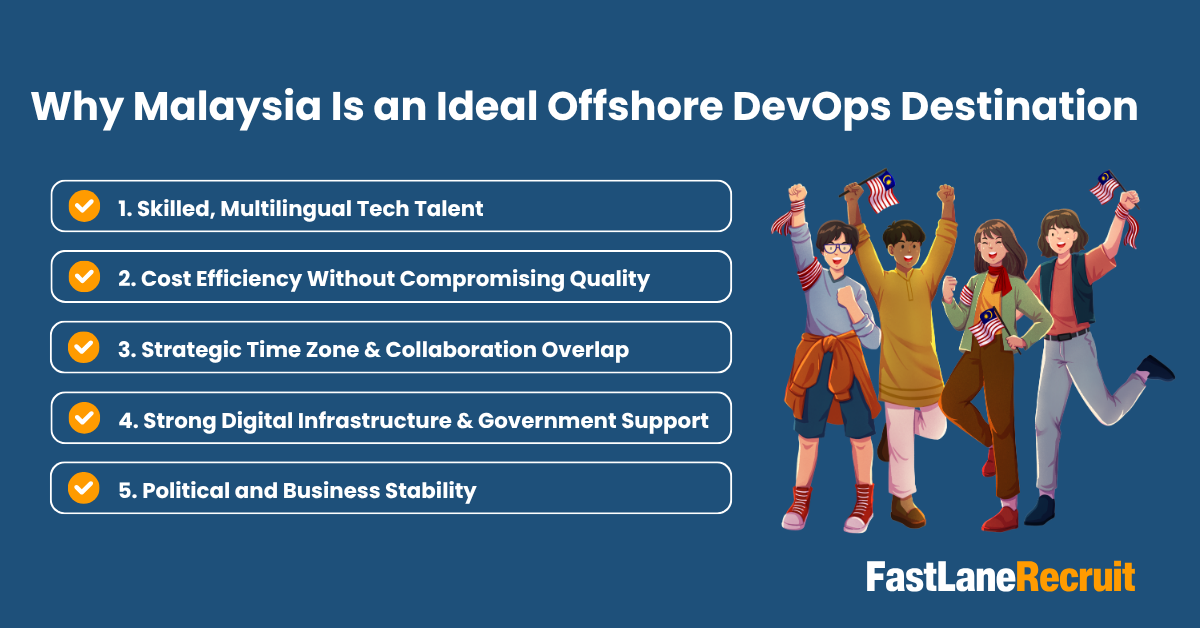
Why Malaysia Is an Ideal Offshore DevOps Destination
Malaysia is not just another low-cost alternative. It offers a compelling mix of talent, stability, infrastructure and strategic incentives. Below are the key advantages.
1. Skilled, Multilingual Tech Talent
- Malaysia produces a steady stream of IT graduates; industry sources estimate thousands per year.
- A high level of English proficiency helps bridge communication; Malaysia often scores well in regional English capability rankings.
- The workforce is typically multilingual (Malay, English, Mandarin, Tamil), improving cross-cultural adaptability.
2. Cost Efficiency Without Compromising Quality
- Outsourcing to Malaysia can save 30–50 % (or more) compared to equivalent Western engineering rates.
- Lower overheads (office, benefits, real estate, taxes) reduce total cost of employment.
3. Strategic Time Zone & Collaboration Overlap
Malaysia is in GMT+8. This provides:
- Reasonable overlap with APAC (Singapore, Hong Kong, Australia)
- Partial overlap with European morning hours
- A workable but smaller overlap with U.S. markets (you may need “late” and “early” sync windows)
Because Malaysia is close to major Asian hubs, intra-Asia collaboration is especially smooth.
4. Strong Digital Infrastructure & Government Support
- Malaysia’s digital economy is projected to reach US $31 billion in gross merchandise value in 2024, a 16 % increase from 2023.
- The Malaysia Digital Economy Corporation (MDEC) is the government agency spearheading digital transformation and attracting tech investment.
- The MSC (Multimedia Super Corridor) and MSC Cyberport in Johor are dedicated ICT hubs hosting tech firms.
- The government is actively laying the groundwork for emerging technologies (AI, digital services) via initiatives and policy support.
- Large investments by global tech companies (Microsoft, Google, Oracle) in cloud, AI, and data infrastructure underscore Malaysia’s push to become a regional digital hub.
5. Political and Business Stability
While no country is risk-free, Malaysia is considered politically stable for business with established legal frameworks, protections for IP, and regulated corporate governance. Its strategic location in ASEAN also gives access to regional trade and partners.
Also Read: Data Engineering Salary Guide 2025
How Malaysia Compares to Other Offshoring Hubs
When evaluating where to build or expand an offshore DevOps team, factors like cost, infrastructure, and cultural compatibility make all the difference. 🇲🇾 Malaysia stands out as a strategic midpoint — affordable, stable, and technically strong — without the talent saturation or high attrition common in other offshoring hubs.
Comparative Overview
| Region / Country | Relative Cost | Infrastructure Maturity | Time-Zone Overlap | English Proficiency | Risks / Considerations |
| Malaysia | Medium–Low | High (advanced data centers, strong internet backbone, and cloud adoption) | Moderate overlap with APAC, partial with EU | High (English widely used in business and IT) | Smaller tech talent pool than India or the Philippines |
| India / Philippines | Low | High (long-established IT ecosystems) | High overlap with U.S. | High | Talent saturation, high attrition, and varying quality levels |
| Eastern Europe (Poland, Ukraine, Romania) | Medium | Very High (especially for cybersecurity, DevOps, and cloud engineering) | Low–Medium with APAC | High | Cultural drift with APAC clients, higher costs than Asia |
| Latin America (Mexico, Colombia, Brazil) | Medium | Medium | Excellent overlap with U.S. | Medium–High | Time difference with APAC, occasional political/economic instability |
Malaysia often strikes the balance, offering strong technical education, stable governance, and an English-speaking environment. It’s especially attractive for APAC-based companies or U.S. firms that need hybrid support spanning Asia and global time zones.
Average Monthly Salary Comparison for DevOps Engineers (2025 Estimates)
| Region / Country | Junior DevOps Engineer | Mid-Level DevOps Engineer | Senior DevOps Engineer |
| Malaysia | RM 6,000 – RM 9,000 (≈ USD 1,250 – 1,900) | RM 9,000 – RM 14,000 (≈ USD 1,900 – 3,000) | RM 14,000 – RM 22,000 (≈ USD 3,000 – 4,600) |
| Eastern Europe | USD 1,800 – 3,000 | USD 3,000 – 5,000 | USD 5,000 – 7,500 |
| Latin America | USD 1,700 – 2,800 | USD 2,800 – 4,800 | USD 4,800 – 7,000 |
| U.S. / Western Europe | USD 4,500 – 6,500 | USD 6,500 – 9,000 | USD 9,000 – 14,000 |
Note: Salaries are indicative of base pay before bonuses or benefits. Malaysian DevOps talent often brings a strong command of AWS, Azure, and containerization tools like Docker and Kubernetes, making them cost-efficient yet highly capable hires.
Malaysia delivers a rare combination of:
- Cost-efficiency with strong English fluency
- Modern infrastructure and cloud readiness
- Cultural alignment with global businesses
- Stable political and economic environment
For companies looking to scale DevOps capacity offshore, Malaysia represents a strategic, sustainable option that balances quality and cost while reducing operational risks.
Also Read: Hiring Data Engineer in Malaysia
Best Practices for Running Offshore DevOps in Malaysia
Offshoring DevOps can deliver significant cost savings and productivity gains, but only when managed with the right structure, tools, and culture. Malaysia offers a strong foundation for offshore DevOps operations thanks to its skilled workforce, high English proficiency, and stable infrastructure. To realize the full potential of your Malaysian DevOps team, follow these best practices:
1. Onboard Culture & Values Early
A DevOps culture thrives on shared ownership, transparency, and collaboration. When building an offshore team in Malaysia, cultural onboarding is just as important as technical onboarding.
Recommendations:
- Run “bootcamp weeks” during the first month, focusing on your company’s mission, coding standards, and communication norms.
- Include interactive sessions, e.g. live code reviews, architecture walkthroughs, or pair programming, to instill best practices.
- Assign mentors or culture champions from the headquarters team to guide offshore members during their first 90 days.
Example:
A U.S.-based SaaS company hosting an offshore DevOps team in Kuala Lumpur runs a “Company DNA Week”, introducing Malaysian engineers to their CI/CD philosophy, sprint rituals, and code review expectations through daily workshops.
2. Define Clear Ownership & Boundaries
Without clarity, offshore DevOps models can suffer from overlap confusion or responsibility gaps. Defining what your offshore team owns prevents delays and accountability issues.
Recommendations:
- Use a RACI matrix (Responsible, Accountable, Consulted, Informed) for all core functions, e.g. CI/CD pipeline, infrastructure provisioning, release approvals, monitoring.
- Establish clear escalation protocols: who resolves what, and when.
- Create interface agreements between teams, e.g., “The offshore team owns staging and deployment automation; HQ owns production release approvals.”
Example:
If your Malaysian team manages Kubernetes clusters, define specific parameters like “offshore team handles pod scaling and monitoring; HQ oversees production security policies.”
3. Design Overlapping Sync Windows
Time zone differences are manageable, but only with structured overlap. Since Malaysia (GMT+8) differs from Western markets, intentional scheduling ensures collaboration flow.
Recommendations:
- Allocate 2–4 hours of overlap for live standups, pair debugging, or joint sprint planning.
- Outside overlap hours, rely on asynchronous tools such as Jira, Confluence, or Notion for updates and documentation.
- Use tools like Slack “huddles” or Zoom recorded standups to bridge timing gaps.
Also Read: Data Engineer Hiring Guide
Example:
A Singapore HQ and U.K. offshore setup might set 3 p.m.–6 p.m. MYT as overlap time, perfect for both sides to align daily before handing off tasks overnight.
4. Adopt Mature DevOps Tooling and Metrics
Visibility drives trust and accountability. When teams are distributed, shared dashboards and real-time data keep everyone aligned on pipeline health and delivery outcomes.
Recommendations:
- Implement monitoring tools like Grafana, Datadog, or Prometheus to track CI/CD pipeline metrics.
- Measure key indicators such as:
- Deployment frequency
- Lead time for changes
- Mean Time to Recovery (MTTR)
- Change failure rate
- Share these dashboards across both local and offshore teams so performance is transparent and measurable.
Example:
A Malaysian offshore team maintaining AWS infrastructure can set up Grafana dashboards linked to CloudWatch and Slack alerts for deployment errors or latency spikes.
Also Read: Why Should You Hire Data Engineers in Malaysia?
5. Continuous Retrospective & Process Improvement
DevOps is about continuous learning. Regular retrospectives ensure the collaboration model evolves, reducing friction and increasing delivery velocity.
Recommendations:
- Run biweekly retrospectives that include both onshore and offshore participants.
- Encourage open, blameless feedback on what’s working and what’s not.
- Use outcome-based metrics (e.g., faster recovery times, reduced rollback rates) to measure improvement.
Example:
If the offshore team reports build queue delays, action items could include provisioning additional Jenkins agents or moving to GitHub Actions for scalability.
6. Invest in Shared Knowledge Bases & Documentation
Documentation is your single source of truth when working across geographies. It reduces dependency on real-time communication and helps onboard new hires faster.
Recommendations:
- Maintain an internal wiki or knowledge base using tools like Confluence, Notion, or GitBook.
- Store runbooks, incident postmortems, and architecture diagrams in shared repositories.
- Keep documentation version-controlled, e.g., via Git for infrastructure-as-code repositories.
Example:
The Malaysian DevOps team contributes to an internal Notion workspace with sections for “CI/CD Deployment Guide,” “Monitoring Escalation Steps,” and “Weekly Learning Notes.”
7. Plan for Redundancies and Knowledge Sharing
Avoid single points of failure, particularly in specialized roles like SRE, security automation, or CI/CD pipeline management.
Recommendations:
- Implement cross-training and shadowing across teams.
- Use a rotation model for critical functions (e.g. on-call duties or release management).
- Back up all operational documentation and automation scripts.
- Record key training sessions and store them in your internal learning hub.
Example:
A Malaysian DevOps engineer who specializes in Terraform provisioning could rotate quarterly with a peer managing Kubernetes clusters to balance skills across the team.
How FastLaneRecruit’s EOR Service Enables Offshore DevOps in Malaysia
Outsourcing DevOps to Malaysia isn’t just about technology; it’s also about legal, payroll, compliance, and local HR. That’s where FastLaneRecruit’s EOR service becomes a powerful enabler.
- Legal Employer: FastLaneRecruit acts as the legal employer in Malaysia, handling employment contracts, statutory deductions, contributions (such as EPF, SOCSO), and local compliance.
- Payroll & HR Administration: You don’t need to navigate Malaysia’s payroll intricacies; the EOR handles salary disbursement, benefits, and deductions.
- Rapid Onboarding: Open positions can be onboarded faster without entity setup, reducing time-to-deployment.
- Maintain Control: You retain full operational control over the DevOps function, while FastLaneRecruit handles the back-office legal, HR, and compliance workload.
- Risk Mitigation: The EOR monitors changes in Malaysia’s labor laws and ensures your offshore team remains fully compliant.
Using an EOR model removes the need for your company to register a Malaysian entity, contract with local authorities, or manage benefits logistics, allowing you to focus on building and operating your DevOps practice instead.
If you’re ready to explore outsourcing Malaysian DevOps engineers, we invite you to book a call with FastLaneRecruit’s EOR team and begin your offshore expansion journey.
Also Read: The Pros and Cons of Outsourcing Data Analytics Team
Conclusion
In conclusion, DevOps can thrive with offshore teams when supported by clear structures, the right tools, and strong alignment between onshore and offshore members. Malaysia stands out as a strategic offshore hub, offering cost efficiency, reliable infrastructure, government incentives, and English-speaking technical talent.
By following best practices in collaboration, ownership, and tooling, companies can bridge the offshore-onshore divide and accelerate delivery. With FastLaneRecruit’s EOR solution, you can hire Malaysian DevOps engineers legally, safely, and efficiently without the complexities of establishing a local entity.
Build Your DevOps Dream Team — Seamlessly and Globally
Thinking about setting up an offshore DevOps team? With FastLaneRecruit’s Employer of Record (EOR) service, you can hire top Malaysian DevOps engineers quickly, compliantly, and without setting up a local entity.
We’ll handle payroll, contracts, compliance, and onboarding, so you can stay focused on scaling your infrastructure and delivery pipeline, not the paperwork.
Start your offshore DevOps transformation today.
Book a Call with FastLaneRecruit and discover how easy global hiring can be.
