
Global businesses are under increasing pressure to manage finances accurately while staying focused on growth. From startups to multinational companies, managing accounting internally can quickly become complex as operations expand across markets. That’s why many organisations are turning to accounting outsourcing. By partnering with experienced professionals, companies can streamline financial management, maintain compliance, and gain valuable insights that support better decision-making.
Among Asian outsourcing destinations, Malaysia has emerged as a popular hub for accounting services. With a strong talent pool, advanced digital capabilities, and a business-friendly environment, Malaysian accounting professionals help companies operate efficiently while supporting global expansion.
In this guide, we explore why companies outsource accounting to Malaysia, what services are commonly outsourced, and how businesses can benefit from this strategic approach.
Content Outline
Key Summary
Operational Efficiency
Outsourcing accounting reduces administrative workloads, streamlines processes, and allows internal teams to focus on core business functions.
Access to Expert Talent
Partnering with Malaysian accountants provides access to certified professionals familiar with international standards and cross-border compliance.
Scalability
Outsourced accounting services can scale with business growth, whether adding payroll support, tax filings, or multi-country reporting.
Compliance and Accuracy
Professional accounting teams ensure adherence to local regulations, tax filings, and financial reporting standards, reducing the risk of errors or penalties.
Focus on Strategic Growth
By delegating routine accounting tasks, leadership can focus on product development, investor relations, and market expansion.
Wide Range of Services
Outsourcing can cover bookkeeping, payroll, accounts payable/receivable, financial reporting, tax compliance, and audit preparation.
Offshore Hiring via EOR
Businesses can hire Malaysian accountants as part of their dedicated team through FastLaneRecruit, without establishing a local entity, ensuring compliance and flexibility.
What Is Accounting Outsourcing?
Accounting outsourcing refers to delegating financial tasks to an external team or service provider instead of managing them entirely in-house.
Companies may outsource a wide range of accounting functions, including bookkeeping, payroll processing, tax compliance, and financial reporting. This allows businesses to access experienced professionals without the time and resources required to recruit and maintain a full internal finance team.
For many organisations, outsourced accounting becomes a strategic partnership that provides both operational support and financial insights.
Why Malaysia Is Becoming a Global Accounting Outsourcing Hub
Malaysia has steadily positioned itself as a preferred location for accounting and finance outsourcing, particularly for companies expanding into the Asia-Pacific region.
Several factors contribute to this growing reputation.
1. Strong Accounting Talent Pool
Malaysia produces a large number of accounting and finance graduates each year, many of whom hold internationally recognised certifications such as ACCA and CPA.
Professional standards are supported by organisations such as the Malaysian Institute of Accountants, which regulates the profession and promotes ethical accounting practices.
This strong professional ecosystem allows companies to access accountants with experience in international financial reporting and cross-border compliance.
2. English-Proficient Workforce
English is widely used in Malaysia’s professional environment. This makes communication easier for international companies working with Malaysian accounting teams.
Clear communication is especially important for financial reporting, audit preparation, and regulatory compliance.
3. Strategic Location for APAC Operations
Malaysia’s location within Southeast Asia makes it an effective hub for companies managing regional operations.
Accounting professionals often support businesses operating across multiple jurisdictions, helping them stay compliant with local tax and reporting regulations.
For example, companies may need guidance on tax submissions through the Inland Revenue Board of Malaysia or compliance with Malaysian Financial Reporting Standards.
4. Advanced Digital Accounting Ecosystem
Malaysia has adopted modern accounting technologies such as cloud-based platforms, automation tools, and data analytics systems.
These tools allow outsourced accounting teams to collaborate remotely while providing real-time financial insights for decision-makers.
Also Read: Why Malaysia Is a Strategic Hub for Offshore Accountants
Key Benefits of Outsourcing Accounting to Malaysia
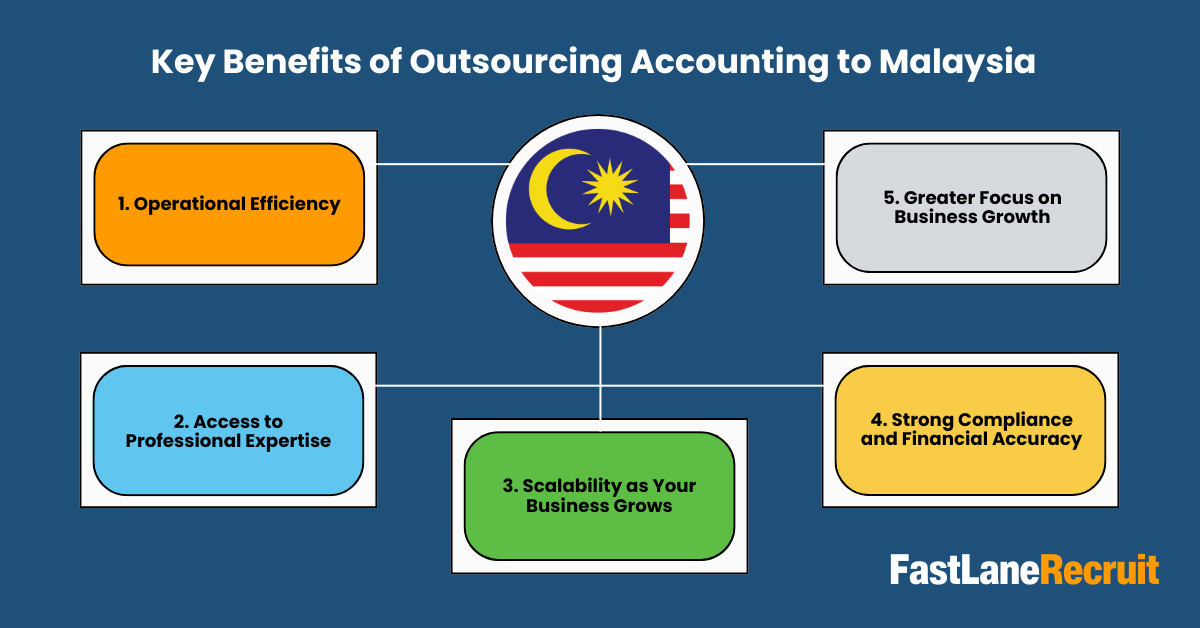
Outsourcing accounting functions to Malaysia offers more than just administrative support. It allows businesses to improve operational efficiency, gain access to professional expertise, and maintain strong financial compliance while focusing on long-term growth. Below are some of the key advantages and how they support companies operating locally or internationally.
1. Operational Efficiency
Managing accounting internally often requires significant time and coordination. Tasks such as recording transactions, reconciling accounts, preparing reports, and managing payroll can quickly consume valuable resources.
By outsourcing these functions, businesses can streamline financial processes and reduce the workload on internal teams. Experienced accounting professionals already have established systems and workflows in place, allowing them to complete tasks accurately and efficiently.
Example:
A growing e-commerce company based in the United States may outsource bookkeeping to a Malaysian accounting team. Instead of spending hours each week updating financial records, the internal team receives organised monthly reports that are ready for review and decision-making.
2. Access to Professional Expertise
Outsourced accounting teams often consist of professionals with specialised knowledge in financial reporting, tax compliance, payroll management, and international accounting standards.
Malaysia has a strong community of qualified accountants supported by organisations such as the Malaysian Institute of Accountants. Many professionals hold internationally recognised certifications and are familiar with global accounting practices.
Working with experienced professionals allows businesses to benefit from insights that go beyond simple bookkeeping.
Example:
A technology startup expanding into Southeast Asia may rely on Malaysian accountants to prepare financial statements and ensure reporting aligns with international standards. This helps the company maintain accurate financial data for investors and stakeholders.
3. Scalability as Your Business Grows
One of the biggest advantages of outsourcing accounting is flexibility. Businesses can increase or adjust accounting support depending on their stage of growth.
For example, during periods of expansion, companies may need additional support for payroll processing, financial reporting, or tax filings. Outsourced accounting services allow companies to scale their support without going through lengthy recruitment processes.
Example:
| Business Stage | Accounting Needs | How Outsourcing Helps |
| Startup | Basic bookkeeping and payroll | External accountants manage daily transactions |
| Growing company | Monthly financial reports and tax filings | Outsourced team handles increasing financial complexity |
| Regional expansion | Multi-country reporting and compliance | Experienced accountants support international operations |
This flexibility allows businesses to grow without constantly restructuring their internal finance teams.
4. Strong Compliance and Financial Accuracy
Financial regulations and tax requirements can be complex, particularly for companies operating across multiple markets. Outsourcing accounting helps ensure that financial records are maintained correctly and regulatory deadlines are met.
Professional accounting teams stay updated on local requirements, including tax submissions and reporting standards. For example, companies operating in Malaysia must comply with regulations administered by the Inland Revenue Board of Malaysia.
By relying on experienced professionals, businesses reduce the risk of compliance errors, penalties, or reporting issues.
Example:
An international consulting firm operating in Malaysia may outsource its tax compliance work to ensure that all corporate tax filings and statutory reports are submitted accurately and on time.
5. Greater Focus on Business Growth
When leadership teams spend less time managing administrative accounting tasks, they can dedicate more energy to strategic priorities such as business development, product innovation, and customer relationships.
Outsourcing routine financial operations allows internal teams to focus on activities that directly support business expansion and long-term success.
Example:
A founder of a fast-growing SaaS company may choose to outsource payroll and bookkeeping. This allows the leadership team to concentrate on product development, investor relations, and entering new markets instead of managing daily accounting tasks.
A Growing Global Trend
The demand for outsourced accounting services continues to rise worldwide. According to research from Deloitte, companies increasingly outsource finance functions to access specialised expertise, modern accounting technology, and scalable financial support.
For many organisations, outsourcing accounting to Malaysia offers a practical way to maintain financial accuracy, improve operational efficiency, and support sustainable business growth.
Also Read: Offshore Vs Local: Accountants 2025 Salary Benchmark Report (Australia Vs Malaysia Edition)
Accounting Services Businesses Commonly Outsource
Businesses can outsource a wide range of accounting tasks depending on their operational needs. Some companies choose to outsource their entire accounting function, while others delegate only specific areas such as payroll or bookkeeping. This flexibility allows organisations to receive the level of financial support that best fits their size, industry, and stage of growth.
Outsourcing these functions helps companies maintain accurate financial records, stay compliant with regulations, and gain clearer insights into their financial performance.
Commonly Outsourced Accounting Services
| Service | Description |
| Bookkeeping | Recording daily financial transactions and maintaining general ledgers |
| Payroll processing | Managing employee salaries, statutory contributions, and payslips |
| Accounts payable and receivable | Handling invoices, payments, and vendor management |
| Tax compliance | Preparing corporate tax filings and regulatory submissions |
| Financial reporting | Producing profit and loss statements, balance sheets, and cash flow reports |
| Audit preparation | Ensuring accurate documentation for statutory audits |
Below is a closer look at how these services support business operations.
1. Bookkeeping
Bookkeeping is the foundation of a company’s financial management. It involves recording daily financial transactions such as sales, expenses, payments, and receipts. Maintaining accurate records ensures that businesses always have a clear picture of their financial position.
Outsourced bookkeeping teams typically handle tasks such as:
- Recording financial transactions
- Maintaining the general ledger
- Reconciling bank statements
- Tracking business expenses
- Organising invoices and receipts
Example:
A growing online retail business may outsource bookkeeping to ensure that every sale, refund, and supplier payment is accurately recorded. This allows the company to easily track revenue trends and manage its cash flow.
2. Payroll Processing
Payroll management involves more than simply paying employees. It requires careful calculation of wages, deductions, and statutory contributions while ensuring compliance with employment regulations.
Outsourced payroll services often include:
- Salary calculation and payment processing
- Employee payslip generation
- Management of statutory contributions and deductions
- Payroll reporting and record keeping
In Malaysia, payroll processes may involve submissions to authorities such as the Inland Revenue Board of Malaysia for tax-related matters.
Example:
A company with employees in several countries may outsource payroll processing to ensure salaries are paid accurately and in compliance with local employment regulations.
3. Accounts Payable and Receivable
Managing incoming and outgoing payments is essential for maintaining healthy cash flow. Outsourced accounting teams can monitor invoices, payments, and outstanding balances to ensure smooth financial operations.
Key responsibilities include:
- Issuing invoices to customers
- Tracking payments and outstanding receivables
- Processing vendor invoices and payments
- Managing supplier relationships
- Monitoring cash flow
Example:
A manufacturing company may outsource accounts payable management to ensure suppliers are paid on time while maintaining accurate records of expenses.
4. Tax Compliance
Tax regulations can be complex, particularly for businesses operating across multiple markets. Outsourcing tax compliance ensures that tax obligations are handled accurately and submitted on time.
Typical tax services include:
- Preparation of corporate tax returns
- Tax planning and advisory support
- Regulatory filings and submissions
- Liaison with tax authorities
In Malaysia, tax compliance requirements are overseen by agencies such as the Inland Revenue Board of Malaysia.
Example:
An international consulting firm operating in Southeast Asia may outsource tax compliance to ensure that corporate tax filings and regulatory submissions are prepared correctly.
5. Financial Reporting
Financial reports provide business leaders with a clear overview of their company’s financial performance. Outsourced accountants prepare structured reports that help businesses analyse revenue, expenses, and profitability.
Common financial reports include:
- Profit and loss statements
- Balance sheets
- Cash flow statements
- Budget and performance analysis
These reports support better decision-making and help companies plan for future growth.
Example:
A software startup may rely on outsourced accountants to produce monthly financial reports for investors, allowing stakeholders to track company performance.
6. Audit Preparation
Businesses are often required to undergo statutory audits to verify the accuracy of their financial records. Preparing for an audit involves gathering financial documentation, organising records, and ensuring compliance with reporting standards.
Outsourced accounting teams help businesses prepare by:
- Maintaining organised financial records
- Ensuring documentation is complete
- Reconciling accounts before audits
- Supporting communication with auditors
In Malaysia, professional accounting standards are guided by organisations such as the Malaysian Institute of Accountants.
Example:
A regional company preparing for its annual financial audit may outsource audit preparation to ensure that all required financial statements and records are ready for review.
Also Read: Building a High-Performing Offshore Accounting Team in Malaysia (Singapore Edition)
Supporting Financial Transparency and Business Growth
By outsourcing these accounting services, companies gain access to experienced professionals who help maintain accurate records, support regulatory compliance, and provide reliable financial insights.
With clearer financial visibility and reduced administrative workload, businesses can focus on strategic planning, investment opportunities, and long-term growth.
How Outsourced Accounting Supports Global Expansion
For companies expanding internationally, managing financial operations across multiple markets can quickly become complicated.
Outsourced accounting teams help businesses maintain consistent financial practices across regions.
| Expansion Challenge | How Outsourcing Helps |
| Multi-country reporting | Standardised financial reporting across markets |
| Regulatory compliance | Guidance on local tax and accounting requirements |
| Investor reporting | Accurate financial data for stakeholders |
| Financial analysis | Insights for strategic decision-making |
For example, a technology company expanding from the United States into Southeast Asia may rely on Malaysian accountants to manage regional financial reporting and ensure compliance with local regulations.
Challenges of Managing Accounting In-House
Many businesses begin by managing their accounting internally, especially during the early stages of operations. However, as a company grows, financial processes become more complex. Managing payroll, financial reporting, tax compliance, and audits can require specialised knowledge, modern accounting systems, and consistent oversight.
Over time, maintaining a fully in-house accounting department can present several operational challenges. These difficulties often encourage businesses to consider outsourcing as a more flexible and scalable solution.
Common Challenges of In-House Accounting
| Challenge | Explanation |
| Hiring specialised talent | Recruiting experienced accountants can take time and resources |
| Staff turnover | Knowledge gaps may occur when finance staff leave |
| Training requirements | Teams must stay updated on regulatory and tax changes |
| Technology adoption | Accounting systems require ongoing expertise and maintenance |
Below is a closer look at how these challenges affect growing businesses.
1. Hiring Specialised Talent
Finding skilled accounting professionals is not always easy. Businesses often need accountants with expertise in areas such as financial reporting, payroll management, tax compliance, and regulatory filings. Recruiting the right talent can take significant time, especially when companies require professionals with both technical knowledge and industry experience.
In addition to recruitment efforts, businesses must also consider employee benefits, training costs, and long-term workforce planning.
Example:
A growing company expanding into new markets may need accountants familiar with international reporting standards. Hiring multiple specialists internally can be time-consuming and may delay financial operations.
2. Staff Turnover
Employee turnover can create disruptions within finance departments. When experienced accountants leave an organisation, important knowledge about financial processes, reporting systems, and company records may be lost or difficult to transfer quickly.
New hires often require time to understand existing systems and workflows, which can temporarily affect productivity and reporting timelines.
Example:
If a finance manager leaves during the financial reporting period, the company may face delays in preparing financial statements or tax filings until a replacement is fully trained.
3. Continuous Training Requirements
Accounting regulations, tax rules, and financial reporting standards frequently change. Internal accounting teams must stay updated on these developments to ensure the company remains compliant with regulatory requirements.
Providing continuous professional training can require additional time and resources, particularly for small and medium-sized businesses that may not have large finance departments.
For instance, companies operating in Malaysia must stay aligned with requirements overseen by the Inland Revenue Board of Malaysia and professional standards supported by the Malaysian Institute of Accountants.
4. Technology Adoption and Maintenance
Modern accounting relies heavily on digital systems such as cloud accounting platforms, financial reporting tools, and automated payroll software. While these technologies improve efficiency, they also require proper implementation and ongoing management.
Internal teams may need to invest time learning new systems, managing software updates, and integrating tools with other business platforms.
Example:
A company adopting a new cloud accounting system may need to train employees, migrate existing financial data, and adjust internal workflows before the system operates smoothly.
Why Businesses Consider Outsourcing
As businesses expand, the complexity of financial management increases. Hiring additional accountants, investing in training, and maintaining modern accounting systems can place pressure on internal teams.
Outsourcing accounting functions provides an alternative approach. By working with experienced professionals, companies can maintain accurate financial records, stay compliant with regulatory requirements, and reduce the operational burden on internal teams.
This allows leadership to focus on strategic priorities such as growth, innovation, and market expansion.
Also Read: Building a High-Performing Offshore Accounting Team in Malaysia (Hong Kong Edition)
Steps to Successfully Outsource Accounting
Outsourcing accounting can significantly improve efficiency and financial management, but a smooth transition requires careful planning. Businesses should take a structured approach to ensure that outsourced accounting services align with their operational needs, reporting requirements, and long-term goals.
Below are several practical steps companies can follow when transitioning to outsourced accounting.
1. Assess Your Current Accounting Challenges
The first step is to evaluate your existing accounting processes and identify areas that may be causing inefficiencies or delays. This helps determine whether outsourcing could provide a practical solution.
Businesses should consider questions such as:
- Which accounting tasks take the most time?
- Are financial reports consistently prepared on schedule?
- Are internal teams struggling with payroll, bookkeeping, or tax filings?
- Are there recurring compliance or reporting issues?
Example:
A growing startup may realise that its internal team spends a large portion of time maintaining bookkeeping records and preparing payroll reports. Outsourcing these routine tasks allows the team to focus on strategic business activities.
2. Define the Scope of Outsourcing
After identifying the challenges, businesses should determine exactly which accounting functions they want to outsource. Some companies outsource only specific tasks, while others prefer to delegate the entire accounting process.
Common outsourcing options include:
| Outsourcing Scope | Example Tasks |
| Partial outsourcing | Bookkeeping, payroll processing, or tax filing |
| Full accounting outsourcing | End-to-end financial management including reporting and compliance |
| Project-based outsourcing | Audit preparation or financial system implementation |
Defining the scope early ensures that both the business and the service provider have clear expectations about responsibilities and deliverables.
3. Choose an Experienced Provider
Selecting the right accounting partner is one of the most important steps in the outsourcing process. Businesses should look for providers that have relevant industry experience, reliable accounting systems, and a strong understanding of financial regulations.
Key factors to consider when evaluating providers include:
- Professional qualifications and certifications
- Experience supporting businesses in your industry
- Use of modern accounting technologies
- Data security and confidentiality practices
- Transparent pricing and service agreements
Professional accounting practices are often supported by regulatory organisations such as the Malaysian Institute of Accountants, which promotes professional standards and ethical practices within the accounting industry.
4. Establish Clear Communication Channels
Effective communication is essential when working with an outsourced accounting team. Businesses should designate a key internal contact who can coordinate with the external provider and ensure that financial information is shared accurately and promptly.
Clear communication helps maintain transparency and ensures that important financial updates are communicated efficiently.
Example:
A company may assign its finance manager or operations director to act as the main point of contact for the outsourced accounting team. This individual can review reports, provide necessary documents, and discuss any financial concerns with the provider.
Also Read: Building a High-Performing Offshore Accounting Team in Malaysia (Australia Edition)
5. Integrate Systems and Workflows
To ensure a smooth working relationship, accounting systems and workflows should be properly integrated between the company and the outsourced team. Many providers use cloud-based accounting platforms that allow businesses to access financial records and reports in real time.
System integration may involve:
- Migrating existing financial data
- Connecting accounting software with payroll or invoicing systems
- Establishing reporting schedules and data-sharing processes
- Creating standardised workflows for financial approvals
Example:
A company using a cloud accounting platform can grant secure access to the outsourced accounting team. This allows accountants to update financial records, prepare reports, and reconcile transactions without disrupting the company’s internal operations.
Building a Successful Outsourcing Partnership
Following these steps helps businesses establish a structured and collaborative outsourcing process. With the right provider, companies can streamline financial operations, improve reporting accuracy, and maintain strong compliance with regulatory requirements.
By carefully planning the transition, businesses can transform outsourced accounting into a long-term partnership that supports operational efficiency and sustainable growth.
Also Read: How to Hire an Offshore Accountant in Malaysia
Tips for Choosing the Right Accounting Outsourcing Partner
Selecting the right partner is essential for long-term success.
| Factor | What to Look For |
| Industry experience | Familiarity with your sector’s accounting requirements |
| Technology capability | Use of modern cloud accounting tools |
| Data security | Strong safeguards for financial data |
| Transparent communication | Regular reporting and updates |
| Flexible services | Ability to scale with your business |
A trusted partner should function as an extension of your internal finance team.
Alternative Solution: Hiring Malaysian Accountants Through an EOR
While outsourcing accounting to a firm is a common approach, some companies prefer to build their own dedicated finance teams.
However, hiring employees in another country can be complex without establishing a local entity.
This is where an Employer of Record (EOR) can help.
Through an EOR solution, businesses can hire Malaysian accountants legally and compliantly without setting up a local company. The EOR provider manages payroll, employment contracts, statutory contributions, and local compliance on behalf of the employer.
How FastLaneRecruit Supports Global Hiring
FastLaneRecruit’s EOR service enables international companies to hire skilled Malaysian accounting professionals quickly and compliantly.
Key advantages include:
- Hire Malaysian accountants without establishing a local entity
- Fully compliant payroll and employment management
- Access to qualified finance professionals
- Faster market entry into Southeast Asia
This approach allows businesses to build their own remote finance team while simplifying cross-border employment requirements.
Also Read: Types Of Accounting Services That Can Be Outsourced
Conclusion
Accounting outsourcing has become a strategic solution for companies seeking efficiency, expertise, and financial clarity. By partnering with experienced accounting professionals, businesses can streamline financial operations while maintaining strong compliance and reporting standards.
Malaysia continues to stand out as a trusted destination for accounting support due to its skilled workforce, advanced digital infrastructure, and strong regulatory framework.
For companies expanding internationally, working with Malaysian accounting professionals can help build reliable financial systems that support long-term growth.
Businesses that want greater control over their finance teams can also consider hiring Malaysian accountants through an Employer of Record solution like FastLaneRecruit, enabling them to access skilled talent while simplifying global hiring.
Hire Offshore Accountants with FastLaneRecruit
In addition to outsourcing accounting tasks, businesses can also hire offshore accountants in Malaysia through FastLaneRecruit’s Employer of Record (EOR) service. Offshore accountants work as part of your dedicated team, providing the same level of expertise and professionalism as in-house staff, but without the need to set up a local entity.
Benefits of Hiring Offshore Accountants
| Benefit | How It Supports Your Business |
| Access to skilled talent | Employ experienced Malaysian accountants familiar with international standards and regulatory compliance |
| Cost-effective team expansion | Reduce operational overhead while gaining full-time finance expertise |
| Full employment compliance | FastLaneRecruit handles statutory contributions, payroll, and local employment laws |
| Seamless integration | Offshore accountants work as part of your existing team, using your processes and reporting systems |
| Flexible scaling | Add or reduce team members as your business needs evolve without long-term commitments |
Offshore accountants are ideal for companies looking to expand their finance operations globally while maintaining high standards of financial accuracy and compliance. They can manage bookkeeping, payroll, tax filings, and reporting while keeping your leadership team informed with real-time insights.
Why Choose FastLaneRecruit for Offshore Accounting
FastLaneRecruit makes it simple to hire and manage offshore accountants in Malaysia. By acting as your local employer, FastLaneRecruit takes care of employment administration, HR compliance, and payroll, allowing your business to focus on strategy, growth, and decision-making.
Start building your offshore accounting team in Malaysia today and enjoy expert financial support without the administrative burden.