Managing finances is one of the most critical aspects of running a business, but building and maintaining an in-house accounting team can be expensive, time-consuming, and complex. Outsourced accounting provides a practical solution: businesses delegate financial tasks to expert professionals who operate remotely, giving leaders time to focus on growth while ensuring accurate, compliant, and strategic financial management.
In this guide, we’ll explain what outsourced accounting is, the services it includes, its benefits, challenges, and how outsourcing accountants, especially from Malaysia, can help your business scale efficiently.
Content Outline
Key Summary
What is Outsourced Accounting
Outsourced accounting allows businesses to delegate financial tasks, bookkeeping, payroll, reporting, or CFO-level advisory, to external professionals who integrate with your team for transparency and real-time oversight.
How Outsourced Accounting Works
The process includes assessment, onboarding, transition of tasks, and ongoing support. Engagement models vary from fully outsourced finance departments to co-sourced or CFO advisory services, tailored to business needs.
Core Services Provided
Outsourced accountants handle bookkeeping, accounts payable/receivable, payroll, financial reporting, tax compliance, and CFO-level strategic advisory, covering both operational and strategic finance functions.
Benefits of Outsourcing
Businesses gain cost savings, access to specialized expertise, scalable support, operational focus, real-time financial clarity, and secure compliance, all without the overhead of full-time internal teams.
Outsourced vs In-House Accounting
Outsourcing offers flexible pricing, a full team of specialists, cloud-based tools, scalability, and CFO-level guidance, while in-house teams carry higher fixed costs and may lack specialized expertise.
Pros and Cons
Pros include cost-efficiency, access to global talent, enhanced accuracy, and freeing internal resources. Challenges include less direct control, communication or time zone issues, and dependency on provider quality.
Malaysia & EOR Advantage
Hiring Malaysian accountants via nearshoring or using an Employer of Record (EOR) like FastLaneRecruit ensures skilled, cost-effective, compliant, and fully integrated remote finance teams for global business growth.
What Is Outsourced Accounting?
Outsourced accounting is when a business hires an external company or team to handle some or all of its financial tasks. Instead of managing these responsibilities internally, you rely on professionals outside your organization to keep your finances accurate, organized, and compliant.
These tasks can range from basic bookkeeping, like recording transactions and reconciling accounts, to more advanced functions such as payroll management, accounts receivable and payable, financial reporting, and even CFO-level advisory services. Essentially, outsourced accounting can cover everything from day-to-day operations to high-level financial strategy, depending on your business’s needs.
Unlike traditional outsourcing, where a distant vendor might simply process transactions with little connection to your business, modern outsourced accounting is designed to work as an extension of your team. The accountants may be remote, but they collaborate closely with your internal staff, follow your workflow, and integrate with your tools. This means you maintain transparency, real-time access to reports, and control over your financial processes, just like having an in-house team without the overhead of hiring full-time employees.
Depending on the provider, outsourced accounting may also be called:
- Client Accounting Services (CAS) – focusing on handling your company’s day-to-day financial activities.
- Client Accounting and Advisory Services (CAAS) – combining bookkeeping, reporting, and financial advisory in one ongoing service.
- Fractional Accounting – providing part-time or project-based financial expertise for businesses that don’t need a full-time accountant or CFO.
In short, outsourced accounting is a flexible, scalable solution that helps businesses save time, reduce costs, and gain access to specialized financial expertise without sacrificing oversight or control.
Also Read: Offshore Vs Local: Accountants 2025 Salary Benchmark Report (Australia Vs Malaysia Edition)
How Outsourced Accounting Works
Outsourced accounting is more than just handing over your books to a third-party team. It’s a structured process designed to integrate seamlessly with your business, providing financial support that grows with you. Here’s a step-by-step look at how it typically works:
1. Assessment & Onboarding
Before any work begins, the outsourced accounting provider evaluates your current financial systems, pain points, and business goals. This step ensures they fully understand your accounting needs and can design a plan that fits your business.
Example: If you’re a mid-sized e-commerce company in Malaysia, the provider might assess how you currently manage your online sales revenue, vendor payments, and payroll, identifying inefficiencies or gaps that could be improved through outsourcing.
2. Transition
Once the assessment is complete, tasks are gradually shifted to the outsourced team. This transition can be tailored to your needs:
- Full support: The provider takes over all accounting functions, acting as your virtual finance department.
- Partial support: You may outsource specific areas such as payroll, financial reporting, or budgeting, while your internal team continues handling other tasks.
Example: A growing tech startup might choose to outsource payroll and accounts receivable while keeping daily bookkeeping in-house until the team expands.
3. Ongoing Support
After the transition, the outsourced team manages daily accounting operations, produces regular reports, and provides advisory support. Most providers use cloud-based tools for real-time collaboration, ensuring your team always has access to up-to-date financial information.
Example: Using platforms like Xero, QuickBooks Online, or NetSuite, your outsourced accountants can reconcile bank statements, generate monthly financial reports, and provide dashboards showing cash flow and profitability in real time.
Common Engagement Models
Outsourced accounting can be structured in different ways depending on your business size, internal resources, and strategic goals. Here’s a simple table to help illustrate the options:
| Model | Description | Ideal For | Example |
| Fully Outsourced | Provider manages all accounting functions as a virtual finance department | Businesses without internal finance teams | A small e-commerce company in Kuala Lumpur that doesn’t have any dedicated finance staff can outsource bookkeeping, payroll, and reporting entirely. |
| Co-sourced | Internal team works alongside outsourced professionals for specialized or high-skill tasks | Companies with some in-house accounting capacity | A mid-sized manufacturing firm keeps its bookkeeping in-house but outsources tax compliance and financial forecasting to experts. |
| CFO-level Advisory | Outsourced CFO provides strategic insights, budgeting, and growth planning | Growing SMEs or startups needing financial guidance | A Malaysian startup expanding regionally hires an outsourced CFO to advise on funding, cash flow, and expansion strategy. |
By choosing the right model, your business can scale accounting support efficiently, gain expert insights, and maintain control over financial operations without the cost and effort of building a full in-house team.
Also Read: Building a High-Performing Offshore Accounting Team in Malaysia (Singapore Edition)
Services Included in Outsourced Accounting
Outsourced accounting firms offer a range of services that cover all levels of financial operations. These services help businesses save time, reduce errors, and make informed decisions. Here’s a closer look at each service:
1. Bookkeeping & Ledger Management
Bookkeeping is the foundation of any accounting function. Outsourced accountants record daily transactions, reconcile accounts, and maintain ledgers.
Benefits:
- Provides accurate financial data for decision-making.
- Simplifies audits and reduces errors.
Example: For a small retail business in Penang, outsourced bookkeepers can track daily sales, reconcile bank accounts with POS transactions, and maintain a clean general ledger, making monthly financial reports easy to prepare.
2. Accounts Payable / Receivable (AP/AR)
Managing money in and out of your business is critical. Outsourced teams can handle vendor payments, customer invoicing, and tracking overdue accounts.
Benefits:
- Ensures steady cash flow.
- Reduces administrative burden for internal staff.
Example: A growing e-commerce store might have hundreds of supplier invoices each month. Outsourced AP/AR services ensure vendors are paid on time and customers are invoiced promptly, reducing late fees and improving relationships.
3. Payroll Management
Payroll can be time-consuming and prone to mistakes. Outsourced accounting firms calculate salaries, withhold taxes, and ensure compliance with labor laws.
Benefits:
- Employees are paid accurately and on time.
- Minimizes payroll errors and legal risks.
Example: A tech startup in Kuala Lumpur with 50 employees can rely on an outsourced team to manage bi-weekly payroll, calculate overtime, and handle statutory contributions like EPF and SOCSO, freeing the founder to focus on growth.
4. Financial Reporting
Outsourced accounting firms prepare monthly, quarterly, and annual reports, including balance sheets, income statements, and cash flow statements.
Benefits:
- Enables data-driven decisions.
- Tracks performance against goals and budgets.
Example: A medium-sized manufacturing firm can receive automated dashboards showing profit margins by product line, helping management decide which products to scale or discontinue.
5. Tax Preparation & Compliance
Taxes are complex and mistakes can be costly. Outsourced accounting teams prepare and file taxes, ensure compliance with laws, and keep up with regulatory changes.
Benefits:
- Avoid penalties and fines.
- Maintains regulatory compliance.
Example: A small consultancy firm can outsource GST/VAT filing and income tax preparation to experts who ensure submissions are accurate and timely, avoiding costly late fees.
6. CFO & Advisory Services
Beyond daily operations, outsourced CFO services provide financial strategy, budgeting, forecasting, and capital-raising support.
Benefits:
- Offers strategic guidance for growth.
- Prepares the business for investment or acquisition opportunities.
Example: A fast-growing SaaS startup can work with an outsourced CFO to design a 3-year financial plan, optimize cash flow, and prepare for a potential Series A funding round.
By leveraging these services, businesses can focus on core activities, gain expert insights, and scale efficiently, without the overhead of a full internal finance team.
Also Read: Building a High-Performing Offshore Accounting Team in Malaysia (Hong Kong Edition)
Outsourced vs In-House Accounting
Choosing between in-house and outsourced accounting is a major decision for businesses. Here’s a detailed comparison to help you understand the differences and benefits of each approach:
1. Cost
In-House Accounting: Maintaining an internal team comes with high fixed costs, including salaries, benefits, training, recruitment, and office space. These costs remain constant even if your workload fluctuates.
Outsourced Accounting: Outsourcing allows you to pay only for the services you need. Pricing is flexible, often structured as a monthly fee or project-based cost, which helps businesses manage cash flow more efficiently.
Example: A startup with seasonal sales cycles avoided hiring additional full-time accountants during peak periods by outsourcing bookkeeping, saving thousands in salaries and benefits.
2. Expertise
In-House Accounting: Your team’s expertise is limited to the skills and experience of your internal hires. Hiring specialists for complex tasks, such as tax strategy or CFO-level planning, can be expensive and time-consuming.
Outsourced Accounting: Provides access to a full team of specialists in bookkeeping, payroll, financial reporting, tax compliance, and strategic advisory. Outsourced providers often have experience across industries and best practices.
Example: An e-commerce firm leveraged an outsourced team to implement advanced financial reporting tools and tax strategies, which their internal team would have struggled to handle.
3. Scalability
In-House Accounting: Scaling an internal team takes time and resources, hiring, onboarding, and training new staff is required, which can slow down your response to business growth or seasonal demand.
Outsourced Accounting: Services can scale quickly, adding or reducing resources as needed. This flexibility is ideal for businesses experiencing rapid growth or seasonal fluctuations.
Example: A retail company increased its outsourced accounting support during the holiday season and reduced it afterward, maintaining efficiency without permanent staff changes.
4. Technology
In-House Accounting: Internal teams may have access only to limited accounting tools and software, which could restrict reporting capabilities and data accessibility.
Outsourced Accounting: Providers typically use cloud-based platforms, automated workflows, and real-time dashboards. This ensures transparency, faster reporting, and easy collaboration between your team and the accounting professionals.
Example: A tech startup gained real-time access to cash flow reports and invoice tracking via an outsourced accounting platform, which improved decision-making and reduced manual work.
Also Read: Building a High-Performing Offshore Accounting Team in Malaysia (Australia Edition)
5. Strategic Support
In-House Accounting: Internal teams may focus mostly on transactional tasks and compliance. They often lack CFO-level expertise to provide strategic guidance for growth, fundraising, or investment decisions.
Outsourced Accounting: Many outsourced providers offer CFO advisory services, helping with budgeting, forecasting, capital raising, and financial strategy. This allows even small businesses to benefit from senior financial expertise without hiring a full-time CFO.
Example: A growing SaaS company used outsourced CFO services to plan a funding round and prepare financial projections, which helped secure investors and guide expansion.
Summary:
- In-House Accounting is ideal for businesses with stable needs and sufficient resources to maintain a full team.
- Outsourced Accounting is best for companies seeking cost efficiency, flexibility, specialized expertise, and strategic financial support.
| Factor | In-House Accounting | Outsourced Accounting |
| Cost | High fixed costs (salaries, benefits, training) | Pay-for-what-you-need, flexible pricing |
| Expertise | Limited to internal hires | Full team of specialists |
| Scalability | Slow, needs new hires | Quickly adjustable to growth or seasonal demand |
| Technology | Often limited | Cloud-based, automated, real-time access |
| Strategic Support | May lack CFO-level guidance | Access to CFO advisory and financial insights |
Pros and Cons of Outsourced Accounting
Outsourced accounting offers many advantages for businesses, but it also comes with potential challenges. Understanding both sides will help you make an informed decision.
Pros of Outsourced Accounting
1. Cost-Efficient and Scalable
Outsourcing accounting allows businesses to avoid the high fixed costs of hiring and maintaining a full-time finance team. You only pay for the services you need, which can be scaled up or down depending on your workload or business growth.
Example: A small e-commerce business outsourced bookkeeping and payroll during its growth phase. They saved 35% in overhead costs compared to hiring additional in-house accountants, and easily scaled services during peak seasons.
2. Access to Global Talent and Industry Expertise
Outsourced providers often employ experienced professionals across multiple industries. They are trained in best practices, regulatory compliance, and the latest accounting technologies, giving businesses access to expertise that might be too costly or difficult to hire in-house.
Example: A tech startup partnered with an outsourced accounting firm in Malaysia via nearshoring. They gained specialized expertise in SaaS revenue recognition and multi-jurisdictional tax compliance without hiring multiple internal specialists.
3. Enhanced Accuracy and Fraud Detection
Professional outsourced teams use advanced accounting software, automated workflows, and strict internal controls to minimize errors and detect irregularities. This improves the accuracy of your financial data and reduces the risk of fraud.
Example: A retail company discovered duplicate vendor payments during an outsourced audit, which saved thousands of dollars and prevented future errors.
Also Read: Types Of Accounting Services That Can Be Outsourced
4. Free Internal Resources for Core Activities
By outsourcing routine accounting tasks, like payroll, invoicing, and reconciliations, your internal team can focus on strategic initiatives, such as product development, sales, or customer engagement.
Example: A mid-sized marketing agency freed up its office manager from bookkeeping tasks, allowing them to focus on client projects and business development.
Cons of Outsourced Accounting
1. Less Direct Control Over Daily Operations
Since outsourced accountants work externally, businesses may feel less control over day-to-day accounting activities. Decisions are often data-driven rather than hands-on, which may require trust in the provider.
Mitigation: Use cloud-based platforms and regular reporting to maintain transparency and oversight.
2. Communication or Time Zone Challenges
Working with teams in different regions can create delays or misunderstandings due to time zone differences or varying communication styles.
Mitigation: Nearshoring, outsourcing to a nearby country in a compatible time zone, can reduce these challenges and allow real-time collaboration.
Example: A Singapore-based startup outsourced to a Malaysian accounting team, enabling daily video calls and instant updates with minimal time lag.
3. Dependence on Provider Quality and Consistency
The success of outsourcing depends heavily on the expertise, reliability, and consistency of your chosen provider. Poor-quality service can lead to errors, delays, or compliance issues.
Mitigation: Vet providers carefully, check references, and establish clear service level agreements (SLAs) and regular reporting protocols.
Example: A small construction company switched providers after inconsistent reporting caused confusion with project budgets. Their new outsourced partner implemented structured workflows, improving both accuracy and timeliness.
Summary:
Outsourced accounting can save costs, provide expertise, and free internal resources, but businesses must choose providers carefully and use modern tools to maintain control and communication.
Also Read: How to Hire an Offshore Accountant in Malaysia
Tips for Choosing the Right Outsourced Accounting Partner
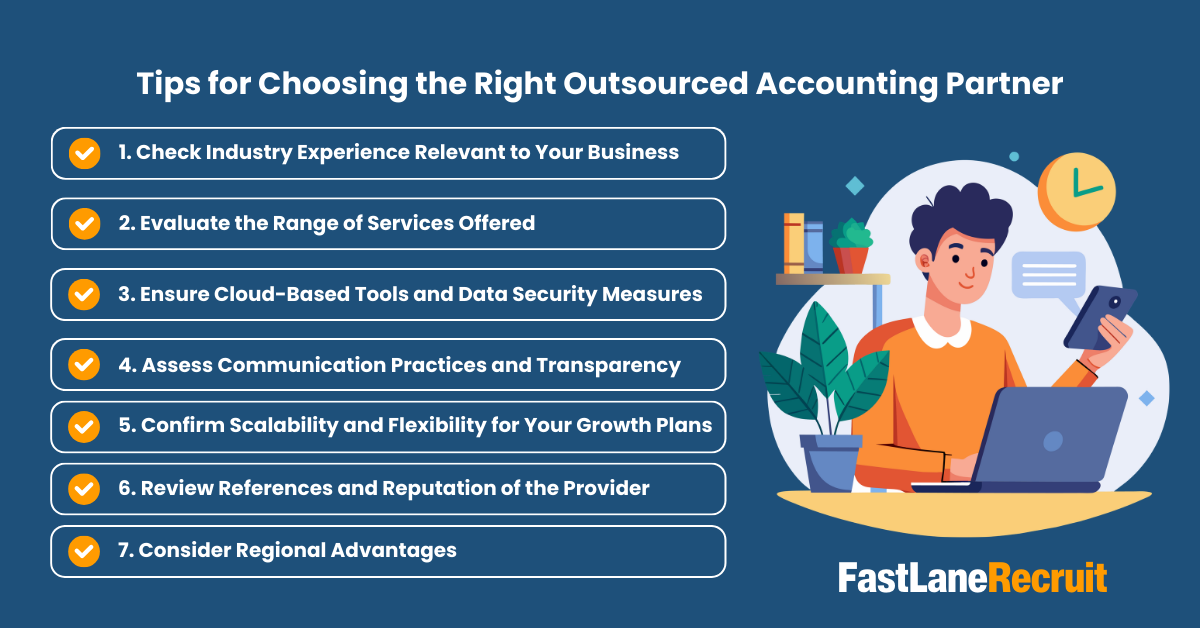
Selecting the right outsourced accounting provider is critical for a successful partnership. Here are key considerations to guide your decision:
1. Check Industry Experience Relevant to Your Business
Look for providers that have experience working with companies in your industry. Different industries have unique accounting requirements, reporting standards, and compliance needs.
Example: A healthcare startup would benefit from a partner familiar with HIPAA-related financial regulations, while a construction firm might need expertise in job costing and project-based accounting.
2. Evaluate the Range of Services Offered
Outsourced accounting services can vary widely, from basic bookkeeping to controller-level management and CFO advisory. Ensure your provider can meet both your current needs and future growth plans.
Example: A growing tech company may start with bookkeeping and payroll but later require strategic CFO guidance for fundraising and investor reporting. Choosing a provider that can scale services avoids switching partners later.
3. Ensure Cloud-Based Tools and Data Security Measures
Modern outsourced accounting relies on cloud-based accounting platforms for real-time reporting and collaboration. Verify that the provider uses secure software and adheres to data protection standards.
Example: Providers using platforms like QuickBooks Online, Xero, or NetSuite allow you to access your financial data anytime, while ensuring encryption and compliance with local or international data privacy regulations.
4. Assess Communication Practices and Transparency
Regular, clear communication is essential for successful outsourcing. Ask about reporting frequency, access to your team, and response times to ensure you won’t be left in the dark.
Example: Some providers offer weekly financial dashboards and monthly review calls, giving you visibility into your cash flow, expenses, and KPIs.
5. Confirm Scalability and Flexibility for Your Growth Plans
Your accounting needs will evolve as your business grows. Make sure your provider can scale services up or down, add specialized expertise, or handle seasonal fluctuations efficiently.
Example: A retail business might need extra support during holiday sales or new store openings. A scalable provider can quickly assign additional resources without disruption.
6. Review References and Reputation of the Provider
Check client reviews, testimonials, and case studies to ensure the provider is reliable and delivers consistent quality. Ask for references from similar-sized businesses or industries.
Example: TOA Global or Botkeeper share case studies showing how they helped mid-sized firms streamline payroll and financial reporting, providing confidence in their track record.
7. Consider Regional Advantages (Malaysia Example)
Outsourcing to Malaysia can be ideal for global businesses seeking skilled accounting talent, strong English proficiency, cultural compatibility, and cost-effective scalability. Nearshoring in Malaysia allows companies to collaborate in similar time zones, maintain high-quality standards, and reduce overhead costs.
Example: A Singapore-based startup outsourced payroll and bookkeeping to a Malaysian team, reducing costs by 40% while keeping workflows fully integrated with their internal operations.
Summary:
Choosing the right outsourced accounting partner requires evaluating expertise, service scope, technology, communication, scalability, and reputation. Regional advantages, like nearshoring to Malaysia, can further enhance efficiency and cost-effectiveness.
Outsourcing Malaysian Accountants
Outsourcing accountants to Malaysia has become an increasingly popular option for businesses looking for cost-effective, skilled, and reliable financial support. Malaysian accountants are known for their strong technical expertise, English proficiency, and cultural compatibility, making collaboration with international teams seamless.
Why Malaysia?
- Cost-Efficient Talent: Hiring full-time accountants locally can be expensive. By outsourcing to Malaysia, businesses can access qualified professionals at a fraction of the cost, without compromising quality.
- Skilled Workforce: Malaysian accountants are well-trained in international accounting standards and familiar with both small and large business needs. This includes bookkeeping, payroll, financial reporting, and CFO-level advisory.
- Nearshore Advantage: Malaysia is in a convenient time zone for Asia-Pacific businesses, which reduces delays and allows for real-time collaboration with teams in Singapore, Hong Kong, or Australia.
- Flexibility and Scalability: Businesses can scale their accounting teams up or down depending on project needs, seasonal demand, or business growth, without the overhead of hiring or firing local staff.
Example: A Singapore-based fintech startup outsourced bookkeeping and payroll to a Malaysian team. The company reduced operational costs by 40%, gained access to expert financial guidance, and freed up internal staff to focus on product development and client acquisition.
Outsourcing to Malaysia is ideal for companies that want professional, reliable accountants integrated with their internal teams while keeping costs under control.
Also Read: Why Malaysia Is a Strategic Hub for Offshore Accountants
Understanding Employer of Record (EOR) for Outsourced Accounting
An Employer of Record (EOR) is a third‑party service that legally employs staff on behalf of your business in a foreign country. This setup lets you hire accounting professionals in regions like Malaysia without establishing a local legal entity, while ensuring full compliance with labor laws, tax regulations, and statutory requirements.
In the context of outsourced accounting, an EOR becomes a powerful tool that lets you expand your finance team internationally, gain access to skilled talent, and maintain operational control without the complexity and risk normally associated with cross‑border employment.
How EOR Works
- Legal Employment: The EOR becomes the official employer of your outsourced accountants in Malaysia or other regions. They handle employment contracts, payroll, statutory filings, tax compliance, and benefits administration.
- Operational Oversight: Your business retains full control of day‑to‑day tasks, workflows, performance reviews, and financial reporting, while the EOR manages legal and administrative employment obligations.
- Compliance and Risk Management: The EOR ensures that all local employment laws, payroll regulations, statutory contributions (such as EPF, SOCSO in Malaysia), and compliance requirements are correctly met, reducing legal and financial risks for your business.
Benefits of Using an EOR for Accounting Teams
- Fast Market Entry: Hire qualified accountants in Malaysia or other strategic locations without the time and cost of setting up a local legal entity.
- Legal Compliance: Avoid complex labor law issues and tax filings with the EOR handling all statutory requirements on your behalf.
- Focus on Growth: With HR, payroll, and legal compliance managed by the EOR, your internal team can focus on core finance operations and strategic business growth.
- Flexible Workforce: Easily scale your team up or down based on business demand, seasonality, project needs, or financial reporting cycles.
Example: A technology services firm in Australia wanted to hire a team of accountants in Southeast Asia to support growth. With an EOR partner, they onboarded experienced Malaysian accountants quickly, maintained compliance with local employment standards, and integrated the team into their existing cloud‑based financial systems with minimal setup time.
FastLaneRecruit’s EOR Solution
If you’re looking to outsource Malaysian accountants or build an international finance team, FastLaneRecruit’s Employer of Record (EOR) service is designed to make this process simple, secure, and compliant.
Here’s how FastLaneRecruit helps:
- Legal Employer Setup: FastLaneRecruit becomes the official employer for your remote Malaysian accountants, managing all payroll, statutory filings, employment contracts, and compliance obligations.
- Seamless Hiring Experience: You can hire full‑time accountants, finance specialists, or outsourced bookkeeping teams in Malaysia without local entity setup or legal complexity.
- Compliance and Risk Mitigation: FastLaneRecruit ensures Malaysian labor laws, tax requirements, and statutory contributions are handled correctly—protecting your business while your team focuses on results.
- Integrated Team Collaboration: Your outsourced accountants operate as part of your team, aligned with your tools, reporting cycles, and business goals, while FastLaneRecruit handles all administrative HR functions.
Why It Works for Global Businesses:
FastLaneRecruit’s EOR solution enables companies of all sizes, from startups to established enterprises, to access Malaysia’s talent pool quickly and securely. You get the benefits of local expertise, real‑time collaboration, and compliant cross‑border employment without the burden of entity creation or compliance complexity.
Example: A UK‑based e‑commerce brand used FastLaneRecruit’s EOR service to onboard a team of Malaysian accountants. The brand expanded its finance operation within weeks, significantly reduced overhead, and maintained consistent reporting quality, all while keeping compliance risks managed by experts.
Also Read: Accountants Salary Guide 2026
Conclusion
Outsourced accounting is more than a cost-saving measure; it’s a strategic choice for growing businesses. From bookkeeping to CFO-level advisory, outsourcing accountants can provide flexibility, expertise, and real-time financial insights while freeing your team to focus on business growth.
Whether your business is expanding regionally or globally, outsourcing accountants, especially from Malaysia, offers a reliable, scalable solution.
Looking for a Seamless Outsourcing Solution?
FastLaneRecruit’s Employer of Record (EOR) service allows you to outsource Malaysian accountants quickly, securely, and compliantly without the hassle of managing local employment. Get in touch to explore how we can help you build a dedicated finance team today.