
Efficiency and focus are essential for business success, yet managing HR information systems (HRIS), payroll, compliance, benefits, and employee engagement can be time-consuming and resource-intensive. Outsourcing HRIS administration offers a practical solution. By partnering with experienced professionals, businesses can optimize HR technology, streamline processes, minimize risks, and free internal teams to concentrate on strategic priorities.
Whether you’re expanding into international markets or optimizing local HR operations, outsourcing HRIS is a strategic way to drive growth efficiently, maintain compliance, and enhance overall workforce productivity.
Content Outline
Key Summary
Cost Efficiency
Outsourcing HRIS administration reduces the expenses of maintaining in-house technical HR staff. Pay only for the services and software you need while optimizing budget and resources.
Access to HRIS Expertise
External HRIS providers offer specialized knowledge in HR technology, payroll systems, compliance, and data analytics, keeping your business up-to-date with modern HR practices.
Focus on Core Business
Free internal teams from administrative HRIS tasks to concentrate on strategic priorities like growth, innovation, and employee engagement.
Scalability and Flexibility
Outsourced HRIS services can grow or adapt with your business, handling seasonal demands, system upgrades, or workforce expansions effortlessly.
Compliance and Risk Management
Professional HRIS administrators ensure adherence to labor laws, payroll regulations, and statutory requirements, minimizing legal risks and penalties.
Technology Integration
Modern HRIS platforms enable automation, real-time analytics, and self-service portals, improving reporting, workforce planning, and operational efficiency.
Talent Management and Employee Retention
Accurate HRIS data supports structured onboarding, training, performance management, and benefits administration, enhancing employee satisfaction and retention.
What is HRIS Outsourcing?
HRIS outsourcing occurs when a business delegates its HR technology administration and HRIS-related tasks, like payroll integration, reporting, analytics, and compliance, to an external expert. Instead of maintaining in-house teams to manage software, data, and processes, companies rely on specialized partners to handle them efficiently and accurately.
Outsourcing HRIS allows your business to focus on strategic growth while leaving system management, reporting, and compliance to experts. Think of it as having a high-performing HR technology team on-demand without hiring an internal department.
Types of HRIS Outsourcing
Businesses can select models based on their size, goals, and technical needs:
| Model | What It Covers | Best For |
| Full-Service HRIS Outsourcing | Manages all HRIS functions, including payroll, benefits integration, employee data management, reporting, and compliance. | Companies seeking an end-to-end HRIS solution without maintaining in-house tech teams. |
| Partial/Task-Based Outsourcing | Covers specific HRIS tasks such as system updates, reporting, or HR data analytics. | Businesses needing targeted support without full system outsourcing. |
| HR Technology & Application Management | Provides software access, analytics dashboards, self-service portals, and integration with payroll or benefits platforms. | Companies wanting streamlined HR processes via technology but retaining internal control over some functions. |
Real-World Example
Many global companies outsource HRIS administration to Malaysia due to its combination of skilled professionals, robust regulatory compliance, and modern HR technology platforms. For example:
- A tech startup may outsource HRIS administration and payroll systems to focus on product development while ensuring compliance with Malaysian labor laws.
- A multinational company expanding in Southeast Asia could use a Malaysian EOR to hire employees locally and manage HRIS seamlessly without establishing a legal entity.
By selecting the right HRIS outsourcing model, businesses save time, reduce errors, stay compliant, and enhance the employee experience while supporting international growth.
Also Read: How to Build an Offshore HR Administration Team in Malaysia
Key Benefits of HRIS Outsourcing
Outsourcing HRIS administrators can transform the way your HR department operates, making it more efficient, scalable, and compliant. Let’s break down the key advantages in detail:
1. Cost Efficiency
Maintaining an in-house HRIS team can be expensive. Not only do you pay salaries, but you also need to invest in software licenses, IT support, training, and ongoing maintenance. Outsourcing HRIS administrators allows you to access skilled professionals and technology solutions without bearing the full costs of an internal team.
Example: A Malaysian startup might outsource HRIS and payroll integrations instead of hiring two full-time HRIS specialists and purchasing software licenses. This can save thousands annually while ensuring payroll and reporting remain accurate and compliant.
Tip: Compare the cost of outsourcing specific HRIS tasks, like payroll automation or data reporting, against hiring internal staff. Outsourcing often delivers professional results at a fraction of the cost.
2. Access to HRIS Expertise
External HRIS administrators bring specialized skills that may be difficult or costly to build in-house. This includes software management, payroll automation, compliance reporting, HR analytics, and data security. By outsourcing, your business gains access to experts who are up-to-date with the latest HRIS trends and local regulations.
Tip: When outsourcing in Malaysia, work with providers familiar with local labor laws and statutory contributions, such as EPF, SOCSO, and HRDF, to ensure compliance.
Example: An HRIS outsourcing provider can set up automated payroll processing and reporting dashboards, reducing errors and allowing your HR team to focus on strategic initiatives.
3. Focus on Core Business
HRIS management involves routine administrative tasks that can distract your internal team from higher-value activities. By outsourcing, your team can focus on strategic priorities like business growth, product development, employee engagement, and innovation, rather than day-to-day HRIS maintenance.
Tip: Treat your HRIS outsourcing partner as an extension of your team, they handle the operational work while your internal team focuses on decisions that drive business results.
4. Scalability and Flexibility
Businesses evolve constantly, whether it’s hiring surges, seasonal workload spikes, or international expansion. Outsourced HRIS services can scale up or down easily, providing the right level of support when needed without the cost and time of recruiting or training additional staff.
Example: A company expanding into Southeast Asia can rely on outsourced HRIS administrators to manage payroll and employee data for new hires without setting up separate HR departments in each country.
Tip: Choose a provider with flexible service plans that can grow alongside your business needs.
5. Compliance and Risk Management
HRIS administrators ensure that all payroll, benefits, and reporting processes adhere to labor laws and statutory regulations, which reduces the risk of fines, penalties, or legal disputes. Outsourcing also keeps you updated on changes in legislation, preventing accidental non-compliance.
Example: A Malaysian HRIS administrator ensures your payroll meets EPF, SOCSO, and tax reporting requirements, protecting your business from potential legal issues.
Tip: Select providers with proven compliance records and certifications to minimize risk.
6. Technology Integration
Modern HRIS outsourcing partners provide access to advanced platforms for payroll, time tracking, employee data management, and reporting. Automation reduces manual errors, while self-service portals let employees update personal details, request leave, or access payslips independently. Real-time analytics also allows HR leaders to make informed decisions quickly.
Example: An HRIS provider implements a dashboard that tracks employee attendance, payroll accuracy, and leave balances, all in real time.
Tip: Ensure your outsourcing provider offers easy-to-use technology solutions that integrate with your existing systems for seamless operations.
7. Talent Management and Employee Retention
Accurate HRIS data improves recruitment, onboarding, performance management, and benefits administration, which helps employees feel valued and supported. A well-organized HRIS system reduces frustration, ensures fairness in benefits, and provides clear career progression paths, ultimately enhancing employee satisfaction and retention.
Example: A company using outsourced HRIS administrators can offer structured onboarding programs, track employee performance, and manage benefits efficiently, even for a distributed workforce in Malaysia or globally.
Tip: Partner with providers who prioritize both operational efficiency and employee experience to maximize engagement and reduce turnover.
Also Read: HR Administrator Salary Guide 2025
How to Implement HRIS Outsourcing
Outsourcing HRIS administration can be a game-changer for your business, but to maximize benefits, it’s important to follow a structured approach. Here’s a step-by-step guide to implementing HRIS outsourcing successfully:
Step 1: Identify Your Needs
Before engaging an HRIS outsourcing provider, it’s essential to understand which HRIS functions require support. Not every task may need outsourcing, and the goal is to focus on areas where external expertise adds the most value.
Common HRIS functions to consider outsourcing:
- Payroll Administration: Automating salary processing, statutory contributions (e.g., EPF, SOCSO in Malaysia), and tax filings.
- Reporting & Analytics: Generating accurate HR reports, dashboards, and performance metrics to guide strategic decisions.
- Employee Data Management: Maintaining accurate records, updating HR databases, and ensuring data privacy compliance.
- Compliance Monitoring: Staying updated with labor laws, statutory requirements, and payroll regulations.
Tip: List the HRIS tasks that are time-consuming, error-prone, or require specialized knowledge. This will help you identify areas where outsourcing provides the highest impact.
Example: A growing Malaysian startup may choose to outsource payroll and benefits management while keeping recruitment and employee engagement in-house, allowing their HR team to focus on strategic growth.
Step 2: Set a Budget
Evaluating the financial impact of outsourcing is a critical step. Compare outsourcing costs versus in-house staffing and software expenses, including salaries, training, software licenses, and IT support.
Key considerations:
- Service fees for outsourced HRIS providers
- Savings from reduced internal staff salaries and training costs
- Potential ROI from improved efficiency, error reduction, and compliance
- Avoided penalties due to non-compliance
Tip: Think beyond immediate costs. Outsourcing often reduces costly errors, minimizes compliance risks, and allows your internal team to focus on revenue-generating activities.
Example: A mid-sized company may find that outsourcing payroll, reporting, and HRIS integrations to a Malaysian EOR is less expensive than hiring two full-time HRIS specialists while ensuring compliance with statutory requirements.
Also Read: Labour Law, Payroll & Compliance in Malaysia for HR Administrators
Step 3: Choose the Right Provider
Selecting the right HRIS outsourcing partner is critical to your success. Look for providers who offer:
- HRIS Technology Expertise: Skilled in managing HRIS platforms, payroll systems, integrations, and analytics.
- Compliance Knowledge: Familiarity with labor laws, payroll regulations, and statutory requirements in your target country.
- Advanced Reporting Tools: Capabilities for real-time dashboards, analytics, and HR metrics to support decision-making.
- Excellent Communication and Support: A responsive partner who provides clear guidance, regular updates, and fast issue resolution.
Tip: Request references, case studies, or client testimonials to verify their reliability and track record.
Example: FastLaneRecruit provides EOR services in Malaysia, including HRIS administration, payroll, and compliance. Their team ensures legal adherence while giving businesses access to skilled HRIS professionals without setting up a local entity.
Step 4: Plan the Transition
A smooth transition ensures continuity and avoids disruptions in HRIS operations.
Steps for a successful transition:
- Communicate Internally: Inform your HR team and employees about which HRIS functions will be outsourced and how responsibilities will change.
- Define Roles and Responsibilities: Clearly specify which tasks will be managed by the outsourcing provider and which remain in-house.
- Provide Training: Ensure internal teams understand how to use new HRIS tools or dashboards provided by the outsourcing partner.
- Monitor Performance: Set clear KPIs, schedule regular check-ins, and track deliverables to measure the effectiveness of the outsourcing arrangement.
Tip: Treat your outsourcing provider as an extension of your HR team. Collaboration, transparency, and regular communication are key to a smooth and efficient transition.
Example: A company outsourcing payroll and HRIS reporting to a Malaysian EOR may schedule weekly video calls and review dashboards to monitor compliance, payroll accuracy, and HR data integrity, ensuring operational continuity from day one.
Also Read: Why Malaysia Is a Prime Destination for Offshore HR Administrators
Tips for Successful HRIS Outsourcing
Outsourcing HRIS administrators can streamline operations, improve compliance, and reduce costs but success depends on careful planning and collaboration. Here are some practical tips to make the most of your HRIS outsourcing partnership:
1. Start Small
When first exploring HRIS outsourcing, it’s wise to begin with a single function or a limited set of tasks rather than outsourcing everything at once. This allows you to test the provider’s capabilities, ensure they meet your quality standards, and build confidence before expanding to other HRIS functions.
Examples of good starting points:
- Payroll processing
- HR reporting and analytics
- Employee data management
Tip: Once you see measurable results and smooth operations in the initial function, gradually expand outsourcing to additional HRIS tasks, such as compliance monitoring, performance tracking, or benefits administration.
Example: A Malaysian startup may begin by outsourcing payroll and benefits management to a local HRIS provider. After successful implementation, they can later outsource HR analytics, reporting, and employee onboarding processes.
2. Maintain Communication
Effective communication is critical for a successful outsourcing partnership. Regular check-ins help ensure that expectations are clear, problems are addressed quickly, and HRIS operations remain aligned with your business goals.
Best practices for communication:
- Schedule weekly or biweekly meetings with the provider
- Use shared platforms or project management tools to track tasks and progress
- Establish clear points of contact for specific HRIS functions
- Provide feedback regularly to improve workflows and outcomes
Example: A company outsourcing HRIS reporting to a Malaysian provider may hold weekly video calls to review payroll dashboards, monitor employee data accuracy, and track recruitment metrics. This keeps both teams aligned and ensures smooth HRIS operations.
3. Leverage Analytics
One of the biggest advantages of outsourcing HRIS is access to data-driven insights. Modern HRIS platforms offer dashboards, reporting tools, and analytics that allow you to monitor performance, spot trends, and make informed decisions.
Key metrics to track:
- Payroll accuracy and timeliness
- Employee turnover and retention rates
- Recruitment cycle time and onboarding success
- Training completion and performance improvements
Tip: Use HRIS analytics not only to track compliance and operational efficiency but also to identify opportunities for workforce optimization, cost savings, and employee engagement improvements.
Example: An HRIS provider can generate real-time dashboards for a remote Malaysian workforce, helping your company spot payroll errors quickly, forecast HR costs, and make informed staffing decisions.
4. Consider an EOR Solution
For businesses hiring internationally or in Malaysia, an Employer of Record (EOR) can simplify HRIS outsourcing significantly. An EOR acts as the legal employer for your employees while managing payroll, compliance, and benefits. This removes administrative and legal burdens from your internal team.
Benefits of using an EOR for HRIS outsourcing:
- Handles payroll processing and statutory compliance automatically
- Manages employee contracts, benefits, and statutory contributions
- Allows quick hiring without setting up a legal entity in a new country
- Supports global or distributed teams with centralized HRIS management
Tip: An EOR is particularly valuable if you plan to scale internationally, hire remote employees, or want to ensure full compliance with local employment laws in Malaysia or other countries.
Example: FastLaneRecruit’s EOR services allow companies to hire Malaysian HRIS administrators quickly, manage payroll and benefits efficiently, and stay fully compliant, without establishing a local office.
Also Read: Why Global Companies Outsource HR Administration Roles
Why Hire Offshore Malaysian HRIS Administrators
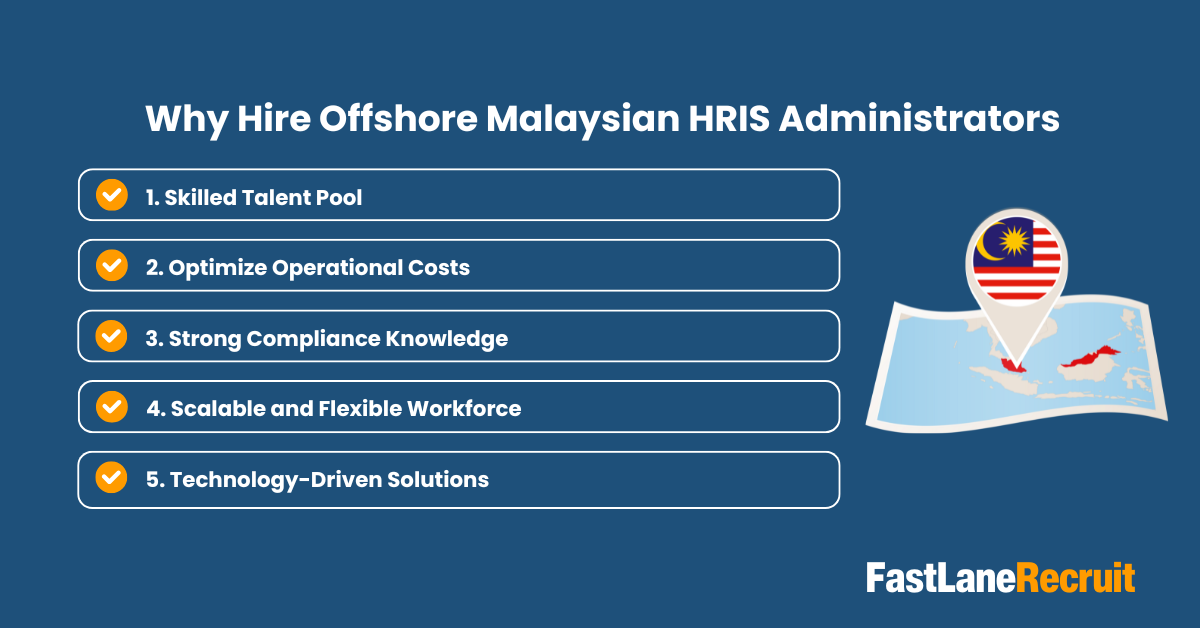
Outsourcing HRIS administration to Malaysia can provide businesses with several strategic advantages. Here’s why Malaysian HRIS administrators are an attractive choice:
1. Skilled Talent Pool
Malaysia has a highly educated and experienced workforce in HR operations, payroll, and HRIS management. Offshore HRIS administrators are trained to handle complex tasks such as payroll automation, employee data management, HR analytics, and compliance reporting.
Example: A company outsourcing HRIS to Malaysia gains access to professionals who can implement advanced HR systems, generate accurate reports, and ensure that HR operations run smoothly without errors.
Tip: Look for providers with certified HRIS administrators who have experience across different industries for maximum impact.
2. Cost Optimization
Outsourcing HRIS administration significantly reduces overhead costs. Instead of hiring full-time staff, purchasing expensive software licenses, and managing IT infrastructure, businesses can leverage external expertise at a fraction of the cost.
Example: A small-to-medium Malaysian startup may outsource payroll, HR analytics, and employee reporting to save on salaries, training, and software subscriptions while still maintaining high-quality HR operations.
Tip: Compare in-house costs against outsourcing fees to calculate ROI, including saved time, reduced errors, and compliance risk mitigation.
3. Compliance Knowledge
Malaysian HRIS administrators are well-versed in local labor laws and statutory requirements, including EPF, SOCSO, HRDF, and tax regulations. They help ensure payroll, benefits, and HR reporting are fully compliant, minimizing legal risk.
Example: Outsourcing payroll and HRIS reporting to a Malaysian expert ensures that your company avoids penalties for late filings, incorrect deductions, or non-compliance with statutory contributions.
Tip: Select a provider with a proven track record in regulatory compliance and up-to-date knowledge of changes in employment laws.
4. Scalable Workforce
Outsourced HRIS services are flexible and can scale alongside your business. Whether you are experiencing seasonal demand, rapid growth, or international expansion, your offshore HRIS team can adjust capacity to meet your needs.
Example: A multinational company expanding in Southeast Asia can rely on outsourced HRIS administrators to manage payroll, employee data, and HR reporting for new hires without creating separate local HR departments.
Tip: Choose an outsourcing partner that offers flexible packages, allowing you to increase or decrease support as business needs change.
5. Technology-Driven Solutions
Malaysian HRIS administrators are proficient in using advanced HR technology, analytics tools, and self-service platforms. Automation reduces manual work, improves accuracy, and provides real-time insights into workforce performance, payroll, and compliance.
Example: An HRIS provider can implement dashboards for employee attendance, performance tracking, payroll, and leave management, giving management actionable insights instantly.
Tip: Ensure your provider integrates HRIS technology with payroll and benefits systems for seamless operations.
Also Read: How to Pay International Employees
How FastLaneRecruit’s EOR Can Help
FastLaneRecruit’s Employer of Record (EOR) service simplify the hiring, management, and administration of Malaysian HRIS administrators, providing a fully compliant, streamlined solution:
1. Legal Compliance
FastLaneRecruit ensures all HRIS and payroll operations comply with Malaysian labor laws, payroll regulations, and statutory contributions, reducing legal risks for your business.
2. Payroll & Benefits Management
The EOR manages payroll processing, tax filings, and employee benefits efficiently, giving employees a smooth experience and freeing your internal team from administrative tasks.
3. Flexible Hiring
Scale your HRIS team quickly and efficiently without setting up a legal entity in Malaysia. Hire a single administrator or an entire offshore HR team as your business needs grow.
4. Access to Skilled Talent
Tap into highly skilled Malaysian HRIS professionals trained in payroll, compliance, HR analytics, and employee management.
5. Centralized Workforce Management
FastLaneRecruit provides a centralized solution for onboarding, performance tracking, and reporting across global teams, ensuring consistency and efficiency.
Tip: Using an EOR is especially valuable if your business is expanding internationally or needs to hire local talent quickly while remaining fully compliant.
Conclusion
Outsourcing HRIS administrators is more than a cost-saving strategy, it is a path to efficiency, compliance, and business growth. By partnering with FastLaneRecruit, companies can:
- Streamline HRIS, payroll, and benefits operations
- Access highly skilled HRIS administrators without full-time hires
- Ensure compliance with Malaysian labor laws and statutory requirements
- Scale workforce operations globally with flexibility
- Focus internal teams on strategic initiatives like innovation, growth, and employee engagement
FastLaneRecruit’s EOR solutions provide a reliable, fully compliant way to manage HRIS, payroll, and employee data, allowing your business to focus on what matters most, growing and innovating.
Discover FastLaneRecruit’s EOR Solutions
Simplify your HRIS operations and grow your business efficiently:
- Ensure compliance with Malaysian labor laws and payroll regulations
- Streamline payroll, benefits, and HRIS processes
- Access skilled HRIS administrators without full-time hires
- Scale globally with flexible workforce management
- Centralize management of remote or distributed teams
