A Strategic Guide for Global Businesses
Managing accounts payable (AP) can feel simple at first until invoice volumes grow, vendors expand across borders, and compliance requirements become more complex.
If your finance team is spending more time processing invoices than analyzing cash flow or planning for growth, outsourcing accounts payable operations may be worth considering.
In this guide, we’ll walk through:
- What accounts payable outsourcing means
- The key benefits and considerations
- Outsourcing vs. automation
- How outsourcing to Malaysia can support global growth
- Practical recommendations for implementation
- When an Employer of Record (EOR) solution may be a smarter alternative.
Content Outline
Key Summary
Accounts Payable Outsourcing Frees Strategic Finance Capacity
Outsourcing shifts repetitive invoice processing, vendor payments, and compliance monitoring to specialists, allowing internal teams to focus on planning and cash flow management.
Growing Invoice Volume Drives Outsourcing Decisions
As businesses scale, invoice complexity increases. Outsourcing provides structured workflows and processing capacity without expanding internal headcount.
Compliance and Risk Management Improve with Structured Support
Experienced AP providers operate with defined controls, audit trails, and regulatory awareness, helping businesses strengthen governance and reduce reporting risks.
Malaysia Offers a Strong Finance Talent Ecosystem
With skilled accounting professionals, English proficiency, and regulatory clarity, Malaysia is increasingly positioned as a hub for global business services.
Outsourcing and Automation Serve Different Strategic Goals
Outsourcing reduces operational workload, while automation keeps processes internal with digital efficiency. Some companies combine both for optimal control and scalability.
A Structured Transition Plan Is Critical
Successful outsourcing depends on clear SLAs, defined workflows, internal alignment, and close performance monitoring during the first 90 days.
An Employer of Record (EOR) Model Offers a Hybrid Alternative
For companies that want direct control over Malaysian AP talent without setting up a local entity, an EOR solution provides compliant hiring and long-term scalability.
What Is Accounts Payable Outsourcing?
Accounts payable outsourcing is when a company works with an external service provider to handle its accounts payable (AP) responsibilities.
Accounts payable refers to the money a business owes to its suppliers, vendors, and service providers. Every time your company receives an invoice for products or services, someone needs to check it, approve it, record it properly, and make sure it gets paid on time. That entire process is part of accounts payable.
When a company outsources accounts payable, it transfers these tasks to a specialized third-party team instead of managing everything internally.
These tasks often include:
- Invoice processing – Receiving invoices, reviewing them for accuracy, entering them into the system, and routing them for approval.
- Vendor payments – Making payments to suppliers on time through bank transfers, checks, or other payment methods.
- Purchase order matching – Checking that invoices match approved purchase orders and delivery receipts (often called three-way matching).
- Expense documentation – Recording and organizing expense records for reporting and audit purposes.
- Payment reconciliation – Ensuring that payments made match accounting records and bank statements.
- Compliance monitoring – Making sure payments and documentation follow tax rules, accounting standards, and internal company policies.
Instead of hiring, training, and supervising a large in-house AP team, businesses rely on an experienced provider that already has trained professionals, defined workflows, and supporting technology in place.
In simple terms, outsourcing accounts payable allows your internal finance team to spend less time on repetitive administrative work and more time on strategic tasks such as financial planning, budgeting, and business growth.
It’s not just about moving the work outside, it’s about improving efficiency, reducing errors, and creating a more structured and scalable process for managing company payments.
Also Read: Offshore Vs Local: Accountants 2025 Salary Benchmark Report (Australia Vs Malaysia Edition)
Why Companies Consider Outsourcing Accounts Payable
As businesses grow, their accounts payable workload usually grows with them. What once felt manageable with a small internal team can quickly become overwhelming.
Global companies often start exploring accounts payable outsourcing when they experience one or more of the following challenges:
1. High Invoice Volume
As sales increase and supplier networks expand, the number of incoming invoices can multiply quickly.
Processing hundreds or even thousands of invoices each month requires time, careful review, and coordination between departments. When invoice volume becomes too high, internal teams may struggle to keep up, leading to delays, missed approvals, or payment backlogs.
Outsourcing provides additional processing capacity without needing to expand internal headcount.
2. Manual Processes and Paper-Based Workflows
Many companies still rely on spreadsheets, email approvals, or even physical paperwork. Manual systems can result in:
- Slow approval cycles
- Data entry mistakes
- Lost invoices
- Duplicate payments
- Limited reporting visibility
Outsourcing providers typically use structured digital systems and standardized workflows, helping businesses move away from inefficient manual processes.
3. Multi-Currency and Cross-Border Payments
When a company operates in multiple countries, accounts payable becomes more complex. Finance teams must manage:
- Currency exchange considerations
- International banking requirements
- Tax documentation
- Local regulatory standards
An experienced outsourcing partner can help manage these complexities more smoothly, especially when payments span different jurisdictions.
4. Rapid International Expansion
Fast-growing businesses often expand into new markets before their finance infrastructure is fully prepared.
Opening operations in a new country may require:
- Understanding local tax rules
- Managing foreign vendors
- Setting up compliant payment processes
Instead of building everything from scratch internally, outsourcing can provide immediate support while the business focuses on growth strategy.
5. Increased Compliance Complexity
Financial regulations, tax reporting standards, and documentation requirements are becoming more structured worldwide.
For example:
- Tax authorities require accurate reporting and recordkeeping.
- Financial institutions monitor payment activities closely.
- Data protection standards must be followed when handling vendor information.
According to the U.S. Bureau of Labor Statistics (BLS), finance and accounting roles remain in steady demand, reflecting the ongoing importance of accurate financial management in modern businesses.
As compliance expectations increase, companies look for ways to strengthen oversight without overburdening internal teams.
6. Pressure to Improve Cash Flow Visibility
Business leaders need clear, real-time insight into:
- Outstanding invoices
- Upcoming payment obligations
- Vendor aging reports
- Cash flow forecasts
When accounts payable processes are slow or fragmented, it becomes difficult to make informed financial decisions.
Outsourcing can help create more structured reporting and better visibility into payment cycles.
Also Read: Building a High-Performing Offshore Accounting Team in Malaysia (Singapore Edition)
A Broader Strategic Shift
At the same time, companies are rethinking how they allocate internal resources. Instead of expanding administrative teams to manage repetitive tasks, many organizations prefer to:
- Keep their internal finance team focused on strategic analysis
- Improve operational efficiency
- Use structured external support for transactional processes
Outsourcing accounts payable is often part of a larger effort to modernize financial operations while maintaining strong governance and control.
It’s not just about reducing workload, it’s about building a more resilient and scalable finance function.
Core Benefits of Outsourcing Accounts Payable
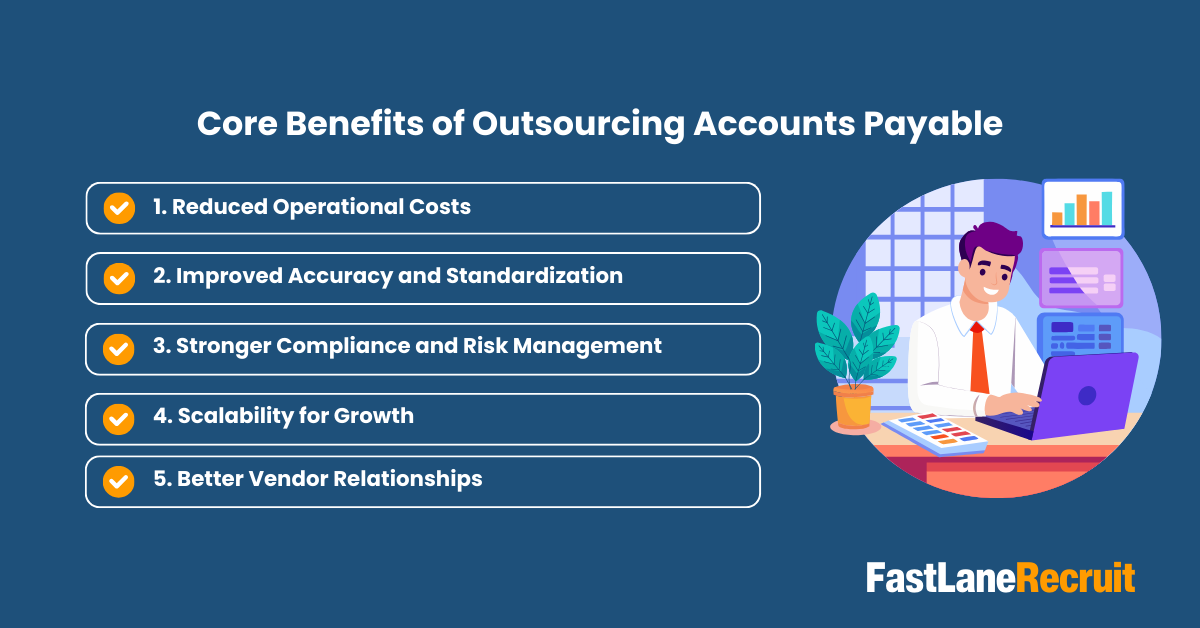
1. Reduced Operational Costs
Outsourcing helps businesses reduce:
- Recruitment and onboarding expenses
- Ongoing payroll costs
- Infrastructure and software licensing
- Training and compliance expenses
Instead of fixed internal overhead, companies often move to structured service pricing aligned with invoice volume.
2. Improved Accuracy and Standardization
Manual data entry increases the likelihood of:
- Duplicate payments
- Incorrect vendor details
- Approval delays
- Reconciliation errors
Professional AP providers implement:
- Structured workflows
- Approval routing systems
- Audit trails
- Digital documentation storage
This reduces processing inconsistencies and strengthens financial controls.
3. Stronger Compliance and Risk Management
AP processes intersect with:
- Tax reporting requirements
- Cross-border payment regulations
- Financial reporting standards
- Data protection laws
For example:
- Malaysia’s Inland Revenue Board (LHDN) governs tax compliance: https://www.hasil.gov.my
- Bank Negara Malaysia regulates financial transactions: https://www.bnm.gov.my
An experienced outsourcing partner understands local and international compliance standards, which helps reduce regulatory risk.
4. Scalability for Growth
If your invoice volume increases 40% during expansion, your internal team may struggle to keep up.
Outsourcing providers can:
- Scale processing capacity
- Adjust service levels
- Support new markets
- Manage multi-entity operations
This flexibility is particularly useful for fast-growing startups and multinational businesses.
5. Better Vendor Relationships
Timely payments improve supplier trust.
Well-managed AP systems can help businesses:
- Capture early payment discounts
- Reduce disputes
- Maintain clear communication
- Improve cash flow predictability
Strong vendor relationships often translate into better pricing and service reliability.
Example: Outsourcing Accounts Payable to Malaysia
In recent years, Malaysia has emerged as a preferred destination for finance and accounting support services, including accounts payable operations.
Many global companies choose Malaysia not only for operational efficiency, but also for its structured business environment and skilled workforce.
Why Malaysia?
Malaysia offers several advantages that make it attractive for AP outsourcing:
1. Strong English Proficiency
English is widely used in business, accounting, and corporate communication. This makes collaboration with global finance teams smoother and reduces communication gaps with international vendors.
2. Established Shared Service Ecosystem
Malaysia hosts many regional shared service centers supporting finance, HR, and IT functions. This means there is an existing infrastructure, trained professionals, and experience in handling cross-border operations.
3. Supportive Regulatory Framework
Malaysia maintains clear financial and tax regulations governed by authorities such as:
- Inland Revenue Board of Malaysia (LHDN)
- Bank Negara Malaysia (BNM)
This regulatory clarity helps businesses operate within well-defined compliance structures.
4. Skilled Accounting Professionals
Malaysia produces a steady pipeline of accounting and finance graduates. Many professionals are trained in international accounting standards and have experience working with multinational organizations.
According to the Malaysia Digital Economy Corporation (MDEC), Malaysia continues strengthening its position as a global business services hub.
Also Read: Building a High-Performing Offshore Accounting Team in Malaysia (Hong Kong Edition)
Example Scenario: In-House vs. Outsourced AP to Malaysia
To better understand the impact, here’s a simplified comparison:
| Scenario | In-House AP Team | Outsourced AP to Malaysia |
| Invoice Volume | 1,500/month | 1,500/month |
| Headcount Required | 4–5 employees | Managed by structured AP team |
| Compliance Monitoring | Internal oversight required | Local compliance expertise included |
| Technology Investment | ERP upgrades and system maintenance required | Often included as part of service |
| Scalability | New hiring required for growth | Scalable support without internal restructuring |
What This Means in Practice
If a company processes 1,500 invoices per month, an internal team may need multiple staff members dedicated solely to invoice entry, approvals, payment coordination, and reconciliation.
In contrast, outsourcing to a Malaysian AP service team can provide:
- Pre-built workflows
- Trained finance professionals
- Established approval systems
- Digital documentation processes
- Reporting support
Instead of building and managing the full infrastructure internally, companies can leverage an existing operational framework.
Maintaining Financial Control
One common concern about outsourcing is losing control. However, many Malaysian service providers operate under structured reporting systems and defined service-level agreements.
This means businesses can still:
- Set approval hierarchies
- Define payment timelines
- Monitor vendor aging reports
- Receive regular performance updates
The goal is not to remove oversight but to reduce operational strain while maintaining governance.
Strategic Value for Global Companies
For businesses expanding into Asia-Pacific or managing regional supplier networks, Malaysia provides:
- Time zone alignment with regional markets
- Familiarity with international accounting practices
- A stable and structured business environment
Outsourcing accounts payable to Malaysia can therefore serve as both an operational improvement and a strategic regional expansion step.
This model allows companies to maintain financial visibility and control while reducing administrative workload and improving scalability for future growth.
Potential Considerations Before Outsourcing
Outsourcing is not a one-size-fits-all solution. Companies should evaluate:
1. Process Control
You may have less direct oversight of day-to-day invoice handling.
2. Data Security
Sensitive vendor and payment data must be handled securely. Ensure providers comply with recognized standards.
You may refer to international best practices such as:
- ISO information security standards (ISO/IEC 27001)
- Data protection regulations applicable to your region
3. Transition Period
Migration may involve:
- System integration
- Process documentation
- Temporary duplication risk
- Internal change management
A clear onboarding roadmap reduces disruption.
Also Read: Building a High-Performing Offshore Accounting Team in Malaysia (Australia Edition)
Accounts Payable Outsourcing vs. Accounts Payable Automation
Many companies compare outsourcing with automation software.
Here’s a simplified breakdown:
| Factor | Outsourcing | AP Automation |
| Who manages process | External team | Internal team using software |
| Control level | Moderate | High |
| Technology included | Often included | Requires implementation |
| Compliance support | Provider-led | Internal responsibility |
| Scalability | Flexible | Depends on internal capacity |
| Data security control | Shared | Fully internal |
Automation works well when a company wants to retain control but streamline workflows.
Outsourcing works well when a company wants to reduce operational load and focus on strategic finance functions.
Some businesses combine both.
Practical Tips Before Choosing an AP Outsourcing Partner
Selecting an accounts payable outsourcing partner is a strategic decision. It affects your financial accuracy, vendor relationships, compliance standards, and overall operational efficiency. Before signing an agreement, it is important to evaluate both the provider and your internal readiness carefully.
Below are key areas to consider.
1. Evaluate Case Studies and Industry Experience
Not all outsourcing providers have the same level of expertise. Look beyond marketing materials and request real examples of client success.
Ask questions such as:
- Have they worked with companies in your industry?
- What invoice volumes do they typically manage?
- Have they supported businesses with multi-country operations?
- What measurable improvements did their clients achieve?
Case studies should demonstrate improvements in processing time, accuracy rates, compliance management, or reporting visibility. A provider with experience in your industry will better understand common challenges such as vendor structures, regulatory requirements, and approval workflows.
2. Review the Security Framework
Accounts payable involves sensitive financial data, including vendor bank details, tax information, and payment records. Data protection should be a priority.
Before engaging a provider, confirm:
- What data security standards they follow
- Whether they comply with recognized information security frameworks
- How they control system access and user permissions
- Whether they conduct regular internal audits
- How they handle fraud prevention and risk monitoring
You should also understand where your data will be stored and who has access to it. Transparency in security policies is a strong indicator of a reliable partner.
3. Clarify Service Level Agreements (SLAs)
A well-defined Service Level Agreement (SLA) protects both parties and ensures accountability. Without clear expectations, misunderstandings can occur.
Make sure your SLA clearly defines:
Processing timelines
- How quickly invoices are entered into the system
- Standard approval turnaround times
- Payment scheduling deadlines
Escalation procedures
- Who is responsible if an invoice is disputed
- How urgent issues are handled
- Defined response times for critical matters
Reporting frequency
- Weekly or monthly performance reports
- Vendor aging summaries
- Exception reports
- Compliance updates
The more clearly these expectations are defined, the smoother your working relationship will be.
4. Conduct a Thorough Cost-Benefit Analysis
Outsourcing should be evaluated strategically, not just operationally. A full comparison helps you understand the real financial impact.
Compare the total cost of:
- Internal salaries and benefits
- Recruitment and onboarding expenses
- Ongoing training and development
- Technology investments and ERP upgrades
- Compliance and audit management costs
Then compare these against:
- Outsourcing service fees
- Transition costs
- Ongoing management oversight
Look at both short-term and long-term financial impact. In many cases, outsourcing reduces operational strain while keeping costs predictable and scalable.
Also Read: How To Onboard Outsourced Accounting Professionals
5. Plan a Structured Transition
A smooth transition determines whether outsourcing succeeds or struggles. Poor onboarding can lead to temporary delays, duplicate entries, or confusion over responsibilities.
Before the transition begins:
Map existing workflows
Document your current approval process, payment cycles, and reconciliation methods. This ensures nothing is overlooked.
Train internal stakeholders
Finance leaders, department managers, and approvers should understand how the new workflow will function. Clear role definitions prevent overlap and confusion.
Set communication channels
Establish regular check-ins, reporting structures, and escalation contacts from day one.
Monitor the first 90 days closely
The first three months are critical. Track performance metrics such as:
- Invoice turnaround time
- Error rates
- Vendor inquiries
- Payment accuracy
Addressing minor issues early prevents larger disruptions later.
A Strategic Mindset Matters
Choosing an AP outsourcing partner is not just a vendor decision. It is a long-term operational partnership.
By conducting due diligence, defining expectations clearly, and planning the transition carefully, companies can significantly improve their accounts payable efficiency while maintaining control and compliance.
A thoughtful approach ensures outsourcing strengthens your finance function rather than complicating it.
When an Employer of Record (EOR) Is a Smarter Alternative
Some companies want:
- Dedicated accounts payable professionals
- Direct team control
- Long-term workforce stability
- Compliance support in Malaysia
But they do not want to establish a legal entity locally.
This is where an Employer of Record (EOR) solution becomes highly strategic.
Instead of outsourcing the function entirely, you can:
- Hire Malaysian Accounts Payable Officers
- Maintain direct workflow control
- Reduce operational costs
- Ensure full payroll and statutory compliance
- Avoid entity setup complexity
FastLaneRecruit’s EOR service enables global companies to legally hire and manage Malaysian AP professionals without setting up a local subsidiary.
This approach combines:
- Talent ownership
- Regulatory compliance
- Cost efficiency
- Long-term scalability
Also Read: Types Of Accounting Services That Can Be Outsourced
Conclusion
Outsourcing accounts payable operations can deliver meaningful improvements in efficiency, compliance, and scalability.
However, the best solution depends on your business goals:
- If you want full delegation → Outsourcing may fit.
- If you want internal control with digital support → Automation may fit.
- If you want direct talent management without entity setup → An EOR model may be ideal.
Global businesses expanding into Asia are increasingly choosing hybrid approaches, combining operational efficiency with strong local talent.
The key is choosing a model aligned with your long-term growth strategy.
Ready to Hire Malaysian Accounts Payable Professionals?
If you’re exploring accounts payable outsourcing but prefer direct team control with compliant local hiring, FastLaneRecruit can help.
Our Employer of Record (EOR) service allows you to:
- Hire skilled Malaysian Accounts Payable Officers
- Stay compliant with local employment laws
- Simplify payroll and statutory contributions
- Scale your finance operations confidently
Contact FastLaneRecruit today to explore how our EOR solutions can support your global finance operations.