Hiring top talent in the Philippines requires more than posting a job; it demands a clear understanding of local labor laws, employee rights, and employer responsibilities. From defining who qualifies as an employer or employee to understanding employment categories, wages, benefits, and workplace safety, compliance with the Philippines labor regulations is essential for smooth operations.
This guide provides a comprehensive overview of the Philippines labor landscape, helping businesses navigate employment rules, avoid legal pitfalls, and build a productive workforce. Additionally, for companies looking to expand across Southeast Asia, we explore Malaysia as a strategic alternative for hiring talent through FastLaneRecruit’s Employer of Record (EOR) solution.
Content Outline
Key Summary
Broad Definitions of Employers and Employees
The Philippine Labor Code defines employers and employees using “includes,” covering most employment arrangements. Labor organizations are excluded unless acting as employers.
Categories of Employers
Employers may belong to the government or the private sector. Government includes national agencies, LGUs, and GOCCs. The private sector includes individuals, businesses, and labor organizations.
Employment Types Matter
Understanding employment categories, regular, probationary, fixed-term, seasonal, project-based, and casual, is crucial for compliance, benefits, and termination procedures.
Wages, Benefits, and Working Hours
Employees are entitled to minimum wages, overtime, night shift differentials, rest days, 13th-month pay, and statutory leaves like SIL, maternity, and paternity leave.
Health, Safety, and Compliance
Employers must provide a safe workplace, conduct training, and comply with OSH standards. Non-compliance can result in fines and penalties.
Termination and Severance Rules
The Philippines does not allow at-will employment. Terminations must be based on just or authorized causes, with proper notice and severance pay for authorized terminations.
Alternative Hiring in Malaysia via FastLaneRecruit EOR
Companies can hire Malaysian talent without a local entity. FastLaneRecruit handles contracts, payroll, compliance, and onboarding, allowing businesses to focus on growth.
Who Is Considered an Employer or Employee in the Philippines?
Understanding who qualifies as an employer or an employee is the first step for any business looking to hire in the Philippines. The definitions are broader than you might think, and the law ensures that most work arrangements fall under clear regulations.
Employer
An employer is any person or entity acting directly or indirectly in the interest of a business or organization. This includes managers, owners, or representatives who hire, supervise, or make decisions on behalf of the company. Notably, labor organizations are excluded from this definition unless they themselves act as an employer. This distinction ensures that unions and similar groups are not automatically considered employers unless they hire and manage staff themselves.
Employee
An employee is any individual working for an employer under a formal or implied agreement. This definition is broad, covering those affected by labor disputes, unfair labor practices, or temporary employment disruptions, as long as they have not secured other regular employment. Essentially, anyone performing services for an organization in exchange for compensation qualifies as an employee under the Philippine Labor Code.
The code deliberately uses the term “includes” rather than “means” to provide a complementary definition. This wording ensures flexibility, so the law can cover most types of employment situations, even ones not explicitly stated. This approach has been affirmed in Philippine jurisprudence, including Feati University v. Bautista (1966).
Also Read: Top 15 Medical Billing Companies in the Philippines
Categories of Employers in the Philippines
Philippine labor law recognizes several types of employers, generally divided into government and private sector categories.
Government Employers
Government employers include entities at the national, local, and semi-government levels:
- National government offices and agencies – such as departments, bureaus, or ministries.
- Local government units (LGUs) – including municipal and provincial offices.
- Government-owned or controlled corporations (GOCCs) – public enterprises or agencies operating in industries like transportation, utilities, and finance.
Private Sector Employers
Private sector employers are usually individuals, companies, or labor organizations:
- Individuals – May employ domestic staff such as household helpers (kasambahay), drivers, or personal assistants.
- Businesses or Companies – Can be organized as sole proprietorships, partnerships, corporations, or cooperatives. These entities hire staff to perform business operations and are responsible for compliance with employment laws.
- Labor Organizations – Unions or associations can also act as employers if they hire, supervise, and pay workers directly. This has been confirmed in Allied Free Workers’ Union v. Compañia Maritima (1967), where a union was considered the employer of its laborers.
Independent Contractors
Independent contractors provide services under a contractual arrangement rather than a traditional employment relationship. It’s crucial to:
- Avoid misclassifying contractors as employees, which can result in fines, back pay, and legal penalties.
- Understand that contractors are not entitled to the same benefits as full-time employees, such as paid leave, 13th-month pay, or social security contributions.
By clearly distinguishing between employers, employees, and contractors, businesses can ensure compliance with Philippine labor laws, avoid legal disputes, and properly manage payroll, benefits, and taxation.
Employment Categories in the Philippines
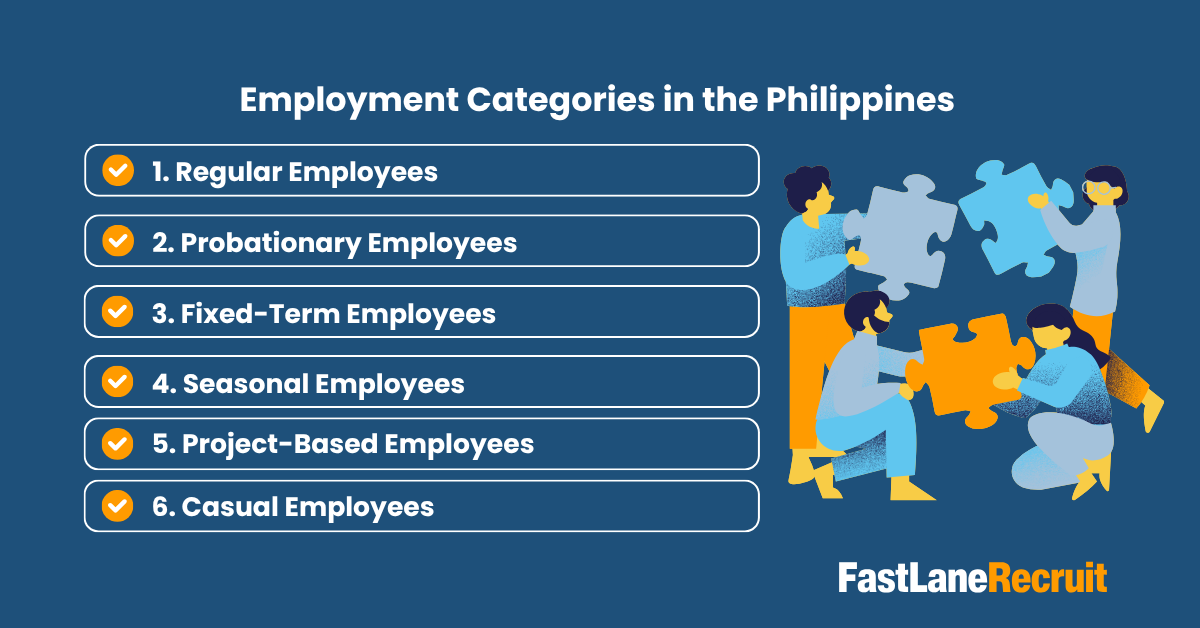
The Philippine Labor Code recognizes several types of employment, each with specific rules regarding duration, benefits, and rights. Understanding these categories is essential for employers to ensure compliance and for employees to know their entitlements.
1. Regular Employees
Regular employees are hired indefinitely and perform work that is essential to the core operations of the business. Once the probationary period (if any) is successfully completed, these employees enjoy full labor protections, including access to benefits, leave entitlements, and protection against unlawful termination.
2. Probationary Employees
Probationary employees are typically hired for a trial period of up to six months. During this time, the employer evaluates the worker’s skills, performance, and suitability for regular employment. While on probation, employees still have basic rights under the Labor Code, but termination may be more flexible if they fail to meet the company’s standards, provided it is done legally.
3. Fixed-Term Employees
Fixed-term employees are engaged under a specific contract with a defined start and end date. These employees are usually hired for seasonal or project-specific tasks, and their employment automatically ends upon contract completion unless extended or renewed.
4. Seasonal Employees
Seasonal employees work during specific periods or seasons, such as harvest times in agriculture, holiday retail, or festival-related work. They may be re-employed each season, but their work is considered temporary and linked to the nature of the season or industry demand.
5. Project-Based Employees
Project-based employees are hired for the duration of a particular project, such as construction, software development, or marketing campaigns. Their employment ends when the project is completed. Unlike casual or seasonal workers, their role is tied directly to the completion of a defined objective.
6. Casual Employees
Casual employees perform tasks that are not considered essential to the core business. However, if a casual employee works continuously for one year, they are automatically considered a regular employee and are entitled to all regular employee benefits and protections.
Also Read: Top 10 Software Outsourcing Companies in the Philippines
Working Hours, Wages, and Benefits
Philippine labor laws establish minimum standards for work hours, wages, and employee benefits to ensure fair treatment and a healthy work-life balance.
1. Standard Workweek
The standard workweek is 40 hours, typically spread over five days. Any work beyond this threshold is considered overtime and is subject to additional compensation.
2. Minimum Wage
The minimum wage in the Philippines is PHP 645 per day (as of 2025), though rates may vary depending on region, industry, and cost of living. Employers must comply with regional wage boards to ensure employees receive at least the legal minimum.
3. Overtime Pay
Employees who work beyond 40 hours a week are entitled to at least 25% above their regular pay for overtime hours.
4. Night Shift Differential
Workers who perform tasks between 10 PM and 6 AM are entitled to a night shift differential of at least 10% of their regular hourly wage, compensating them for the inconvenience of working overnight.
5. Rest Days
Employees are guaranteed at least 24 consecutive hours of rest per week to promote health and well-being.
6. 13th-Month Pay
All employees are entitled to 13th-month pay, which equals 1/12 of their total basic salary earned within the year. This must be paid by December 24th to help workers with year-end expenses and holiday needs.
7. Paid Leave
- Service Incentive Leave (SIL): After one year of service, employees earn five days of paid leave that can be used for vacation, sick leave, or personal matters. Unused leave may sometimes be converted to cash.
- Maternity Leave: Female employees are entitled to 105 days of paid maternity leave, with the option to request an additional 30 days of unpaid leave.
- Paternity Leave: Male employees receive seven days of paid leave, and mothers may transfer seven days of maternity leave to the father, making a total of 14 days. Paternity leave applies to married employees for up to their first four children.
- Holiday Leave: Employees receive paid time off on regular holidays. If they work on these days, they are entitled to double their regular pay. Special non-working holidays may vary by region, and compensation depends on employer policy.
Health and Safety Standards
Ensuring a safe and healthy workplace is a fundamental responsibility of all employers in the Philippines. The Occupational Safety and Health (OSH) Law mandates that businesses provide conditions that protect employees from hazards and promote overall well-being.
Employer Responsibilities:
- Hazard-Free Workplace: Employers must identify and eliminate potential risks in the workplace, including physical, chemical, and ergonomic hazards. This applies to offices, factories, warehouses, and any work environment.
- Training and Emergency Preparedness: Employees must receive proper training on emergency procedures, safety protocols, and use of equipment. Regular drills for fire, earthquake, or other emergencies are encouraged to ensure readiness.
- Health and Safety Communication: Workers should be informed of potential health risks and procedures to mitigate them. This includes posting safety signs, hazard warnings, and sharing updates on workplace safety policies.
Penalties for Non-Compliance:
Failure to meet health and safety standards can result in fines ranging from PHP 10,000 to PHP 20,000 per violation. Employers may also face additional penalties if negligence leads to employee injury or fatality. Compliance with OSH standards not only avoids fines but also fosters employee trust and productivity.
Also Read: Top 15 International Payroll Services in the Philippines
Termination and Severance
Unlike some countries, the Philippines does not have at-will employment, meaning employers cannot terminate employees arbitrarily. Terminations must follow clear legal guidelines and must be based on either just cause or authorized cause as defined by the Labor Code.
Just Cause Terminations:
- Applied for serious employee misconduct, including theft, fraud, violence, or gross insubordination.
- Also includes habitual neglect of duties or actions that cause significant harm to the company.
- Employers must provide written notice of the cause, evidence supporting the dismissal, and allow the employee five days to respond.
Authorized Cause Terminations:
- Occur due to redundancy, retrenchment, business closure, or employee illness.
- Employers must provide 30 days’ notice prior to termination.
- Proper documentation and proof of financial necessity or business rationale must be provided to comply with the law.
Severance Pay:
- Employees terminated for authorized causes are entitled to separation pay equal to half a month’s salary per year of service.
- No severance is given for terminations due to misconduct, fraud, or criminal acts.
Trade Union Rights
Employees in the Philippines have constitutionally protected rights to organize and engage in collective bargaining. Labor unions play a critical role in safeguarding employee interests, including wages, working conditions, benefits, and termination policies.
Key Points:
- Collective Agreements: Union agreements remain in effect for five years, with a 60-day period post-expiration during which terms cannot be renegotiated or challenged.
- Unions as Employers: In some cases, labor unions themselves can act as employers if they hire, supervise, pay, and discipline their own workers. This has been affirmed in landmark cases such as Allied Free Workers’ Union v. Compañia Maritima (1967).
- Right to Bargain Collectively: Only recognized employees of an employer or union have the legal right to negotiate terms collectively. If no employment relationship exists, no collective bargaining obligation arises.
How to Hire Employees in the Philippines
Hiring employees in the Philippines involves navigating local labor laws, understanding employment categories, and ensuring full compliance with statutory requirements. Whether you’re looking for remote talent or planning to establish a local presence, following a structured hiring process is essential to avoid legal issues and foster a productive workforce.
1. Define the Role and Employment Type
Before recruiting, clearly define the position, responsibilities, and employment type. In the Philippines, employees can fall into various categories, such as:
- Regular employees: Indefinite employment performing tasks essential to your business.
- Probationary employees: Trial period (usually six months) to assess suitability.
- Fixed-term employees: Hired for a specific duration with a defined contract end date.
- Project-based or seasonal employees: Engaged for specific projects or periods, such as holiday retail or agricultural work.
- Casual employees: Non-essential tasks, with the possibility of becoming regular after one year of service.
Clearly specifying the employment type helps determine benefits, leave entitlements, and termination rules in compliance with Philippine labor law.
2. Recruitment and Selection Process
- Job Posting: Advertise the vacancy on local job boards, recruitment platforms, or via recruitment agencies. Highlight qualifications, experience, and required skills.
- Screening: Review resumes, conduct preliminary interviews, and assess skills relevant to the role. Consider using skills tests or work samples for technical positions.
- Interviews: Conduct structured interviews to evaluate cultural fit, work ethics, and competency. For remote employees, video interviews are standard.
- Background Checks: Verify employment history, references, and educational credentials to ensure credibility.
Also Read: Top 15 IT Companies in the Philippines
3. Offer Letter and Employment Contract
Once a candidate is selected, provide a written offer letter outlining:
- Job title and description
- Employment status (regular, probationary, fixed-term, etc.)
- Salary, allowances, and benefits
- Work schedule, leave entitlements, and other key conditions
Follow up with a formal employment contract, which is mandatory under Philippine labor law. This protects both the employer and employee and ensures compliance with the Labor Code.
4. Register with Government Agencies
Employers in the Philippines are required to register employees with several government agencies:
- Social Security System (SSS): Mandatory social security coverage for retirement, disability, and other benefits.
- Philippine Health Insurance Corporation (PhilHealth): Provides health insurance coverage.
- Home Development Mutual Fund (Pag-IBIG): Offers savings and housing benefits.
Contributions are shared between the employer and employee, and compliance ensures employees’ access to benefits and legal protection.
5. Onboarding and Compliance
Proper onboarding ensures employees understand their duties, rights, and company policies. Employers must also comply with:
- Minimum wage regulations
- Standard work hours (40 hours per week)
- Overtime pay, night shift differentials, and rest day entitlements
- Leave policies, including Service Incentive Leave, maternity/paternity leave, and holiday leave
Tips for Efficient Hiring
- Partner with local recruitment agencies or an Employer of Record (EOR): Simplifies legal compliance and administrative tasks.
- Use clear job descriptions and contracts: Reduces risk of disputes and misclassification.
- Stay updated on labor law changes: The Department of Labor and Employment (DOLE) regularly issues advisories.
By following these steps, companies can hire talented Filipino employees efficiently and legally, ensuring a smooth onboarding experience and compliance with local labor regulations.
Also Read: Top 30 Business Consulting Firms in the Philippines
Alternative Solution: Hiring Talent in Malaysia with FastLaneRecruit
While the Philippines remains a popular hub for skilled, English-speaking employees, businesses looking for flexibility and strategic diversification in Southeast Asia may also consider Malaysia as a viable alternative. Malaysia offers a growing talent pool across tech, customer service, and specialized industries, making it an attractive destination for global hiring.
Partnering with FastLaneRecruit’s Employer of Record (EOR) makes it simple for companies to tap into Malaysian talent without the complexities of establishing a local legal entity. This solution is especially valuable for startups, SMEs, and multinational companies seeking to expand efficiently across borders.
Benefits of FastLaneRecruit’s EOR in Malaysia:
- Hire Without a Local Entity: Businesses can legally employ Malaysian talent without registering a company in the country, saving time and administrative costs.
- Comprehensive HR Administration: FastLaneRecruit manages employment contracts, payroll, taxes, benefits, and statutory compliance, reducing operational burden for global employers.
- Full Legal Compliance: Ensures adherence to Malaysia’s labor laws, including minimum wages, working hours, leave entitlements, and health and safety requirements.
- Avoid Misclassification Risks: Properly classifies employees and contractors to prevent penalties, fines, or back pay obligations.
- Streamlined Onboarding: Simplifies the hiring process for both remote and on-site employees, providing a smooth transition and immediate workforce integration.
- Focus on Growth: Companies can focus on business expansion, productivity, and strategic goals while FastLaneRecruit handles HR, legal compliance, and administrative tasks efficiently.
By leveraging FastLaneRecruit’s EOR, employers can access a reliable and compliant solution for hiring in Malaysia, enabling them to expand their Southeast Asian footprint while mitigating legal and operational risks.
Conclusion
Employers hiring in the Philippines must carefully navigate local labor laws to ensure compliance and avoid penalties. While the Philippines offers a skilled, English-speaking workforce, Malaysia can be a smart alternative for businesses seeking flexibility and cost-efficiency.
Ready to Hire the Best Talent in Malaysia?
Expanding your team in Malaysia for strategic growth doesn’t have to be complicated. With FastLaneRecruit’s Employer of Record (EOR) solution, you can hire top talent quickly, stay fully compliant with local labor laws, and streamline HR administration, all without setting up a local entity.
Take the next step: Partner with FastLaneRecruit today and focus on growing your business while we handle payroll, benefits, contracts, and compliance seamlessly.
Contact FastLaneRecruit Now to start hiring your ideal employees in Malaysia with ease.