Hiring employees in the Philippines can give international companies access to a large, skilled talent pool without immediately committing to a full local operation. However, employing people in the Philippines also means managing local employment contracts, payroll, statutory contributions, benefits, tax requirements, leave entitlements and labor compliance.
An Employer of Record (EOR) in the Philippines provides a way to employ local workers without requiring the client company to establish and operate its own Philippine employment entity.
Instead, the EOR becomes the local legal employer while the client retains control over the employee’s day-to-day work and responsibilities.
For companies entering the Philippines, testing the market, or building a small initial team, employer of record services in the Philippines can provide a more streamlined alternative to establishing a local entity from the outset.
Content Outline
Key Summary
An EOR can simplify Philippine hiring
An EOR can employ workers locally on behalf of an overseas company and manage employment administration, payroll, statutory requirements and other HR responsibilities.
You do not necessarily need to establish an entity first
Using an EOR can allow a company to begin hiring in the Philippines without immediately building its own local employment infrastructure.
Philippine employment compliance still matters
An EOR does not mean Philippine employment law can be bypassed. Employment contracts, wages, statutory contributions, benefits, leave and termination must still be handled according to applicable Philippine requirements.
Payroll involves several statutory obligations
Employers may need to account for requirements involving SSS, PhilHealth, Pag-IBIG, withholding tax and mandatory 13th-month pay, depending on the employee and arrangement.
An EOR is not always the best option
Companies planning substantial long-term operations may eventually prefer their own Philippine entity. The right structure depends on hiring volume, business plans, risk, cost and desired level of control.
What Is an Employer of Record in the Philippines?
An Employer of Record Philippines arrangement allows an international company to employ workers in the Philippines through a local EOR provider.
The EOR is responsible for the formal employment relationship, while the client company generally manages the employee’s daily work, objectives and performance.
In practical terms:
International company → EOR → Philippine employee
The EOR handles the local employment infrastructure while the client focuses on managing its team.
How does an EOR work in the Philippines?
The process generally follows these stages:
- The company identifies a candidate in the Philippines.
- The EOR reviews the proposed employment terms.
- The EOR prepares a locally compliant employment agreement.
- The employee completes onboarding and required documentation.
- The EOR manages payroll and applicable statutory contributions.
- The client manages the employee’s day-to-day work.
- The EOR supports ongoing employment administration and compliance.
- If employment ends, the EOR manages the required offboarding and final-pay process.
The exact responsibilities should be clearly defined in the service agreement between the EOR and client.
What does an EOR handle?
Depending on the provider and scope of service, employer of record services in the Philippines may include:
- Employee hiring and onboarding
- Employment contracts
- Payroll administration
- Statutory contributions
- Payroll tax administration
- 13th-month pay
- Employee benefits administration
- Leave administration
- Employment documentation
- HR support
- Work permits and visa support where applicable
- Termination and offboarding
- Final pay and employment records
The important distinction is that the EOR manages the employment administration; the client remains responsible for managing the employee’s actual work.
When Should You Use an EOR in the Philippines?
An EOR is particularly useful when a company wants to hire in the Philippines but does not yet want to establish its own local employment infrastructure.
You do not have a Philippine entity
If your company has identified a Filipino employee but has no local entity through which to employ them, an EOR can provide an alternative route to establishing a full operation.
You want to test the Philippine market
An EOR can make sense when a company wants to test demand, build an initial team or assess the market before making a larger investment.
You only need a small team
For one employee or a relatively small initial workforce, establishing an entity and building an internal HR and payroll function may create disproportionate administrative work.
You need to hire quickly
An EOR can reduce the amount of employment infrastructure a company needs to build before hiring, although actual onboarding timelines depend on the employee, documentation, role and provider.
The strategic question is not simply “Can I use an EOR?” It is “Does an EOR make more sense than building my own Philippine employment structure at this stage?”
How to Use an Employer of Record in the Philippines
Once a company decides that an EOR is appropriate, the process can be broken down into eight practical steps.
Step 1: Assess Your Hiring Needs
Start by determining:
- Number of employees
- Job roles
- Work location
- Proposed salary
- Employment type
- Start date
- Benefits
- Expected employment duration
- Whether the employee is Filipino or a foreign national
This information helps determine whether an EOR is appropriate and what employment requirements may apply.
Step 2: Choose an EOR Provider
Compare providers based on:
- Philippine employment expertise
- Payroll capabilities
- Compliance support
- Benefits administration
- Work permit support
- Pricing transparency
- Employee support
- Contract flexibility
- Geographic coverage
- Offboarding capabilities
Do not select an EOR solely because it offers the lowest monthly fee. A provider’s ability to manage local compliance can be more important than a small difference in service charges.
Step 3: Confirm Employee Details
The EOR typically needs information such as:
- Full legal name
- Identification documents
- Address
- Job title
- Compensation
- Start date
- Working arrangement
- Benefits
- Bank information
- Tax and statutory information where required
Step 4: Onboard the Employee
The EOR coordinates required employment documentation and onboarding.
A good onboarding process should make it clear to the employee:
- Who their legal employer is
- Who manages their day-to-day work
- How payroll works
- When they will be paid
- What benefits they receive
- How leave is requested
- Who handles HR questions
Step 5: Sign a Local Employment Contract
The employment agreement should reflect applicable Philippine requirements and clearly define:
- Position
- Salary
- Working hours
- Work location
- Benefits
- Leave
- Probationary or employment terms where applicable
- Confidentiality
- Termination provisions
The contract should not simply be a foreign company’s standard employment agreement with “Philippines” added to it.
Step 6: Run Payroll
The EOR calculates payroll, applicable deductions and employer obligations.
This may involve:
- Salary
- Withholding tax
- SSS
- PhilHealth
- Pag-IBIG
- 13th-month pay
- Other applicable benefits and deductions
Step 7: Manage Ongoing Employment
After onboarding, employment does not become “set and forget.”
The EOR may continue supporting:
- Payroll
- Benefits
- Leave
- Employee records
- Statutory contributions
- Employment changes
- Compliance questions
- Salary adjustments
- HR administration
Step 8: Terminate or Offboard
If employment ends, the process should follow applicable Philippine rules and the employee’s contract.
Final pay, employment documentation and other obligations must be handled correctly. DOLE currently reminds employers that final pay should generally be released within 30 days after separation, unless a more favorable company policy applies, and a Certificate of Employment should be provided within three days of an employee’s request.
How to Hire Employees in the Philippines
International companies generally have three broad approaches.
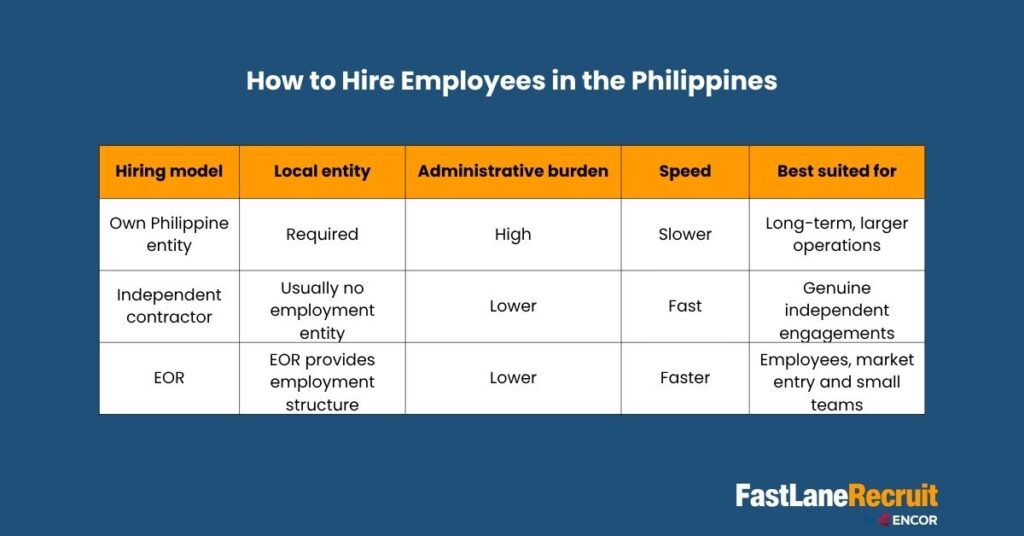
| Hiring model | Local entity | Administrative burden | Speed | Best suited for |
| Own Philippine entity | Required | High | Slower | Long-term, larger operations |
| Independent contractor | Usually no employment entity | Lower | Fast | Genuine independent engagements |
| EOR | EOR provides employment structure | Lower | Faster | Employees, market entry and small teams |
Local entity
Establishing a Philippine entity gives the company greater control over its operations, but also creates additional corporate, tax, HR and compliance responsibilities.
The Philippine SEC provides registration routes for domestic and foreign corporations, including licensing of foreign corporations doing business in the Philippines.
Contractor
Hiring an independent contractor can be appropriate when the relationship genuinely meets the characteristics of independent contracting.
It should not simply be used to avoid employee obligations.
The Philippines regulates contracting arrangements, and DOLE Department Order No. 174 prohibits labor-only contracting and regulates permissible contracting and subcontracting arrangements.
EOR
An EOR is generally more appropriate when the person is functioning as an employee but the overseas company does not want to establish its own local employment infrastructure.
Philippines Employment Laws You Need to Know
Philippine employment relationships are governed by the Labor Code and related legislation, regulations and wage orders.
Companies hiring employees should pay particular attention to:
- Employment contracts
- Minimum wage requirements
- Working hours
- Overtime
- Holiday pay
- Service incentive leave
- Statutory benefits
- 13th-month pay
- Social security contributions
- Termination rules
- Final pay
- Employment records
Working hours
The normal hours of work for covered employees generally should not exceed eight hours per day.
Minimum wage
The Philippines does not operate with one nationwide private-sector minimum wage.
Minimum wages are determined through regional wage orders, meaning the applicable rate depends on where the employee works and the applicable wage classification.
For example, NCR Wage Order No. NCR-27 sets the current non-agricultural minimum wage at ₱755 per day effective July 25, 2026, with another tranche scheduled for January 20, 2027. This makes location an important payroll consideration.
Service incentive leave
Covered employees who have completed at least one year of service are generally entitled to five days of paid service incentive leave, subject to statutory exceptions.
13th-month pay
Rank-and-file private-sector employees who have worked for at least one month during the calendar year are generally entitled to 13th-month pay.
The minimum amount is one-twelfth of the employee’s total basic salary earned during the year, and DOLE requires payment no later than December 24.
Payroll and Taxes When Using an EOR in the Philippines
Philippine payroll requires more than simply transferring the employee’s monthly salary.
An EOR may coordinate:
- Gross salary
- Withholding tax
- Employee deductions
- Employer contributions
- SSS
- PhilHealth
- Pag-IBIG
- 13th-month pay
- Applicable allowances and benefits
- Final payroll
SSS
The SSS contribution rate for regular Social Security contributions is 15% of the applicable Monthly Salary Credit, with the employer paying 10% and the employee paying 5%, under the contribution schedule effective January 1, 2025.
PhilHealth
PhilHealth’s 2025 advisory maintained the premium contribution rate at 5%, with an income floor of ₱10,000 and ceiling of ₱100,000 for direct contributors.
Because contribution rules and employee circumstances can change, employers should use the applicable current schedules rather than relying on a fixed percentage from an old payroll guide.
This is one reason payroll expertise matters when choosing an EOR.
Employee Benefits and Leave in the Philippines
Benefits can include both statutory entitlements and employer-provided benefits.
Common areas include:
- 13th-month pay
- Service incentive leave
- Holiday pay
- Maternity leave
- Paternity leave
- Solo-parent benefits where applicable
- SSS benefits
- PhilHealth coverage
- Pag-IBIG contributions
- Employer-provided health insurance
- Additional paid leave
- Allowances
Maternity leave
Under the Expanded Maternity Leave Law, qualified female employees are generally entitled to 105 days of maternity leave with full pay, with an additional 15 days for qualified solo mothers and an optional 30 days of additional maternity leave without pay for live childbirth.
Paternity leave
Qualified married male employees are entitled to seven days of paternity leave with full pay for the first four deliveries of their legitimate spouse, subject to the law’s requirements.
The employee’s exact entitlement should always be assessed against current law and the applicable circumstances.
Work Permits and Visas in the Philippines
Hiring a Filipino employee and hiring a foreign national in the Philippines are different compliance scenarios.
Foreign nationals working in the Philippines may require the appropriate employment authorization.
The Alien Employment Permit (AEP) is administered by DOLE, and as of June 9, 2026, DOLE centralized the processing and issuance of AEPs at its Central Office.
Foreign employees may also require an appropriate immigration status, such as the 9(g) Pre-arranged Employee Visa. The Bureau of Immigration describes the 9(g) commercial visa as a working visa for foreign nationals employed by a Philippine-based company.
For international companies hiring foreign nationals, an EOR provider with work permit and visa support can therefore simplify a particularly complex part of the hiring process.
EOR vs Setting Up a Company in the Philippines
The right choice depends on the company’s expansion strategy.
| Consideration | EOR | Own entity |
| Entity setup | EOR structure | Company establishes one |
| Initial administrative burden | Lower | Higher |
| Hiring small teams | Suitable | May be disproportionate |
| Market testing | Strong fit | Less flexible |
| Operational control | Lower | Higher |
| HR infrastructure | EOR-supported | Build internally |
| Long-term large operation | May eventually be less suitable | Often more suitable |
| Compliance administration | EOR-supported | Company-managed |
A useful rule: If the immediate goal is to employ a small number of people and validate the market, an EOR can be efficient. If the Philippines will become a major long-term operating market, establishing an entity may eventually provide greater control and flexibility.
EOR vs PEO in the Philippines
EOR and PEO arrangements are sometimes used interchangeably, but they are not necessarily the same.
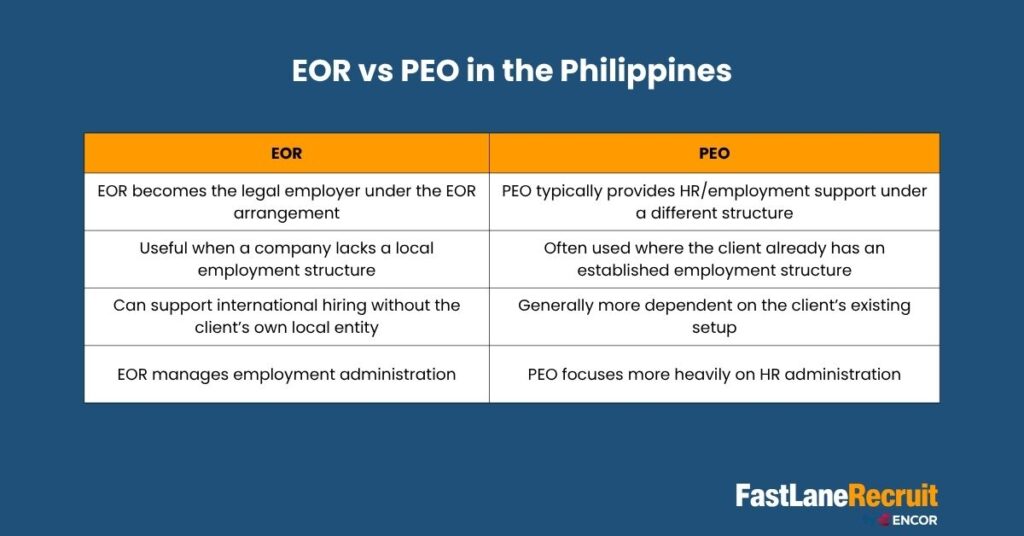
| EOR | PEO |
| EOR becomes the legal employer under the EOR arrangement | PEO typically provides HR/employment support under a different structure |
| Useful when a company lacks a local employment structure | Often used where the client already has an established employment structure |
| Can support international hiring without the client’s own local entity | Generally more dependent on the client’s existing setup |
| EOR manages employment administration | PEO focuses more heavily on HR administration |
For an international company that has no Philippine entity but wants to employ a Filipino worker, an EOR is generally the more relevant model to investigate.
How Much Does an EOR Cost in the Philippines?
There is no single standard EOR price in the Philippines.
Providers may use:
- Fixed monthly employee fees
- Percentage-based pricing
- One-time onboarding fees
- Offboarding fees
- Visa or work permit charges
- Additional HR service fees
The total employment cost can also include:
Employee salary + employer statutory contributions + mandatory benefits + EOR service fee + optional benefits
When comparing providers, avoid looking only at the headline monthly EOR fee.
Ask what is actually included.
A lower fee may not be cheaper if payroll, benefits administration, visa support or offboarding are charged separately.
Benefits of Using an EOR in the Philippines
Faster market entry
An EOR can reduce the infrastructure required before hiring.
Lower administrative burden
Payroll, employment documentation and statutory administration can be handled through the EOR.
Local compliance support
A knowledgeable provider can help interpret and administer Philippine employment requirements.
Easier small-team hiring
Companies can build an initial Philippine team without immediately creating a full HR and payroll function.
Reduced employment administration
The client can focus on managing its people and business while the EOR handles the employment infrastructure.
Flexible expansion
An EOR can be useful when a company is testing a market before committing to a permanent local structure.
Risks and Considerations When Using an EOR
Using an EOR does not eliminate every employment risk.
Provider quality matters
A weak provider can create payroll, compliance or employee-experience problems.
Employment responsibility must be clear
The EOR and client should clearly define who handles:
- Recruitment
- Performance management
- Payroll
- Employee relations
- Benefits
- Disciplinary matters
- Termination decisions
Compliance remains important
An EOR should not be treated as a shortcut around Philippine labor requirements.
Contractor classification requires care
If a person functions like an employee, simply labeling the relationship “contractor” does not necessarily eliminate employment-related risks.
Pricing needs to be transparent
Understand the full cost before signing.
Who Should Use an EOR in the Philippines?
An EOR is particularly useful for:
- International companies hiring their first Filipino employee
- Startups entering the Philippines
- Companies testing the Philippine market
- Businesses building small remote teams
- Companies that need specialized talent quickly
- Businesses that do not yet want to establish a local entity
- Companies hiring foreign nationals who require local employment and immigration support
For large companies planning a substantial permanent Philippine operation, an EOR can also serve as an initial hiring solution while the company evaluates whether establishing its own entity makes commercial sense.
How to Choose an EOR Provider in the Philippines
Before selecting an EOR, evaluate the provider against the actual employment lifecycle.
Look for:
Local employment expertise
Can the provider manage Philippine employment requirements rather than simply process payroll?
Payroll capability
Can it manage salary, statutory contributions, tax administration and 13th-month pay?
Benefits support
Does it understand statutory and supplemental benefits?
Work permit support
Can it help with foreign employee work authorization where required?
Hiring support
Can it support onboarding and employment documentation?
Offboarding capability
Can it manage termination, final pay and employment records?
Transparent pricing
Are additional fees clearly disclosed?
Regional coverage
Can the provider support your next market when your expansion moves beyond the Philippines?
The best EOR is not necessarily the cheapest provider. It is the provider that can manage the employment lifecycle with the level of local expertise and support your business requires.
Also Read: 20 Best Employer of Record in the Philippines: EOR Philippines Guide 2026
Why FastLaneRecruit for EOR in the Philippines?
Once the decision has been made to use an EOR, the next question is how much of the employment lifecycle you want your provider to manage.
FastLaneRecruit provides an integrated approach to international employment, supporting companies with the practical requirements involved in building teams across borders.
For the Philippines, our services can support:
- Hiring and employment
- Payroll
- Compensation and benefits
- Work visas and permits
- International expansion
- Independent contractor hiring
This means companies do not have to treat hiring, payroll and compliance as separate international expansion problems.
Instead, FastLaneRecruit can help connect the process from hiring → employment → payroll → benefits → compliance → ongoing workforce management.
For a company hiring one employee in the Philippines, that can mean less administrative complexity. For a company building a regional team, it provides a pathway to broader international workforce support.
EOR Hiring Checklist for the Philippines
Before hiring through an EOR, confirm that you have:
- Defined the employee’s role
- Confirmed the work location
- Agreed on salary and compensation
- Determined required benefits
- Confirmed the intended start date
- Selected an EOR provider
- Reviewed the EOR’s pricing
- Confirmed payroll responsibilities
- Confirmed statutory contribution handling
- Reviewed the employment contract
- Completed employee documentation
- Confirmed visa/work permit requirements for foreign nationals
- Established an onboarding process
- Defined who manages the employee day to day
- Confirmed the termination and offboarding process
Expanding beyond the Philippines?
An EOR strategy becomes even more valuable when hiring is not limited to one market.
FastLaneRecruit operates services across Malaysia, Singapore, Hong Kong, China, India, Philippines, Taiwan, Vietnam, Australia, United Kingdom, Switzerland, UAE, Saudi Arabia, and Qatar.
This allows companies to consider their international workforce strategy beyond a single country rather than selecting disconnected employment providers for every new market.
Ready to Hire in the Philippines?
Hiring internationally should not require you to build an entire local employment infrastructure before you can make your first hire.
If your company wants to hire employees in the Philippines, manage payroll and benefits, support work permits, or build a compliant international workforce without immediately establishing a local employment structure, FastLaneRecruit can help you evaluate the right approach.
Talk to FastLaneRecruit about your Philippines hiring requirements and find an EOR solution that fits your expansion plans.
FAQs About Using an EOR in the Philippines
What is an EOR in the Philippines?
An Employer of Record is a service arrangement in which the EOR becomes the local legal employer of a worker while the client company manages the employee’s day-to-day work.
Can I hire employees in the Philippines without setting up a company?
An EOR can provide an alternative employment structure for companies that do not have their own Philippine entity. The specific arrangement should be assessed based on the company’s activities, employee circumstances and applicable Philippine requirements.
How does an EOR work in the Philippines?
The EOR handles the formal employment relationship, including applicable contracts, payroll, statutory requirements and HR administration, while the client generally manages the employee’s daily responsibilities.
What does an EOR handle in the Philippines?
Depending on the provider, services can include hiring, employment contracts, payroll, statutory contributions, benefits, HR administration, visa and work permit support, and offboarding.
How much does an EOR cost in the Philippines?
EOR pricing varies by provider and employee. Costs can include a monthly service fee, employee compensation, statutory employer contributions, benefits and additional services such as visa processing.
Does an EOR handle Philippine payroll?
Yes. Payroll is one of the core functions commonly provided by an EOR, including salary calculations, applicable deductions, statutory contributions and other payroll requirements.
Is 13th-month pay mandatory in the Philippines?
Yes. Covered rank-and-file private-sector employees who have worked for at least one month during the calendar year are generally entitled to 13th-month pay, calculated at no less than one-twelfth of total basic salary earned during the year.
Can an EOR hire foreign employees in the Philippines?
An EOR may support foreign-national employment, but appropriate employment permits and immigration requirements must be addressed. Foreign nationals may require an AEP and an appropriate visa, depending on their circumstances.
Is an EOR better than hiring a contractor in the Philippines?
It depends on the relationship. If the individual is genuinely an independent contractor, contracting may be appropriate. If the person functions as an employee, an EOR can provide a more appropriate employment structure.
Is an EOR better than setting up a Philippine company?
Not necessarily. An EOR is often more suitable for small teams, market testing and faster initial hiring, while an entity can make more sense for companies planning substantial, long-term operations in the Philippines.