Managing finance and accounting is one of the most critical aspects of running a business. But building a full in-house finance team can be costly, time-consuming, and rigid, especially if your business is scaling internationally. Outsourcing finance and accounting (F&A) provides a practical solution. By partnering with specialized providers, you can streamline operations, access global talent, and focus on growing your business.
This guide will cover everything from the types of F&A services and the benefits of outsourcing to debunked myths and best practices for choosing the right partner.
Content Outline
Key Summary
Cost-Efficient Operations
Outsourcing F&A allows businesses to pay only for the services they need, avoiding high fixed costs like salaries, benefits, and office space.
Access to Skilled Expertise
External providers bring professionals updated on tax laws, accounting standards, and industry best practices, offering specialized knowledge beyond a small in-house team.
Focus on Core Business
By delegating transactional and analytical finance tasks, your internal team can concentrate on growth, strategy, and business development.
Scalable and Flexible Support
Outsourced teams adjust resources to match seasonal peaks, expansion plans, or sudden workload changes without long-term commitments.
Enhanced Accuracy and Compliance
Dedicated F&A providers use advanced tools, checks, and standardized processes, ensuring accurate reporting and adherence to regulations.
Business Continuity and Security
Operations continue uninterrupted even if internal staff leave, while professional systems ensure secure handling of sensitive financial data.
What is Outsourced Finance and Accounting?
Outsourced Finance and Accounting (F&A) means hiring an external team or service provider to handle some or all of your company’s financial tasks instead of managing everything internally. These tasks can include bookkeeping, payroll, tax filing, financial reporting, budgeting, forecasting, and even higher-level analysis like management accounting or CFO advisory.
Think of it like having a virtual finance department that works with your business but is not physically part of your office. This approach offers several benefits:
- Cost Flexibility – You only pay for the services you actually need. This avoids the fixed costs of hiring full-time staff, such as salaries, benefits, software licenses, and office space. For example, if you need extra help during tax season, you can scale up temporarily without committing to permanent hires.
- Scalable Support – Outsourced teams can quickly adjust their resources to match your business needs. Whether your company is growing rapidly or experiencing seasonal peaks, your outsourced team can increase or decrease support without delays.
- Expertise on Demand – Outsourced F&A providers bring a team of trained professionals who are up-to-date on the latest regulations, accounting tools, and industry best practices. You gain access to collective experience and knowledge that a small in-house team might not have.
- Continuity and Reliability – With an outsourced team, your business is not dependent on a single employee. If someone is unavailable or leaves the company, the work continues without interruption, ensuring timely reporting and smooth operations.
One common misconception is that outsourcing means losing control over your finances. In reality, you still define how processes are handled, who has access to information, and what reporting standards are followed. The outsourced team works under your guidance, using specialized technology to make processes more efficient and accurate.
In short, outsourced F&A is like having a flexible, expert, and reliable finance team at your disposal without the full cost and management burden of building one internally.
Also Read: Offshore Vs Local: Accountants 2025 Salary Benchmark Report (Australia Vs Malaysia Edition)
Limitations of Traditional In-House Accounting
While having an internal accounting team can seem straightforward, it is not always the most efficient solution, especially for growing businesses. Traditional in-house accounting comes with several challenges:
- High Fixed Costs – Maintaining a full accounting team requires salaries, benefits, software licenses, and office space. These costs remain the same even during slow months when business activity may be lower. This can strain your budget and reduce financial flexibility.
- Limited Skill Sets – No single accountant can master every aspect of finance. Tax rules, reporting standards, and compliance regulations are constantly changing. In-house staff may lack exposure to complex scenarios or industry-specific best practices, which can limit the quality and insight of financial operations.
- Dependency Risks – When your business relies heavily on one key employee for financial processes, losing that person can create gaps in knowledge, delayed reports, and operational disruptions. Training replacements takes time and may impact decision-making.
- Delayed Reporting – Manual processes, spreadsheet-heavy workflows, and overworked teams often lead to slow or inaccurate financial reporting. Delays make it harder for management to make informed, timely decisions about budgeting, investments, or growth opportunities.
- Scaling Challenges – Growing businesses need flexible accounting support. Adding more in-house accountants is slow and expensive, and scaling internationally can be even more challenging due to labor costs, recruitment hurdles, and different regulatory environments.
These limitations explain why many businesses are shifting to outsourced accounting services. Outsourcing allows companies to access a skilled, scalable, and cost-effective finance team, while reducing dependency on in-house resources and improving reporting speed and accuracy.
Types of Finance and Accounting Services You Can Outsource
Outsourced finance and accounting providers can manage a wide range of tasks, from routine bookkeeping to high-level strategic planning. Partnering with an external team allows businesses to focus on growth while ensuring financial operations run smoothly. Here’s a detailed breakdown of the types of services you can outsource:
| Function | Description | Level / Purpose | Example |
| Bookkeeping | Track income and expenses, reconcile accounts, maintain accurate financial records. | Entry-level / transactional | An outsourced team can record daily sales for an e-commerce business in Malaysia and reconcile bank accounts weekly, reducing errors and saving time. |
| Payroll Services | Manage employee salaries, payroll cycles, and compliance with labor regulations. | Transactional | A U.S company can outsource payroll to ensure employees are paid on time, taxes are filed correctly, and leave calculations are automated. |
| Tax Accounting | Handle filing, reporting, and compliance with local and international tax regulations. | Mid-level / compliance | Outsourcing tax accounting ensures businesses meet deadlines for corporate tax, GST, or VAT without hiring multiple in-house experts. |
| Account Reconciliation | Ensure accuracy and completeness of financial records by comparing internal records with bank statements. | Transactional | A company importing goods from abroad can have reconciliations done by an outsourced team to avoid mismatches and errors. |
| Management Accounting | Produce internal reports, cash forecasts, KPI tracking, and budgets to guide decision-making. | Mid-level / analytical | Outsourced providers can create monthly management dashboards for a startup, showing profitability per product line. |
| Financial Controller Services | Oversee monthly reporting, budgets, and overall business financial health. | Senior-level | A mid-sized business can have a controller from an outsourced team review budgets and provide insights to improve cash flow. |
| Financial Analysis | Analyze profitability, product costing, scenario modeling, and ROI calculations. | Senior-level / strategic | An e-commerce company expanding to Southeast Asia can receive profit forecasts and pricing advice from an outsourced analyst. |
| Accounting Audit | Perform compliance checks, internal audits, and fraud prevention measures. | Senior-level / governance | Outsourced auditors can verify that company records meet GAAP or IFRS standards and detect inconsistencies in revenue reporting. |
| Forensic Accounting | Investigate financial irregularities, fraud, or suspicious transactions. | Specialized / investigative | If unusual financial activity is detected, outsourced forensic accountants can trace transactions and identify causes. |
| Statutory Reporting & Compliance | Ensure adherence to GAAP, IFRS, or other local accounting standards, and prepare regulatory reports. | Mid to Senior-level | Outsourced teams can handle year-end statutory reporting for Malaysian entities while keeping up with changing laws. |
Many outsourced providers also offer CFO-level advisory and strategic planning, helping businesses make data-driven decisions, optimize processes, and plan for future growth.
Example in Practice:
A growing U.S tech startup outsourced its payroll, bookkeeping, and management accounting to a trusted external team. This allowed the founders to focus on product development while the finance team provided timely cash flow forecasts, tax compliance, and KPI dashboards, all without increasing overhead costs or hiring additional full-time staff.
Also Read: Building a High-Performing Offshore Accounting Team in Malaysia (Singapore Edition)
Why Outsource Finance and Accounting Services?
Outsourcing finance and accounting (F&A) provides measurable advantages that go beyond what traditional in-house accounting can offer. By partnering with an external team, businesses gain access to specialized skills, modern technology, and flexible support, all while keeping costs under control. Here’s a detailed look at the benefits:
1. Cost Efficiency
Outsourcing allows you to pay only for the services you need, rather than maintaining a full-time in-house team with salaries, benefits, and office space.
Example: A small Malaysian e-commerce company outsourced bookkeeping and payroll. Instead of hiring two full-time accountants, they paid for just the services they used, saving over 40% in labor costs.
2. Access to Expertise
Outsourced F&A providers bring professionals who are trained, experienced, and up-to-date on the latest tax laws, accounting standards, and financial tools.
Example: A start-up expanding internationally benefited from outsourced tax specialists who navigated GST and VAT rules in multiple countries without needing to hire in-house experts.
3. Better Focus on Core Business
When routine financial tasks are handled externally, your in-house team can focus on strategic initiatives and business growth.
Example: A SaaS company outsourced monthly accounting reconciliations, allowing its finance team to concentrate on forecasting revenue and pricing strategies.
4. Improved Accuracy and Compliance
Specialized providers implement strict checks, controls, and automated systems, reducing the risk of errors and ensuring regulatory compliance.
Example: An outsourced provider detected discrepancies in a client’s payroll system, preventing potential compliance fines and employee disputes.
5. Flexibility and Scalability
Outsourced teams can quickly scale services up or down depending on business needs, seasonal demand, or expansion plans.
Example: During peak tax season, a company increased outsourced accounting support temporarily, then scaled back once deadlines were met, avoiding long-term staff costs.
6. Consistent Financial Reporting
Timely and accurate reports are critical for decision-making. Outsourced teams ensure that financial statements, cash flow reports, and KPI dashboards are consistently delivered.
Example: A retailer received weekly revenue and expense reports from its outsourced provider, helping the leadership team make informed inventory and staffing decisions.
7. Reduced Operational Burden
Outsourced providers handle HR tasks for finance personnel, payroll administration, training, and leave management, freeing internal resources.
Example: A mid-sized business no longer needed to track leave or payroll schedules internally, as the outsourced team managed everything efficiently.
8. Data Security and Controls
Professional F&A firms invest in advanced security systems and protocols, ensuring sensitive financial data is safe and access is controlled.
Example: Cloud-based accounting platforms used by outsourced teams encrypt data, providing protection against cyber threats and internal breaches.
9. Business Continuity
Outsourcing ensures that operations continue smoothly even if an internal employee leaves or is unavailable. Service continuity and workflow consistency are maintained.
Example: When a finance manager resigned, outsourced accounting services continued without interruption, avoiding delays in reporting or payroll processing.
10. Global Standards and Tools
Outsourced providers often use modern, standardized accounting software and follow international financial reporting standards, which internal teams may lack.
Example: A growing company benefited from access to cloud-based ERP systems and AI-driven analytics tools without investing heavily in software licenses or training.
In short: Outsourcing F&A lets businesses reduce costs, access top-tier expertise, improve efficiency, and scale operations flexibly, all while maintaining control, security, and compliance.
Also Read: Building a High-Performing Offshore Accounting Team in Malaysia (Hong Kong Edition)
Debunking Common Outsourcing Myths
Many businesses hesitate to outsource finance and accounting due to misconceptions. Let’s address the most common myths and clarify the reality:
Myth 1: Outsourcing Means You Lose Control
Reality: Outsourcing does not mean handing over your financial processes blindly. You still define the workflows, reporting standards, access permissions, and decision-making authority. The outsourced team works under your direction, ensuring processes align with your business strategy.
Example: A U.S.-based tech start-up outsourced payroll and bookkeeping but maintained approval rights for all financial reports. They could monitor cash flow and budgets in real time while the outsourced team handled routine data entry and reconciliations.
Myth 2: Outsourcing Is Only for Large Corporations
Reality: Outsourcing is particularly beneficial for small and mid-sized businesses that may lack in-house expertise or resources. By partnering with an experienced provider, smaller companies gain access to skills and technology typically available only to larger firms.
Example: A boutique marketing agency hired an outsourced accounting service to manage tax filings and invoicing. Without the cost of a full-time accountant, they received the same level of accuracy and professionalism as large competitors.
Myth 3: Data Is Not Safe
Reality: Professional accounting firms implement advanced security measures such as encrypted cloud platforms, secure access controls, and compliance with data protection regulations. This often makes outsourcing safer than maintaining internal spreadsheets or outdated systems.
Example: A global e-commerce company used an outsourced provider with SOC 1-certified systems. Sensitive payroll and financial data were fully encrypted and backed up, preventing unauthorized access and data loss.
Myth 4: Communication Will Be Difficult
Reality: Modern collaboration tools, like cloud accounting platforms, video conferencing, and project management software, enable seamless communication across different time zones. Structured reporting schedules and clear points of contact make coordination straightforward.
Example: A Singapore-based export company worked with an outsourced accounting team in the Philippines. Weekly video calls and cloud-based dashboards ensured real-time updates without delays or misunderstandings.
Myth 5: Quality Is Affected
Reality: Outsourced accounting services are often more accurate and timely than in-house teams because experts specialize in specific financial functions and follow standardized procedures. Automation, AI, and regular audits improve accuracy and compliance.
Example: A fast-growing SaaS company outsourced monthly financial statements and noticed a significant reduction in errors compared to its previous in-house reports, allowing faster and more confident strategic decisions.
In summary: Outsourcing finance and accounting does not mean losing control or quality. On the contrary, it provides access to specialized expertise, advanced tools, scalable support, and secure processes, making it a smart choice for businesses of all sizes.
Also Read: Building a High-Performing Offshore Accounting Team in Malaysia (Australia Edition)
How to Choose the Right Finance & Accounting (F&A) Partner
Selecting the right F&A outsourcing provider is crucial to ensure efficiency, accuracy, and a seamless integration with your business. Here’s what to consider in detail:
1. Process – Clear Onboarding and Workflow Transparency
A strong partner should clearly explain how your accounting processes will be handled, from onboarding to daily operations. This includes timelines, responsibilities, and communication channels. Transparency ensures there are no surprises and allows you to track progress effectively.
Example: A retail company outsourced its accounts payable to a third-party provider. The provider mapped out the workflow, including invoice submission, approval processes, and payment schedules, so the company always knew who was responsible for each task.
2. Experience – Proven Track Record and Client References
Look for a provider with a history of successfully managing similar businesses or industries. Ask for case studies, references, and examples of how they have improved processes or resolved challenges. Experience reduces risk and ensures best practices are followed.
Example: A small SaaS business chose a provider with extensive experience in subscription-based revenue accounting. The provider implemented automated recurring billing reports, reducing errors by 70%.
3. Technology – Cloud Accounting, Automation, AI, and BI Tools
Modern outsourced accounting providers use advanced technology to increase efficiency and accuracy. Cloud platforms allow real-time access, automation reduces manual errors, AI can identify anomalies, and Business Intelligence (BI) tools provide insights for decision-making.
Example: An e-commerce company outsourced bookkeeping to a provider using AI-powered software that flagged unusual transactions automatically, helping prevent fraud and saving hours of manual review.
Also Read: Types Of Accounting Services That Can Be Outsourced
4. Culture – Alignment in Communication Style and Values
Your partner should align with your company’s culture and communication style. Shared values and good rapport make collaboration smoother and ensure that financial decisions support your strategic goals.
Example: A creative agency outsourced financial reporting to a firm that preferred regular video updates and collaborative dashboards, which matched the agency’s team-oriented culture.
5. Metrics – KPIs, Reporting Standards, and Measurable Performance
Establish what metrics and Key Performance Indicators (KPIs) the provider will track. This ensures accountability, enables performance monitoring, and allows you to measure the return on outsourcing.
Example: A logistics company tracked invoice processing speed, error rates, and monthly reporting accuracy. The outsourced provider exceeded targets, giving the in-house team confidence in their work.
6. Security – SOC 1 Certification, Data Protection, and Compliance
Financial data is sensitive. Ensure your provider has robust security measures, including encryption, access controls, regular audits, and SOC 1 or equivalent certifications. Compliance with local and international regulations is essential.
Example: A multinational firm chose a provider with ISO 27001 certification and encrypted cloud storage to protect sensitive payroll and tax data.
7. Scope – Flexibility to Handle Selected Tasks or Full-Service Solutions
Your business may need only specific tasks handled (e.g., payroll or bookkeeping) or a full-service solution that includes CFO advisory, financial analysis, and statutory reporting. A flexible provider allows you to scale services as your business grows.
Example: A start-up initially outsourced only accounts payable, then later expanded to full financial reporting and forecasting as it scaled internationally.
Pro Tip: If outsourcing to Malaysian accountants, ensure the provider is familiar with Malaysian payroll laws, tax codes, and statutory compliance. Local expertise avoids errors and ensures smooth reporting.
Best Practices for a Seamless Outsourcing Project
Outsourcing finance and accounting can deliver huge benefits, but only if done thoughtfully. Here are the best practices to ensure a smooth, successful project:
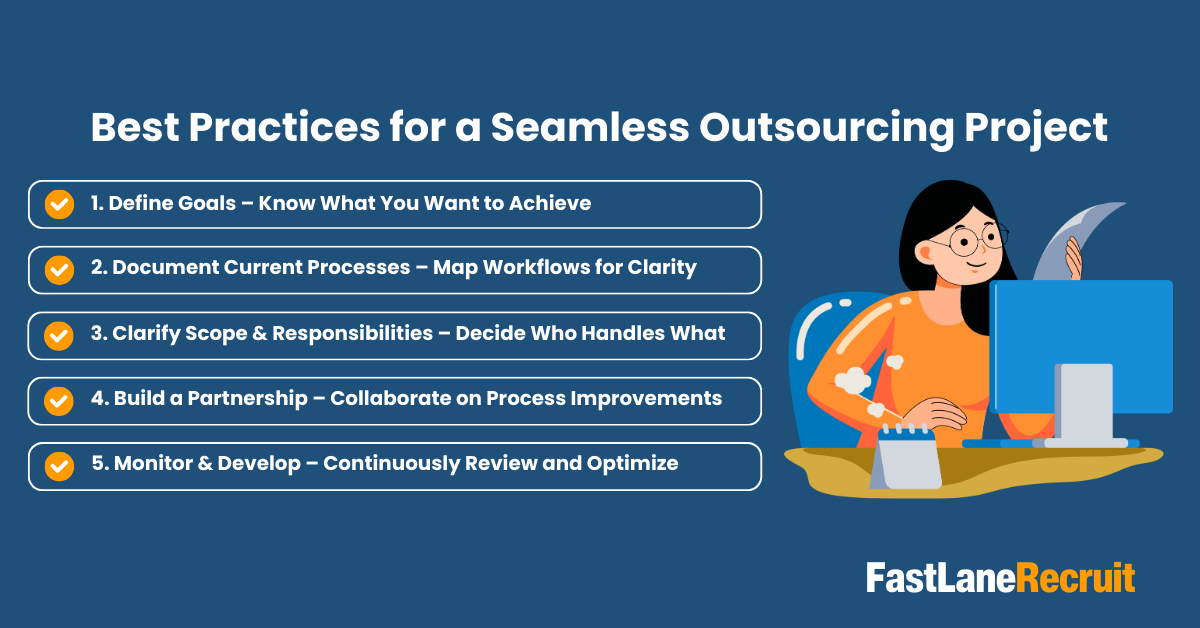
1. Define Goals – Know What You Want to Achieve
Before starting, clearly identify the purpose of outsourcing. Are you aiming for cost savings, faster reporting, access to expertise, or strategic support? Setting concrete goals helps both you and your provider stay aligned and measure success.
Example: A medium-sized retailer outsourced payroll to save costs and reduce overtime errors. Their goal was clear: reduce payroll processing time by 50% while maintaining accuracy.
Also Read: How to Hire an Offshore Accountant in Malaysia
2. Document Current Processes – Map Workflows for Clarity
Understanding your current financial processes is essential. Documenting workflows, approvals, and responsibilities allows the provider to suggest improvements and ensures a smooth transition. This also highlights inefficiencies that can be automated or optimized.
Example: A SaaS company documented its invoicing, expense approvals, and monthly closing processes before outsourcing. The provider used this map to automate repetitive tasks, reducing manual effort by 60%.
3. Clarify Scope & Responsibilities – Decide Who Handles What
Clearly define which tasks remain in-house and which are outsourced. Include roles, responsibilities, timelines, and reporting standards. Avoid partial outsourcing of fragmented tasks unless you’re confident in coordination; full or well-defined partial scopes work best.
Example: A manufacturing firm kept financial planning and strategy in-house but outsourced accounts payable, reconciliations, and tax filings. Responsibilities were mapped so no overlaps or gaps occurred.
4. Build a Partnership – Collaborate on Process Improvements
Outsourcing is not just handing off tasks, it’s a partnership. Work with your provider to identify process improvements, implement automation tools, and optimize workflows. This collaborative approach ensures long-term efficiency and continuous innovation.
Example: A logistics company partnered with its outsourced accounting firm to implement robotic process automation (RPA) for repetitive invoice processing, freeing internal staff for more strategic tasks like budgeting and forecasting.
5. Monitor & Develop – Continuously Review and Optimize
Set KPIs, review reports, and track service quality regularly. Keep an eye on emerging technology, regulatory changes, and industry best practices. Continuous monitoring and development help maintain efficiency, accuracy, and scalability.
Example: An e-commerce startup monitored key metrics like error rates, turnaround times, and reporting accuracy. Quarterly reviews with the outsourced provider led to workflow improvements and adoption of new AI tools for faster data reconciliation.
Tip: Treat outsourcing as a dynamic process, not a one-time project. Regular check-ins, shared dashboards, and open communication channels are key to long-term success.
Example: Outsourcing to Malaysia
Many global businesses are turning to Malaysia for outsourced finance and accounting (F&A) services because it offers a combination of skilled talent, cost efficiency, and regulatory expertise. Malaysia is particularly attractive for companies looking to scale operations in Asia without the overhead of building a full in-house team.
Why Malaysia?
- Skilled Talent Pool – Malaysia has a growing base of accountants and finance professionals trained in international accounting standards like IFRS and GAAP. Many professionals are experienced in multi-country operations, making them ideal for businesses with global needs.
- Time Zone Advantage – Malaysia’s GMT+8 time zone provides overlapping hours with major markets in Asia, Europe, and even parts of North America for early-morning communication. This ensures smoother collaboration across geographies.
- Cost Efficiency – Operational costs in Malaysia are lower than in Western countries. Companies can access top-quality finance talent without paying the high salaries or benefits typical in the U.S., U.K., or Australia.
- Regulatory Compliance – Malaysian labor, tax, and payroll laws can be complex. Local outsourced F&A providers ensure accurate payroll processing, tax filings, and statutory reporting while reducing compliance risks.
Salary Benchmark Table (Malaysia Example)
| Role | Typical Monthly Rate (MYR) | Typical Monthly Rate (USD) |
| Accountant | 4,000–6,000 | 880–1,320 |
| Finance Manager | 8,000–12,000 | 1,760–2,640 |
| Financial Analyst | 6,000–10,000 | 1,320–2,200 |
| Payroll Specialist | 3,500–5,500 | 770–1,210 |
Note: USD values are approximate and may vary with exchange rates. These rates are indicative and can vary depending on experience, city, and company requirements.
Enhancing Outsourcing with EOR (Employer of Record)
An Employer of Record (EOR) allows companies to outsource not only the work but also the employment relationship. This means the EOR legally employs staff on your behalf while you retain operational control of the team. Benefits include:
- Speed and Compliance – Quickly hire local talent without setting up a legal entity in Malaysia. The EOR handles employment contracts, payroll, taxes, and benefits according to local laws.
- Reduced Risk – The EOR ensures labor law compliance, minimizing potential penalties.
- Flexibility – Scale teams up or down based on business needs without dealing with complex HR processes.
FastLaneRecruit’s EOR Solution
FastLaneRecruit offers a full-service EOR solution tailored for finance and accounting outsourcing in Malaysia:
- Local Expertise – Handles payroll, tax compliance, benefits, and statutory reporting according to Malaysian laws.
- Seamless Onboarding – Quickly integrate your F&A team into your operations with minimal delay.
- Scalable Model – Add or reduce staff as your business requirements change.
- Global Compatibility – Ideal for companies with multiple offices or cross-border operations, ensuring alignment with international accounting standards.
Example Scenario:
A U.S.-based startup needed a payroll team in Malaysia to support its regional operations. By partnering with FastLaneRecruit’s EOR service, the company quickly onboarded three payroll specialists and an accountant. FastLaneRecruit handled all compliance, contracts, and local HR requirements, while the startup managed operational workflows and strategic oversight. Within weeks, the team was fully operational, saving both time and administrative burden.
Also Read: Why Malaysia Is a Strategic Hub for Offshore Accountants
Conclusion
Outsourcing finance and accounting can enhance efficiency, reduce costs, and provide access to global expertise. With the right partner, your business can scale quickly, modernize processes, and maintain high accuracy and compliance.
If you want to outsource Malaysian accountants or build a scalable finance team globally, FastLaneRecruit’s EOR Service ensures compliance, payroll management, and dedicated support so you can focus on business growth.
Contact FastLaneRecruit today to explore how outsourcing finance and accounting can transform your business.