Skills & Interview Tips
Hiring a strong recruiting coordinator can transform how your hiring team works, especially when you are scaling globally. From scheduling interviews to keeping candidates engaged and ensuring hiring tasks stay on track, recruiting coordinators play a vital role behind the scenes.
Many global companies now build an offshore recruiting coordination team in Malaysia to streamline operations, improve speed, and stay compliant, all while maintaining excellent hiring experiences.
This guide shows you how to hire the right offshore recruiting coordinator in Malaysia, including the skills to look for, interview tips, and why many international companies choose Malaysia for this role.
Content Outline
Key Summary
Understanding the Role of a Recruiting Coordinator
Recruiting coordinators manage daily hiring operations, from scheduling interviews to candidate communication and onboarding, ensuring a smooth process.
Why Malaysia Is Ideal for Offshore Teams
Communication, organization, HR knowledge, scheduling expertise, attention to detail, and cultural awareness are essential for effective offshore recruiting coordinators.
Effective Interview Strategies
Outsourcing unlocks a host of advantages: accurate and on-time salary payments, secure handling of sensitive data, simplified benefits administration, and scalable support as your team grows across borders.
Choosing the Right Provider Requires More Than Just Price Comparison
Use structured, behavioural, situational, video, and panel interviews to assess candidate skills, decision-making, and cultural fit accurately.
Step-by-Step Hiring Process
From job posting and screening to interviews, offers, contracts, and onboarding, a structured process ensures you hire the right candidate efficiently and compliantly.
Compliance Essentials for Hiring in Malaysia
Follow key regulations, including the Employment Act, EPF, SOCSO, IRBM, and work permit requirements, to maintain legal and operational compliance.
Benefits of Partnering with an Employer of Record (EOR)
An EOR handles payroll, contracts, statutory contributions, and work permits, allowing companies to focus on growth while ensuring full compliance.
What Does a Recruiting Coordinator Do?
A recruiting coordinator plays a key role in making sure the entire hiring process runs smoothly from start to finish. While recruiters focus on finding and evaluating candidates, the recruiting coordinator manages the day-to-day coordination work that keeps everything organised, on time, and professional.
They act as the main point of contact between candidates, recruiters, and hiring managers. By handling communication, scheduling, and document preparation, they help prevent delays, reduce confusion, and create a positive experience for everyone involved.
In growing or global teams, recruiting coordinators are especially important because they help manage interviews across different time zones, support remote hiring, and make sure each candidate moves through the hiring process without unnecessary waiting.
Core Responsibilities and Why They Matter
| Core Responsibility | What It Involves | Why It Matters |
| Scheduling interviews | Coordinating calendars, confirming availability, sending meeting links, and making sure interviews start on time | Keeps hiring on schedule and avoids long waiting periods that may cause candidates to lose interest |
| Candidate communication | Sending interview invitations, reminders, follow-ups, and offer updates | Helps candidates feel informed, respected, and confident about your company |
| Coordinating hiring steps | Tracking each candidate’s progress, reminding interviewers of deadlines, and organising next steps | Reduces confusion and ensures no candidate is overlooked |
| Document tracking | Collecting resumes, interview notes, evaluation forms, and compliance documents | Supports proper record-keeping and hiring compliance |
| Onboarding support | Preparing contracts, sharing first-day information, and guiding new hires through onboarding steps | Helps new employees settle in faster and start their roles with clarity |
By handling these essential tasks, a recruiting coordinator improves hiring speed, strengthens candidate trust, and gives your recruitment team the structure needed to scale smoothly, especially when working with offshore recruiting coordination teams in Malaysia.
Also Read: Outsource Payroll Specialist Teams: A Guide for Global Employers
Why Global Companies Hire Recruiting Coordinators in Malaysia
Malaysia has become one of the best locations for global companies looking to build reliable offshore recruiting coordination teams. One of the key reasons is the country’s well-educated, English-proficient workforce, which allows recruiting coordinators to communicate clearly with international candidates, recruiters, and hiring managers across different regions.
Beyond talent quality, Malaysia also offers a mature and well-defined HR environment. Hiring and employment practices are supported by clear government regulations, giving companies confidence that their hiring activities are aligned with local labour standards and professional guidelines.
Several government-backed authorities provide a strong legal and compliance framework, including:
- Ministry of Human Resources Malaysia – Oversees employment policies, labour standards, and workplace practices.
- Employees Provident Fund (EPF) – Manages retirement savings and mandatory contributions for employees.
- Social Security Organisation (SOCSO) – Provides social security protection for employees in case of workplace injury or job loss.
- Inland Revenue Board Malaysia (IRBM) – Regulates payroll tax and income tax matters.
- Immigration Department of Malaysia – Manages work permits and immigration requirements for foreign workers.
Together, these institutions create a transparent and structured employment system. This allows international businesses to hire recruiting coordinators in Malaysia with confidence, knowing that payroll, contracts, statutory contributions, and employment practices can be managed properly.
Because of this stable framework, companies are able to build compliant offshore recruiting coordination teams in Malaysia that support global hiring needs while maintaining consistent standards and professional credibility.
Also Read: Why Malaysia Stands Out for Payroll and HR Shared Services
Key Skills to Look for in an Offshore Recruiting Coordinator
When building an offshore recruiting coordination team, it’s essential to hire coordinators with the right mix of skills. These skills ensure the hiring process runs smoothly, candidates have a positive experience, and your global HR team can operate efficiently. Here’s a detailed breakdown of the key skills and what to look for:
| Skill | What to Check / Why It Matters |
| Communication | Look for clear and professional communication in emails, calls, and virtual meetings. A good coordinator keeps candidates and hiring managers informed at every step, ensuring nothing gets lost in translation. |
| Organization | Coordinators should be able to manage multiple interviews, schedules, and tasks simultaneously. Strong organizational skills reduce delays and prevent double bookings or missed deadlines. |
| HR Process Knowledge | They should understand all hiring steps—from screening resumes to scheduling interviews, conducting reference checks, and onboarding. This knowledge helps ensure that your recruitment workflow is smooth and compliant. |
| Scheduling Tools | Familiarity with calendars, Applicant Tracking Systems (ATS), and scheduling platforms is essential. A coordinator who can efficiently use these tools saves time and keeps everyone aligned. |
| Attention to Detail | Accuracy matters. Coordinators must track documents, contracts, and candidate information carefully to prevent errors in hiring, payroll, or compliance. |
| Cultural Awareness | Offshore coordinators often work with global teams and candidates from different countries. Being culturally aware ensures smooth communication, minimizes misunderstandings, and promotes positive interactions across borders. |
By focusing on these skills, global companies can ensure that their offshore recruiting coordinators in Malaysia are not only efficient but also enhance the overall candidate experience and support international HR teams effectively.
Interview Types That Work Best in Malaysia
Different interview methods help HR teams in Malaysia evaluate candidates effectively based on the role, skills, and company needs. Here’s a breakdown of the most commonly used interview types, when to use them, and practical examples:
Structured Interview
Best Use:
Structured interviews are ideal for fair and consistent comparison between candidates. Every candidate is asked the same set of questions, reducing bias and making it easier to evaluate objectively.
Example Questions:
- “Can you describe a time you managed multiple tasks under tight deadlines?”
- “How do you prioritize competing tasks in your daily workflow?”
Behavioural Interview
Best Use:
Behavioural interviews focus on past actions to predict future performance. They are great for assessing teamwork, problem-solving, leadership, and adaptability.
Example Questions:
- “Tell me about a time you handled last-minute interview changes.”
- “Describe a situation where you resolved a conflict within a team.”
Also Read: How to Hire Payroll Specialists in Malaysia
Situational Interview
Best Use:
Situational interviews test how candidates would handle hypothetical scenarios relevant to the role. This approach helps assess decision-making, critical thinking, and problem-solving skills.
Example Questions:
- “What would you do if a key project deadline was suddenly moved up?”
- “How would you handle a client complaint that could affect your team’s performance?”
Video Interview
Best Use:
Video interviews are perfect for remote or global hiring, allowing candidates from different states or countries to participate without travel. They are also useful for fast initial screenings.
Example Questions:
- “Walk us through how you would organize a virtual onboarding session for new hires.”
- “Explain a process you improved in your previous role and how you implemented it remotely.”
Panel Interview
Best Use:
Panel interviews involve multiple interviewers assessing the candidate at once. This speeds up decision-making and ensures cross-department perspectives. Panel interviews are ideal for senior or specialized roles.
Example Questions:
- HR asks about culture fit: “What motivates you in a work environment?”
- Manager asks about project experience: “Describe a project where you had to manage tight deadlines and limited resources.”
- Technical lead tests skills: “Explain how you solved a challenging technical problem in your previous role.”
Example Behavioural and Situational Questions
Behavioural:
- “Tell me about a time you had to handle multiple candidates’ schedules at the same time. How did you manage it?”
- “Describe a situation where you received negative feedback from a candidate or hiring manager. How did you respond?”
Situational:
- “If a top candidate cancels at the last minute, how would you adjust the interview schedule without affecting other candidates?”
- “Imagine two managers want different candidates for the same role. How would you facilitate a fair selection process?”
Using the right interview type for each role, combined with well-prepared questions, allows HR teams in Malaysia to hire faster, reduce mistakes, and create a smoother candidate experience.
Also Read: Why Outsourcing HRIS Administration Is a Smart Move for Global Companies
Hiring Process for Recruiting Coordinators in Malaysia
Hiring a Recruiting Coordinator in Malaysia involves several structured steps to ensure you find the right candidate efficiently while staying compliant with local regulations. Below is a detailed breakdown of each step:
1. Job Posting
What Happens:
The first step is to advertise the role. This involves sharing the job description, qualifications, responsibilities, and benefits clearly. Job postings can be shared on:
- Online job portals (e.g., JobStreet, LinkedIn)
- Company website careers page
- Social media platforms (e.g., Facebook, LinkedIn)
- Recruitment agencies for broader reach
Example:
“Looking for a Recruiting Coordinator to manage end-to-end hiring processes. Must have 2+ years of experience in HR or recruitment, proficient in ATS tools, and excellent communication skills.”
2. Screening
What Happens:
Applications are reviewed to shortlist candidates who meet the basic requirements. Screening may include:
- Resume and cover letter review
- Checking for relevant HR experience
- Initial phone or video screening to assess communication and professionalism
Example:
A recruiter may shortlist candidates who have experience coordinating interviews for 50+ hires annually and familiarity with HR systems like BambooHR or Workday.
3. Interviews
What Happens:
Shortlisted candidates undergo interview rounds to assess skills, cultural fit, and problem-solving ability. Common methods include:
- Behavioural interviews: Focus on past experiences (e.g., “Tell me about a time you managed scheduling conflicts for multiple candidates.”)
- Situational interviews: Present hypothetical scenarios (e.g., “How would you handle a candidate canceling last-minute before an important panel interview?”)
- Panel interviews: Involving multiple stakeholders for cross-departmental evaluation
Tip: Include at least one interview round with the hiring manager and one with HR to cover both operational and strategic aspects of the role.
4. Offer
What Happens:
Once a suitable candidate is selected, the employer presents the job offer. This includes:
- Salary and benefits
- Work schedule and location
- Probation period and evaluation criteria
Candidates may negotiate elements such as flexible work arrangements, bonuses, or additional perks.
Example:
“Base salary of RM4,500/month with 3% EPF contribution, 14 days annual leave, and remote work option twice a week.”
Also Read: How to Hire HRIS Administrators in Malaysia
5. Contract
What Happens:
The employment contract is prepared in compliance with Malaysian labor laws. It outlines:
- Roles and responsibilities
- Working hours
- Probation and confirmation details
- Termination clauses
- Confidentiality or non-compete clauses if applicable
Example:
A permanent contract may specify a 3-month probationary period, after which the candidate will be confirmed if performance standards are met.
6. Onboarding
What Happens:
The onboarding process ensures the new Recruiting Coordinator integrates smoothly into the company. Key activities include:
- Orientation on company policies, culture, and values
- Introduction to recruitment systems (ATS, HRIS)
- Setting up email, system access, and tools
- Assigning a mentor or buddy for guidance
Example:
The coordinator may spend the first week learning company hiring protocols, attending shadow sessions with senior recruiters, and practicing interview scheduling and candidate communication.
This step-by-step process ensures that companies in Malaysia hire Recruiting Coordinators who are well-prepared to manage the recruiting workflow efficiently, support hiring managers, and deliver a positive candidate experience.
Compliance Essentials for Hiring in Malaysia
When building a recruiting team or hiring employees in Malaysia, it’s crucial to follow government regulations to ensure legal compliance and avoid penalties. Here’s a breakdown of the key compliance areas and the authorities that oversee them:
1. Employment Law
Authority: Employment Act 1955
Details:
The Employment Act 1955 governs the rights and obligations of both employers and employees in Malaysia. It covers areas such as:
- Minimum wages
- Working hours and overtime
- Leave entitlements (annual, sick, maternity/paternity)
- Termination and notice periods
- Employee protection against harassment and discrimination
Example:
A recruiting coordinator must ensure new hires receive proper probation terms and notice periods as outlined in the Employment Act, preventing legal disputes.
2. Retirement Fund
Authority: Employees Provident Fund (EPF)
Details:
EPF is Malaysia’s retirement savings system. Employers and employees contribute a fixed percentage of monthly salary to the fund:
- Provides retirement savings for employees
- Contributions are mandatory for all Malaysian employees
- Some expatriates may opt out depending on visa type
Example:
For a RM4,000 monthly salary, the employer contributes 12% to EPF, while the employee contributes 11%, ensuring compliance with the law.
Also Read: How Outsourcing HR Operations Can Streamline Business Efficiency
3. Social Security
Authority: Social Security Organisation (SOCSO)
Details:
SOCSO provides social security protection, including:
- Employment Injury Scheme: Covers work-related accidents
- Invalidity Scheme: Provides benefits in case of disability or inability to work
Employers must register all eligible employees and make monthly contributions.
Example:
If a recruiting coordinator gets injured on the job while attending an offsite interview session, SOCSO provides medical coverage and financial support under the Employment Injury Scheme.
4. Payroll Tax
Authority: Inland Revenue Board of Malaysia (IRBM)
Details:
Employers are responsible for deducting and remitting income tax on behalf of employees through the Monthly Tax Deduction (MTD) system. This ensures:
- Accurate tax collection
- Employees remain compliant with local income tax laws
Example:
A Malaysian employee earning RM5,000/month will have income tax deducted according to the IRBM’s MTD schedule, with the employer submitting the payment monthly.
5. Work Permits
Authority: Immigration Department of Malaysia
Details:
Foreign employees require valid work permits to work legally in Malaysia. Types of permits include:
- Employment Pass (for professionals and managers)
- Temporary Employment Pass (for semi-skilled or low-skilled workers)
- Professional Visit Pass (short-term foreign experts)
Employers must apply for, renew, and maintain these permits, ensuring foreign hires comply with immigration regulations.
Example:
If a company hires a recruiting coordinator from the Philippines, the employer applies for an Employment Pass and ensures it’s renewed on time to avoid legal issues.
Following these compliance essentials allows companies to operate smoothly, avoid penalties, and provide a secure, legally compliant workplace for employees in Malaysia.
Example: Outsourcing Recruiting Coordinators to Malaysia
Many global companies choose to outsource recruiting coordinators to Malaysia to streamline hiring processes, reduce costs, and leverage a skilled, English-proficient workforce. Here’s a detailed look at common challenges and how an offshore recruiting coordination team can solve them:
1. Slow Scheduling
Challenge:
Coordinating interviews across multiple time zones and busy calendars often slows down the hiring process. Delays can frustrate both candidates and hiring managers, leading to a longer time-to-hire.
Offshore Solution:
A dedicated offshore recruiting coordination team in Malaysia can handle all interview scheduling efficiently. Using tools like shared calendars and applicant tracking systems (ATS), they ensure that interviews are booked promptly, reminders are sent, and rescheduling is handled smoothly.
Example:
Instead of the hiring manager juggling schedules between New York and London, the Malaysian team manages all timing conflicts, ensuring interviews happen within 24–48 hours.
2. Candidate Drop-Offs
Challenge:
Candidates may lose interest or accept another offer if communication is slow or inconsistent during the recruitment process.
Offshore Solution:
Offshore recruiting coordinators provide consistent, professional follow-ups with candidates. They update candidates on their application status, respond to queries quickly, and maintain engagement throughout the hiring process.
Example:
A software developer from India applied for a role in Singapore. The Malaysian recruiting coordinator ensured weekly updates were sent, questions answered, and interview logistics confirmed, preventing the candidate from dropping out.
3. Hiring Delays
Challenge:
Delays in screening, coordination, or administrative tasks can stretch hiring cycles, making it harder for companies to fill critical roles.
Offshore Solution:
Centralized coordination from a dedicated offshore team reduces bottlenecks. Coordinators manage every step, screening, scheduling, document collection, and onboarding, so internal HR teams can focus on strategic tasks rather than administrative work.
Example:
For a multinational marketing firm, having a Malaysian offshore team handle all pre-interview screenings and document verifications reduced the average time-to-hire from 6 weeks to 3 weeks.
4. Compliance Worries
Challenge:
Hiring employees, especially foreign talent, comes with regulatory requirements. Missteps can lead to fines, legal disputes, or visa issues.
Offshore Solution:
Partnering with an Employer of Record (EOR) in Malaysia ensures all statutory requirements are handled correctly, including:
- Work permits and visa applications
- Payroll and statutory contributions (EPF, SOCSO, IRBM)
- Employment contracts aligned with Malaysian labor laws
Example:
A US-based startup hired three recruiting coordinators in Malaysia through an EOR. The EOR handled all tax filings, work visas, and statutory registrations, ensuring the startup remained compliant without managing local HR operations directly.
Outsourcing recruiting coordinators to Malaysia addresses operational bottlenecks, enhances candidate experience, accelerates hiring, and guarantees compliance. For companies expanding globally, this approach combines efficiency, cost-effectiveness, and peace of mind, allowing internal HR teams to focus on strategic initiatives rather than day-to-day recruitment logistics.
Tips for Hiring Success
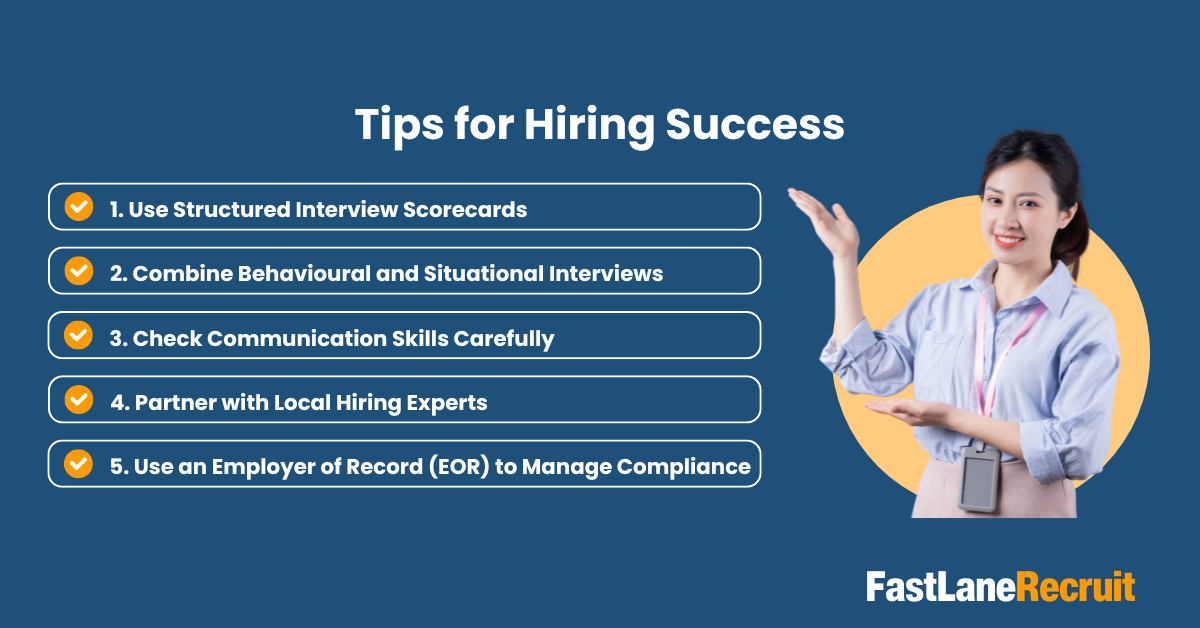
Hiring the right recruiting coordinator or any HR professional requires a strategic approach. Here are some practical tips to improve your hiring outcomes:
1. Use Structured Interview Scorecards
Why it matters:
Structured interviews ensure each candidate is evaluated fairly and consistently. Scorecards allow you to quantify responses, compare candidates objectively, and reduce hiring bias.
Example:
Create a scorecard with categories such as communication, organization, HR knowledge, and cultural fit. Each interviewer rates the candidate on a 1–5 scale, making it easy to compare multiple candidates side by side.
2. Combine Behavioural and Situational Interviews
Why it matters:
Behavioural interviews help you understand how candidates have handled real-world situations in the past, while situational interviews test how they might respond to hypothetical challenges. Using both methods provides a well-rounded view of their skills.
Example:
Ask a behavioural question like, “Tell me about a time you managed multiple interview schedules at once.”
Follow up with a situational question like, “If two key interviews conflict tomorrow, how would you resolve it?”
3. Check Communication Skills Carefully
Why it matters:
Recruiting coordinators serve as the main point of contact for candidates and hiring teams. Strong written and verbal communication is essential for maintaining professionalism and candidate engagement.
Example:
Evaluate their email etiquette during the screening process and observe how clearly they explain processes or respond to questions during interviews.
4. Partner with Local Hiring Experts
Why it matters:
Local experts understand the Malaysian labor market, employment laws, and cultural nuances, making it easier to attract and retain top talent. They can also provide guidance on competitive compensation packages and candidate expectations.
Example:
Collaborate with a Malaysian recruitment agency or consultant to gain insights on typical salary ranges for recruiting coordinators and learn the best channels to find candidates.
Also Read: How to Build an Offshore HR Administration Team in Malaysia
5. Use an Employer of Record (EOR) to Manage Compliance
Why it matters:
An EOR handles all legal and regulatory requirements for hiring in Malaysia, including work permits, payroll contributions (EPF, SOCSO), taxes, and employment contracts. This reduces risk and ensures your team is fully compliant.
Example:
A global tech firm used an EOR to hire recruiting coordinators in Malaysia. The EOR managed all statutory filings, work visas, and local labor law compliance, allowing the company to focus on growing their team without worrying about regulatory hurdles.
Summary:
By following these tips, structured interviews, behavioural + situational assessments, strong communication checks, local expertise, and EOR support, companies can hire highly effective recruiting coordinators efficiently, compliantly, and with minimal risk.
Why Use an Employer of Record (EOR) in Malaysia?
Hiring in a new country comes with a maze of legal, administrative, and compliance responsibilities. An Employer of Record (EOR) simplifies this process by acting as the official employer for your offshore team while you retain full control over day-to-day operations.
What an EOR Handles
By partnering with an EOR in Malaysia, you can delegate complex tasks, including:
- Payroll: Ensures employees are paid accurately and on time, accounting for local salary norms, allowances, and deductions.
- Statutory Contributions: Manages mandatory contributions to the Employees Provident Fund (EPF), Social Security Organization (SOCSO), and Employment Insurance System (EIS).
- Contracts: Drafts employment agreements that comply with Malaysian labor laws, protecting both the company and employee.
- Work Permits and Visas: Handles applications and renewals for foreign hires, ensuring legal eligibility to work in Malaysia.
- Local Compliance: Keeps your team aligned with Employment Act 1955 regulations, tax requirements from the Inland Revenue Board (IRBM), and other government guidelines.
Why it matters: With all administrative and compliance tasks handled by the EOR, your team can focus on strategic growth, recruitment, and business objectives rather than paperwork or legal risks.
FastLaneRecruit EOR: Your Hiring Shortcut
FastLaneRecruit’s EOR service is designed to help global companies quickly and compliantly build offshore recruiting coordination teams in Malaysia. Instead of setting up a local entity which can be time-consuming and expensive, FastLaneRecruit acts as your legal employer while you manage the team’s daily operations.
Benefits of Using FastLaneRecruit’s EOR:
- Speed: Start hiring recruiting coordinators within weeks rather than months.
- Compliance: Fully adheres to Malaysian employment laws, EPF/SOCSO contributions, payroll regulations, and work permit requirements.
- Scalability: Easily expand your offshore recruiting team as your business grows, without worrying about legal complexities.
- Reduce Operational Costs: Avoid operational costs and administrative overhead of establishing a local entity while still hiring top talent.
Example:
A multinational tech company wanted to set up a recruiting coordination team in Malaysia to support their APAC expansion. By using FastLaneRecruit’s EOR, they onboarded a full team of coordinators within 4-8 weeks, with all contracts, payroll, and work permits handled seamlessly, allowing their HR team to focus on hiring strategy and candidate engagement.
Conclusion
Hiring the right recruiting coordinator can make a real difference in how smoothly and quickly your hiring process runs. From managing interview schedules to keeping candidates informed and supporting onboarding, recruiting coordinators are the backbone of an organized and positive hiring experience.
Malaysia has become a trusted location for building offshore recruiting coordination teams because of its skilled talent pool, strong employment framework, and global-ready workforce. With the right skills, structured interviews, and a clear hiring process, you can confidently find an offshore recruiting coordinator who supports your growth goals.
If you want a simpler and compliant way to get started, FastLaneRecruit’s EOR service gives you a reliable alternative. You can hire recruiting coordinators in Malaysia without setting up a local entity, while payroll, contracts, and statutory matters are handled for you, so your team can stay focused on building great hires, faster.
Hire Your Recruiting Team with Confidence
FastLaneRecruit’s EOR service provides a fast, reliable, and compliant solution to hire recruiting coordinators in Malaysia. Whether you’re expanding regionally or building a fully offshore HR team, FastLaneRecruit lets you grow globally without the typical legal or administrative headaches. Contact us for a free call!