
Skills & Best Practices
HRIS administrators play a critical role in managing HR technology systems, ensuring data accuracy, and supporting HR operations such as payroll, compliance, and employee lifecycle management. For companies looking to hire in Malaysia, finding the right HRIS administrator can be challenging. FastLaneRecruit’s Employer of Record (EOR) service provides a seamless way to hire and manage HRIS Administrators in Malaysia without the administrative and legal burdens, allowing your team to focus on strategic HR initiatives. Understanding the responsibilities, skills, and best practices for hiring HRIS administrators is essential to build a high-performing HR tech team.
Content Outline
Key Summary
Role Overview of HRIS Administrators
HRIS Administrators manage HR software systems, maintain accurate employee data, and support HR teams with reporting, compliance, and workflow automation.
Core Responsibilities
Key duties include system configuration, data integrity management, report generation, user support, HR process automation, compliance tracking, and workflow optimization.
Essential Skills
Candidates should have expertise in HRIS platforms (Workday, SAP SuccessFactors, Oracle HCM), data management, reporting, system troubleshooting, automation, and problem-solving abilities.
Secondary Skills Matter
Communication, attention to detail, project management, collaboration, ethical judgment, adaptability, continuous learning, and innovation improve HRIS effectiveness.
Assessing Candidate Skills
Evaluate candidates through system configuration exercises, HRIS reporting tasks, scenario-based problem solving, Excel and database tests, and compliance knowledge assessments.
Best Practices for Hiring
Define your business needs, clarify KPIs, leverage HR technology, ensure compliance with Malaysian labor laws, promote data-driven decisions, foster collaboration, and consider EOR solutions.
Streamlined Hiring with FastLaneRecruit
FastLaneRecruit’s EOR service enables companies to hire HRIS Administrators in Malaysia efficiently, managing payroll, compliance, onboarding, and benefits without a local legal entity.
What Does an HRIS Administrator Do?
An HRIS Administrator (Human Resources Information System Administrator) is the go-to person for managing all HR technology systems in an organization. Their main goal is to make sure HR software runs smoothly, employee data is accurate, and HR operations, like payroll, benefits, onboarding, and reporting, work efficiently. Think of them as the bridge between HR teams and technology: they ensure HR processes are automated, organized, and compliant with laws, while making it easier for employees and HR staff to access the information they need.
In simpler terms, they handle all things HR tech so HR teams can focus on people, not paperwork.
Core Responsibilities
| Responsibility | What It Means | Example Tools & Tasks |
| System Configuration & Maintenance | Setting up and maintaining the HRIS system so it works correctly for all users. This includes adding new employees, managing access permissions, and updating workflows. | Workday, SAP SuccessFactors, Oracle HCM – e.g., setting up onboarding flows for new hires or configuring payroll approval processes. |
| Data Management & Accuracy | Keeping all employee information accurate, complete, and secure. This involves checking records, correcting errors, and ensuring compliance with regulations. | Excel, HRIS, SQL – e.g., updating employee contact info, verifying payroll entries, or checking leave balances. |
| Reporting & Dashboards | Creating reports and visual dashboards that help HR leaders make informed decisions. They turn raw HR data into clear insights. | Power BI, Tableau, HRIS reporting tools – e.g., generating reports on staff turnover, headcount, or employee engagement scores. |
| User Support & Troubleshooting | Helping HR staff and employees navigate the HRIS system. Fixing issues and answering questions about using the software. | Internal support portals, ticketing systems – e.g., guiding a manager on how to approve leave requests or resolving a payroll error. |
| HR Process Automation | Automating repetitive HR tasks to save time and reduce mistakes, such as onboarding, leave requests, approvals, or payroll processing. | HRIS automation modules, Zapier – e.g., setting up automatic leave balance updates or automated onboarding email sequences. |
| Compliance Monitoring | Ensuring that HR processes and data in the system comply with Malaysian labor laws and internal company policies. | HRIS, HR policies – e.g., making sure leave accrual rules follow Employment Act 1955, or audit-ready recordkeeping. |
| Integration & System Evaluation | Connecting the HRIS with other company software and reviewing system performance to ensure it meets organizational needs. | API tools, Workday, SAP SuccessFactors – e.g., linking HRIS to payroll or accounting systems and checking for errors. |
Essential Skills for HRIS Administrators
HRIS Administrators need a mix of technical skills for system management and analytical skills to interpret HR data accurately.
| Skill | What It Means | Example in Action |
| HRIS Expertise | Deep knowledge of HR software, modules, and workflows to manage all HR operations efficiently. | Configuring onboarding workflows in Workday or customizing leave management in SAP SuccessFactors. |
| Data Management | Ensuring HR data is accurate, secure, and up-to-date. | Cleaning employee records, fixing payroll errors, validating benefits data. |
| Reporting & Analytics | Ability to generate clear, actionable insights from HR data. | Creating dashboards to track turnover, headcount, and employee engagement trends. |
| Problem-Solving | Quickly identifying and fixing system issues or workflow errors. | Troubleshooting payroll mismatches or broken automation flows. |
| Technology Proficiency | Navigating HR software, Excel, and databases effectively. | Automating leave approval notifications, running HR reports, or building HR dashboards. |
| Compliance Awareness | Understanding Malaysian labor laws and company policies to avoid legal risks. | Updating system workflows to reflect statutory leave entitlements. |
Secondary Skills
- Communication: Explaining technical HRIS details in simple terms so HR teams and employees understand.
Example: Teaching HR staff how to generate a leave report. - Attention to Detail: Ensuring every system entry, workflow, and report is correct.
Example: Spotting a mismatch in payroll deductions before processing. - Project Management: Planning and coordinating HRIS updates or implementations.
Example: Leading a system upgrade or new module rollout. - Ethical Judgment: Keeping employee data confidential and secure.
Example: Making sure sensitive HR data is only accessible to authorized personnel. - Adaptability: Adjusting quickly to new HR tools or processes.
Example: Learning a new HRIS module after a software update. - Continuous Learning: Staying current with HR tech trends, updates, and best practices.
Example: Attending webinars on AI-driven HR analytics or exploring HR automation tools.
An HRIS Administrator ensures your HR software works accurately, efficiently, and compliantly, so HR teams can focus on strategic work like employee engagement and talent management instead of manual admin tasks. They are the technical backbone of modern HR operations, keeping data clean, workflows automated, and reports insightful.
Also Read: How to Build an Offshore HR Administration Team in Malaysia
How to Assess HRIS Administrator Skills
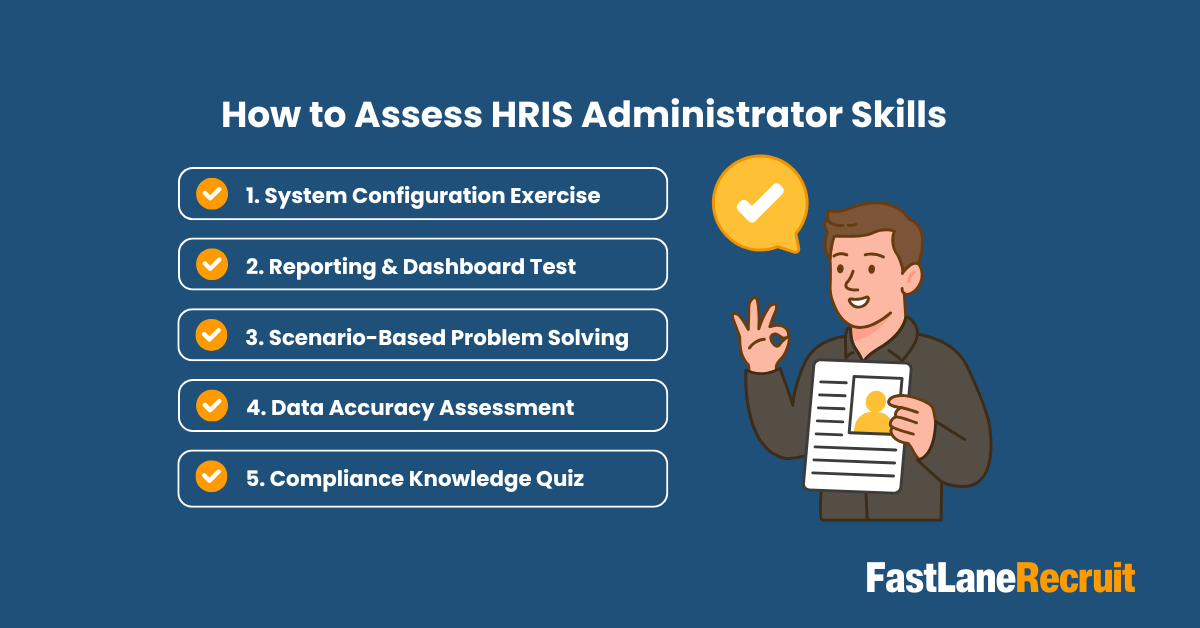
Hiring the right HRIS Administrator isn’t just about looking at resumes, it’s about testing whether they can handle real HR systems, manage data accurately, and solve practical HR tech challenges. Here’s a detailed breakdown of effective assessment methods:
1. System Configuration Exercise
Purpose: Test a candidate’s ability to set up HRIS workflows, user roles, permissions, and automation.
Why It Matters: HRIS Administrators must configure systems correctly to ensure smooth onboarding, payroll processing, leave management, and approvals. Mistakes can lead to workflow errors, payroll issues, or compliance risks.
Example:
- Ask candidates to create a workflow for onboarding new hires with automated notifications and approvals.
- Have them set permissions so managers can approve leave requests, but employees can only view their own data.
Tools: Workday, SAP SuccessFactors, Oracle HCM, BambooHR
2. Reporting & Dashboard Test
Purpose: Evaluate their ability to generate actionable HR reports and visual dashboards.
Why It Matters: HR leaders rely on clear, accurate data to make strategic decisions. A candidate who can translate raw HR data into insights adds real value.
Example:
- Provide a dataset of employee attendance, performance, or turnover. Ask candidates to create a dashboard showing trends, KPIs, and key metrics.
- Have them summarize insights in a brief report for HR management.
Tools: Power BI, Tableau, Excel, HRIS reporting modules
3. Scenario-Based Problem Solving
Purpose: Simulate real HRIS challenges such as system errors, automation failures, or data inconsistencies.
Why It Matters: HRIS Administrators need practical problem-solving skills to resolve issues quickly and prevent operational disruptions.
Example:
- Present a scenario where leave balances are incorrect in the system and payroll is affected. Ask candidates to diagnose the issue, propose a solution, and prevent it from happening again.
- Simulate a failed automation for onboarding tasks and ask them to troubleshoot.
Tools: HRIS sandboxes, workflow simulators
4. Data Accuracy Assessment
Purpose: Test ability to maintain clean, accurate, and compliant HR data.
Why It Matters: Data errors can affect payroll, compliance, and employee trust. Accuracy is critical.
Example:
- Give candidates a messy employee dataset with duplicate entries, missing fields, or incorrect payroll codes. Ask them to clean and validate the data.
- Ask them to explain how they ensure ongoing data integrity.
Tools: Excel, HRIS, SQL
5. Compliance Knowledge Quiz
Purpose: Ensure candidates understand Malaysian labor laws and company HR policies.
Why It Matters: HRIS processes must comply with legal requirements to avoid penalties and maintain proper recordkeeping.
Example:
- Ask questions about leave entitlements, statutory contributions, payroll rules, or data privacy under the Employment Act 1955 and PDPA.
- Scenario question: “How would you configure the HRIS to ensure leave accrual complies with Malaysian law?”
Also Read: HR Administrator Salary Guide 2025
Best Practices When Hiring HRIS Administrators
Hiring is more than finding someone with technical skills, it’s about ensuring alignment with your business goals, compliance requirements, and HR strategy. Here’s how to do it effectively:
1. Define Business Needs
Action: Identify the HR processes your HRIS Administrator will manage.
Why It Matters: Clear role definition ensures candidates understand responsibilities and allows you to match skills with actual business requirements.
Example: Managing onboarding, payroll, leave management, HR reporting, or benefits administration.
2. Set KPIs
Action: Establish measurable objectives for system performance and HRIS efficiency.
Why It Matters: KPIs guide performance evaluation and ensure the HRIS Administrator contributes to organizational goals.
Examples:
- System uptime above 99%
- Accuracy of HR reports at 100%
- Workflow automation completion rates
3. Leverage Technology
Action: Use HRIS, automation tools, and reporting platforms to maximize efficiency.
Why It Matters: Technology allows HRIS Administrators to focus on strategy, not repetitive tasks.
Example: Automating onboarding emails, payroll approvals, or generating monthly HR dashboards automatically.
4. Ensure Compliance
Action: Ensure HRIS processes follow Malaysian labor laws and internal company policies.
Why It Matters: Protects the organization from legal or financial risks.
Example: Configuring leave accrual and payroll workflows to comply with statutory requirements.
5. Encourage Data-Driven Decisions
Action: HRIS Administrators should provide accurate insights to help HR leaders make informed decisions.
Why It Matters: Data-driven decisions reduce bias and align HR strategy with organizational goals.
Example: Using turnover and engagement reports to design retention programs.
6. Promote Collaboration
Action: Ensure HRIS Administrators work closely with HR, finance, and leadership teams.
Why It Matters: Collaboration ensures workflows are integrated, data is shared appropriately, and systems meet all departmental needs.
Example: Coordinating with payroll to verify salary data or with finance to integrate benefits reports.
7. Consider an Employer of Record (EOR)
Action: Use an EOR like FastLaneRecruit to handle local employment compliance, payroll, and onboarding.
Why It Matters: Frees HRIS Administrators to focus on technology and strategy rather than administrative burdens.
Example: Hiring a Malaysian HRIS Administrator through FastLaneRecruit without setting up a legal entity, while the EOR manages payroll, benefits, and statutory compliance.
Also Read: Why Malaysia Is a Prime Destination for Offshore HR Administrators
Hiring HRIS Administrators in Malaysia: Step-by-Step Workflow
Hiring skilled HRIS Administrators in Malaysia requires a structured approach to ensure you attract top talent, evaluate their skills effectively, and maintain compliance with local laws. Here’s a detailed workflow you can follow:
Step 1: Define Role & Responsibilities
Before you start hiring, clearly outline the HRIS Administrator’s duties and expectations. A well-defined role ensures candidates understand what is expected and allows you to assess the right skills during recruitment.
Key Actions:
- List core HRIS responsibilities, such as:
- System configuration and maintenance
- Data management and accuracy
- Reporting and dashboards
- HR process automation
- Compliance monitoring
- User support and troubleshooting
- Include measurable goals for the role, for example:
- Increase report accuracy to 99%
- Automate 80% of onboarding workflows
- Reduce manual HR tasks by 30% through automation
- Clearly define how this role fits into the HR and IT teams.
Tip: Consider including secondary responsibilities like training HR staff on HRIS systems, integrating HRIS with other business tools, or providing insights to improve HR processes.
Step 2: Identify Required Skills
Identify the skills and traits needed for success in the role. Categorize them into core and secondary skills to guide your hiring and assessments.
Core Skills:
- HRIS expertise (Workday, SAP SuccessFactors, Oracle HCM)
- Data management and reporting
- Problem-solving and troubleshooting
- Compliance awareness with Malaysian labor laws
Secondary Skills:
- Communication and consultation
- Attention to detail
- Project management
- Adaptability and continuous learning
Tip: Balance technical proficiency with soft skills. Candidates who can manage systems and communicate insights clearly are more effective.
Step 3: Source Candidates
Reach out to potential HRIS talent using multiple channels to ensure you access a strong talent pool:
- Job boards: JobStreet Malaysia, LinkedIn Jobs
- HR tech communities: Forums, Slack groups, or LinkedIn HRIS-focused communities
- Professional referrals: Ask current HR or IT professionals for recommendations
Tip: Highlight your company culture, the HRIS systems in use, and opportunities for professional growth to attract high-quality candidates.
Step 4: Assess Skills
Use a combination of practical assessments and scenario-based exercises to evaluate real-world capabilities:
- System Configuration Exercise: Test ability to set up workflows, user roles, and permissions in a sandbox environment.
- Reporting & Dashboard Test: Evaluate skills in generating actionable HR reports and dashboards.
- Scenario-Based Problem Solving: Present HRIS challenges like automation failures or data discrepancies and see how candidates respond.
- Data Accuracy Assessment: Test the ability to clean, validate, and maintain HR data.
- Compliance Knowledge Quiz: Check understanding of Malaysian labor laws and internal HR policies.
Tip: Tools like HRIS sandboxes, Excel exercises, or HR tech simulations make these tests realistic and effective.
Also Read: Labour Law, Payroll & Compliance in Malaysia for HR Administrators
Step 5: Interview & Shortlist
Conduct interviews to assess both technical capabilities and cultural fit:
- Ask about past experience with HRIS systems and reporting tools
- Discuss scenarios like resolving data errors or improving workflow automation
- Evaluate collaboration skills with HR, finance, and leadership teams
- Confirm understanding of Malaysian employment laws and compliance requirements
Tip: Include practical questions and problem-solving discussions rather than just theoretical knowledge.
Step 6: Offer & Onboard
Once you select the best candidate, use FastLaneRecruit’s EOR service to handle the hiring, onboarding, and administrative tasks.
How an EOR Helps:
- Legal compliance: Contracts, statutory benefits, and payroll are fully compliant with Malaysian labor laws.
- Payroll & Benefits: Salaries, EPF/SOCSO contributions, and leave entitlements are managed automatically.
- Smooth Onboarding: Employees can start immediately without your company needing a local entity.
- Focus on Strategy: Your HRIS Administrator can concentrate on system management, data accuracy, reporting, and automation instead of administrative work.
Tip: FastLaneRecruit allows global companies to hire top HRIS talent in Malaysia quickly while handling all compliance, payroll, and administrative requirements.
Also Read: How to Pay International Employees
How an Employer of Record (EOR) Supports Hiring HRIS Administrators
When hiring HRIS Administrators in Malaysia, companies often face challenges like:
- Complying with local labor laws (Employment Act 1955, statutory contributions, PDPA data protection)
- Managing payroll and benefits for local employees
- Handling contracts, onboarding, and terminations
- Avoiding the need to set up a legal entity in Malaysia
This is where an Employer of Record (EOR) service such as FastLaneRecruit comes in. An EOR acts as the legal employer of your HRIS staff in Malaysia while you maintain full control over their daily tasks, projects, and HRIS strategy.
Key Benefits of Using an EOR for HRIS Hiring
- Legal Compliance & Risk Mitigation
FastLaneRecruit ensures that employment contracts, payroll, statutory benefits, and HR processes comply with Malaysian labor laws. This protects your company from legal penalties and ensures all HRIS operations follow regulations. - Payroll Management
The EOR handles salary processing, EPF/SOCSO contributions, income tax deductions, and bonus calculations. Your HRIS Administrator can focus entirely on system management and HR tech tasks rather than payroll concerns. - Benefits Administration
FastLaneRecruit manages employee benefits, insurance, leave entitlements, and other statutory requirements, ensuring a smooth employee experience. - Streamlined Onboarding
New HRIS Administrators can start immediately without your company needing a local office or HR setup. The EOR handles contracts, compliance checks, and access to payroll and benefits. - Global Expansion Made Easy
For international companies, FastLaneRecruit allows hiring skilled HRIS talent in Malaysia without establishing a local legal entity, enabling fast scaling and cost efficiency. - Focus on Strategy & Technology
By offloading administrative, payroll, and compliance tasks to the EOR, your HRIS Administrators can dedicate their time to:- Configuring HRIS workflows
- Maintaining data accuracy
- Generating insightful reports and dashboards
- Automating HR processes
- Ensuring system compliance and security
Example Scenario:
Imagine your company wants to hire two HRIS Administrators in Malaysia to manage Workday workflows, automate leave approvals, and generate monthly HR dashboards.
Without an EOR, you would need:
- A local legal entity in Malaysia
- Payroll and benefits setup
- HR contracts compliant with Malaysian law
- Time to source and vet candidates
With FastLaneRecruit:
- You hire the HRIS Administrators directly through the EOR.
- FastLaneRecruit handles contracts, payroll, benefits, and compliance.
- Your HRIS Administrators focus entirely on system management, reporting, and HR automation from day one.
Also Read: Why Global Companies Outsource HR Administration Roles
Conclusion
Hiring skilled HRIS administrators in Malaysia allows your HR function to operate efficiently, ensuring:
- Accurate, secure employee data
- Streamlined HR processes and automated workflows
- Compliance with Malaysian labor laws and internal policies
- Actionable insights from reports and dashboards
By following a structured hiring workflow, focusing on core and secondary skills, implementing robust assessments, and leveraging an EOR like FastLaneRecruit, you can build a high-performing HR tech team without the administrative burden of a local entity.
Start Building Your HR Tech Team in Malaysia Today
- Hire top HRIS talent without setting up a local office or entity
- Ensure full compliance with employment laws and payroll regulations
- Streamline onboarding and HRIS workflows for faster productivity
- Let your HRIS team focus on strategy and system optimization, not paperwork
Partner with FastLaneRecruit to unlock the full potential of Malaysian HRIS talent and build a scalable, compliant, and highly effective HR tech team.
