Expanding into Japan offers businesses access to one of Asia’s most established economies and a highly skilled workforce. However, hiring local employees involves more than finding the right candidates. Foreign employers must consider Japanese employment contracts, payroll administration, social insurance, taxation and labour regulations before bringing a new team on board.
Establishing a Japanese subsidiary or branch office may not be practical when a business only needs to hire a few employees or test the market before making a larger investment. An Employer of Record (EOR) offers an alternative employment arrangement that allows businesses to hire internationally without immediately establishing their own local entity, provided the arrangement is structured appropriately under Japanese law.
Understanding how an Employer of Record in Japan works, what responsibilities it covers and which legal requirements apply can help businesses choose an appropriate hiring structure.
This guide explores the EOR model in Japan, its benefits, costs, compliance considerations and key factors foreign employers should evaluate before selecting an employment partner.
Content Outline
Key Summary
Hire without immediate entity incorporation
An EOR arrangement may allow foreign businesses to employ workers in Japan through an appropriately structured local employment arrangement without first establishing their own subsidiary.
Understand the employment relationship
The EOR and foreign client company have different responsibilities. The legal employer, work direction and contractual arrangements must be clearly defined.
Meet Japanese employment requirements
Employment contracts, working hours, overtime, paid leave, payroll deductions and statutory contributions must follow applicable Japanese regulations.
Consider social insurance and taxation
Eligible employees may need coverage under Japan’s health insurance and employees’ pension systems, while employers must address applicable payroll withholding and reporting obligations.
Evaluate the total hiring cost
EOR fees are separate from employee salaries, employer contributions, benefits and other employment-related expenses.
Choose the right expansion structure
EOR, direct employment through a local entity and independent contracting serve different business needs. The appropriate option depends on hiring scale, operational control, duration and compliance requirements.
What Is an Employer of Record in Japan?
An Employer of Record (EOR) is an organisation that legally employs workers on behalf of another business under an agreed employment arrangement. The EOR manages employment administration, including local employment documentation, payroll processing and applicable statutory responsibilities, while the client company directs the employee’s work according to the agreed arrangement.
For foreign businesses hiring in Japan, an EOR model may provide a way to engage local talent without immediately incorporating a Japanese subsidiary. However, the arrangement must comply with Japan’s employment, worker dispatch and other applicable regulations. The term EOR itself should not be treated as automatic authorisation to supply labour or direct workers in Japan.
How Does an Employer of Record Work in Japan?
An EOR arrangement generally involves three parties:
| Party | Main responsibilities |
| Foreign client company | Identifies the candidate, defines job responsibilities, sets business objectives and manages day-to-day work within the agreed legal structure |
| Employer of Record | Enters into the applicable employment arrangement and handles agreed employment administration, payroll and statutory responsibilities |
| Local employee | Performs the agreed work and receives salary and applicable employment benefits under the employment terms |
The exact allocation of responsibilities depends on the contractual structure and applicable Japanese law.
For example, a foreign technology company may want to hire a software developer based in Tokyo but does not yet have a Japanese subsidiary. Rather than immediately establishing a local entity, the company may explore an appropriate third-party employment arrangement.
Before proceeding, the business should confirm who employs the worker, who directs and supervises the work, which licences or registrations are required and how employment obligations are fulfilled.
What Services Does an EOR Typically Provide?
Depending on the provider, employment arrangement and local requirements, EOR services may include:
- Employment contract administration: Preparing employment agreements that reflect applicable local requirements, compensation and working conditions.
- Payroll processing: Calculating salaries, processing payments and administering applicable payroll deductions.
- Tax administration: Supporting applicable salary withholding, payroll reporting and employment-related tax procedures.
- Social insurance administration: Coordinating eligible employee enrolment and contributions under applicable Japanese systems.
- Employee benefits administration: Managing applicable statutory benefits and agreed additional benefits.
- Employee onboarding: Collecting employment documentation and coordinating onboarding procedures.
- Ongoing HR administration: Supporting employment records, leave administration and changes to employment terms.
- Offboarding support: Coordinating employment termination procedures, final salary and relevant documentation in accordance with applicable law.
The scope should be confirmed in writing before engaging an EOR provider. Not every provider offers the same services, and immigration support, recruitment and specialist legal advice may require separate arrangements.
Why Do Foreign Companies Use an EOR to Hire Employees in Japan?
Japan can be an attractive location for international expansion, but establishing a permanent local operation requires financial and administrative commitments. Businesses that need a smaller initial workforce may prefer to evaluate an EOR arrangement before investing in a full corporate structure.
1. Hire Without Immediately Establishing a Japanese Entity
Setting up a local subsidiary involves incorporation, corporate administration, accounting, banking and ongoing compliance.
An appropriately structured EOR arrangement may provide an alternative for businesses that need to employ a limited number of people without immediately creating their own Japanese legal entity.
This can be useful for:
- Companies testing demand in the Japanese market.
- Businesses hiring their first local employee.
- International organisations building a small regional team.
- Companies establishing local sales or customer-support functions.
2. Simplify Employment and Payroll Administration
Japanese employment administration involves multiple requirements, including payroll calculations, tax withholding, social insurance and employee documentation.
Working with a qualified local employment provider can reduce the administrative burden on foreign HR and finance teams.
Rather than managing every local procedure independently, businesses can establish a defined process for employment documentation, payroll coordination and ongoing HR administration.
3. Access Local Employment Expertise
Employment practices and statutory requirements differ between countries. Foreign employers may be unfamiliar with Japanese employment documentation, working-hour rules, paid leave and termination procedures.
A provider with appropriate local expertise can help businesses understand these requirements and coordinate the relevant administrative processes.
4. Build a Workforce Before Committing to Long-Term Expansion
Businesses may want to evaluate the Japanese market before establishing a permanent office.
An EOR arrangement can offer flexibility where the intended workforce and business activities are suitable for the structure.
However, it should not be treated as a substitute for corporate incorporation when the business requires a permanent local operating presence or the arrangement creates regulatory or tax obligations that require a separate structure.
What Are the Employment and Compliance Requirements for Hiring in Japan?
Japan has established employment protections and statutory obligations that employers must consider when hiring local workers. Foreign employers should understand these requirements before entering into an EOR arrangement.
1. Japanese Employment Contracts and Working Conditions
Employment terms must be documented appropriately. Employers should provide employees with clear information about their working conditions, including:
- Employment duration and contract type.
- Job responsibilities and work location.
- Working hours, breaks and holidays.
- Salary, payment methods and payroll periods.
- Overtime arrangements and applicable allowances.
- Paid leave and other benefits.
- Employment termination and retirement conditions.
The Labour Standards Act and related employment legislation establish important minimum protections.
Foreign companies should ensure that employment terms are consistent with Japanese requirements rather than simply adapting an overseas employment contract.
2. Working Hours, Overtime and Paid Leave
Japan generally sets statutory working hours at eight hours per day and 40 hours per week.
When employers require work beyond statutory hours or on statutory rest days, the applicable procedures, including a properly executed and filed Article 36 agreement where required, must be considered.
Key requirements include:
| Employment requirement | General Japanese rule |
| Daily working hours | Generally 8 hours |
| Weekly working hours | Generally 40 hours |
| Overtime premium | Generally at least 25% above ordinary wages |
| Statutory holiday work | Generally at least 35% additional pay |
| Late-night work | Generally at least 25% additional pay |
| Annual paid leave | Generally begins at 10 days after six months of continuous employment, subject to the statutory attendance requirement |
Additional overtime premiums may apply in certain circumstances, including monthly overtime exceeding 60 hours.
Employers should also consider applicable work-hour limits, rest periods, weekly holidays and the requirements governing annual paid leave.
3. Social Insurance and Statutory Contributions
Eligible employees in Japan may be required to participate in applicable social insurance systems.
These generally include:
| Insurance or contribution | Purpose |
| Employees’ Health Insurance | Medical care and related health insurance benefits |
| Employees’ Pension Insurance | Retirement, disability and survivor pension benefits |
| Employment Insurance | Support for eligible workers during unemployment and other covered circumstances |
| Workers’ Accident Compensation Insurance | Protection for eligible work-related injuries and illnesses |
Eligibility depends on the applicable statutory conditions, workplace coverage and employment circumstances.
Japan Pension Service confirms that foreign nationality does not automatically exempt an employee from Employees’ Health Insurance or Employees’ Pension Insurance when the relevant coverage requirements are met.
Employers must identify applicable enrolment obligations and calculate contributions correctly. Employer and employee contribution responsibilities should be reflected in the payroll structure.
4. Payroll Tax and Withholding Requirements
Employers paying salaries in Japan generally need to consider income tax withholding and applicable payroll reporting procedures.
Employee tax treatment depends on factors such as tax residency, compensation and individual circumstances.
Businesses should account for:
- Salary income tax withholding.
- Applicable resident tax deductions and administration.
- Social insurance deductions.
- Year-end tax adjustment procedures where applicable.
- Payroll records and reporting requirements.
The National Tax Agency distinguishes between residents and non-residents for salary withholding purposes. Therefore, businesses should not assume that every employee follows the same tax treatment.
5. Work Visa and Immigration Requirements
Hiring a foreign national in Japan requires checking whether the individual has an appropriate residence status permitting the intended employment activities.
An employment contract alone does not grant permission to work in Japan.
Before onboarding an overseas employee, employers should consider:
- The employee’s existing residence status.
- Whether the intended job duties fall within the permitted activities.
- Whether a change of status or other immigration procedure is required.
- Whether the proposed employment arrangement is compatible with the immigration requirements.
- Which organisation is responsible for the relevant immigration documentation and support.
Businesses should confirm the provider’s immigration capabilities rather than assume that every EOR offers visa sponsorship or immigration services.
6. Foreign Worker Employment Reporting
Japan requires employers to submit foreign employment status notifications when hiring or separating from employment certain foreign workers.
The reporting obligation generally excludes specified categories, including diplomatic and official-status holders and special permanent residents.
The applicable notification procedure and deadline depend on the employee’s employment insurance status.
Foreign employers should establish who is responsible for completing these notifications under the relevant employment structure.
How Much Does an Employer of Record Cost in Japan?
There is no government-fixed or statutory fee for EOR services in Japan. Providers determine their pricing based on the employment arrangement, workforce requirements and scope of administration.
Businesses should evaluate the complete employment cost rather than comparing the EOR service fee alone.
What Factors Affect Japan EOR Pricing?
| Cost component | What businesses should consider |
| EOR service fee | Monthly or annual administration fee charged by the provider |
| Employee salary | Agreed gross compensation |
| Employer social insurance | Applicable employer contributions |
| Labour insurance | Relevant employment and workers’ accident insurance costs |
| Employee benefits | Statutory and additional benefits |
| Onboarding fee | Initial employment setup and documentation |
| Immigration support | Additional visa or immigration-related services, where available |
| Offboarding fee | Administrative costs associated with ending employment |
| Currency and payment fees | Foreign exchange and international payment costs, where applicable |
How to Evaluate an EOR Quotation
Before selecting a provider, request a written cost breakdown that separates:
- Monthly EOR administration fees.
- Gross salary and employer contributions.
- Statutory benefits and insurance costs.
- One-time onboarding charges.
- Additional service and immigration fees.
- Termination and offboarding costs.
This helps businesses understand the actual cost per employee and avoid unexpected expenses during the employment period.
An inexpensive monthly service fee does not necessarily represent the lowest total employment cost. The scope of compliance support, local infrastructure and contractual responsibilities should also be considered.
EOR vs Setting Up a Japanese Subsidiary: Which Is Better?
An EOR arrangement and establishing a Japanese subsidiary serve different business objectives. The right option depends on the number of employees, operating model, long-term investment plans and regulatory requirements.
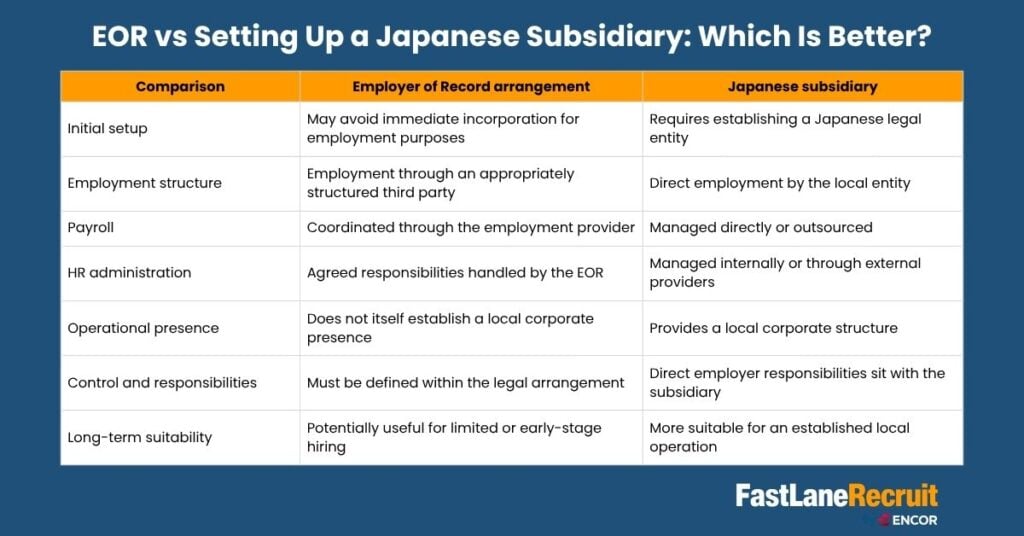
| Comparison | Employer of Record arrangement | Japanese subsidiary |
| Initial setup | May avoid immediate incorporation for employment purposes | Requires establishing a Japanese legal entity |
| Employment structure | Employment through an appropriately structured third party | Direct employment by the local entity |
| Payroll | Coordinated through the employment provider | Managed directly or outsourced |
| HR administration | Agreed responsibilities handled by the EOR | Managed internally or through external providers |
| Operational presence | Does not itself establish a local corporate presence | Provides a local corporate structure |
| Control and responsibilities | Must be defined within the legal arrangement | Direct employer responsibilities sit with the subsidiary |
| Long-term suitability | Potentially useful for limited or early-stage hiring | More suitable for an established local operation |
When Should You Consider an EOR?
An EOR arrangement may be worth evaluating when:
- You need to employ one or a small number of workers.
- You want to assess the market before establishing a subsidiary.
- Your business does not yet require a permanent Japanese corporate presence.
- You want to reduce the administrative work associated with local employment.
- Your intended workforce and work arrangement are compatible with the applicable Japanese regulations.
When Is Setting Up a Japanese Entity More Suitable?
Direct entity establishment may be more appropriate when:
- You plan to build a substantial local workforce.
- You need to conduct ongoing business operations in Japan.
- You require a local corporate identity for commercial activities.
- You want direct employment and internal HR administration.
- Your activities require local registrations, licences or a corporate structure that an EOR arrangement cannot replace.
A Japanese subsidiary also introduces ongoing corporate, accounting, tax and governance responsibilities that should be included in the expansion budget.
Also Read: Foreign Subsidiary vs EOR: Which Costs Less and Is Faster to Set Up?
What Should You Consider Before Choosing an EOR Provider in Japan?
Selecting an EOR provider is not simply a matter of comparing monthly fees. Businesses should assess the provider’s legal structure, local capabilities and ability to manage employment obligations.
1. Verify the Local Employment Structure
Ask who will legally employ the worker and how the proposed arrangement complies with Japanese regulations.
In particular, clarify the distinction between employment, worker dispatch and outsourcing. These arrangements have different legal requirements.
Japan regulates worker dispatch and other labour-supply activities. A provider should be able to explain which structure applies, whether relevant licences are required and how day-to-day work direction will be handled.
2. Review Payroll and Social Insurance Capabilities
Confirm whether the provider can manage the applicable payroll deductions, employer contributions, employee enrolment and reporting procedures.
Ask for a clear explanation of how salary payments, insurance contributions and tax administration are handled.
3. Understand Immigration Support
If you intend to hire foreign nationals, confirm whether immigration support is included or provided separately.
Clarify the provider’s role in residence-status procedures and whether specialist immigration advice is required.
4. Review Employment Contracts and Termination Procedures
Request information about employment contract preparation, probation arrangements, leave administration and termination procedures.
Japanese employment termination rules should not be treated as interchangeable with those in other jurisdictions. Employers should understand the applicable legal requirements before agreeing to an offboarding process.
5. Check Data Protection and Confidentiality
Employment administration involves personal information, salary records and other confidential employee data.
Review how the provider handles employee information, access permissions, data transfers and confidentiality obligations.
6. Request Transparent Pricing and Service Terms
Before signing an agreement, confirm:
- Monthly administration fees.
- Employer contribution calculations.
- Deposit and onboarding requirements.
- Additional charges.
- Currency and payment arrangements.
- Termination and transition procedures.
- Service responsibilities and liability allocation.
A clear service agreement helps both parties understand their obligations throughout the employment relationship.
Why Businesses Choose FastLaneRecruit for International EOR Services
International hiring requires more than payroll processing. Businesses need an employment partner that understands local requirements, coordinates HR administration and supports workforce expansion across multiple markets.
FastLaneRecruit helps businesses manage international employment through Employer of Record services across selected markets in Asia Pacific, Europe, and the Middle East & Africa.
One EOR Partner Across Multiple Markets
Businesses expanding into several countries can work with one EOR partner rather than coordinating separate employment administration providers in every market.
Local Employment and Payroll Support
We support employment administration, payroll coordination, statutory requirements, employee benefits and onboarding according to the applicable requirements of our supported markets.
Simplified International Hiring
Our EOR model helps businesses hire employees in supported countries without first establishing a separate local company solely for employment purposes.
Flexible Workforce Expansion
Whether you are hiring your first international employee or building a regional team, we help coordinate employment processes as your business grows.
FastLaneRecruit EOR Service Coverage
FastLaneRecruit supports international employment across selected markets in three regions.
FastLaneRecruit operates in
- Asia Pacific: Malaysia, Singapore, Hong Kong, China, India, Philippines, Taiwan, Vietnam, Australia,
- Europe: United Kingdom, Switzerland
- Middle East & Africa: UAE, Saudi Arabia, Qatar
This regional coverage helps businesses coordinate international hiring, employment contracts, payroll administration, statutory requirements and ongoing HR processes through one EOR partner.
If your expansion plans involve Japan alongside other Asian markets, speak with our team to discuss your workforce requirements and the countries where we can currently provide EOR support.
Explore International Hiring with FastLaneRecruit
Expanding into a new market requires the right employment structure, reliable payroll administration and a clear understanding of local compliance obligations.
Whether you are planning to hire your first international employee or build a workforce across several countries, FastLaneRecruit helps simplify employment administration through EOR services in our supported markets.
Our team can help you understand the available hiring arrangements, employment requirements and next steps for your international expansion.
Planning to expand your workforce across Asia or other international markets?
Contact FastLaneRecruit to discuss your hiring requirements, explore our EOR service coverage and identify an appropriate employment solution for your business.
Book a Free 30-Minute Discovery Call with FastLaneRecruit.
Frequently Asked Questions About Employer of Record Japan
1. What is an Employer of Record in Japan?
An Employer of Record is a third-party organisation that legally employs workers on behalf of another business under an appropriate employment arrangement. It can manage employment documentation, payroll and applicable statutory administration while the client company directs the work within the agreed legal structure.
2. Can a foreign company hire employees in Japan without setting up a local entity?
Potentially, yes. A foreign company may explore an appropriately structured third-party employment arrangement rather than immediately establishing a Japanese subsidiary. However, the arrangement must comply with applicable Japanese employment, worker dispatch, immigration and tax requirements.
3. Is using an EOR legal in Japan?
EOR is a commercial term rather than a standalone guarantee of legal compliance. The legality of a proposed arrangement depends on its actual structure, including who employs the worker, who directs their work and whether relevant regulatory requirements or licences apply. Businesses should obtain Japan-specific legal advice before proceeding.
4. How much does an Employer of Record cost in Japan?
There is no standard statutory EOR service fee. Pricing depends on the provider, employee salary, number of employees, statutory contributions, benefits and additional services. Businesses should request an itemised quotation that separates the EOR fee from total employment costs.
5. What does an EOR handle for employees in Japan?
Depending on the service agreement, an EOR may handle employment documentation, payroll processing, tax withholding administration, social insurance coordination, employee benefits, onboarding and offboarding. The precise scope depends on the provider and legal employment structure.
6. Does an EOR provide health insurance and pension in Japan?
Eligible employees may need to be enrolled in Employees’ Health Insurance and Employees’ Pension Insurance under Japanese law. Coverage depends on the applicable workplace and employment eligibility requirements. The responsible employer must arrange the required procedures and contributions.
7. Can an Employer of Record sponsor a Japanese work visa?
Immigration support depends on the provider and the employee’s circumstances. An employment arrangement does not automatically grant a foreign national permission to work in Japan. Businesses should confirm the appropriate residence status, sponsoring arrangements and immigration procedures before hiring.
8. What is the difference between an EOR and a recruitment agency in Japan?
A recruitment agency generally introduces candidates to employers, whereas an EOR provides an employment arrangement and associated administration. Recruitment, employment and worker dispatch are distinct activities and may be subject to different Japanese regulatory requirements.
9. Can I hire just one employee through an EOR?
An EOR arrangement can be suitable for businesses that need to employ a small number of people rather than establish a local entity immediately. However, the provider’s minimum requirements, pricing and the legality of the proposed arrangement should be confirmed first.
10. What happens if I later establish my own Japanese subsidiary?
Businesses may consider transitioning employees from a third-party employment arrangement to direct employment through their own entity. This requires careful planning around employee consent, contract continuity, applicable legal obligations, payroll, benefits and immigration status where relevant.
11. Does FastLaneRecruit provide Employer of Record services in Japan?
Japan is not currently listed among FastLaneRecruit’s supported EOR markets. We provide EOR services across selected countries in Asia Pacific, Europe and the Middle East & Africa. Contact our team to confirm current service availability and discuss your international hiring plans.