
A Strategic Guide for Global Employers
Outsourcing software development is not just a cost-cutting measure—it’s a strategic lever for growth, speed, and access to global talent. Whether you’re a startup launching your first product or an established business scaling features rapidly, partnering with the right external team can transform your roadmap.
But outsourcing is not without its challenges. Without clear planning, strong security safeguards, and effective management, you risk delays, quality issues, or even data breaches. This guide walks you step by step through how to outsource software development successfully, including when outsourcing alone might not be enough and how EOR (Employer-of-Record) hiring in Malaysia via FastLaneRecruit provides a strategic alternative.
Content Outline
Key Summary
Outsourcing Expands Access to Global Talent
Businesses can tap into specialized developers worldwide, from AI to cloud and mobile, without long hiring cycles.
Costs Become More Flexible and Predictable
Outsourcing reduces fixed staffing expenses and allows teams to scale resources up or down as project needs change.
Faster Product Delivery and Scalability
External teams help accelerate development timelines, launch MVPs faster, and support rapid feature expansion.
Clear Communication Prevents Delays
Establishing structured workflows, overlapping hours, and regular check-ins ensures alignment despite time-zone or cultural differences.
Quality and Security Must Be Actively Managed
To avoid rework or IP risks, businesses need strong contracts, defined coding standards, regular reviews, and compliance checks.
Choosing the Right Outsourcing Model Matters
Models like Fixed-Price, T&M, Dedicated Teams, Staff Augmentation, and EOR offer different levels of flexibility and control.
Strategic Outsourcing Supports Long-Term Growth
Modern outsourcing isn’t just about cost, it enables innovation, value-based partnerships, and entry into new markets with minimal risk.
What is Outsourced Software Development?
Outsourced software development refers to hiring external teams or third-party companies to handle software design, coding, testing, and maintenance instead of relying solely on in-house staff. It enables businesses to leverage external expertise, resources, and processes to deliver software projects efficiently and cost-effectively.
In practice, outsourcing can take several forms:
| Outsourcing Model | Description | When to Use |
| Staff Augmentation | Hire external developers to work alongside your internal team temporarily | Use this to fill skill gaps or scale teams quickly without long-term hires. |
| Project-Based Outsourcing | Contract a vendor to deliver an entire software project from start to finish. | Best for clearly defined projects with fixed requirements and deadlines. |
| Managed/Virtual Teams | An entire external team handles your project under the vendor’s management, often in coordination with your internal team. | Best for ongoing projects or when you want to offload day-to-day management. |
| White-Label Development | A vendor develops software which you can rebrand as your own. | Best for companies seeking fast product launches without investing heavily in development infrastructure. |
Key advantages of outsourced software development include:
- Access to specialized expertise: Work with developers experienced in modern technologies, frameworks, and methodologies.
- Flexible team sizes: Scale the development team up or down according to project requirements.
- Cost and time efficiency: Reduce overheads and speed up development timelines by leveraging pre-established vendor teams and processes.
- Risk management: Rely on vendors that follow industry-standard quality control, security, and compliance protocols.
Outsourced software development is especially beneficial for businesses looking to enter new markets, launch software products faster, or supplement internal technical capabilities without committing to permanent hires.
For example, a Singapore-based company looking to develop a mobile app might outsource development to a trusted Malaysian software development team. This approach provides cost savings, access to skilled developers, and faster project delivery, while the in-house team focuses on business strategy and customer experience.
Also Read: Outsourcing IT Support Specialists: Cost Savings & Service Quality
Why Outsource Software Development? — Core Benefits
Outsourcing software development is more than a cost-saving tactic; it is a strategic way to access global talent, accelerate project timelines, and focus on growing your business. Here’s a breakdown of the key benefits:
1. Cost Efficiency & Flexibility
One of the main reasons companies outsource software development is cost efficiency. Hiring an in-house team involves fixed costs such as salaries, office space, equipment, and benefits. Outsourcing converts many of these fixed costs into variable costs—you only pay for the work delivered or the hours logged.
Outsourcing can significantly reduce labour and overhead costs compared to maintaining a full in-house development team, especially in high-cost markets.
Additionally, outsourcing provides flexibility. You can scale the team up or down depending on project needs, avoiding the financial risk of underutilized resources or overstaffing.
2. Access to Global Talent & Niche Expertise
Outsourcing opens the door to a global pool of developers with specialized skills that may be difficult to find locally. Whether you need expertise in cloud computing, DevOps, AI/ML, mobile app development, or legacy system upgrades, outsourcing allows you to tap into these niche skill sets without spending months hiring and training.
This access ensures your project benefits from experienced professionals who have already worked on similar challenges, improving quality, efficiency, and innovation.
3. Faster Time-to-Market and Scalability
Speed is critical in today’s tech landscape. Outsourced teams can ramp up quickly, allowing you to launch a Minimum Viable Product (MVP) or new features in weeks rather than months.
Outsourcing also makes it easier to scale development efforts. If your project expands or contracts, you can adjust team size without the long-term commitments associated with full-time staff. This flexibility keeps your product development timeline on track while keeping costs manageable.
4. Focus on Core Business Goals
By outsourcing routine or specialized software development tasks, your internal team can concentrate on strategic priorities such as product vision, business growth, and customer experience.
For example, your in-house team can focus on defining product strategy, engaging with stakeholders, or improving user experience, while the outsourced team handles coding, testing, and deployment. This division of labour enhances productivity and ensures your company scales without getting bogged down in technical execution.
5. Risk and Overhead Reduction
Outsourcing also reduces operational risks and overhead costs. You avoid expenses related to infrastructure, hardware, software licences, and employee benefits. You also reduce the burden of hiring, onboarding, and training new staff.
Additionally, partnering with a reputable outsourcing vendor mitigates risks such as project delays, technical failures, or skill shortages. Many vendors follow industry-standard quality processes, testing, and compliance protocols, which protect your project and intellectual property.
Potential Challenges & Risks — What to Watch Out For
Outsourcing software development brings many advantages, but it also comes with risks that can affect project success if not properly managed. Understanding these challenges helps you plan, mitigate risks, and ensure smooth delivery.
1. Quality Control Issues
Differences in coding standards, testing procedures, or development practices can lead to inconsistent results. Without proper oversight, the software delivered may not meet your expectations.
Tips to Mitigate:
- Set clear quality benchmarks and coding standards.
- Request regular demos and progress reports.
- Use project management tools like Jira, Trello, or ClickUp to track progress and maintain quality.
2. Communication Challenges & Time-Zone Gaps
Offshore teams may work in different time zones, speak different languages, or follow different work cultures, leading to misunderstandings, delays, or coordination difficulties.
Tips to Mitigate:
- Establish overlapping work hours for real-time collaboration.
- Schedule regular stand-up meetings to clarify tasks.
- Use communication platforms like Slack, Zoom, or Microsoft Teams.
3. Security & Intellectual Property (IP) Risks
Sharing sensitive data, designs, or source code with external vendors can expose your business to data breaches or IP theft, especially if the vendor’s security measures are weak.
Tips to Mitigate:
- Implement NDAs and secure data-sharing protocols.
- Verify vendor compliance with standards like ISO 27001, GDPR, HIPAA, or PCI-DSS.
- Limit access to sensitive information to only those who need it.
4. Hidden Costs & Vendor Dependency
Some vendors quote low rates upfront but charge extra for scope changes, rework, or extended timelines. Over-reliance on a single vendor may also create dependency risks.
Tips to Mitigate:
- Draft clear contracts specifying pricing, milestones, and scope.
- Include clauses for change requests and exit strategies.
- Keep internal documentation and, if possible, diversify vendors.
Also Read: IT Support Specialist Salary Guide
5. Reduced Control Over Project Execution
Without proper project management, it can be difficult to ensure the project aligns with your vision, deadlines, and quality standards.
Tips to Mitigate:
- Assign a dedicated project manager (internal or vendor-side).
- Use dashboards to monitor progress and transparency.
- Define KPIs and review milestones regularly.
Key Takeaway: Outsourcing software development is more than choosing a low-cost vendor. It requires strategic planning, careful vendor selection, and strong governance to ensure your project is delivered on time, within budget, and to the expected quality standards.
Outsourcing Models: Pick What Fits Your Needs
There’s no one-size-fits-all approach to outsourcing software development. Choosing the right model depends on your project size, complexity, timeline, budget, and internal management capacity. Understanding each model helps you make an informed decision and avoid costly mistakes.
1. Fixed‑Price (Project-Based Model)
In the fixed-price model, the project scope, deliverables, and timeline are clearly defined upfront, and the price is agreed upon before work begins.
Best For:
- Small to medium-sized projects with well-defined requirements
- Projects where changes in scope are unlikely
Pros:
- Predictable budget
- Clear expectations for deliverables
Cons:
- Less flexibility for evolving requirements
- Changes can require renegotiation
Example: Developing a simple mobile app with defined features for a 3-month launch.
2. Time & Materials Model
The time and materials (T&M) model charges you based on the actual time and resources used. This model provides flexibility if project requirements may shift during development.
Best For:
- Projects with evolving requirements
- Longer timelines or iterative development approaches
Pros:
- Flexible to changing scope
- Easier to implement Agile methodology
Cons:
- Budget can fluctuate
- Requires more monitoring of hours and progress
Example: Iteratively developing a cloud-based SaaS product where features may evolve based on user feedback.
3. Dedicated Team Model
A dedicated team works exclusively on your project, managed by you or your in-house project manager. This model is ideal for long-term development or maintenance work.
Best For:
- Long-term projects
- Ongoing software maintenance or multiple product lines
Pros:
- Full control over team tasks
- High alignment with your business goals
Cons:
- Requires in-house management
- Less cost-effective for short-term projects
Example: Building and maintaining a complex enterprise ERP system.
4. Staff Augmentation Model
Staff augmentation involves adding external developers to your in-house team temporarily. You manage them directly while leveraging their expertise for specific tasks.
Best For:
- Short-term projects requiring extra capacity
- Specialized skills that your in-house team lacks
Pros:
- Flexible, fast ramp-up
- No long-term hiring commitment
Cons:
- Requires integration with your internal team
- Dependent on your management capabilities
Example: Adding two senior Python developers to support an existing in-house team for a 6-week sprint.
5. Offshore Teams / EOR Model
An offshore team or Employer of Record (EOR) model allows you to hire full-time developers in another country without setting up a legal entity. The EOR handles HR, payroll, and compliance, while you manage day-to-day work.
Best For:
- Accessing global talent while avoiding administrative and legal burdens
- Scaling development teams quickly in regions like Malaysia, Vietnam, or Eastern Europe
Pros:
- Quick access to international talent
- Reduced administrative and compliance burden
- Full-time dedication to your projects
Cons:
- Requires careful selection of a trusted EOR
- Communication and cultural differences may require adjustment
Example: Hiring a Malaysian development team via an EOR to build a cloud-based application while the FastLaneRecruit team manages payroll and legal compliance.
Also Read: Malaysia’s Labour Laws for Hiring IT Support Specialists: EPF, SOCSO & Compliance
Summary Table: Outsourcing Models at a Glance
| Model | Description | Best For | Pros | Cons |
| Fixed-Price | Predefined scope, timeline, and cost | Small-medium projects | Budget certainty, clear deliverables | Less flexible to changes |
| Time & Materials | Pay for actual time and resources | Evolving requirements, long-term projects | Flexible, supports Agile | Budget may vary, requires monitoring |
| Dedicated Team | Exclusive team managed by you | Long-term or ongoing projects | Full control, aligned with business goals | Needs in-house management, costlier for short-term |
| Staff Augmentation | Temporary addition to in-house team | Short-term tasks, specialized skills | Quick ramp-up, flexible | Requires integration and management |
| Offshore Team / EOR | Full-time remote team with HR/payroll managed externally | Scaling globally, accessing international talent | Fast hiring, reduced admin & compliance | Communication/cultural gaps, depends on trusted partner |
Step-by-Step Guide: How to Outsource Software Development Successfully
Outsourcing software development can save costs, accelerate delivery, and give access to global talent but only if done systematically. Here’s a practical roadmap for successful outsourcing, including tips and real-world examples.
1. Define Project Goals and Requirements
Before engaging any vendor, clarity is critical. Define what you want to build, why, and for whom.
Action Points:
- Document features, platforms, and tech stack (e.g., mobile app on iOS/Android with React Native backend).
- Clarify the target audience, business problem, and expected outcomes.
- Include user scenarios, wireframes, or a simple proof-of-concept.
Example: A startup in Singapore wants to develop a cloud-based inventory management system. Defining goals like “track warehouse stock in real time, enable multi-user access, integrate with ERP” helps vendors understand requirements upfront.
2. Write a Detailed Project Scope Statement
A detailed project scope ensures alignment between your vision and the outsourced team.
Include:
- Objectives and expected deliverables
- In-scope vs out-of-scope items
- Budget, timeline, and key milestones
- Quality benchmarks and acceptance criteria
Example: For a mobile banking app, the scope may include account management, transaction history, and security features, but exclude AI-based loan recommendations to avoid scope creep.
3. Estimate Budget & Timeline
Set realistic budgets and timelines based on project complexity and vendor location.
Tips:
- Account for hourly rates or fixed-price models depending on region (Eastern Europe vs Southeast Asia can differ 30–50%).
- Include buffer for scope changes, testing, and unexpected delays.
- Plan contingency budget (~10–15%) for unforeseen adjustments.
Example: Outsourcing to Malaysia might cost USD 25–40/hour for mid-level developers, whereas the same roles in the US could be USD 80–120/hour.
4. Choose the Outsourcing Model & Region
Select a model that aligns with your project size, management capacity, and flexibility needs.
Models: Fixed-price, Time & Materials, Dedicated Team, Staff Augmentation, Offshore Team/EOR.
Regional Considerations:
- Eastern Europe: Strong technical expertise, good time-zone overlap with Europe
- India: Large talent pool, cost-effective
- Southeast Asia (Malaysia, Vietnam): Emerging talent, English-speaking, lower costs
- Latin America: Proximity to US, cultural alignment
Example: A Singaporean e-commerce company might hire a Malaysian development team via an EOR to save on legal setup and payroll while retaining direct management.
5. Shortlist & Vet Potential Vendors
Quality outsourcing depends on choosing the right vendor.
Steps:
- Check trusted review sites: Clutch, GoodFirms, G2 Crowd.
- Review portfolios and case studies.
- Verify industry experience, methodology (Agile, CI/CD), security compliance, and communication practices.
Example: A fintech startup might shortlist three vendors with prior experience in payment processing apps, ensuring they comply with PCI-DSS standards.
6. Negotiate Agreements & Legal Protections
Protect your intellectual property and set clear expectations via legal agreements.
Key Documents:
- NDA: Protects confidential data and IP
- SOW: Defines scope, milestones, deliverables
- SLA: Sets quality and performance metrics
- MSA or Contract: Covers payment, change management, and IP ownership
Example: FastLaneRecruit can assist companies hiring Malaysian developers via EOR to ensure compliance with local labor laws and IP protection.
Also Read: Malaysia as a Competitive Hub for Offshore IT Support
7. Establish Communication & Project Management Workflow
Clear communication is essential, especially for remote or offshore teams.
Tips:
- Use PM tools: Jira, Trello, or ClickUp
- Chat & video: Slack, Microsoft Teams, Zoom
- Schedule overlapping working hours for time-zone differences
- Hold regular stand-ups, demos, and milestone reviews
Example: A US-based company outsourcing to Malaysia may set 3 hours of overlapping work each day for live collaboration and feedback sessions.
8. Monitor Progress, Quality & Compliance
Track deliverables and quality metrics throughout the project.
Action Points:
- Conduct code reviews, testing, and audits
- Validate deliverables against acceptance criteria
- Maintain comprehensive documentation
Example: Weekly code reviews and automated CI/CD testing for a SaaS product prevent errors from accumulating, reducing post-launch bugs.
9. Test, QA & Launch
Before going live, thorough testing ensures performance, usability, and security.
Include:
- Functional and performance testing
- UX/UI review
- Security and vulnerability assessment
Example: A mobile healthcare app is tested for HIPAA compliance, data encryption, and multi-device responsiveness before launch.
10. Plan for Maintenance and Future Updates
Software requires ongoing support. Decide who handles maintenance and updates.
Options:
- Outsourced team continues under a dedicated or support contract
- Staff augmentation for specific updates
- Gradual knowledge transfer to in-house team
Example: After launching a SaaS product, the outsourced team provides quarterly updates and bug fixes while documenting the architecture for future internal development.
Summary Table: Key Steps to Outsourcing Software Development
| Step | Action | Example |
| Define Goals | Features, tech stack, users, objectives | Inventory app for Singapore warehouse |
| Project Scope | Deliverables, constraints, quality benchmarks | Mobile banking app with security features |
| Budget & Timeline | Rates, buffer, contingency | Malaysian dev team vs US dev team rates |
| Model & Region | Fixed, T&M, Dedicated, Staff Aug | Offshore team via EOR in Malaysia |
| Shortlist Vendors | Portfolios, reviews, methodology | Fintech vendors with PCI-DSS experience |
| Legal Protections | NDA, SOW, SLA, Contract | IP protection with Malaysian EOR |
| Communication | PM tools, overlapping hours | Jira + Slack for US-Malaysia team |
| Monitor Progress | Code reviews, testing, compliance | Weekly QA and CI/CD checks |
| Test & Launch | QA, UX, security | HIPAA-compliant healthcare app |
| Maintenance | Support contract, knowledge transfer | SaaS quarterly updates |
Why Outsourcing Is Evolving — Not Just Cost, But Strategy
While cost savings have long been the primary driver for outsourcing software development, 2025 and beyond marks a shift toward strategic value. Companies now view outsourcing not just as a cost-cutting measure, but as a key enabler of business growth, innovation, and operational efficiency.
1. Value-Based Partnerships Over Cheapest Bids
Businesses are moving away from choosing vendors solely based on low rates. Instead, they are prioritizing long-term, value-driven partnerships.
Why it matters:
- Proven quality, reliability, and workflow efficiency now outweigh just price considerations.
- Companies look for vendors with a history of delivering projects on time, adhering to quality standards, and demonstrating strong technical and communication capabilities.
Example: A Singaporean fintech company might choose a Malaysian development firm that charges slightly more but has a proven track record of PCI-DSS-compliant software delivery, rather than opting for the lowest bid offshore.
Also Read: How to Hire and Manage Offshore IT Support Teams in Malaysia
2. Demand for Specialized Skills
As technology and industries become more complex, there’s growing demand for niche expertise that may not exist internally.
Key Points:
- Industries like healthcare, fintech, AI, cloud computing, and enterprise SaaS require deep technical knowledge and compliance awareness.
- Outsourced teams with specialized skills can accelerate development, reduce errors, and improve regulatory compliance without extensive in-house retraining.
Example: A healthcare startup outsourcing to a Malaysian software team experienced in HIPAA-compliant cloud solutions will launch faster and maintain higher compliance standards than if training internal staff from scratch.
3. Faster Speed-to-Market and Reduced Development Cycles
Outsourcing now helps businesses accelerate product launches and iterate quickly.
How this works:
- Mature development pipelines, Agile methodologies, and specialized tooling allow outsourced teams to deliver working software faster.
- Parallel development processes and cross-functional teams reduce bottlenecks.
Example: A SaaS platform outsourcing backend and mobile development to an offshore team can release MVP features in weeks, while the in-house team focuses on marketing, customer acquisition, and strategic improvements.
4. Strategic Flexibility & Scalability
Modern outsourcing provides scalability without long-term commitments.
Benefits:
- Businesses can quickly scale development resources up or down depending on project demands.
- Allows companies to experiment with new technologies, features, or products without permanent overhead.
Example: An e-commerce company uses a dedicated Malaysian team via an Employer of Record (EOR) model, scaling from 5 to 15 developers during peak development cycles, then scaling down post-launch.
Summary
Today, outsourcing is no longer purely a cost-saving tool. It’s a strategic lever that allows businesses to:
- Access specialized global talent
- Accelerate time-to-market
- Reduce operational risks and overhead
- Form long-term, value-driven partnerships
This strategic approach transforms outsourcing from a transactional service into a core component of business growth and innovation.
Tips & Recommendations — How to Maximize Success in Outsourcing Software Development
Outsourcing software development can be highly effective but success depends on planning, communication, and quality control. Here are actionable tips to maximize your outcomes:
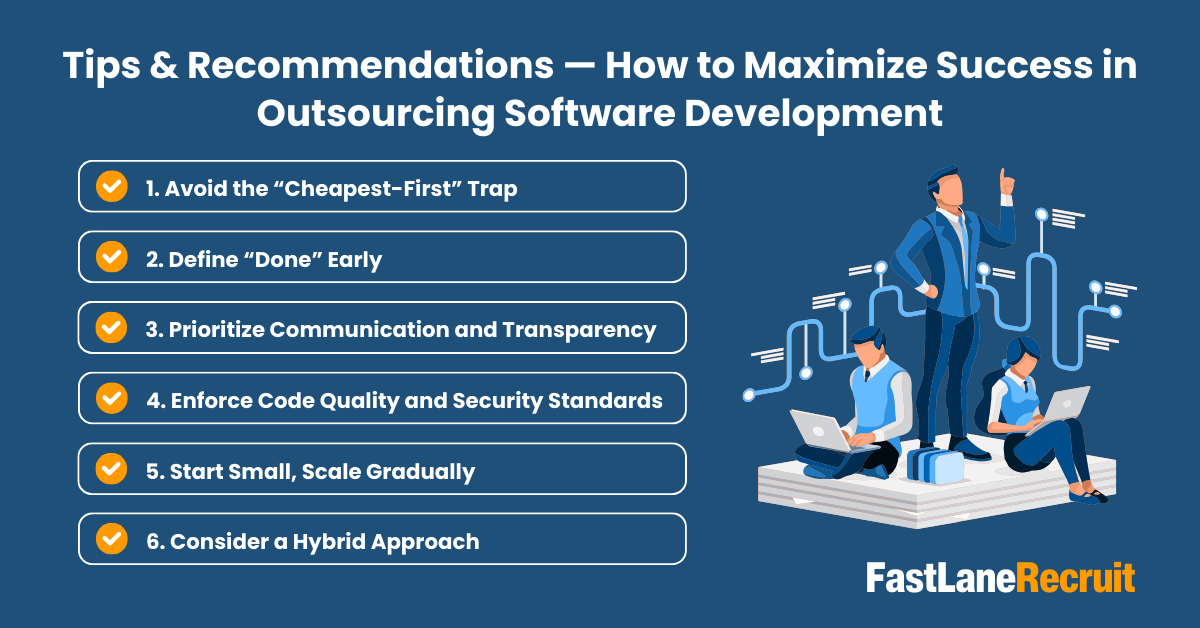
1. Avoid the “Cheapest-First” Trap
While low costs can be tempting, choosing a vendor solely based on price often leads to delays, poor-quality code, or misaligned expectations. Instead, prioritize proven expertise, process discipline, and communication skills.
Recommendation: Evaluate vendors on portfolios, client testimonials, and technical capabilities. Platforms like Clutch and GoodFirms can help you find vetted agencies with strong track records.
2. Define “Done” Early
Clearly define scope, deliverables, and acceptance criteria from the start. This ensures that both your team and the vendor have aligned expectations, reducing the risk of scope creep, rework, and unexpected costs.
Example: Specify the number of features for an MVP, testing benchmarks, and target platforms in the project scope document before development begins.
3. Prioritize Communication and Transparency
Strong communication is critical when working across time zones and cultural contexts. Use project-management tools, maintain logs, and schedule regular updates. Transparency builds trust, prevents misunderstandings, and ensures alignment on goals.
Recommended Tools:
- Project Management: Jira, Trello, ClickUp
- Communication: Slack, Microsoft Teams, Zoom
- Documentation: Confluence, Google Workspace
4. Enforce Code Quality and Security Standards
Quality and security should never be compromised. Ensure the vendor follows coding standards, automated testing, and regular code reviews. Include contractual agreements on IP ownership, data protection, and security compliance.
Example: For a fintech app, require end-to-end encryption, GDPR or PDPA compliance, and version-controlled repositories for all code.
5. Start Small, Scale Gradually
Begin with a pilot project or MVP before committing to large-scale outsourcing. This allows you to test the collaboration dynamic, workflow efficiency, and vendor reliability before scaling up.
Example: Launch a simple module of a larger platform with a dedicated team to evaluate delivery quality, response time, and team compatibility.
6. Consider a Hybrid Approach
A hybrid model, combining an in-house core team with outsourced specialists, can maximize flexibility, maintain control over critical areas, and ensure high-quality delivery. This approach works well for projects requiring niche expertise, such as AI, cybersecurity, or cloud infrastructure.
Example: Your in-house team handles core product features while outsourced developers manage AI-powered recommendation engines or mobile front-end development.
Summary Table — Maximizing Outsourcing Success
| Tip | Key Action | Benefit |
| Avoid Cheapest-First Trap | Prioritize expertise over cost | Higher quality, reduced risk of delays |
| Define “Done” Early | Set scope, deliverables, acceptance criteria | Prevents scope creep and rework |
| Prioritize Communication | Use PM tools, schedule updates | Aligns expectations, reduces misunderstandings |
| Enforce Code & Security Standards | Require testing, code reviews, IP agreements | Protects IP, ensures high-quality software |
| Start Small | Pilot project or MVP | Test collaboration, reduce risk |
| Consider Hybrid Approach | In-house + outsourced specialists | Flexibility, control, access to niche skills |
Why Consider Malaysia for Software Development Outsourcing
Malaysia has become an increasingly attractive destination for companies looking to outsource software development. Its combination of competitive costs, technical talent, and regional proximity makes it a strategic choice for businesses across Southeast Asia and beyond.
1. Cost-Effective Development Without Compromising Quality
Outsourcing to Malaysia can reduce labour costs by 30–50% compared to Singapore or Western countries, while maintaining high development standards. Skilled developers are available at competitive rates, and companies can scale teams up or down without long-term commitments.
Example: A Singaporean fintech startup may save significant overhead by outsourcing backend and mobile app development to a Malaysian firm while keeping the product quality comparable to in-house development.
2. Access to Skilled and Multilingual Talent
Malaysia boasts a large pool of English-speaking developers experienced in cloud computing, AI/ML, fintech, mobile apps, and legacy system upgrades. Many teams are trained in Agile, CI/CD, and DevOps practices, allowing smooth collaboration with international clients.
Example: An e-commerce company outsourcing web platform development to Malaysia can leverage developers with expertise in React, Node.js, and AWS, ensuring rapid deployment and integration with global services.
3. Geographic Proximity & Time-Zone Alignment
Malaysia’s proximity to Singapore, Thailand, and Indonesia ensures minimal time-zone gaps, making real-time collaboration easier. Communication delays are reduced, and overlapping working hours enable daily standups, progress reviews, and rapid troubleshooting.
Example: A Singaporean company can hold morning meetings with a Malaysian development team, then continue progress asynchronously throughout the day without major delays.
4. Reliable Infrastructure and Government Support
Malaysia offers strong digital infrastructure, high internet penetration, and government incentives for tech development, making it a stable environment for outsourced software projects. Programs like the Malaysia Digital Economy Corporation (MDEC) support tech startups and software firms with guidance, funding, and training.
5. Compliance and Data Protection
Many Malaysian software companies follow international data security standards (ISO 27001, GDPR compliance) and implement robust QA and testing processes. This ensures that sensitive information and intellectual property are well-protected.
Example Scenario: Outsourcing to Malaysia — What to Consider
Suppose your company is headquartered in Singapore and you’re considering outsourcing software development to Malaysia. Here’s a practical roadmap:
| What to Do | Recommended Best Practice |
| Define scope & deliverables | Write clear requirements (features, user roles, platforms), and plan milestones. |
| Choose model & team size | For a one-time product launch: fixed-price or short-term dedicated team. For ongoing product development: dedicated team or staff augmentation. |
| Vet vendor | Check past projects, domain expertise, communication skills. Pick firms with strong QA processes and data-protection compliance. |
| Set up contracts | Sign NDA, SOW, SLA. Specify IP ownership and data-security clauses. |
| Manage timezone & communication | Align overlapping work hours, schedule regular meetings (daily standups, weekly reviews), and use collaboration tools (Slack, Jira). |
| Maintain quality & security | Enforce code reviews, automated testing, encryption, access control, and compliance with local data protection laws. |
Key Takeaway: Outsourcing to Malaysia provides cost efficiency, technical expertise, and collaboration ease, making it a strategic choice for companies looking to scale software development quickly and securely.
Alternative Solution to Outsourcing: Hire via EOR with FastLaneRecruit
Outsourcing works well for project-based or short-to-mid term development, but sometimes businesses need deeper integration, long-term commitment, or direct control over team members. In such cases, outsourcing may not fully meet your needs.
If you’re considering building a dedicated development team, perhaps with employees based in Malaysia, but legally employed according to local labour law, a better route is using an EOR (Employer‑of‑Record) solution.
At FastLaneRecruit, we offer Employer of Record (EOR) service that enable you to hire and manage Malaysian developers compliantly, while we handle payroll, compliance, and local administrative requirements. This gives you:
- Full control and long-term commitment from developers
- Compliance with local employment regulation
- Easier team integration compared to traditional outsourcing
- Option to gradually build a stable, in‑house–like remote team without setting up a physical entity
If you’re looking for a balanced approach, combining global talent access, cost efficiency, and long-term control, reach out to FastLaneRecruit and explore our EOR solution.
Conclusion
Outsourcing software development remains a powerful strategy for businesses seeking agility, cost efficiency, and access to global talent. Done right, it accelerates time-to-market, lets you tap into specialized skills, and frees your team to focus on core strategic goals.
However, outsourcing is not a silver bullet. Success depends on clarity in requirements, contracts, communication, and quality standards. Combining careful vendor vetting, robust project management, and security practices positions you to reap maximum benefits while minimising risk.
For companies needing deeper integration, long-term commitment, and full control over remote developers, especially in Malaysia using an EOR solution like FastLaneRecruit offers an excellent, compliant alternative to traditional outsourcing.
Build Your Dream Software Development Team with FastLaneRecruit
Looking to hire skilled software developers quickly and efficiently? Whether you want to outsource your project to Malaysia, FastLaneRecruit can help you assemble the right team tailored to your needs.
From vetting experienced developers to handling legal, payroll, and compliance matters through our Employer of Record (EOR) service, we make outsourcing simple, secure, and scalable. Focus on your product vision while we take care of the operational and administrative complexities.
Take the next step: Contact FastLaneRecruit today to find top-tier software development talent and launch your project with confidence.