
Expanding your business internationally brings exciting opportunities but managing payroll and HR across borders can be complex. Malaysia has become a top destination for payroll and HR shared services, offering a highly skilled workforce, a strong compliance framework, advanced technology, and cost-efficient solutions.
From regulatory adherence to employee engagement and scalability, Malaysia offers businesses a solid foundation for streamlined HR and payroll management. In this guide, we explore why Malaysia is the go-to choice for global employers and how FastLaneRecruit’s EOR services make hiring and managing Malaysian talent effortless. For many employers, the goal isn’t just payroll processing—it’s building a controllable shared services function.
Content Outline
Key Summary
Malaysia Offers Global Payroll Advantages
A skilled, multilingual workforce, strong compliance framework, and technological adoption make Malaysia a top destination for payroll and HR shared services.
Simplified Compliance
Outsourcing payroll ensures accurate handling of EPF, SOCSO, EIS, and tax regulations, reducing legal risks and administrative burden.
Cost Efficiency and Resource Optimization
Bundled services, lower overheads, and predictable pricing allow businesses to save up to 40% on payroll-related costs while focusing resources strategically.
Leveraging Modern HR Technology
AI-driven payroll systems, HRMS, and cloud-based platforms enhance accuracy, streamline reporting, and protect sensitive employee data.
Focus on Core Business Activities
Payroll outsourcing frees HR and leadership teams to prioritize talent acquisition, employee engagement, and strategic business expansion.
Scalability and Flexibility
Outsourced solutions adapt to seasonal hiring, business growth, and multi-location operations, making expansion seamless without additional in-house staff.
FastLaneRecruit EOR for Smarter Hiring
The EOR model allows global companies to hire Malaysian payroll specialists quickly, remain compliant, leverage HR technology, and reduce administrative overhead.
Why Malaysia Stands Out Globally
Malaysia has emerged as one of the best destinations for payroll and HR services in the global business landscape. Its combination of skilled talent, strong regulations, technological adoption, and strategic location makes it an ideal choice for companies looking to streamline payroll, HR, and shared services.
Highly Skilled Workforce
Malaysia boasts a multilingual, highly educated workforce capable of supporting both local and international operations. Employees often speak English, Malay, Mandarin, and Tamil, which is a major advantage for companies managing global teams or multinational operations.
Example:
A US-based company expanding into Southeast Asia relied on Malaysian HR specialists to manage payroll and compliance for its regional employees. The skilled and multilingual workforce ensured smooth communication, accurate reporting, and seamless integration with the global team.
Strong Regulatory Framework
Malaysia has a well-established regulatory system for payroll and HR operations. Employers must comply with EPF, SOCSO, EIS, LHDN, and the Employment Act. These laws protect both employees and companies, ensuring transparency, fair labor practices, and smooth business operations.
Example:
A European firm outsourcing payroll in Malaysia appreciated that local providers handled statutory contributions and tax filings accurately, reducing the risk of penalties or legal issues. Partnering with an expert provider ensures that your business stays compliant with evolving regulations.
Tip:
Regularly check updates on LHDN and SOCSO to stay informed on statutory changes.
Technological Adoption
Malaysia is embracing digital transformation in HR and payroll. Providers leverage AI, automation, and cloud-based platforms to simplify payroll management, reduce errors, and provide actionable insights. These technologies improve efficiency, speed, and transparency in HR operations.
Example:
A growing tech company adopted a Malaysian provider with AI-driven payroll systems. Payroll calculations, compliance checks, and reporting became faster and more accurate, freeing HR teams to focus on strategic initiatives rather than administrative tasks.
Market Growth and Industry Insights
The Malaysian payroll and HR solutions market is rapidly expanding. According to Verified Market Reports, the market is projected to grow from USD 45 billion in 2024 to USD 75 billion by 2033, at a CAGR of 6.5%.
This growth is driven by:
- Increasing adoption of technology-enabled payroll and HR solutions
- Rising demand from SMEs and multinational corporations
- Expansion of remote work and global workforce management
The trend highlights Malaysia as a stable, forward-looking, and innovation-friendly market for global HR services.
Strategic Location as a Global Hub
Malaysia’s geographic location in Southeast Asia makes it a strategic base for regional and international operations. Companies can use Malaysia as a hub for managing payroll, HR, and shared services across the ASEAN region and beyond, benefiting from lower operational costs and a favorable business environment.
Example:
A multinational corporation used Malaysia as its regional payroll hub to manage employees in Singapore, Thailand, and Indonesia. With local expertise and robust infrastructure, the company streamlined operations, reduced costs, and ensured compliance across borders.
Also Read: Building a High-Performing Offshore HR and Payroll Management Team in Malaysia (Singapore Edition)
Key Summary
Malaysia stands out globally because it combines:
- A highly skilled, multilingual workforce
- Strong regulatory compliance and legal protections
- Advanced technological adoption in payroll and HR
- Robust market growth and investment opportunities
- Strategic location for regional and global operations
These factors make Malaysia an attractive destination for companies looking to outsource payroll and HR services, reduce risks, optimize costs, and scale operations efficiently.
Benefits of Outsourcing Payroll to Malaysia
Outsourcing payroll to Malaysia allows businesses to simplify payroll processes, reduce compliance risks, and optimize resources. Here’s why Malaysia works so well as a hub for payroll and HR services, explained in detail:
1. Cost Efficiency and Resource Optimization
One of the biggest advantages of outsourcing payroll to Malaysia is the significant cost savings and better allocation of resources. Managing payroll internally can be expensive and time-consuming, especially when considering software costs, staff salaries, and infrastructure. Outsourcing helps companies reduce these costs while keeping payroll accurate and efficient.
Bundled Services for Simplified Management
Outsourcing providers often offer all-in-one solutions. This means payroll software, tax filing, statutory compliance, and reporting are included in a single package. You no longer need to invest in multiple systems or train employees on complicated software.
Example:
A small manufacturing company switched to an outsourced payroll provider. Instead of paying separately for payroll software, tax filing, and monthly reporting, they now have a single monthly fee covering all services, saving both money and administrative headaches.
Lower Overheads with Outsourced Payroll
Maintaining an in-house payroll team requires salaries, benefits, and workspace, as well as secure systems to handle sensitive employee data. By outsourcing, companies eliminate the need for dedicated payroll staff and extra office resources, because the provider handles everything remotely.
Example:
A retail chain with multiple locations in Malaysia used outsourced payroll instead of hiring a full-time payroll team. This allowed them to cut staffing costs, reduce office space requirements, and avoid expensive software licenses.
Predictable Costs for Better Budgeting
Outsourcing also makes budgeting more predictable. Providers usually offer pricing based on the size of your workforce and the services you need, meaning you only pay for what you use. This is especially helpful for businesses that experience seasonal hiring spikes or rapid growth.
Example:
A mid-sized company expanding its Malaysian operations outsourced payroll and reported a 40% reduction in administrative overhead. They were able to plan monthly costs accurately, without worrying about unexpected software updates, overtime for payroll staff, or compliance penalties.
Additional Benefits
- Time Savings: Less internal HR time spent on payroll means teams can focus on strategic initiatives like recruitment, training, and employee engagement.
- Reduced Risk: Providers handle compliance with EPF, SOCSO, EIS, and LHDN tax requirements, minimizing errors and potential fines.
- Scalability: As your business grows, outsourcing solutions can expand seamlessly without adding internal payroll staff.
Tip: Consider outsourcing if your business is growing rapidly or managing employees across multiple locations. It allows you to save money, reduce administrative burden, and focus on your core operations.
2. Leveraging Modern HR Technology
Outsourcing payroll to Malaysia isn’t just about compliance; it’s also about taking advantage of modern HR technology. Local providers combine payroll expertise with advanced tools to streamline operations, improve accuracy, and protect sensitive data.
HR System Software (HRMS) for Better Management
Many Malaysian payroll providers integrate HR Management Systems (HRMS) alongside payroll services. These systems help manage daily HR tasks like attendance tracking, leave requests, and employee benefits, while complementing payroll processing.
Example:
A mid-sized IT company outsourced payroll to a Malaysian provider that offered HRMS integration. The HR team could track attendance, leave balances, and employee benefits in real time, while payroll specialists handled salary calculations and statutory contributions accurately. This eliminated double work and allowed HR to focus on engagement and development programs.
Also Read: Building a High-Performing Offshore HR and Payroll Management Team in Malaysia (Hong Kong Edition)
Automation and AI Reduce Errors
Modern payroll providers use automation and AI tools to reduce errors in complex calculations such as overtime, bonuses, deductions, and statutory contributions. AI-powered systems also check for compliance with tax regulations and statutory requirements like EPF, SOCSO, and EIS, ensuring accurate payroll every month.
Example:
A retail chain with hundreds of employees relied on AI-driven payroll automation. The system automatically calculated deductions, generated payslips, and flagged discrepancies. This reduced payroll errors by 70% compared to their previous manual process.
Data Security and Compliance
Payroll contains highly sensitive information, including employee personal details and financial data. Malaysian providers implement robust data protection measures, including:
- PDPA-compliant systems for legal data handling.
- Encryption of payroll and HR data.
- Digital audit trails for transparent record-keeping.
Example:
A healthcare company with strict confidentiality requirements outsourced payroll to a Malaysian provider. All employee data was securely stored and encrypted, meeting both local regulations and internal compliance standards, giving management peace of mind.
Tip for Choosing the Right Provider
When selecting a payroll partner, ensure they separate payroll processing from HRMS management. This allows:
- Clear accountability for payroll compliance.
- Full visibility of HR operations for internal teams.
- Secure and accurate management of sensitive employee data.
Example:
A multinational corporation in Malaysia chose a provider that handled payroll calculations separately from HRMS access. Payroll specialists ensured compliance with EPF, SOCSO, and LHDN, while HR teams used the system for employee management without affecting payroll accuracy.
By leveraging modern HR technology, Malaysian payroll providers not only streamline operations and reduce errors but also enhance security and transparency, giving businesses confidence and employees a better experience.
3. Focus on Core Business Activities
One of the most overlooked benefits of outsourcing payroll to Malaysia is the freedom it gives your team to concentrate on what really drives business growth. When payroll is handled by experts, internal teams are no longer bogged down by administrative tasks, allowing them to focus on strategic initiatives and employee development.
HR Teams Can Prioritize Talent and Employee Engagement
Managing payroll internally takes significant time and resources from HR teams, time that could otherwise be spent on recruitment, training, and employee engagement. By outsourcing payroll, HR staff can focus on initiatives that directly impact workforce productivity and retention.
Example:
A Malaysian startup with 200 employees outsourced payroll to a local provider. The HR team was able to dedicate time to launching an internal mentorship program and streamlining recruitment processes, resulting in faster onboarding of new hires and improved employee satisfaction.
Also Read: Building a High-Performing Offshore HR and Payroll Management Team in Malaysia (Australia Edition)
Leadership Can Focus on Strategic Expansion
Payroll management, statutory compliance, and tax reporting are time-consuming responsibilities for leadership teams, especially when managing multiple locations. Outsourcing these functions allows executives to focus on strategic decisions, including international expansion, market entry, and revenue growth.
Example:
A European company expanding into Southeast Asia relied on outsourced payroll in Malaysia. With payroll handled by a compliant provider, the leadership team could focus on market research, business development, and partnerships, accelerating their entry into the region.
Improved Accuracy, Speed, and Productivity
Companies that outsource payroll often report fewer errors, faster turnaround times, and higher overall productivity. By leaving payroll to specialists, internal teams can rely on accurate and timely processes, while employees enjoy consistent and reliable salary disbursements.
Example:
A retail chain with multiple Malaysian branches outsourced payroll and experienced a 50% reduction in payroll errors and faster monthly reporting. The HR team spent less time troubleshooting payroll issues and more time on staff development and operational planning.
Tip: Treat Payroll Outsourcing as a Strategic Investment
Think of payroll outsourcing not just as a cost-saving measure, but as a way to optimize human resources. By freeing internal teams from administrative tasks, you create capacity for:
- Driving innovation and growth initiatives.
- Strengthening employee engagement programs.
- Enhancing talent acquisition and retention strategies.
Outsourcing payroll in Malaysia lets businesses balance operational efficiency with strategic growth, making it a smart choice for startups, SMEs, and multinational corporations alike.
4. Scalability and Flexibility
One of the major advantages of outsourcing payroll to Malaysia is the ability to scale services according to your business needs. Whether you’re a startup just getting off the ground or a large company with hundreds of employees, Malaysia-based providers offer flexible solutions that grow with you.
Adaptable Services for Business Growth
Payroll and HR needs often change due to seasonal hiring, new market entry, or business expansion. Outsourced providers can adjust services quickly and efficiently, ensuring that your payroll processes remain smooth, accurate, and compliant.
Example:
A retail chain in Malaysia grew from 100 to 500 employees during a regional expansion. By outsourcing payroll, the company avoided hiring additional in-house HR staff, while the provider seamlessly managed all payroll and statutory contributions across multiple locations.
Also Read: How Outsourcing HR Operations Can Streamline Business Efficiency
Flexible Plans for Cost Efficiency
Many Malaysian payroll providers offer tiered service plans, allowing businesses to pay only for the services they need. This flexibility helps manage costs and ensures that payroll and HR operations are tailored to your company size and growth stage.
Example:
A tech startup initially needed only payroll and statutory compliance. As the company expanded, it added HR reporting, employee self-service, and benefits management, all within the same outsourced platform, without disrupting existing operations.
Tip: Evaluate Your Growth Needs
When choosing a provider, consider whether they can scale alongside your business. Ask about their ability to handle:
- Seasonal workforce changes
- Multisite operations
- Expansion into new regions or markets
Scalable outsourcing ensures that your payroll operations remain efficient, accurate, and adaptable as your company evolves.
5. Employee Satisfaction and Self-Service
Outsourced payroll doesn’t just benefit the company; it directly improves employee experience. Timely payments, transparency, and self-service options build trust and engagement, which are crucial for retention and morale.
Self-Service Portals for Convenience
Many providers offer employee portals where staff can access payslips, leave balances, and tax forms anytime. This reduces administrative queries, saves HR time, and gives employees more control over their information.
Example:
An IT company outsourced payroll and implemented a self-service portal. Employees no longer had to email HR for payslips or tax forms, which cut manual queries by 60% and allowed HR to focus on professional development programs.
Timely and Accurate Payments
Accurate, on-time payroll is essential for employee trust. Outsourcing ensures that all salaries, deductions, and statutory contributions are processed correctly and punctually, reducing errors and frustration.
Example:
A multinational retail business in Malaysia experienced frequent payroll errors before outsourcing. After partnering with a provider, errors dropped by over 70%, and employees consistently received accurate, timely payments.
Enhanced HR Experience
When payroll is outsourced, HR teams are freed from administrative tasks and can focus on employee engagement, training, and growth initiatives. This strengthens company culture and improves overall workforce productivity.
Tip:
Encourage employees to use self-service portals for leave requests, payslips, and tax forms. It enhances transparency, reduces manual HR queries, and allows your HR team to focus on strategic initiatives that drive employee satisfaction.
Also Read: Why Malaysia Is Emerging as a Hub for HR Operations Analysts
Tips for Choosing a Payroll & HR Partner in Malaysia
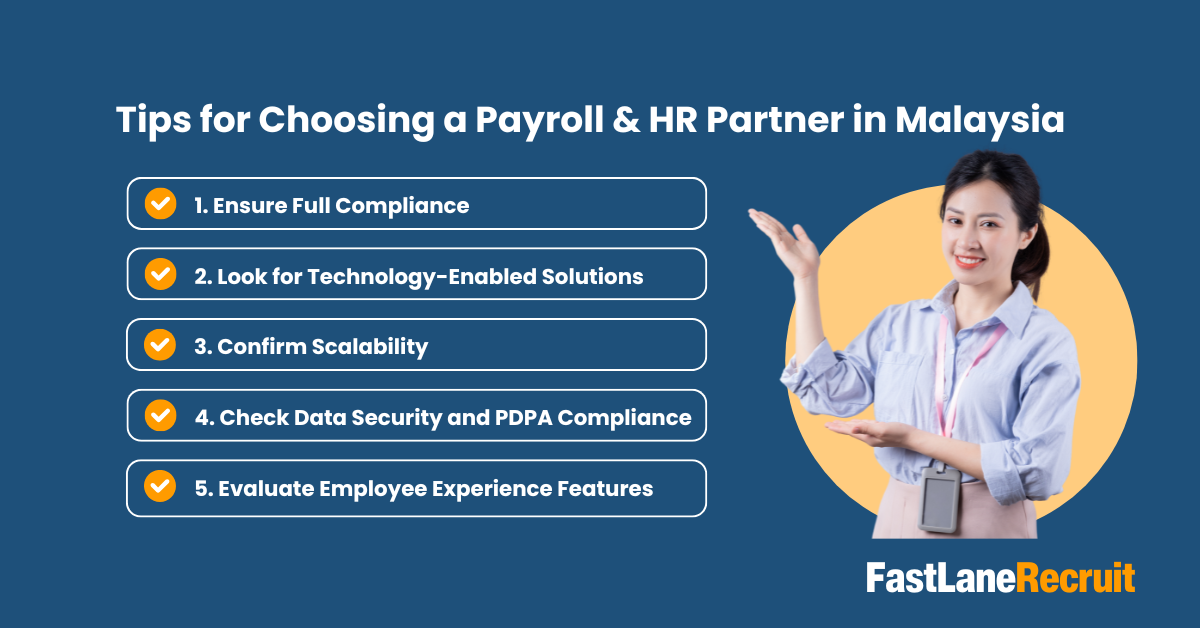
Selecting the right payroll and HR partner in Malaysia is crucial for ensuring compliance, efficiency, and a smooth employee experience. Here are some practical tips to guide your decision:
1. Ensure Full Compliance
A reliable partner must handle all statutory contributions and tax regulations accurately, including EPF, SOCSO, EIS, and LHDN tax deductions. Compliance ensures that your business avoids penalties, maintains good standing with authorities, and builds trust with employees.
Example:
A European company expanding to Malaysia partnered with a local payroll provider. The provider managed statutory contributions accurately every month, eliminating the risk of fines and errors while keeping payroll fully compliant with Malaysian law.
Tip:
Check that the provider stays updated with regulatory changes. Resources like LHDN Malaysia and SOCSO are good reference points.
2. Look for Technology-Enabled Solutions
Modern payroll providers use technology to improve accuracy, speed, and transparency. Look for solutions such as:
- AI-powered payroll systems to automate calculations and deductions.
- HR Management Systems (HRMS) to track attendance, leave, and benefits.
- Cloud-based platforms for accessibility, reporting, and remote management.
Example:
A tech startup adopted a Malaysian provider with an AI-powered payroll platform. Payroll calculations, statutory contributions, and compliance checks became automated and error-free, freeing HR to focus on strategic initiatives.
3. Confirm Scalability
Your payroll provider should be able to grow with your business. As you hire more employees, expand into new regions, or have seasonal workforce fluctuations, the provider should adjust services without disruption.
Example:
A retail chain scaled from 100 to 500 employees across multiple Malaysian branches. The outsourced provider handled payroll for the expanding workforce without requiring additional in-house HR staff, making scaling seamless.
4. Check Data Security and PDPA Compliance
Payroll and HR data is highly sensitive. Ensure your provider has:
- PDPA-compliant systems for legal data handling.
- Data encryption and secure servers to protect employee information.
- Digital audit trails for transparency and accountability.
Example:
A healthcare company needed strict confidentiality for employee data. Partnering with a compliant Malaysian provider ensured that all payroll and HR data was encrypted, secure, and fully traceable, meeting internal and legal standards.
Also Read: How to Hire HR Operations Analysts in Malaysia
5. Evaluate Employee Experience Features
A good payroll partner should enhance the employee experience, not just handle calculations. Features to look for include:
- Self-service portals for payslips, leave requests, and tax forms.
- Timely payments with minimal errors.
- Easy access to HR support for questions or updates.
Example:
An IT company implemented self-service portals through its Malaysian payroll provider. Employees could independently access payslips and leave balances, which reduced HR queries by 60% and improved overall employee satisfaction.
Summary
Choosing the right payroll and HR partner in Malaysia requires careful consideration of:
- Regulatory compliance for EPF, SOCSO, EIS, and taxes
- Technology integration for accuracy and efficiency
- Scalability to support workforce growth
- Data security and PDPA compliance
- Employee experience features for transparency and satisfaction
By selecting a provider that meets these criteria, businesses can streamline payroll and HR operations, reduce risks, and enhance productivity, while ensuring employees are happy and supported.
How to Hire Payroll Specialists in Malaysia
Hiring skilled Payroll Specialists in Malaysia is essential for ensuring accurate, compliant, and efficient payroll operations. Whether you’re building an in-house team or partnering with local experts, here’s a guide to help you navigate the process:
1. Define the Role and Responsibilities
Before recruiting, clearly outline the responsibilities of your payroll specialist. Common duties include:
- Processing salaries, overtime, and bonuses
- Managing statutory contributions (EPF, SOCSO, EIS)
- Filing monthly income tax (PCB/LHDN)
- Generating payslips, reports, and year-end EA forms
- Maintaining compliance with employment laws and company policies
Example:
A mid-sized company expanding to Malaysia defined its payroll specialist role to cover both payroll processing and employee inquiries. This clarity helped attract candidates with the right experience and skills.
2. Identify Required Skills and Qualifications
Key skills to look for in Malaysian payroll specialists include:
- Knowledge of Malaysian statutory contributions and labor laws
- Experience with payroll software and HRMS
- Strong analytical and problem-solving skills
- Attention to detail and accuracy
- Communication skills for employee support and coordination
Tip:
Prioritize candidates who have experience with multinational companies or EOR providers, as they are familiar with both local compliance and global payroll practices.
Also Read: Payroll and Compliance for HR Operations Teams in Malaysia
3. Explore Recruitment Channels
There are multiple ways to hire payroll specialists in Malaysia:
- Job Portals: Platforms like JobStreet, LinkedIn, and Indeed have active HR and payroll communities.
- Recruitment Agencies like FastLaneRecruit: Local recruitment firms can help identify qualified candidates quickly.
- Networking & Professional Associations: Engage with HR networks or payroll forums to find experienced professionals.
4. Conduct Thorough Interviews
Focus on both technical and soft skills:
- Ask candidates to demonstrate knowledge of EPF, SOCSO, and tax filing procedures.
- Evaluate their experience with HRMS and payroll software.
- Test problem-solving abilities using scenarios like correcting payroll errors or handling employee inquiries.
Tip:
Consider a trial period or probation to ensure the candidate can handle your company’s payroll volume and complexity effectively.
5. Provide Continuous Training
Malaysian payroll regulations and technology tools are constantly evolving. Provide ongoing training to ensure your team remains up-to-date with compliance, tax changes, and software upgrades.
Example:
A multinational partnered with a payroll provider to deliver quarterly training sessions for their in-house payroll team, ensuring consistent compliance and smooth operations.
FastLaneRecruit EOR: A Smarter Way to Hire Malaysian Payroll Specialists
For companies looking to hire quickly, scale efficiently, or avoid setting up a local entity, FastLaneRecruit’s Employer of Record (EOR) service provides a smarter solution.
1. Hire Without Establishing a Local Entity
FastLaneRecruit acts as the legal employer of record in Malaysia, allowing global companies to hire offshore payroll specialists without creating a subsidiary. This eliminates the need for local registration, compliance setup, and administrative overhead.
2. Fully Compliant Payroll and HR Management
FastLaneRecruit ensures that your employees’ payroll is processed accurately, statutory contributions are remitted on time, and all HR operations meet Malaysian labor laws and tax regulations.
Tip:
This approach is particularly useful for companies expanding into Malaysia for the first time or testing a new market, as it reduces risk while ensuring legal compliance.
3. Quick Onboarding and Scalable Hiring
FastLaneRecruit enables companies to hire quickly and scale efficiently. Whether you need one offshore payroll specialist or an entire offshore HR team, the EOR model provides flexibility to match business growth.
4. Reduced Administrative Burden
By managing compliance, payroll processing, and HR administration, FastLaneRecruit allows your internal teams to focus on strategic growth initiatives rather than administrative tasks.
Example:
A US-based firm wanted to hire payroll staff for its Malaysian operations. Using FastLaneRecruit’s EOR, they onboarded qualified specialists within 4-6 weeks, completely bypassing the complexities of local incorporation.
Summary:
Partnering with FastLaneRecruit’s EOR service is an efficient, compliant, and scalable solution for hiring Malaysian payroll specialists. It reduces setup time, ensures legal compliance, leverages technology, and enhances employee experience, all while keeping costs predictable.
Also Read: HR Operations Analyst Salary Guide 2026
Conclusion
Outsourcing payroll to Malaysia offers cost efficiency, compliance assurance, advanced technology, and employee satisfaction. With its skilled workforce, regulatory strength, and global positioning, Malaysia is a standout hub for payroll and HR shared services.
Whether you’re a small business, SME, or multinational corporation, outsourcing payroll or leveraging FastLaneRecruit’s EOR solution provides a modern, scalable, and efficient way to manage your workforce.
Ready to Simplify Payroll and HR in Malaysia?
Unlock the full potential of Malaysia’s skilled workforce, robust compliance framework, and modern HR technology. With FastLaneRecruit’s Employer of Record (EOR) services, you can hire and manage offshore Malaysian employees seamlessly without setting up a local entity or worrying about compliance.
- Fully compliant payroll and HR management
- Quick onboarding and scalable hiring
- Access to self-service portals and modern HR technology
- Focus on growth while reducing administrative burden
Take the next step: Explore FastLaneRecruit’s EOR services today and transform the way you manage payroll and HR in Malaysia.
