Businesses are constantly looking for ways to streamline operations, scale efficiently, and access top talent without compromising quality. Malaysia has emerged as one of the most attractive hubs for operations support, offering a unique combination of skilled professionals, multilingual capabilities, modern infrastructure, and flexible operational models. Whether you’re expanding into Southeast Asia or managing a global workforce, Malaysia provides a reliable and future-ready environment for business growth.
In this guide, we will explore the key reasons why Malaysia is becoming a preferred destination for operations support, the types of services available, trends shaping the market, tips for choosing the right operations partner, and how solutions like FastLaneRecruit’s EOR services can help your business scale seamlessly in Malaysia.
Content Outline
Key Summary
Strategic Location & Time Zone Advantage
Malaysia’s central location in Southeast Asia allows companies to operate across Asia-Pacific, the Middle East, and Europe. Its time zone supports near 24/7 operations, enabling round-the-clock customer support, IT services, and back-office management.
Skilled & Multilingual Workforce
The country offers a highly educated workforce proficient in English, Mandarin, Japanese, Bahasa Malaysia, and Arabic. This talent pool supports diverse operational functions, including customer support, finance, HR, IT, and analytics, making it ideal for global businesses.
Modern Infrastructure & Technology Integration
Malaysia’s advanced ICT infrastructure, cloud systems, AI tools, and smart city initiatives allow companies to streamline processes, adopt automation, and deliver enterprise-grade operations efficiently.
Flexible & Cost-Effective Operational Models
Businesses can scale teams quickly for seasonal demand, product launches, or regional expansion without significant overhead. Malaysia provides operational efficiency at a lower cost while maintaining quality and compliance.
Compliance & Supportive Business Environment
Government-backed initiatives, such as MDEC, and adherence to international standards like GDPR and ISO ensure a stable, regulated, and secure environment for global companies.
Seamless Global Expansion with EOR Solutions
Services like FastLaneRecruit’s Employer of Record (EOR) enable businesses to hire and manage local operations coordinators, HR, finance, and IT teams in Malaysia without setting up a local entity, ensuring compliance, speed, and operational efficiency.
Why Malaysia Stands Out in the Global Operations Landscape
Several factors make Malaysia a preferred destination for businesses seeking operational support:
1. Strategic Location & Time Zone Advantage
Located in Southeast Asia, Malaysia bridges key markets in Asia-Pacific, the Middle East, and Europe. Its time zone allows companies to maintain near 24/7 operations, making it ideal for round-the-clock customer support, IT services, and back-office management.
2. Skilled & Multilingual Workforce
Malaysia boasts a highly educated workforce, proficient in English and other languages such as Mandarin, Japanese, Bahasa, and Arabic. This talent pool enables businesses to deliver high-quality services across diverse markets, including customer support, finance, HR, IT, and analytics.
Also Read: Why Businesses Outsource Corporate Services Functions
3. Supportive Business Environment
Government initiatives, such as the Malaysia Digital Economy Corporation (MDEC), have strengthened the country’s position as a regional hub for Global Business Services (GBS). Policies encourage digital adoption, infrastructure investment, and compliance with international standards, creating a stable environment for foreign businesses.
4. Modern Infrastructure & Technology Adoption
Malaysia’s robust ICT infrastructure supports enterprise-grade service delivery. Companies can leverage cloud-based systems, advanced IT solutions, and AI-driven tools to optimize efficiency. The rise of smart city initiatives and 5G adoption further enhances the country’s operations capabilities.
5. Cost-Effective Operations
While avoiding negative labels like “cheap,” Malaysia allows companies to reduce operational costs compared to onshore setups. Savings come from lower labor costs, shared infrastructure, optimized recruitment, and access to managed operational services.
Key Operations Support Services Available in Malaysia
Malaysia’s operations support ecosystem goes far beyond traditional call centers. Businesses can access a wide range of managed services that help them operate efficiently, scale quickly, and maintain high-quality standards. Here’s a breakdown of the main services available, what they typically involve, and how they benefit your business:
| Service Category | Typical Functions | Benefits |
| Back-Office Support | Includes routine administrative tasks such as data entry, payroll management, document processing, and record keeping. | Frees up your internal teams to focus on core business activities, ensures accuracy in everyday tasks, and helps maintain compliance with local and international regulations. |
| Customer Support & Multilingual Services | Provides 24/7 call centers, helpdesk services, chat support, and email support in multiple languages including English, Mandarin, Japanese, and Bahasa. | Improves customer satisfaction and loyalty, allowing your business to serve global clients seamlessly while handling high volumes of inquiries efficiently. |
| Finance & Accounting | Covers bookkeeping, payroll accounting, tax filing, auditing, financial reporting, and regulatory compliance. | Helps your company maintain accurate financial records, meet legal requirements, and reduce operational costs by outsourcing complex financial processes to skilled professionals. |
| HR & Recruitment Support | Handles recruitment, onboarding, payroll management, employee engagement, benefits administration, and performance tracking. | Allows you to scale your workforce quickly, stay compliant with local labor laws, and reduce the administrative burden on your internal HR team. |
| IT & Software Support | Provides software development, IT infrastructure management, cloud solutions, cybersecurity monitoring, and technical support. | Drives digital transformation, ensures systems are secure and reliable, and enables your business to adopt new technologies without heavy upfront investment. |
| Network & Operations Support Systems (OSS) | Manages service provisioning, network performance monitoring, fault detection, billing systems, and revenue management. | Streamlines complex network operations, reduces manual workload, integrates AI and IoT technologies, and improves operational efficiency across your business systems. |
Why These Services Matter for Your Business
By tapping into Malaysia’s operations support ecosystem, companies can:
- Focus on strategic growth instead of spending time on administrative or technical tasks
- Access specialized skills that may not be available locally
- Maintain compliance with regulatory standards for finance, HR, IT, and networks
- Scale quickly to meet market demand or seasonal peaks
- Leverage technology such as AI, cloud, and IoT to improve efficiency and reduce errors
In short, Malaysia offers a full spectrum of operational support services, allowing businesses to operate like a global enterprise without the complexities of managing every function in-house.
Also Read: Why Malaysia Is a Corporate Services Hub for Regional Operations
Trends Driving Malaysia’s Operations Support Growth
Malaysia’s operations support sector is evolving rapidly, driven by technological innovation, skilled talent, and flexible business models. Understanding these trends can help companies make informed decisions when expanding their operations in the region.
1. Digital Transformation & AI Integration
Companies in Malaysia are increasingly adopting artificial intelligence (AI), machine learning, and automated workflows to improve business efficiency. AI-powered analytics help teams make faster, data-driven decisions, while automation reduces repetitive tasks and minimizes human errors. For example:
- Predictive analytics can forecast customer demand, helping operations teams plan resources more effectively.
- AI chatbots can handle routine customer inquiries 24/7, freeing human agents for more complex tasks.
This trend allows businesses to deliver faster, smarter, and more reliable services while keeping costs in check.
2. Cloud-Based & Scalable Solutions
The shift toward cloud-based platforms and remote operations enables businesses to scale quickly without large upfront infrastructure costs. Companies can deploy virtual networks, cloud-hosted applications, and Operations Support Systems (OSS) to manage complex workflows efficiently.
Benefits include:
- Rapid expansion of teams or services without building physical offices
- Centralized data access for remote employees
- Easier integration with new technologies like AI, IoT, and automation tools
By leveraging cloud solutions, businesses can remain agile and responsive to market changes.
3. Hybrid & Flexible Operational Models
Malaysia supports flexible operational structures, combining in-office, nearshore, and offshore teams. This hybrid approach allows companies to:
- Adjust workforce size during seasonal peaks or product launches
- Access specialized skills from multiple locations without long-term commitments
- Maintain business continuity even in times of disruption
This flexibility helps businesses optimize resources and maintain service quality while staying cost-efficient.
4. Focus on Compliance & Data Security
Global businesses often worry about regulatory compliance and data security when expanding internationally. Malaysia adheres to strict standards such as GDPR, ISO, and local labor laws, ensuring that operations meet international requirements.
Key advantages include:
- Protection of sensitive client data and confidential information
- Reduced risk of regulatory penalties
- Confidence for international companies in adopting Malaysia as a trusted operations hub
Strong compliance frameworks make Malaysia a reliable and low-risk destination for managing global operations.
5. Expanding Multilingual & Professional Talent Pool
Malaysia continues to produce a highly skilled, diverse workforce in areas like IT, finance, HR, engineering, and customer support. Many professionals are internationally trained and fluent in multiple languages, including:
- English (business and technical proficiency)
- Mandarin and Japanese (regional markets)
- Bahasa Malaysia and Arabic (local and international clients)
This growing talent pool allows companies to scale teams efficiently, offer multilingual services, and access professional expertise without geographical limitations.
Why These Trends Matter
By understanding and leveraging these trends, businesses can:
- Increase operational efficiency with AI and automation
- Scale operations globally through cloud-based and hybrid models
- Maintain compliance while protecting sensitive data
- Access skilled, multilingual talent to serve diverse markets
In short, these trends position Malaysia as a future-ready operations hub that supports sustainable growth, innovation, and global competitiveness.
Also Read: How to Build an Offshore Corporate Services Team in Malaysia
Tips for Choosing an Operations Partner in Malaysia
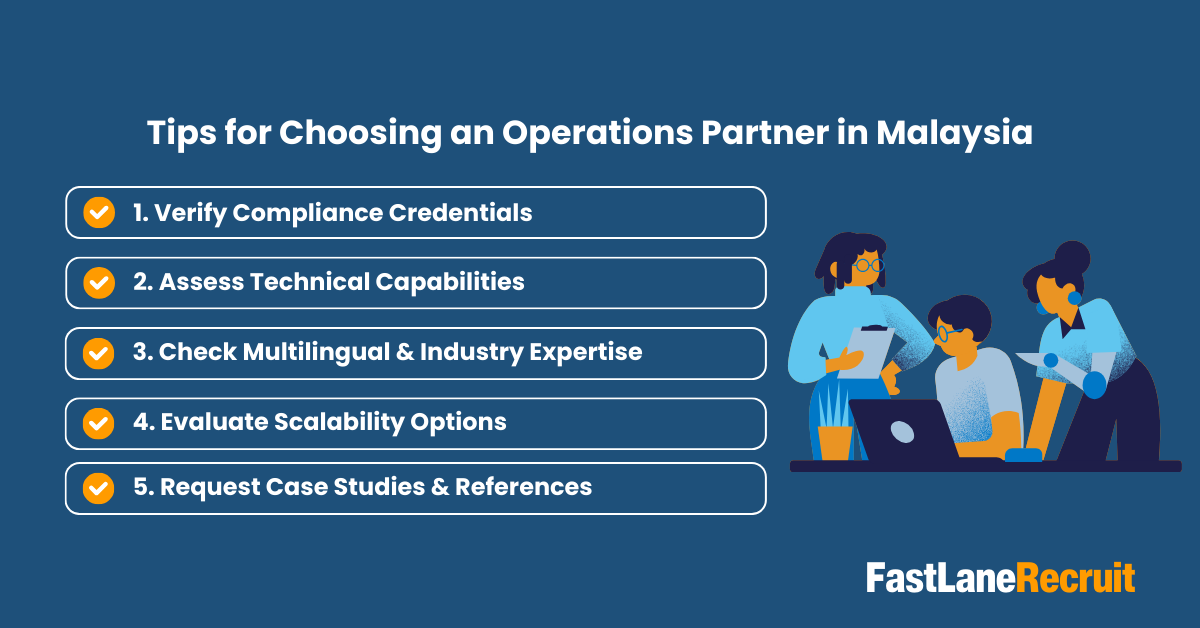
Selecting the right operations partner is critical to ensuring smooth business expansion, high-quality service delivery, and regulatory compliance. Here are some detailed tips to guide your decision:
1. Verify Compliance Credentials
Before partnering with any vendor, make sure they adhere to Malaysian labor laws and relevant international regulations such as GDPR or ISO standards. Compliance ensures your business avoids legal risks and operates ethically.
Example: A partner that manages payroll must follow local employment regulations, tax requirements, and employee benefits rules to prevent penalties or disputes.
2. Assess Technical Capabilities
Check whether the vendor can support your technology needs, such as cloud platforms, AI-driven tools, or Operations Support Systems (OSS). A partner with strong technical capabilities can improve operational efficiency and adapt to changing business requirements.
Example: A company offering IT support should be able to manage cloud infrastructure, provide cybersecurity monitoring, and integrate automation tools for faster workflows.
3. Check Multilingual & Industry Expertise
Your operations partner should have a workforce that matches your business needs, both in language and domain expertise. For global operations, multilingual staff and industry knowledge are key to providing quality services.
Example: If your business serves Japanese and Mandarin-speaking customers, ensure the partner has fluent agents trained in customer service and industry-specific protocols.
4. Evaluate Scalability Options
Choose a partner that allows you to expand or reduce teams quickly in response to market demand, seasonal spikes, or new service lines. Scalability ensures your business can grow without being constrained by fixed resources.
Example: During a product launch, your partner should be able to add extra customer support agents within weeks instead of months, without compromising service quality.
5. Request Case Studies & References
Always ask for real-life examples of previous projects and speak to existing clients if possible. Case studies and references provide insight into the vendor’s capabilities, reliability, and approach to problem-solving.
Example: A partner that has successfully managed finance outsourcing for multinational clients demonstrates proven processes and the ability to handle complex compliance requirements.
Also Read: Labour Law, Payroll & Compliance in Malaysia for Corporate Services Officer
Bonus Tip: Prioritize Communication & Transparency
Effective collaboration is critical when managing offshore or remote teams. Ensure your partner maintains clear reporting, regular updates, and open communication channels. This reduces misunderstandings, improves accountability, and ensures alignment with your business goals.
By following these tips, companies can choose an operations partner in Malaysia that is not only reliable and compliant but also adaptable, skilled, and ready to support global growth.
Why Businesses Are Turning to Malaysia for Operations Support
Malaysia has quickly become a preferred hub for companies looking to strengthen their operational capabilities. By leveraging the country’s skilled workforce, modern infrastructure, and flexible operational models, businesses can achieve efficiency, scalability, and global competitiveness. Here’s a deeper look at why Malaysia stands out:
1. Reduce Operational Overhead Without Compromising Quality
One of the biggest advantages of operating in Malaysia is the ability to lower costs while maintaining high-quality services. Businesses can save on office space, equipment, recruitment, and training by partnering with local providers or using managed services.
Example: A multinational company can outsource finance, HR, or IT functions to Malaysia and reduce operational overhead by 40–60%, while still receiving professional, reliable service.
2. Scale Teams Efficiently for Regional or Global Operations
Malaysia’s flexible operational models allow companies to expand or contract teams based on demand, seasonal fluctuations, or new market launches. This means businesses can quickly add specialists or customer support staff without the delays or costs of traditional hiring.
Example: During a product launch in Southeast Asia, a company can rapidly scale its customer support team in Malaysia to serve multiple languages and time zones.
3. Access Multilingual, Professional Staff for Complex Functions
Malaysia offers a diverse and highly skilled workforce, proficient in English, Mandarin, Japanese, Bahasa Malaysia, and Arabic. Employees often have international training and expertise in fields such as IT, finance, HR, engineering, and analytics.
Example: A global e-commerce business can rely on Malaysian teams to manage customer inquiries, data processing, and financial reporting across multiple regions with ease.
4. Implement Advanced Technology Solutions
Companies operating in Malaysia can leverage modern technology tools, including cloud-based platforms, AI-driven analytics, Operations Support Systems (OSS), and automated workflows. These technologies help streamline processes, reduce errors, and generate actionable insights for better decision-making.
Example: Using an AI-powered ticketing system, a customer support team can automatically route inquiries, prioritize urgent issues, and report key metrics in real-time.
5. Enjoy Stable, Compliant, and Government-Supported Business Frameworks
Malaysia provides a stable business environment with strong regulatory compliance, labor protections, and government-backed incentives. Programs such as Malaysia Digital Economy Corporation (MDEC) support digital adoption, skill development, and investment in Global Business Services (GBS), giving companies confidence when expanding operations.
Example: International companies can operate with peace of mind knowing local labor laws, tax requirements, and data protection standards are clearly defined and enforced.
The Bottom Line
By turning to Malaysia for operations support, businesses gain efficiency, flexibility, and reliability. Whether it’s scaling teams, accessing multilingual talent, implementing cutting-edge technology, or operating within a stable regulatory framework, Malaysia offers everything companies need to optimize operations, reduce costs, and compete globally.
Also Read: Corporate Services Officer Salary Guide 2026
Future Outlook for Malaysia’s Operations Support Market
The Malaysian operations support market is set for steady and sustained growth over the coming years. Several key trends and developments are shaping the future of this sector, offering opportunities for businesses to operate more efficiently, deliver higher-quality services, and remain competitive in global markets.
1. Accelerated Digital Adoption
Malaysia is increasingly embracing digital transformation across industries, from telecommunications and finance to e-commerce and healthcare. Companies are adopting cloud platforms, automated workflows, AI-powered analytics, and remote collaboration tools.
Impact for Businesses: Organizations can streamline operations, reduce manual tasks, and gain real-time insights into performance, making processes faster, more accurate, and more cost-efficient.
2. Growth of Smart Infrastructure Initiatives
Government-backed programs, such as the Malaysia Digital Economy Blueprint and smart city initiatives, are enhancing connectivity, ICT infrastructure, and operational efficiency. Investments in 5G networks, broadband expansion, and integrated management systems are making Malaysia a future-ready hub for operations support.
Impact for Businesses: Companies can leverage advanced infrastructure to support high-volume operations, real-time monitoring, and scalable services without heavy upfront investment.
3. Increasing Integration of AI and Automation
Artificial intelligence (AI), machine learning, and robotic process automation (RPA) are becoming central to operations support in Malaysia. From predictive analytics to automated customer support and network monitoring, AI is helping businesses reduce errors and optimize resource allocation.
Impact for Businesses: By integrating AI-driven tools, companies can improve operational efficiency, reduce costs, and offer faster, more personalized services to customers.
4. Expansion of Multilingual and Specialized Talent
Malaysia’s workforce continues to grow in size, expertise, and language capabilities. Professionals are increasingly trained in specialized fields such as IT, finance, engineering, analytics, and HR, and many are fluent in multiple languages.
Impact for Businesses: Organizations can quickly build teams for complex, cross-border operations, ensuring consistency and quality while serving diverse markets.
5. Emergence of Hybrid and Flexible Work Models
Post-pandemic, hybrid operational models combining on-site, nearshore, and remote teams have gained popularity. Malaysia’s operations support ecosystem is highly adaptable, allowing businesses to scale teams up or down based on market needs.
Impact for Businesses: Companies can maintain flexibility, reduce overhead, and respond quickly to new market opportunities or seasonal demands without disrupting service delivery.
Also Read: Recruiting Coordinator Salary Guide 2026
Overall Market Outlook
With a combination of advanced technology adoption, skilled workforce availability, and supportive government policies, Malaysia’s operations support market offers significant long-term potential. Businesses that invest in this ecosystem can expect:
- Improved operational efficiency through automation, AI, and streamlined workflows
- Enhanced service quality with multilingual, professional, and specialized talent
- Competitive advantages in global markets by leveraging Malaysia as a strategic operational hub
- Scalable and future-ready operations that adapt to evolving business demands
In short, Malaysia is positioned to remain a top choice for global businesses seeking reliable, cost-efficient, and high-quality operations support for the foreseeable future.
FastLaneRecruit’s EOR Solution: Simplifying Your Malaysia Operations
Expanding your business in Malaysia doesn’t have to be complicated. For companies looking for a hassle-free alternative to traditional outsourcing or entity setup, FastLaneRecruit offers EOR (Employer of Record) Service designed to make operations smooth, legal, and efficient.
With our EOR solution, your business can hire and manage operations coordinators in Malaysia without the time, cost, and administrative burden of establishing a local company. This allows you to focus on strategic growth, while FastLaneRecruit handles the operational details.
What You Can Achieve with FastLaneRecruit’s EOR Services
1. Hire and Manage Local Teams Easily
FastLaneRecruit enables companies to quickly onboard offshore operations coordinators, finance and accounting staff, HR professionals, IT specialists, or customer support teams in Malaysia. We act as the official employer, taking care of contracts, payroll, and compliance, so your team can start delivering value immediately.
Example: A global e-commerce company can launch a Malaysia-based offshore operations coordination team in weeks rather than months, serving multiple regions with multilingual staff.
2. Ensure Compliance with Malaysian Labor Laws
Navigating local labor laws, taxes, and benefits can be challenging for international businesses. FastLaneRecruit ensures full compliance with Malaysian employment regulations, including statutory benefits, taxation, and local employment policies.
Example: Payroll, leave management, and statutory reporting are all handled seamlessly, reducing the risk of penalties and legal complications.
3. Scale Your Team Quickly and Flexibly
Whether you need to expand for seasonal demand, new product launches, or regional growth, FastLaneRecruit offers flexible scaling options. You can increase or decrease your workforce without the overhead of hiring and managing a local entity.
Example: During peak sales periods, your operations team can be scaled up rapidly to handle higher workloads and scaled down when demand stabilizes.
4. Focus on Strategic Growth
By letting FastLaneRecruit handle the administrative, payroll, and compliance tasks, your leadership team can concentrate on business strategy, market expansion, and customer experience instead of operational management.
Example: Senior management can focus on launching new products or entering new markets, while your EOR partner ensures your Malaysia operations run smoothly behind the scenes.
5. Streamline Operations with Confidence
FastLaneRecruit’s EOR solution combines efficiency, compliance, and local expertise, giving businesses the confidence to operate in Malaysia without the complexity of traditional outsourcing models.
Explore FastLaneRecruit’s EOR services today and simplify your Malaysia operations while hiring offshore operations coordinators, maintaining regulatory compliance, and scaling your business efficiently.
Conclusion
Malaysia has become a strategic hub for operations support, offering the perfect balance of skilled talent, modern infrastructure, multilingual capabilities, and cost-efficient operations. Whether you’re looking for back-office support, IT, HR, finance, or end-to-end operational management, Malaysia provides a scalable, future-ready solution for global businesses.
By partnering with trusted providers or leveraging FastLaneRecruit’s EOR services, you can expand operations seamlessly, optimize costs, and maintain compliance, all while focusing on growing your core business.
Ready to Simplify Your Malaysia Operations?
With FastLaneRecruit’s Employer of Record (EOR) services, you can quickly hire and manage offshore operations coordinators without setting up a local entity or handling administrative burdens.
Contact FastLaneRecruit today and discover how our EOR solutions can help you streamline your operations, access top talent, and grow your business confidently.