

Building an offshore team isn’t just about cutting costs; it’s about finding skilled, reliable, and culturally compatible talent that helps your business scale smoothly. In Southeast Asia, Malaysia stands out as a premium destination for companies looking to hire high-quality remote teams. With a well-educated workforce, strong English proficiency, and a strategic time zone, Malaysia offers the perfect mix for businesses expanding globally.
In this guide, we will explore the reasons why Malaysia stands out as a top choice for offshore data entry teams and how to hire and manage data entry offshore teams in Malaysia. We will also cover the smarter alternative solution to outsourcing, such as an Employer of Record service, to help you hire in Malaysia quickly and compliantly without setting up a local entity.
Content Outline
Key Summary
High-Quality Talent Pool
Outsourcing payroll is no longer just about saving time, it’s a smart move for businesses expanding globally. It helps ensure compliance with local tax and labor laws, reduces administrative overhead, and minimizes the risk of penalties and errors.
Operational Cost-Efficiency Without Compromising Quality
Hiring in Malaysia reduces operational costs significantly compared to Singapore, US, UK, or Australia while maintaining top-quality output.
Cultural Compatibility & Professionalism
Malaysian teams adapt easily to Western business standards, ensuring smooth collaboration and minimal miscommunication.
Strategic Time Zone Advantage
Malaysia’s GMT+8 time zone enables real-time collaboration with Asian and European offices while supporting independent task management.
Reliable Infrastructure & Legal Compliance
Stable internet, digital tools, and clear labor regulations ensure safe, secure, and compliant offshore operations.
Smarter Alternative with EOR Services
Using an Employer of Record like FastLaneRecruit allows businesses to hire and manage offshore teams quickly, compliantly, and flexibly.
Flexibility and Scalability
Malaysia’s workforce allows easy scaling, whether hiring a single data entry specialist or an entire offshore team for growing operations.
Benefits of Hiring Offshore Teams in Malaysia
1. High-Quality Talent Pool
Malaysia has a well-educated workforce with professionals skilled in data entry, IT, finance, marketing, HR, and creative roles. For data entry in particular, Malaysian specialists are trained to handle large volumes of data accurately, quickly, and securely. They are familiar with international standards for data management, ensuring your operations remain precise and efficient.
Companies looking for reliable offshore talent can find individuals who understand global business processes, are detail-oriented, and are comfortable using modern productivity tools like Excel, Google Workspace, and specialized CRM or ERP systems.
Why it matters: High-quality talent ensures fewer errors, faster turnaround, and seamless integration with your existing teams, making Malaysia an excellent choice for offshore data-intensive roles.
2. Operational Cost Efficiency Without Compromising Quality
While Malaysia provides top-quality talent, operational costs remain significantly lower than in developed countries. Businesses can hire skilled data entry clerks at a fraction of what they would pay in countries like Singapore, Australia, the US, or the UK.
Here’s a comparison of average annual salaries for Data Entry roles:
| Country | Average Annual Salary (USD) | Notes |
| Malaysia | $8,000 – $12,000 | Skilled, multilingual talent; high accuracy rates |
| Singapore | $28,000 – $35,000 | Premium market; high cost of living impacts salaries |
| Australia | $35,000 – $45,000 | Experienced professionals; high employment costs |
| United States | $32,000 – $42,000 | Senior talent expensive; overheads add up |
| United Kingdom | $30,000 – $40,000 | Costly for SMEs; strong legal compliance needed |
Takeaway: Hiring data entry teams in Malaysia allows businesses to reduce operational costs without sacrificing quality or efficiency, freeing up resources for growth, technology, and innovation.
3. Cultural Compatibility & Professionalism
Malaysian professionals are known for their adaptability, reliability, and strong work ethic. They are accustomed to working with international teams and understand Western business etiquette, which makes cross-border collaboration smooth and productive.
For data entry teams, this means:
- Following instructions accurately
- Meeting deadlines consistently
- Adapting quickly to new processes or tools
Tip: Cultural alignment reduces miscommunication and training time, allowing businesses to scale offshore teams faster.
Also Read: Recruiting Coordinator Salary Guide 2026
4. Strategic Time Zone Advantage
Malaysia operates on GMT+8, which overlaps with most Asian and European business hours. For companies in the US or UK, partial overlap allows for real-time communication for urgent data processing, while Malaysian teams can manage tasks independently during other hours.
This is especially useful for:
- Processing daily transactions or reports
- Maintaining 24/7 operational support
- Managing time-sensitive client data
Result: Faster workflows, minimal delays, and smooth global operations without needing night shifts for offshore staff.
5. Stable Infrastructure & Business Environment
Malaysia provides reliable internet, modern office infrastructure, and supportive government initiatives that make offshore work safe and efficient. Programs like Malaysia Digital Economy Corporation (MDEC) and TalentCorp support workforce development, ensuring the country produces skilled professionals for global business needs.
For data entry, this translates to:
- Secure digital systems for sensitive information
- High-speed connectivity for large data transfers
- Government support that ensures smooth payroll, taxes, and compliance
Benefit: Companies can trust that offshore teams in Malaysia have the tools, environment, and legal backing to deliver high-quality work consistently.
6. Access to Multilingual Talent
Malaysia’s workforce is fluent in English, Mandarin, Bahasa Malaysia, and Tamil, making it ideal for businesses that serve international clients. For data entry teams handling multilingual records or customer data, this ensures:
- Accurate transcription of diverse data sets
- Better understanding of localized formats (dates, currencies, addresses)
- Smooth communication with global stakeholders
Edge: Multilingual capability allows your business to expand into multiple markets confidently without hiring additional resources elsewhere.
7. Strong Regulatory & Legal Compliance
Malaysia has clear labor laws and regulations, making it easier for businesses to hire without facing compliance issues. Partnering with a local EOR (Employer of Record) service like FastLaneRecruit ensures that your offshore data entry team is fully compliant with employment, tax, and labor regulations.
Why it matters: Peace of mind knowing your remote team operates legally while you focus on core business activities.
8. Flexibility and Scalability
Whether you need a single data entry specialist or a full offshore team, Malaysia offers the flexibility to hire, train, and scale quickly. Businesses can:
- Expand teams as data volumes increase
- Adjust workloads based on project needs
- Combine offshore and onshore teams for hybrid collaboration
Outcome: Malaysia provides a scalable solution for businesses of all sizes, from SMEs to large enterprises.
9. High Retention & Loyalty
Malaysian professionals are known for their dedication and loyalty. This means:
- Lower turnover rates compared to some offshore markets
- Stronger team cohesion and knowledge retention
- Reduced recruitment and retraining costs
Advantage: Long-term stability of offshore teams ensures continuity in data quality and business operations.
Also Read: Employment Laws and Compliance for Hiring Recruitment Teams in Malaysia
How to Hire and Manage Offshore Data Entry Teams in Malaysia
Hiring and managing offshore data entry teams in Malaysia requires a strategic approach to ensure quality, efficiency, and smooth collaboration. Here’s a step-by-step guide to help you build a successful remote data entry team.
1. Define Your Requirements Clearly
Before hiring, outline your project scope, volume of work, and key responsibilities. For data entry teams, consider:
- Type of data to be processed (financial, customer, HR, marketing, etc.)
- Expected accuracy and quality standards
- Volume of daily or weekly tasks
- Software and tools required (Excel, Google Sheets, ERP systems, CRM platforms)
Tip: Create a detailed job description with clear expectations. Highlight technical skills, language requirements, and attention to detail, as these are critical for data entry roles.
2. Choose the Right Hiring Approach
There are multiple ways to hire offshore teams in Malaysia:
| Approach | Description | Pros | Cons |
| Direct Hiring | Recruit staff directly and manage employment in-house | Full control over team | Requires understanding of local labor laws and payroll |
| EOR (Employer of Record) | Use a service like FastLaneRecruit to handle legal employment, payroll, and compliance | Hassle-free, fully compliant, fast setup | Slightly higher cost than direct hiring |
| Staffing Agencies | Partner with local recruitment agencies | Faster recruitment, local expertise | Limited control over hiring and contracts |
Recommendation: For most global companies, an EOR model is the fastest and safest way to hire Malaysian data entry specialists without setting up a local entity.
3. Recruit Skilled and Reliable Talent
To ensure high-quality hires:
- Target professionals with experience in data accuracy, spreadsheet management, and reporting
- Look for English proficiency and attention to detail
- Conduct skills assessments or practical tests before hiring (e.g., sample data entry tasks)
Tip: Use local job boards, LinkedIn, or FastLaneRecruit’s network to access verified Malaysian candidates.
4. Onboard Your Offshore Team Effectively
Successful offshore management starts with structured onboarding:
- Introduce your company, processes, and expectations
- Provide access to all required tools and software
- Explain data security protocols and confidentiality requirements
- Assign a mentor or team lead to guide initial tasks
Example: For a new data entry hire, assign a 5-day onboarding plan with practice tasks, quality checks, and feedback sessions to ensure accuracy and comfort with tools.
5. Implement Clear Communication Channels
Communication is key to managing offshore teams efficiently:
- Use Slack, Microsoft Teams, or Zoom for daily check-ins
- Establish overlapping working hours to align with your main office
- Set expectations for response times, reporting, and status updates
Tip: For data entry teams, daily or weekly progress reports help track task completion and accuracy.
Also Read: How to Hire Recruiting Coordinators in Malaysia
6. Monitor Performance and Maintain Quality
Maintain high standards with:
- KPIs for accuracy, speed, and completeness (e.g., 99% data accuracy per batch)
- Regular quality checks and spot audits
- Feedback sessions to identify challenges and provide guidance
Example KPI: A data entry team processes 500 records per day with ≥98% accuracy, with weekly audits to maintain quality.
7. Leverage Technology for Productivity
Using the right tools improves efficiency:
- Data Entry Tools: Excel, Google Sheets, Airtable
- Collaboration Tools: Slack, Teams, Trello, Asana
- Automation: Consider basic RPA (Robotic Process Automation) for repetitive tasks
Tip: Automate repetitive tasks when possible to free up your team for more complex data work.
8. Ensure Data Security and Compliance
Data entry teams often handle sensitive information. Malaysia has clear regulations, but you should:
- Use secure cloud storage and access controls
- Sign NDAs and confidentiality agreements
- Follow global data protection standards like GDPR if dealing with EU clients
Pro Tip: Using an EOR service like FastLaneRecruit ensures that your offshore team is fully compliant with local labor and data regulations, reducing risk.
9. Foster Engagement and Retention
Keeping your offshore team motivated improves performance:
- Recognize achievements and provide feedback regularly
- Offer training and upskilling opportunities
- Encourage team collaboration through virtual meetings, team-building activities, and open communication
Outcome: Engaged employees are more loyal, productive, and accurate in data handling.
10. Scale Your Offshore Team Strategically
As your business grows, Malaysia allows for quick scaling of data entry teams:
- Start with a small team and increase size based on workload
- Consider a hybrid model combining Malaysian and onshore staff
- Use tools for task tracking and performance monitoring to maintain quality at scale
Tip: Scaling with Malaysia lets you maintain cost-efficiency, high accuracy, and operational continuity without the administrative burden of local hiring.
Tips and Recommendations for Offshore Data Entry Teams in Malaysia
Managing offshore data entry teams effectively requires proactive strategies to reduce errors, maintain quality, and improve efficiency. Here are practical tips and recommendations:
1. Implement Standardized Data Entry Procedures
- Use clear templates, formats, and naming conventions for all datasets.
- Provide step-by-step guidelines for repetitive tasks to minimize mistakes.
- Ensure all team members follow the same workflow, reducing inconsistencies.
Tip: Create a central document with all instructions and examples for reference, especially for new hires or complex projects.
2. Use Double-Check and Verification Systems
- Introduce peer-review or cross-check processes for critical data.
- Use automated checks to flag duplicate entries, missing fields, or inconsistencies.
- For sensitive data, implement a two-step verification system before final submission.
Recommendation: Assign a small subset of data for verification daily to catch errors early rather than waiting for the full batch to finish.
3. Track Key Performance Metrics
- Monitor accuracy rates, data processing speed, and task completion.
- Identify patterns in errors to understand whether they stem from training gaps, unclear instructions, or tool inefficiencies.
- Use dashboards or reporting tools for real-time performance visibility.
Tip: Set benchmarks (e.g., 98–99% accuracy) and review performance weekly to maintain quality.
4. Use Technology to Reduce Human Error
- Utilize spreadsheet validation rules, automated formulas, or macros to prevent common mistakes.
- Consider basic RPA (Robotic Process Automation) for repetitive tasks like copying, formatting, or data aggregation.
- Enable error alerts or conditional formatting to catch anomalies immediately.
Recommendation: Combining human oversight with smart tools drastically lowers errors while increasing productivity.
Also Read: Malaysia’s Advantage for Building Offshore Recruitment Teams
5. Establish Clear Communication Channels
- Encourage your team to ask questions immediately if they’re unsure about data formats or instructions.
- Use collaboration tools like Slack, Microsoft Teams, or project boards to log updates and clarifications.
- Schedule regular feedback sessions to address recurring mistakes and clarify expectations.
Tip: Even small misunderstandings in data entry can lead to costly errors; clarity and open communication are critical.
6. Provide Ongoing Training and Upskilling
- Conduct periodic refresher sessions on data entry best practices.
- Train employees on new tools, updated templates, or regulatory requirements.
- Encourage self-audits and peer learning to continuously improve accuracy.
Recommendation: Well-trained teams are not only faster but also more confident and less prone to errors.
7. Implement Version Control and Backup Systems
- Use cloud storage with version history to track changes and revert mistakes.
- Encourage team members to save work frequently and follow proper file naming conventions.
- Regularly back up critical data to prevent loss due to technical errors or accidental deletions.
Tip: Proper version control prevents small mistakes from turning into major issues, especially in large datasets.
8. Focus on Task Prioritization and Workload Management
- Assign manageable workloads to avoid rushed work, which increases errors.
- Break large datasets into smaller batches with quality checks at each stage.
- Use project management tools to track progress and balance workload across the team.
Recommendation: Gradual, structured workflows are more effective than large, unmonitored bulk processing.
9. Foster a Culture of Accountability and Continuous Improvement
- Encourage team members to review their work before submission.
- Reward accuracy, attention to detail, and proactive problem-solving.
- Conduct post-project reviews to identify improvements for future tasks.
Tip: Teams that take ownership of data quality consistently deliver better results.
A Smarter Alternative to Traditional Outsourcing: Employer of Record (EOR) Services
While traditional outsourcing can work, it often comes with challenges like complex contracts, compliance risks, and limited control over your offshore team. A smarter alternative is using an Employer of Record (EOR) service, such as FastLaneRecruit, which allows you to hire and manage Malaysian data entry specialists seamlessly.
Also Read: How Outsourcing Recruitment Coordination Streamlines Global Hiring
What Is an Employer of Record (EOR)?
An Employer of Record (EOR) is a trusted partner that legally employs your offshore staff on your behalf. This means the EOR handles:
- Payroll and tax compliance
- Employment contracts and benefits
- Local labor law adherence
- Administrative and HR tasks
Meanwhile, your business retains full control over day-to-day operations, workflows, and team management.
Benefits of Using an EOR for Offshore Data Entry Teams
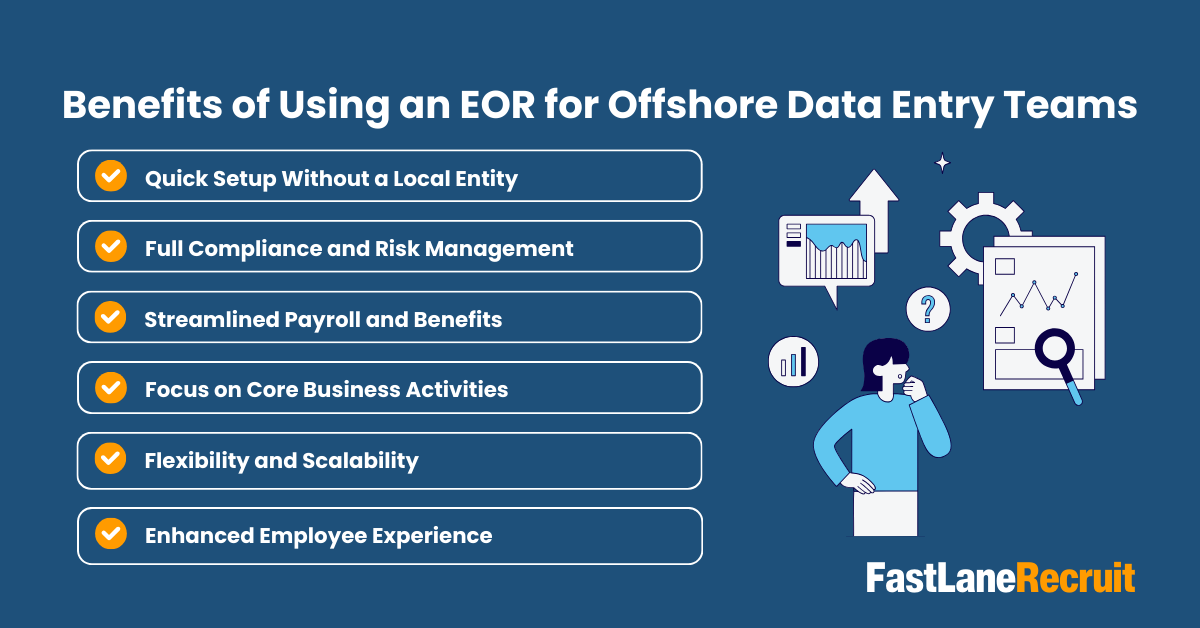
- Quick Setup Without a Local Entity
You don’t need to establish a company in Malaysia. The EOR allows you to start hiring skilled data entry specialists immediately, saving months of administrative work. - Full Compliance and Risk Management
Malaysia has specific labor laws, payroll regulations, and employee benefits requirements. An EOR ensures your offshore team meets all legal obligations, reducing risks of fines or disputes. - Streamlined Payroll and Benefits
The EOR handles monthly salaries, mandatory contributions, and benefits, so your team is fully supported without additional administrative burden. - Focus on Core Business Activities
By offloading HR, payroll, and compliance, your management can focus on supervising tasks, improving processes, and scaling your operations, rather than getting bogged down in legalities. - Flexibility and Scalability
Need to add more data entry specialists quickly? An EOR allows you to scale your team up or down without dealing with complex local employment processes. - Enhanced Employee Experience
EORs ensure employees receive timely salaries, proper benefits, and local compliance, which improves morale, retention, and productivity.
Also Read: The Ultimate Playbook for Building and Integrating Offshore Teams (Singapore Edition)
Why FastLaneRecruit EOR Is Ideal for Malaysian Data Entry Teams
FastLaneRecruit provides a turnkey solution for companies looking to hire Malaysian data entry clerks and other offshore roles:
- Immediate access to skilled, pre-vetted Malaysian professionals
- Handles all legal, payroll, and compliance responsibilities
- Lets businesses retain operational control while reducing administrative burden
- Ensures your team is accurate, efficient, and reliable, ready to integrate with global operations
Recommendation: For companies looking to hire offshore data entry teams in Malaysia safely and efficiently, partnering with an EOR is the most strategic choice. It combines the benefits of outsourcing with full control, compliance, and scalability.
Conclusion
Hiring offshore data entry teams in Malaysia is more than a cost-saving move, it’s a strategic decision for businesses aiming to scale efficiently, maintain high-quality operations, and access a skilled, reliable workforce.
With its well-educated talent pool, strong English proficiency, cultural compatibility, and stable infrastructure, Malaysia offers everything companies need to build high-performing remote teams. From reducing operational costs to ensuring data accuracy, regulatory compliance, and scalability, Malaysia provides a unique combination of advantages that few offshore destinations can match.
By adopting smart hiring strategies, implementing performance monitoring, and leveraging technology, businesses can maximize the productivity of their offshore data entry teams while minimizing errors. And for companies seeking a hassle-free, fully compliant, and flexible solution, partnering with an Employer of Record (EOR) like FastLaneRecruit is the ideal way to hire quickly and confidently without setting up a local entity.
Ready to Hire Offshore Data Entry Teams in Malaysia?
With the right talent, tools, and support, you can expand your operations, reduce overhead, and maintain high-quality data management.
FastLaneRecruit’s EOR service provides:
- Immediate access to Malaysian professionals
- Full handling of payroll, compliance, and employment contracts
- Flexible scaling to match your business growth
- Peace of mind knowing your team operates legally and efficiently
Contact FastLaneRecruit to hire your Malaysian data entry specialists quickly, compliantly, and confidently, and start building a high-performing offshore team that drives your business forward.
