

Accounting teams are under pressure from tighter compliance expectations, talent shortages, and the need to scale without slowing delivery. Small and mid-sized firms often need more delivery capacity without compromising review quality, turnaround time, or compliance discipline.
This is where Malaysia emerges as a strategic hub for offshore accounting talent. By partnering with skilled Malaysian finance professionals, businesses can access expertise, streamline operations, and scale effectively, all while maintaining compliance and high-quality standards.
Content Outline
Key Summary
Access Skilled Malaysian Accountants
Malaysian accounting teams hold global certifications like ACCA, CPA, and CIMA, ensuring professional, accurate, and compliant financial management.
Streamline Compliance & Risk Management
Proactive monitoring of tax rules, reporting obligations, and e-invoicing readiness reduces avoidable errors, late filings, and operational risk.
Operational Efficiency & Focus
Offloading bookkeeping, payroll, and routine accounting tasks frees your internal team to focus on advisory services, business development, and client relationships.
Scale with Flexibility
Malaysian offshore teams provide the ability to quickly scale resources up or down to match seasonal workloads or sudden client demands.
24/7 Productivity Across Time Zones
Malaysia’s GMT+8 time zone can create a handover rhythm—tasks assigned late day in the US/UK can be progressed during Malaysia business hours, improving turnaround time.
Strengthen Global Accounting Capabilities
Offshore accounting enables small and medium-sized firms to access global expertise, enhance client service, and maintain operational resilience despite local talent shortages.
Simplified Offshore Hiring with FastLaneRecruit’s EOR
FastLaneRecruit’s EOR Service handles payroll, compliance, and HR logistics, giving businesses immediate access to highly skilled Malaysian accountants without setting up a local entity.
The Strategic Advantage of Malaysian Accounting Talent
Malaysia is rapidly becoming a preferred destination for companies around the world looking to expand their accounting capabilities. It’s not just about headcount. Malaysia offers internationally trained finance professionals, strong communication, and a mature operating environment for distributed teams. Here’s a closer look at why Malaysian accounting talent is a strategic choice:
| Feature | Benefit | Example |
| Certified Professionals | Many Malaysian accountants hold globally recognized certifications such as ACCA, CPA, and CIMA. This ensures your financial records are managed with accuracy and expertise. | A UK-based firm hires a Malaysian accountant with ACCA certification to manage international tax filings. They can confidently comply with both local and UK regulations without needing additional training. |
| Strong English Proficiency | Malaysia has strong English usage in business and professional services, which supports smoother collaboration with global teams. | An Australian company outsourcing bookkeeping to Malaysia can hold real-time video calls and review reports without needing translation or additional clarification. |
| Government Support | Malaysia has established digital-economy initiatives and business support ecosystems that can help companies operationalise remote teams more smoothly. | A US fintech company partners with a Malaysian team and uses local partners and established processes to structure onboarding and compliance workflows more efficiently. |
| Reliable Infrastructure | Modern office setups, fast internet, and secure digital platforms ensure that Malaysian accountants can work remotely just as effectively as in-house staff. | A Canadian accounting firm assigns data-heavy tasks like invoice reconciliation and reporting to a Malaysian team using secure cloud-based accounting software, using secure cloud-based accounting tools and access controls aligned with the company’s internal policies. |
| Time Zone Advantages | Malaysia’s location allows work to overlap with countries like Australia, the UK, and the US, enabling near real-time collaboration or even round-the-clock productivity. | A US-based accounting firm sends reports at the end of their workday. Malaysian accountants complete reviews overnight, so the reports are ready for clients first thing in the morning. |
Summary:
Malaysian accounting teams bring a practical mix of capability and operating maturity: internationally trained talent, clear communication, digital readiness, and team scalability. These factors make Malaysia an ideal hub for building global accounting teams that can operate seamlessly across borders.
Also Read: Offshore Vs Local: Accountants 2025 Salary Benchmark Report (Australia Vs Malaysia Edition)
Top Accounting Roles Offshoreable to Malaysia
Businesses can delegate a variety of accounting functions to Malaysian teams to improve efficiency and focus on strategic growth.
| Role | Key Responsibilities | Business Benefits |
| Accountant | Prepare financial statements, support audits, manage reporting schedules, and coordinate tax/compliance workflows. | Accurate reporting, expert compliance guidance. |
| Financial Analyst | Forecasting, risk analysis, investment evaluation, market trend insights. | Data-driven decision-making, growth planning. |
| Bookkeeper | Record daily transactions, reconcile statements, payroll support. | Smooth operations, up-to-date financial data. |
| Accounts Payable/Receivable Specialist | Invoice management, receivable tracking, cash flow oversight. | Improved cash flow, reduced errors. |
| Accounting Officer | Oversight of financial processes, budget monitoring, internal audits. | Compliance assurance, operational efficiency. |
Compliance & Risk Management Expertise
Accounting compliance is more complex today than ever before. Companies must keep up with constantly changing tax laws, regulatory updates, and industry-specific standards. Even small mistakes can lead to financial penalties, legal issues, or loss of stakeholder trust. Malaysian accounting teams offer expertise that helps businesses navigate these challenges efficiently and confidently.
Here’s how:
1. Proactive Regulatory Monitoring
Malaysia-based accounting professionals stay ahead of local and international regulatory changes, so your business is never caught off guard. They monitor developments such as:
- E-invoicing requirements from Lembaga Hasil Dalam Negeri Malaysia (LHDN)
- ESG (Environmental, Social, and Governance) reporting guidelines for companies operating in regulated industries
Example: A Singapore-based SME relies on a Malaysian team to prepares e-invoicing workflows early—so implementation doesn’t become a last-minute operational scramble. By doing so, the company avoids last-minute compliance rushes and ensures all invoices meet regulatory standards.
2. Reduced Risk of Errors and Penalties
Structured processes, multiple layers of review, and independent oversight reduce the likelihood of mistakes. This not only protects your business from costly fines but also improves accuracy and operational efficiency.
Example: An Australian accounting firm partners with a Malaysian team for quarterly tax filings. The offshore team double-checks entries, reconciles accounts, and identifies discrepancies before submission, helping the firm avoid penalties for missed deadlines or incorrect reporting.
3. Data Security
Sensitive financial information is always protected. Malaysian teams use advanced encryption, secure platforms, and use encrypted platforms, role-based access controls, and documented handling procedures to protect sensitive financial data.
Example: A UK-based firm shares payroll and client financial data with a Malaysian offshore accounting team via a secure cloud platform. The platform uses encrypted communication and access controls, so only authorized personnel can view or modify the data.
Why It Matters
These practices don’t just prevent mistakes, they enhance trust with clients, investors, and stakeholders. Businesses can confidently focus on growth and strategy, knowing that regulatory compliance and data security are being managed by experienced professionals.
In short: partnering with Malaysian accounting teams transforms compliance from a reactive headache into a proactive, strategic advantage.
Also Read: Building a High-Performing Offshore Accounting Team in Malaysia (Singapore Edition)
Operational Efficiency & Business Growth
Partnering with Malaysian accounting teams does more than just manage your financial operations; it unlocks efficiency, scalability, and growth potential for your business. Here’s how:
1. Free Internal Resources
By delegating time-consuming accounting tasks like bookkeeping, payroll, and invoice reconciliation to a Malaysian team, your in-house staff can focus on higher-value activities such as:
- Strategic advisory services
- Building client relationships
- Business development and expansion initiatives
Example: A UK accounting firm offloads day-to-day bookkeeping to a Malaysian team. This frees up their local accountants to focus on advising clients on tax planning and investment strategies, improving client satisfaction and driving new business opportunities.
2. Scale With Ease
Malaysian accounting teams offer the flexibility to quickly scale up or down based on your business needs. Whether it’s handling a surge in clients during tax season or adjusting resources during slower months, offshore teams provide agility without the need for hiring, training, or restructuring local staff.
Example: An Australian SME experiences a spike in payroll processing during the holiday season. By leveraging their Malaysian offshore team, they can handle the extra workload seamlessly, then scale back once the peak period is over without disrupting operations.
3. Enable 24/7 Productivity
Time zone differences can become a powerful advantage. Work assigned at the end of your business day can be completed by your Malaysian team overnight, so reports, reconciliations, and analyses are ready by the start of the next day.
Example: A US-based firm sends invoices for reconciliation at 5 PM EST. The Malaysian accounting team completes the work while the US office sleeps, so by 8 AM the next morning, the finance team has ready-to-use reports for management decisions.
4. Boost Stakeholder Confidence
Accurate financial reporting and timely compliance are crucial for maintaining trust with clients, investors, and partners. Malaysian accounting teams follow robust processes and maintain high standards, ensuring your business always delivers reliable and transparent financial information.
Example: A Canadian firm outsourcing accounts payable and receivable to Malaysia consistently meets reporting deadlines and maintains error-free records. This reliability strengthens investor confidence and enhances the firm’s reputation for operational excellence.
Why It Matters
By partnering with Malaysian accounting professionals, businesses can work smarter, not harder. You gain operational flexibility, reduce bottlenecks, and free your team to focus on growth-oriented strategies, all while maintaining high standards of accuracy and compliance.
Also Read: Building a High-Performing Offshore Accounting Team in Malaysia (Hong Kong Edition)
How Offshore Accounting Supports Accounting Firms & SMEs Globally
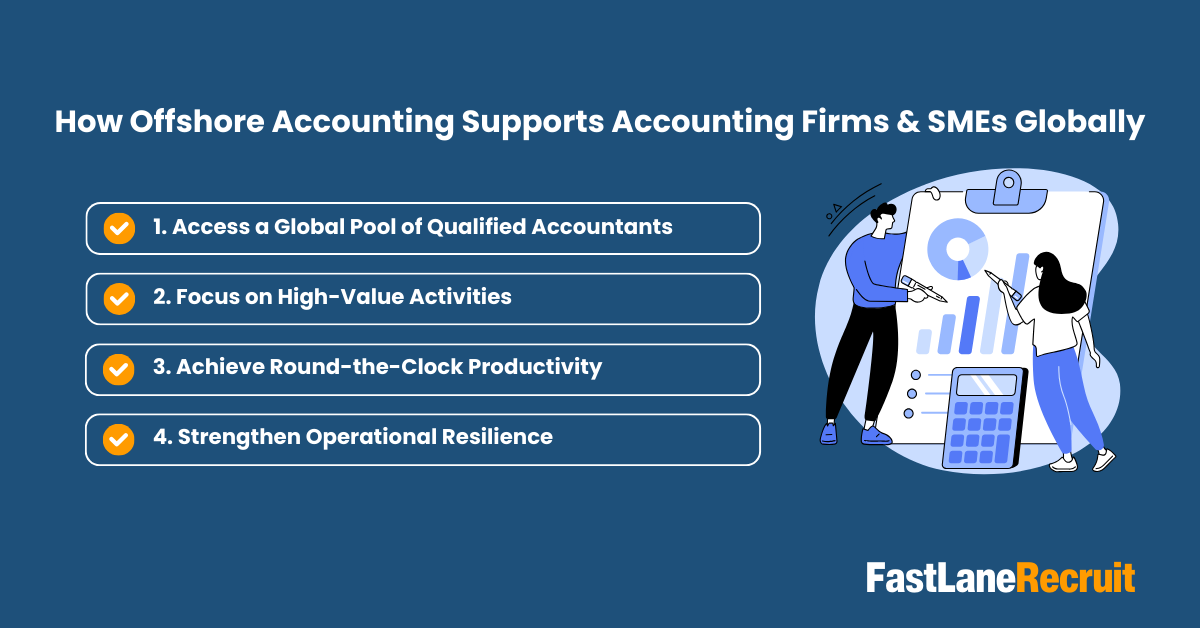
Small and medium-sized accounting firms often face serious talent shortages and recruitment challenges, especially when trying to meet increasing client demands or maintain compliance with evolving regulations. Offshore accounting services, like partnering with Malaysian accounting teams, offer an effective solution. Here’s how:
1. Access a Global Pool of Qualified Accountants
Offshore accounting provides access to professionals with both local and international expertise. These accountants are trained to handle complex compliance standards, tax regulations, and financial reporting requirements across multiple regions.
Example: A UK-based accounting firm serving clients in Asia and Europe hires a Malaysian accountant with ACCA certification. This professional is familiar with both Malaysian tax laws and international accounting standards, enabling the firm to manage cross-border client accounts efficiently without hiring multiple specialists locally.
2. Focus on High-Value Activities
By offloading routine tasks, such as bookkeeping, payroll processing, and accounts reconciliation, to offshore teams, in-house staff can focus on activities that directly contribute to business growth. These high-value activities include:
- Advisory services for clients
- Strategic business planning
- Developing new client relationships
- Enhancing financial analysis and insights
Example: An Australian accounting firm delegates accounts payable and receivable to a Malaysian team. Their in-house accountants now have more time to consult with clients on tax strategy and investment planning, increasing client satisfaction and retention.
3. Achieve Round-the-Clock Productivity
Time zone differences can be leveraged to your advantage. Work assigned at the end of one business day can be completed overnight by offshore teams, ensuring reports, reconciliations, and analyses are ready for review the following morning.
Example: A US-based SME submits invoices to their Malaysian accounting team at the end of the day. The team completes reconciliation and generates reports overnight, so the company has real-time financial insights first thing in the morning, reducing turnaround times for decision-making.
4. Strengthen Operational Resilience
Offshore accounting adds flexibility and stability to a firm’s operations. Even during peak periods, talent shortages, or sudden workload spikes, offshore teams provide a scalable solution without overburdening in-house staff. This reduces the risk of errors, delays, or burnout.
Example: During tax season, a Canadian accounting firm expands its offshore team in Malaysia to handle the increased volume of tax filings. The firm maintains service quality and meets deadlines without hiring temporary local staff, saving time and resources.
Why It Matters
Offshore accounting is far more than a cost-saving measure. It’s a strategic tool for growth, client satisfaction, and operational resilience. By leveraging highly skilled offshore accountants, firms can deliver faster, more accurate services, enhance client trust, and focus on initiatives that drive long-term business success.
Also Read: Building a High-Performing Offshore Accounting Team in Malaysia (Australia Edition)
Tips for a Successful Offshore Accounting Partnership
Partnering with an offshore accounting team can be a game-changer, but success depends on choosing the right partner and establishing clear processes. Here are some tips to ensure your offshore collaboration runs smoothly:
1. Choose Certified Providers
Prioritise candidates with relevant credentials (e.g., ACCA/CPA/CIMA where applicable) and validate experience against the work you’re delegating (month-end close, audit support, tax schedules, AP/AR controls). These credentials demonstrate that the accountants are trained to meet high professional standards and understand global compliance requirements.
Example: A UK accounting firm hires a Malaysian accountant with ACCA certification. The accountant quickly navigates both UK and Malaysian tax regulations, ensuring accurate filings for cross-border clients without needing additional training.
2. Evaluate Technology & Security
Make sure your offshore partner uses secure, modern accounting platforms and automated systems. This helps maintain data accuracy, confidentiality, and compliance with regulations. Security measures such as encryption, access controls, and secure cloud storage are essential.
Example: A Canadian SME uses a Malaysian team for payroll processing through a cloud-based accounting system. The platform encrypts employee salary data, reducing the risk of data breaches while allowing real-time collaboration.
3. Prioritize Proactive Communication
Open, consistent communication is key to avoiding misunderstandings and ensuring deadlines are met. Schedule regular updates, use clear reporting structures, and maintain an open dialogue for questions or clarifications.
Example: An Australian accounting firm holds weekly video calls with their Malaysian team to review financial reports, clarify outstanding items, and plan upcoming tasks. This keeps both teams aligned and reduces errors.
4. Assess Industry Expertise
Different industries have unique accounting and compliance requirements. Your offshore partner should have experience with your sector to ensure accurate reporting and regulatory adherence.
Example: A healthcare company partners with a Malaysian accounting team experienced in healthcare accounting standards and patient data compliance, ensuring reports meet both local and international regulations.
5. Define Clear Roles & Responsibilities
Clearly outline who is responsible for which tasks, expected deliverables, and performance metrics (KPIs). Structured agreements prevent confusion, improve accountability, and set expectations for both teams.
Example: A US-based firm defines KPIs for their Malaysian team, such as “process all vendor invoices within 24 hours” and “complete monthly reconciliations by the 5th of each month.” This ensures accountability and smooth workflow.
Why It Matters
A strong offshore partnership is built on trust, expertise, and clear processes. Following these tips helps businesses maximize efficiency, maintain compliance, and focus on growth, while minimizing risks and operational challenges.
Also Read: Types Of Accounting Services That Can Be Outsourced
Simplify Global Accounting with FastLaneRecruit’s EOR Service
Building an offshore accounting team in Malaysia can be a strategic advantage, but managing employment, payroll, and compliance across borders can be complicated. That’s where FastLaneRecruit’s Employer of Record (EOR) Service comes in.
With FastLaneRecruit, you can hire Malaysian accountants without setting up a local entity. FastLaneRecruit manages employment, payroll, and statutory compliance, while you manage day-to-day work output and performance.
- Payroll and Benefits Management: Ensure timely salary payments and statutory benefits compliance.
- Legal and Tax Compliance: Navigate Malaysia’s labor laws, tax regulations, and social security requirements effortlessly.
- HR and Administrative Support: Onboard talent, manage contracts, and provide day-to-day HR services.
Example: A US-based accounting firm wants to hire a team of accountants in Malaysia. Instead of setting up a local branch or navigating complex employment laws, they use FastLaneRecruit’s EOR service. Within days, the firm has a fully compliant, ready-to-work team handling bookkeeping, AP/AR, and reporting, allowing the local team to focus on advisory and client services.
Why It Matters:
FastLaneRecruit lets you focus on growth and strategy while we handle compliance, payroll, and employment logistics. Your business gets the operational flexibility, efficiency, and expertise of an offshore accounting team without the administrative headache.
Take the next step: Partner with FastLaneRecruit today and start building a high-performing offshore accounting team in Malaysia that supports your global growth.
Conclusion
Malaysia offers a unique combination of skilled talent, regulatory know-how, and operational flexibility, making it a strategic hub for businesses seeking offshore accounting support. By leveraging Malaysian finance professionals, companies can enhance efficiency, maintain compliance, scale seamlessly, and focus on growth.
For businesses ready to tap into Malaysia’s accounting expertise without the complexity of managing offshore employment, FastLaneRecruit’s EOR Service provides a structured route to hire compliantly in Malaysia. If you want to build a dedicated offshore accounting team, FastLaneRecruit can map the right hiring model and onboarding process.
Discover how FastLaneRecruit can help you build your offshore accounting team today.
