
Software outsourcing has become one of the most strategic ways for global businesses to scale efficiently, reduce costs, and tap into specialized IT expertise. Among the leading destinations, the Philippines has built a strong reputation for offering skilled, English-proficient software developers who serve multinational enterprises and growing startups alike.
But the Philippines is not the only country businesses should consider. Malaysia is also emerging as a high-value outsourcing hub, offering competitive talent, cost advantages, and strong government support for the tech sector.
In this guide, we will explore the top software outsourcing companies in the Philippines, what to consider when choosing an outsourcing partner, and why Malaysia might be an even better option for hiring software developers through FastLaneRecruit.
Content Outline
Key Summary
The Philippines Leads Asia’s Software Outsourcing Scene
The Philippines remains one of the most trusted destinations for software outsourcing, offering skilled, English-proficient developers and cost savings of up to 60% compared to Western markets.
Global-Ready Companies with Proven Expertise
Top firms like MicroSourcing, Eastvantage, and ThinkBIT Solutions have earned international recognition for delivering end-to-end software development, cloud integration, and digital transformation services.
Outsourcing Goes Beyond Coding
Philippines outsourcing providers act as long-term partners managing full software lifecycles from planning and design to maintenance and support, allowing businesses to scale efficiently.
What to Look for in a Partner
Evaluate each company’s technical expertise, client case studies, scalability, and compliance standards (like ISO 27001 and PEZA accreditation) before committing to long-term outsourcing.
Malaysia Is the Rising Star in Tech Outsourcing
While the Philippines excels in IT-BPO and software services, Malaysia is emerging as a competitive alternative with multilingual developers, strong government support through MDEC, and cost-efficient talent for fintech, AI, and cybersecurity projects.
Hybrid Teams Deliver the Best Results
Many global businesses now combine Philippine and Malaysian outsourcing teams — balancing cost, skill diversity, and cultural alignment for better collaboration and innovation.
Simplify Global Hiring with FastLaneRecruit
Through FastLaneRecruit’s Employer of Record (EOR) services, companies can legally hire and manage Malaysian software developers without setting up a local entity ensuring compliance, payroll efficiency, and faster scaling.
Ready to Build Your Offshore Software Team?
If you’re expanding your tech capacity in Asia, partner with FastLaneRecruit to access Malaysia’s top software developers and streamline your global workforce management all in one place.
What Do Software Outsourcing Companies Do?
Software outsourcing companies provide businesses with dedicated technology expertise without the need to hire full-time, in-house employees. Their role goes beyond just coding; they serve as long-term strategic partners that help companies reduce costs, access specialized skills, and scale quickly.
Here’s what they typically offer:
| Service | What It Means | Example |
| Custom Software Development | Building tailored applications, platforms, or tools based on client needs | Developing a mobile app for an e-commerce brand |
| IT Staff Augmentation | Supplying skilled developers or teams to work alongside your in-house staff | Hiring a remote frontend developer in Malaysia |
| End-to-End Project Management | Managing the full lifecycle of software projects (design, development, testing, deployment, support) | Delivering a complete cloud-based HR platform |
| Maintenance & Support | Providing bug fixes, updates, and ongoing technical support | 24/7 monitoring for financial services applications |
| Specialized Solutions | Expertise in areas like AI, cloud computing, cybersecurity, or blockchain | Blockchain development for fintech startups |
| Advisory & Consulting | Guiding digital transformation strategies and tech adoption | Helping SMEs migrate to the cloud securely |
Example: A U.S. startup might outsource mobile app development to a Philippine or Malaysian software outsourcing firm. This allows them to launch faster, reduce costs by up to 60%, and access top-tier developers who can scale as the business grows.
Tip: Businesses should clearly define their scope (e.g., full project outsourcing vs. hiring individual developers) before choosing a provider. This ensures they select a company that aligns with their growth strategy.
Also Read: Why Malaysia Is a Premier Destination for Offshore Cybersecurity Talent in APAC
Top Software Outsourcing Companies in the Philippines
Below are the ten most reputable and established software outsourcing companies that have made their mark both locally and globally.
1. MicroSourcing
Headquarters: Manila
Overview:
MicroSourcing is one of the largest and most trusted outsourcing providers in the Philippines. The company specializes in software development, IT services, and business process solutions for global clients.
Why They Stand Out:
- ISO-certified operations
- Scalable teams with expertise in Java, .NET, PHP, and mobile app development
- Serves Fortune 500 clients and fast-growing startups alike
2. Eastvantage
Headquarters: Taguig City
Overview:
Eastvantage offers end-to-end software development, DevOps, and cloud integration services. They are known for their agile teams and European-managed service delivery.
Key Strengths:
- Offices in the Philippines, Belgium, and India
- Strong experience in fintech, SaaS, and enterprise software
- PEZA-accredited and GDPR-compliant
3. The Remote Group
Headquarters: Angeles City
Overview:
The Remote Group delivers tailored outsourcing solutions, including full-stack development, UI/UX design, and quality assurance. Their flexible staffing model makes them a go-to for startups.
Why Clients Choose Them:
- Rapid hiring and onboarding
- Experienced remote teams with time zone flexibility
- Expertise in cloud-based app development and testing
4. ConnectOS
Headquarters: Mandaluyong City
Overview:
ConnectOS combines technology and talent to support businesses in software development, IT infrastructure, and digital transformation.
Key Highlights:
- Focus on building dedicated offshore teams
- Seamless integration with client systems
- Known for transparent pricing and high retention rates
5. Syntactics, Inc.
Headquarters: Cagayan de Oro
Overview:
Syntactics, Inc. has over two decades of experience providing software, web, and IT solutions. They serve SMEs and enterprises globally, with an emphasis on personalized service.
Strengths:
- Custom software development and web apps
- Microsoft-certified professionals
- Recognized by the DTI as a leading IT solutions provider
6. Diffco
Headquarters: Cebu City
Overview:
Diffco specializes in enterprise software and mobile app development. They bring Silicon Valley experience to Philippine outsourcing, offering top-tier innovation with local cost benefits.
Why They’re Notable:
- Expertise in AI, blockchain, and automation
- Works with global startups and enterprise clients
- Strong focus on scalable and secure software systems
7. Mugna Technologies
Headquarters: Cebu City
Overview:
Mugna Technologies is known for creative software solutions and user-focused design. Their multidisciplinary team handles everything from UI/UX to backend development.
Key Offerings:
- Web and mobile app development
- Startup incubation support
- Experienced team in modern frameworks like React, Node.js, and Flutter
8. ThinkBIT Solutions
Headquarters: Quezon City
Overview:
ThinkBIT Solutions is an ISO 27001-certified software company providing full-cycle development, QA, and project management services.
Strengths:
- Experienced in game development and enterprise software
- Focus on quality assurance and cybersecurity
- Recognized by Clutch as one of the top IT service providers in Asia
9. Big Outsource
Headquarters: Laguna
Overview:
Big Outsource provides dedicated software teams for clients across the U.S., UK, and Australia. They’re well-known for flexible engagement models and affordable pricing.
Why They’re a Trusted Choice:
- End-to-end project management
- Cost-efficient offshore software development
- Excellent communication and cultural compatibility
10. NTT DATA Philippines
Headquarters: Makati City
Overview:
Part of Japan’s NTT Group, NTT DATA is a global IT and software powerhouse with a strong Philippine presence. They provide enterprise-level software development, systems integration, and IT consulting.
Key Strengths:
- Deep expertise in ERP and large-scale enterprise systems
- CMMI Level 5 certification
- Global clientele across banking, healthcare, and government sectors
Comparison Table: Top Software Outsourcing Companies in the Philippines
| Company | Location | Core Services | Best For |
| MicroSourcing | Manila | Software Dev, IT Services | Large enterprises |
| Eastvantage | Taguig | DevOps, SaaS | Mid-to-large companies |
| The Remote Group | Angeles | Web & Mobile Dev | Startups |
| ConnectOS | Mandaluyong | IT Infra, Software | Dedicated teams |
| Syntactics, Inc. | Cagayan de Oro | Custom Software | SMEs |
| Diffco | Cebu | AI, Automation | Tech startups |
| Mugna Technologies | Cebu | UI/UX, Apps | Creative firms |
| ThinkBIT Solutions | Quezon City | Enterprise Software | Gaming & IT firms |
| Big Outsource | Laguna | Full-cycle Dev | Cost efficiency |
| NTT DATA | Makati | Enterprise IT | Global corporations |
Also Read: The Ultimate Checklist for Hiring a Cybersecurity Analyst in Malaysia
Tip: Before selecting a software outsourcing company, always review verified ratings on platforms like Clutch or DesignRush. These directories provide detailed client reviews that can help you evaluate a firm’s reliability, communication style, and delivery standards.
Summary Table
Here’s a breakdown of some of the most reputable outsourcing providers in the country:
| Company | Specialty | Strengths | Target Clients |
| Accenture Philippines | Enterprise IT & Consulting | Large-scale digital transformation | Fortune 500 firms |
| Cognizant | Cloud, AI, Test Automation | 50,000+ employees in PH | Global enterprises |
| IBM Philippines | Hybrid Cloud & AI | Longstanding presence since 1937 | Multinationals |
| Infosys Philippines | Digital Transformation & App Dev | Strategic Asia-Pacific hub | Corporates & large businesses |
| Arcanys | Agile Dev Teams | Swiss-owned, based in Cebu | Startups & tech companies |
| Global BrainForce | Remote IT Teams | Dutch-managed | SMEs & scale-ups |
| Outsourced.ph | BPO & Staff Augmentation | Dedicated IT staff | SMEs to corporates |
| 1902 Software | Web, Mobile & E-commerce | Danish-managed | EU & AU clients |
| Exist Software Labs | IoT, Blockchain, Agile Dev | Innovation-driven | Finance & healthcare |
| Pointwest Innovations | Custom Enterprise Solutions | Data analytics & IT consulting | Financial institutions |
Also Read: Guide to Hiring Cybersecurity Talent in Malaysia
Factors to Consider When Choosing a Software Outsourcing Partner
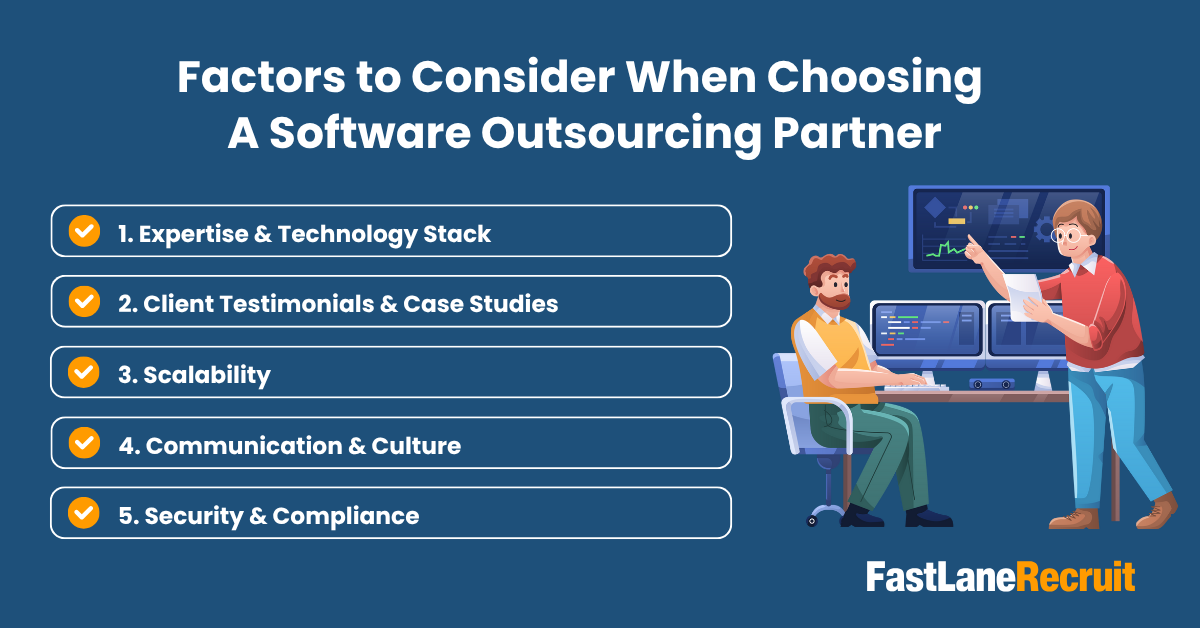
Selecting the right software outsourcing company is a strategic decision that impacts not just project delivery but also your long-term growth. While cost savings are a major benefit, businesses should also focus on quality, reliability, and alignment with business goals. Below are the key factors to evaluate, along with examples for easier understanding:
1. Expertise & Technology Stack
Not every outsourcing company has expertise in the same tools, programming languages, or platforms. For example, some firms specialize in mobile app development (using Swift, Kotlin, or React Native), while others are strong in enterprise solutions (using Java, .NET, or cloud platforms like AWS and Azure).
Example: If your company wants to build an AI-powered chatbot, you’ll want to partner with a company that has proven experience in machine learning frameworks like TensorFlow or PyTorch. Choosing a partner that lacks these skills could result in delays, poor functionality, or higher long-term costs.
Tip: Always request a technical capability document or portfolio of past projects to verify if the provider can deliver the specific tech solutions you need.
2. Client Testimonials & Case Studies
A trustworthy outsourcing partner should be able to provide client references, case studies, or reviews on platforms like Clutch or DesignRush. These resources give insights into the provider’s track record, project success rate, and reliability.
Example: Suppose you’re a U.S. healthcare startup looking to outsource software development. If a company can show case studies where they successfully built HIPAA-compliant healthcare apps, that’s a strong indicator they understand your industry’s regulatory requirements.
Tip: Don’t just read case studies; ask to speak directly with a past or current client of the outsourcing company for honest feedback.
Also Read: How to Choose between Outsourced vs In-House Cybersecurity
3. Scalability
Your outsourcing needs may change over time. Some companies only provide a single developer or small team augmentation, while others can manage entire large-scale projects from end to end. Understanding their scalability helps ensure your provider can grow alongside your business.
Example: A fintech startup may begin by outsourcing just two developers to build a prototype. As the product gains traction, they may need to quickly scale to a team of 20 developers plus QA engineers. If the outsourcing partner lacks scalability, you may face costly and time-consuming vendor switches later.
Tip: Ask upfront whether the company can scale your team within 30–60 days if your business demands it.
4. Communication & Culture
Even with high English proficiency, cultural alignment plays a crucial role in avoiding misunderstandings and ensuring smooth workflows. Communication style, time zone differences, and work ethics should all align with your company’s processes.
Example: A U.S.-based e-commerce company working with a Philippine outsourcing partner will benefit from overlapping time zones (due to PH’s night shifts aligning with U.S. daytime). However, if communication tools (e.g., Slack, Jira, or Zoom) are not adopted properly, collaboration can still break down.
Tip: Start with a trial project (2–4 weeks) to evaluate how well the outsourcing team communicates and integrates with your existing team culture.
5. Security & Compliance
Data security is a top concern when outsourcing. Make sure your outsourcing partner complies with international security standards such as ISO 27001, GDPR (Europe), HIPAA (healthcare in the U.S.), or other industry-specific regulations.
Example: If you’re outsourcing software development for a fintech platform, you must ensure the provider follows PCI-DSS compliance for handling online transactions securely. Failing to do so could expose your company to data breaches or regulatory fines.
Tip: Always request information about the company’s data protection policies, disaster recovery plans, and access control systems. You may also consider signing a Non-Disclosure Agreement (NDA) before sharing any sensitive information.
Pro Recommendation:
When comparing outsourcing providers in the Philippines vs. Malaysia, check how they handle compliance and data security. Malaysia’s government, through MDEC (Malaysia Digital Economy Corporation), actively supports companies in adhering to global digital standards, making it an attractive option for industries with stricter regulations like finance, e-commerce, and healthcare.
Also Read: How to Successfully Outsource a Cloud Engineering Team
Why Consider Malaysia for Software Outsourcing Employees
While the Philippines has built a global reputation for IT outsourcing, Malaysia is emerging as a competitive and strategic alternative. Global companies are increasingly turning to Malaysia not only for its skilled software developers but also for its multilingual workforce, government-backed digital initiatives, and cost-efficiency.
Here’s a side-by-side comparison to better understand Malaysia’s advantages:
| Factor | Philippines | Malaysia |
| Language | High English proficiency | High English proficiency + multilingual abilities (Mandarin, Malay, Tamil, Cantonese), making it ideal for global teams and clients across Asia-Pacific |
| Cost Efficiency | Lower labor costs compared to Western markets | Comparable to the Philippines, often with added cost savings for certain roles (e.g., software engineers, data analysts) |
| Government Support | Strong IT-BPO policies supporting the outsourcing sector | Stronger emphasis on digital economy through MDEC (Malaysia Digital Economy Corporation), offering incentives for tech growth, AI, and cloud adoption |
| Tech Talent Pool | Large pool of IT professionals, focused on BPO and software outsourcing | Highly skilled graduates from top universities (University of Malaya, Multimedia University, etc.) with global exposure in AI, fintech, cloud engineering, and cybersecurity |
| Time Zone | GMT+8, suitable for Asia-Pacific collaboration | GMT+8 as well, but with stronger integration into ASEAN markets and better alignment with regional trade agreements |
Unique Advantages of Malaysian Software Outsourcing Employees
- Multilingual Talent for Global Communication
Malaysian employees are not only fluent in English but also commonly speak Mandarin, Malay, and Tamil. This makes them particularly valuable for companies targeting diverse markets across Asia (China, Singapore, India, etc.), where language plays a crucial role in communication and customer engagement.
Example: A U.S.-based fintech expanding into Southeast Asia can benefit from Malaysian developers who can collaborate effectively with clients in both English and Mandarin, reducing miscommunication risks. - Strong Government Support for the Digital Economy
The Malaysian government, through MDEC, actively promotes IT development, outsourcing, and digital transformation. Initiatives such as the Malaysia Digital initiative and tax incentives for technology adoption make the country attractive for outsourcing and global expansion.
Trusted Source: Malaysia Digital Economy Corporation (MDEC) outlines how Malaysia supports innovation in areas like cloud adoption, AI, and e-commerce ecosystems. - Skilled and Globally Exposed Talent
Malaysia produces thousands of IT and computer science graduates every year from internationally recognized universities. Many professionals also gain work exposure abroad before returning, bringing global best practices into local outsourcing projects.
Example: A European e-commerce business outsourcing to Malaysia may gain access to developers with prior experience working with EU data privacy standards (GDPR), making compliance easier. - Cost-Effective Yet High-Quality Services
Similar to the Philippines, Malaysia offers significant cost savings compared to Western markets. However, Malaysia is often seen as delivering a better balance of cost vs. skill specialization, particularly in high-demand areas like cybersecurity, data science, and fintech software development.
Example: A U.S. healthcare startup can outsource compliance-heavy software development to Malaysian teams at a fraction of U.S. hiring costs, while maintaining high-quality output aligned with HIPAA regulations. - Strategic Location in ASEAN
Malaysia’s location and close ties with Singapore, China, and other ASEAN markets make it an attractive outsourcing hub for companies looking to expand in Asia. Its time zone overlap with major financial hubs ensures smooth real-time collaboration.
Also Read: Cybersecurity Analyst Salaries in 2025
Why Malaysian Employees Stand Out
Malaysian employees are known for their:
- Technical expertise in software engineering, AI, and cloud computing.
- Multilingual communication skills, enabling cross-border collaboration.
- Adaptability, easily integrating into global teams and aligning with diverse business cultures.
- Problem-solving mindset, often praised by international employers for independent thinking and innovative solutions.
Pro Recommendation:
If your business is considering outsourcing in Asia, Malaysia offers a future-proof workforce with the right mix of cost efficiency, technical depth, and multilingual skills. By leveraging FastLaneRecruit’s Employer of Record (EOR) services, companies can legally hire Malaysian developers and software engineers without setting up a local entity, streamlining recruitment, payroll, and compliance.
Tips for Businesses Outsourcing Software Development
Outsourcing software development can unlock huge advantages, from cost savings to accessing global talent, but success depends on how you approach it. Below are actionable tips to help you get the most value out of your outsourcing strategy:
1. Start Small, Scale Later
Jumping into a long-term outsourcing contract without testing the waters can be risky. Instead, begin with a pilot project or small feature development to assess the outsourcing partner’s capabilities.
Example: If you’re building an e-commerce platform, start by outsourcing a shopping cart module or payment gateway integration. This way, you can evaluate the outsourcing team’s technical skills, communication style, and project management approach before committing to larger projects.
Tip: Treat the pilot project as a “trial run” and set clear KPIs (e.g., delivery time, code quality, bug rate).
2. Consider Hybrid Teams
A hybrid model, combining in-house employees with offshore staff, often provides the best balance of control and flexibility. This setup lets your internal team handle strategic tasks while your outsourced team covers execution-heavy development work.
Example: A U.S. SaaS company could keep its product managers and lead architects in-house while outsourcing backend developers and QA engineers to Malaysia or the Philippines. This ensures cost efficiency while maintaining direct oversight of core decisions.
Tip: Use collaboration tools like Jira, Slack, and GitHub to keep hybrid teams aligned, no matter the time zone.
3. Focus on Retention
High employee turnover in outsourcing can derail projects and increase costs. Long-term outsourcing success depends on retaining skilled developers who understand your product, processes, and culture.
Example: A fintech startup outsourcing to Asia may lose momentum if developers frequently change. To prevent this, some outsourcing firms offer dedicated teams who work exclusively on your projects, ensuring continuity.
Tip: Invest in building strong relationships with outsourced staff by recognizing achievements, providing career growth opportunities, and integrating them into your company culture (e.g., including them in team meetings and celebrations).
4. Leverage Employer of Record (EOR) Services
Hiring overseas talent directly often requires setting up a local legal entity, which can be expensive, time-consuming, and complex. An Employer of Record (EOR) service like FastLaneRecruit eliminates this barrier.
With EOR services, you can:
- Legally employ Malaysian software developers without creating a local subsidiary.
- Handle compliance, payroll, and HR administration seamlessly.
- Scale teams faster, focusing on product development instead of navigating labor laws.
Example: A European company wanting to hire 5 Malaysian developers could avoid the cost of registering a Malaysian entity by partnering with FastLaneRecruit. The developers are officially employed through FastLaneRecruit, but work full-time for the client — reducing risk and simplifying management.
Tip: If you plan to build a long-term remote development team, an EOR is the most efficient solution to manage compliance and reduce administrative overhead.
Conclusion
The Philippines remains a top destination for software outsourcing, offering a wide range of providers from large-scale enterprises like Accenture to specialized firms like Arcanys and Global BrainForce. However, for businesses looking to maximize cost savings, diversify their teams, and tap into a multilingual, highly skilled workforce, Malaysia is quickly becoming the smarter choice.
With FastLaneRecruit’s Employer of Record (EOR) services, you can hire top Malaysian software engineers seamlessly, handling payroll, compliance, and HR administration on your behalf. This allows you to focus on innovation while we manage the complexity of cross-border hiring.
Ready to Build Your Offshore Software Development Team?
Unlock global growth with FastLaneRecruit. Tap into Malaysia’s top software development talent and let us handle the complexities of hiring through our trusted Employer of Record (EOR) services. From compliance to payroll, we make offshore recruitment seamless, so you can focus on scaling your business.
Learn more about outsourcing Malaysian employees with FastLaneRecruit today.
