What’s the Difference and Which Do You Need?
Managing your business finances is more than just keeping records; it’s about understanding your numbers, making informed decisions, and planning for growth.
That’s where the difference between outsourced bookkeeping and outsourced accounting becomes important.
While these terms are often used interchangeably, they serve very different purposes. Understanding how they work and when to use each can help you build a stronger financial foundation and scale with confidence.
Content Outline
Key Summary
Bookkeeping vs Accounting
Bookkeeping records your daily financial transactions, while accounting interprets this data to provide insights, strategy, and financial guidance.
How They Work Together
Bookkeeping lays the foundation for accurate records; accounting builds on it to guide decisions, forecast growth, and manage financial risks.
Responsibilities of Outsourced Bookkeepers
Includes daily transaction recording, accounts payable/receivable, payroll processing, bank reconciliations, and generating basic financial reports.
Responsibilities of Outsourced Accountants
Focus on financial reporting, performance analysis, budgeting, forecasting, compliance, risk management, and strategic advisory.
When to Move Beyond Bookkeeping
Outsourced accounting becomes essential when your business grows, requires forecasting, expands into new markets, or faces audits, funding, or multiple revenue streams.
Benefits of Malaysian Offshore Talent
Skilled accountants and bookkeepers with international experience, strong English proficiency, knowledge of IFRS/GAAP, and support for different time zones.
Smart Scaling with FastLaneRecruit EOR
Hire dedicated offshore finance teams in Malaysia, stay compliant without setting up a local entity, retain control, and scale your finance function as your business grows.
Accounting and Bookkeeping: How They Work Together
You can think of bookkeeping and accounting as two parts of the same system; they work hand in hand to give you a complete picture of your business finances.
- Outsourced bookkeeping focuses on recording and organizing your financial data
- Outsourced accounting takes that data and turns it into insights, strategy, and decisions
A simple way to look at it:
- Bookkeeping tells you what happened
- Accounting tells you what it means and what to do next
You can think of bookkeeping as the foundation of a house, and accounting as the structure and design built on top of it. Without a strong foundation, everything else becomes unreliable.
What Is Outsourced Bookkeeping?
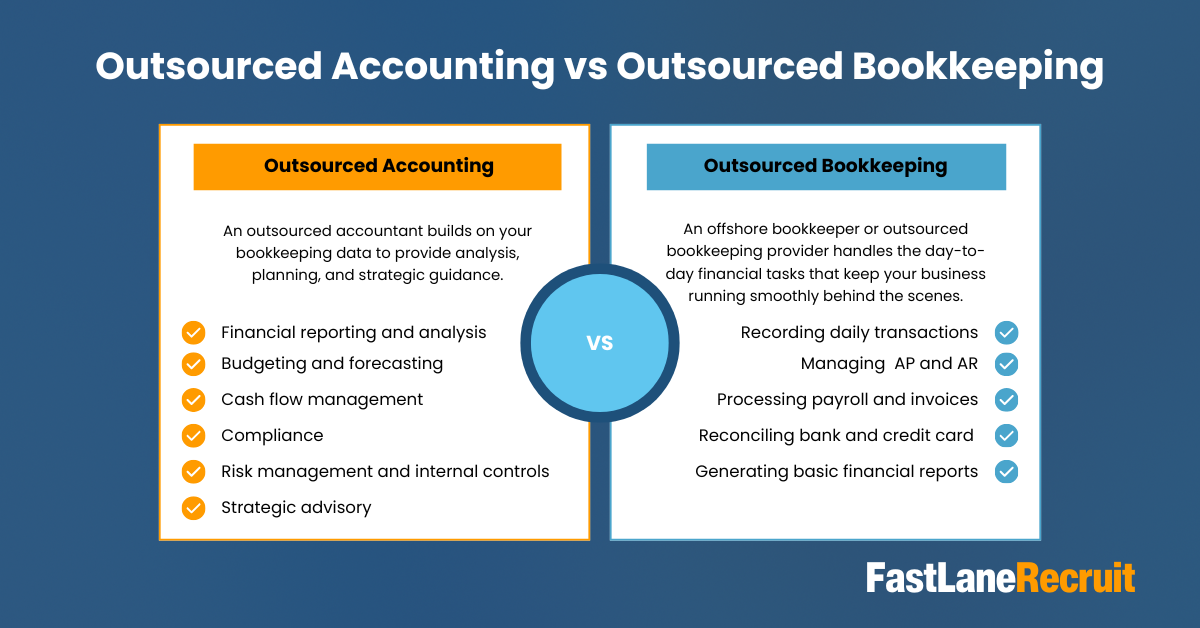
An offshore bookkeeper or outsourced bookkeeping provider handles the day-to-day financial tasks that keep your business running smoothly behind the scenes.
What does that look like in real life?
Let’s say you run an e-commerce business:
- Every sale, refund, and expense needs to be recorded
- Supplier invoices need to be tracked and paid
- Customer payments need to be matched correctly
- Your bank balance needs to match your records
That’s exactly where bookkeeping comes in.
Key Responsibilities of Outsourced Bookkeeping
- Recording daily transactions (sales, expenses, payments)
- Managing accounts payable and receivable
- Processing payroll and invoices
- Reconciling bank and credit card statements
- Generating basic financial reports (profit & loss, cash flow)
These tasks ensure your financial records are accurate, complete, and up to date, which is essential for reporting and compliance.
Many businesses use cloud-based tools like Xero or QuickBooks to make bookkeeping more efficient and give real-time visibility into their finances.
Simple Example of Bookkeeping
Imagine your business made:
- $10,000 in sales
- $4,000 in expenses
A bookkeeper will:
- Record all transactions correctly
- Categorize income and expenses
- Prepare a profit & loss report
At this stage, you know your numbers, but you may not yet know what they mean for your next move.
What Is Outsourced Accounting?
An outsourced accountant builds on your bookkeeping data to provide analysis, planning, and strategic guidance.
Instead of just recording numbers, they help you understand and use them.
Key Responsibilities of Outsourced Accounting
- Financial reporting and performance analysis
- Budgeting and forecasting
- Cash flow management
- Compliance with financial regulations and standards
- Risk management and internal controls
- Strategic advisory (e.g., expansion, investments, cost optimization)
What does this mean in practice?
Using the same example:
- You made $10,000 in sales and $4,000 in expenses
An accountant will go further and ask:
- Why did expenses increase this month?
- Are there areas where costs can be optimized?
- Is your pricing strategy working?
- Can your cash flow support hiring or expansion?
Real-World Example of Accounting in Action
Let’s say your business is growing quickly, but cash feels tight.
Your accountant might:
- Identify that too much cash is tied up in unpaid invoices
- Recommend improving your payment terms
- Create a forecast to predict future cash flow
- Help you plan hiring or expansion based on real data
This is where accounting becomes a decision-making tool, not just a reporting function.
Why Both Matter
Bookkeeping and accounting are not replacements for each other; they work best together.
- Without bookkeeping → your data is incomplete or inaccurate
- Without accounting → your data isn’t fully used to guide your business
Together, they help you:
- Stay compliant
- Understand your financial health
- Make confident business decisions
A Quick Summary
| Function | What It Does | Example |
| Bookkeeping | Records financial data | Logs sales and expenses |
| Accounting | Interprets financial data | Advises on growth strategy |
For compliance and reporting, businesses often follow standards set by organizations like the Financial Accounting Standards Board or the IFRS Foundation, ensuring financial data is accurate and consistent.
Also Read: Why Malaysia Is a Strategic Hub for Offshore Accountants
Outsourced Accounting vs Bookkeeping: Key Differences Explained
While outsourced bookkeeping and outsourced accounting are closely connected, they serve different purposes in your business. Understanding these differences helps you choose the right support at the right stage.
1. Primary Role
| Outsourced Bookkeeping | Outsourced Accounting |
| Records financial data | Analyzes and interprets data |
- An offshore bookkeeper focuses on capturing every transaction accurately, including sales, expenses, and payments.
- An offshore accountant looks at that data and explains what it means for your business.
Example:
A bookkeeper records that your expenses increased this month.
An accountant explains why they increased and whether it’s a concern.
2. Focus
| Outsourced Bookkeeping | Outsourced Accounting |
| Daily operations | Strategy and decision-making |
- Bookkeeping is about keeping things running smoothly day to day
- Accounting focuses on the bigger picture, planning and improving performance
Example:
Bookkeeping ensures invoices are sent and payments are tracked.
Accounting helps decide if you should expand into a new market.
3. Output
| Outsourced Bookkeeping | Outsourced Accounting |
| Financial records | Business insights and forecasts |
- Bookkeepers produce reports like profit & loss statements
- Accountants turn those reports into actionable insights
Example:
A bookkeeper gives you a monthly report.
An accountant uses that report to forecast next quarter’s revenue and expenses.
4. Level of Expertise
| Outsourced Bookkeeping | Outsourced Accounting |
| Operational | Analytical and advisory |
- Bookkeeping requires strong attention to detail and accuracy
- Accounting requires deeper expertise in analysis, compliance, and financial strategy
Many accountants follow standards set by organizations like the Financial Accounting Standards Board or the IFRS Foundation to ensure proper reporting and compliance.
5. Business Impact
| Outsourced Bookkeeping | Outsourced Accounting |
| Keeps finances organized | Drives growth and planning |
- Bookkeeping ensures your financial data is clean and reliable
- Accounting helps you use that data to grow your business and make informed decisions
Example:
Without bookkeeping, your numbers may be inaccurate.
Without accounting, you may miss opportunities to improve profitability.
6. Ideal For
| Outsourced Bookkeeping | Outsourced Accounting |
| Startups, simple operations | Growing or complex businesses |
- Businesses with straightforward operations can start with bookkeeping
- As complexity increases, accounting becomes essential
Example:
- A small online store may only need an offshore bookkeeper
- A scaling company with multiple revenue streams will benefit from outsourced accounting
Bringing It All Together
The difference between outsourced accounting vs bookkeeping is not about choosing one over the other, it’s about knowing when to use each.
- Start with bookkeeping to build a solid financial foundation
- Add accounting as your business grows and needs deeper insights
Many successful companies use both together, ensuring their financial data is not only accurate, but also actively supporting better business decisions.
Also Read: How to Hire an Offshore Accountant in Malaysia
When Do You Need More Than Bookkeeping?
Many businesses start with outsourced bookkeeping, and that’s completely normal. In the early stages, your main priority is keeping financial records accurate and organized.
But as your business grows, your financial needs become more complex. You’re no longer just tracking numbers; you’re trying to understand them, plan ahead, and make better decisions.
That’s when bookkeeping alone may not be enough.
Signs You Need Outsourced Accounting
Here are some common signs that it’s time to move beyond bookkeeping and consider outsourced accounting:
1. You Need Financial Forecasting or Budgeting
Bookkeeping tells you what has already happened.
Accounting helps you plan what comes next.
If you’re starting to think about:
- Setting revenue targets
- Managing future expenses
- Planning hiring or expansion
You’ll need forecasting and budgeting support.
Example:
You want to hire new employees but aren’t sure if your cash flow can support it. An accountant can create projections to guide your decision.
2. You’re Expanding into New Markets or Services
Growth often brings new financial complexity, different pricing models, currencies, or cost structures.
An offshore accountant can help you:
- Evaluate whether expansion is financially viable
- Plan for additional costs
- Monitor profitability across different markets
Example:
If you expand into another country, accounting support ensures you understand tax implications, pricing, and margins.
3. Your Reporting Requirements Are Increasing
As your business grows, stakeholders may expect more detailed and structured reports.
This may include:
- Monthly management reports
- Cash flow analysis
- Performance tracking
Many businesses align their reporting with standards set by organizations like the Financial Accounting Standards Board or the IFRS Foundation.
Example:
Your investors or leadership team may want insights into profitability by product or region, not just basic financial statements.
Also Read: Types Of Accounting Services That Can Be Outsourced
4. You’re Preparing for Audits, Funding, or Partnerships
High-stakes business events require more than accurate records, they require well-structured, reliable, and compliant financial data.
Outsourced accounting helps ensure:
- Financial statements are properly prepared
- Documentation is complete and organized
- You’re ready for due diligence
Example:
If you’re seeking investment or a business loan, lenders will expect clear financial analysis and projections, not just transaction records.
5. Your Business Has Multiple Entities or Revenue Streams
Managing multiple entities, departments, or income streams adds complexity to your finances.
An accountant can help:
- Consolidate financial data
- Track performance across different areas
- Ensure accurate reporting
Example:
If you operate in multiple regions or offer different services, accounting helps you understand which areas are most profitable.
6. You Need Better Financial Visibility for Decision-Making
If you often find yourself asking:
- Why is cash flow inconsistent?
- Where are we overspending?
- How can we improve margins?
These are questions that bookkeeping alone cannot answer.
Accounting provides:
- Data analysis
- Insights into trends
- Recommendations for improvement
Why This Shift Matters
At a certain point, relying only on bookkeeping can limit your ability to grow effectively.
- Bookkeeping keeps your records accurate
- Accounting helps you use those records to make smarter decisions
When your business reaches this stage, outsourced accounting becomes essential, not just for managing finances, but for supporting sustainable growth and reducing operational risk.
Also Read: Offshore Vs Local: Accountants 2025 Salary Benchmark Report (Australia Vs Malaysia Edition)
The Value of Outsourced Accounting (Beyond Cost)
Outsourced accounting typically involves a broader scope, which reflects the value it delivers.
Why Businesses Invest in Outsourced Accounting
- Access to experienced professionals (controllers, advisors)
- Stronger financial controls and compliance
- Better forecasting and planning
- Improved decision-making through data insights
- Reduced operational cost compared to building a full in-house team
For example, staying compliant with tax and reporting obligations, such as those outlined by the Internal Revenue Service, requires more than just accurate records. It requires interpretation, oversight, and expertise.
Outsourcing Globally: Why Businesses Choose Malaysian Offshore Talent
As businesses grow and operate across borders, many are turning to offshore accountants and offshore bookkeepers to build finance teams that are both scalable and efficient.
Instead of relying solely on local hiring or traditional outsourcing firms, companies are increasingly tapping into global talent pools to access skilled professionals while maintaining flexibility and control.
Malaysia has become one of the preferred destinations for outsourcing finance functions and for good reason.
Why Malaysia Is a Strong Outsourcing Destination
1. Skilled Accounting Professionals with Global Experience
Malaysia has a well-developed talent pool of accounting professionals trained in international practices. Many have experience working with global clients across industries such as e-commerce, technology, professional services, and manufacturing.
This means businesses can rely on offshore teams to handle everything from outsourced bookkeeping to more advanced outsourced accounting functions with confidence.
2. Strong English Proficiency and Communication
Clear communication is essential when managing financial data.
Malaysia is widely recognized for its strong English proficiency, making it easier for global businesses to:
- Collaborate with offshore teams
- Discuss financial reports and insights
- Align on processes and expectations
This reduces miscommunication and helps ensure smooth day-to-day operations.
3. Familiarity with International Standards (IFRS & GAAP)
Malaysian accounting professionals are well-versed in global standards such as those set by the IFRS Foundation and the Financial Accounting Standards Board.
This is especially important for businesses that:
- Operate internationally
- Require standardized financial reporting
- Work with global investors or stakeholders
Having a team that understands these frameworks helps ensure consistency, accuracy, and compliance.
4. Strong Professional Ecosystem and Governance
The accounting profession in Malaysia is supported by established regulatory and professional bodies such as the Malaysian Institute of Accountants.
These organizations help maintain:
- Professional standards
- Ethical practices
- Ongoing training and certification
For businesses, this adds an extra layer of confidence when working with offshore talent.
5. Ability to Support Different Time Zones and Business Models
Malaysia’s strategic location allows offshore teams to support businesses across:
- North America
- Europe
- Asia-Pacific
This flexibility enables:
- Faster turnaround times
- Extended business hours
- Continuous workflow across regions
For example, a company in the US can have financial data updated overnight, ready for review the next business day.
What This Means for Your Business
By leveraging Malaysian offshore talent, businesses can:
- Build a reliable and skilled finance team
- Scale operations without heavy overhead
- Maintain high-quality financial reporting and compliance
- Free up internal resources to focus on growth
In short, outsourcing to Malaysia is not just about efficiency; it’s about creating a smarter, more scalable finance function that supports long-term business success.
Also Read: Building a High-Performing Offshore Accounting Team in Malaysia (Singapore Edition)
Outsourced Accounting vs Bookkeeping: Which One Is Right for You?
Choose Outsourced Bookkeeping If:
- Your business operations are straightforward
- You need help managing daily transactions
- You want to maintain accurate financial records
- You’re in the early stages of growth
Choose Outsourced Accounting If:
- You need financial strategy and insights
- Your business is scaling quickly
- You require compliance and reporting support
- You want to improve financial performance and planning
In many cases, businesses benefit from both working together.
Example: Scaling with Offshore Support
| Business Stage | Recommended Support |
| Startup | Offshore bookkeeper for daily transactions |
| Growing Business | Add outsourced accounting for reporting and planning |
| Expansion Stage | Full accounting support + financial strategy |
This approach ensures your financial operations grow alongside your business.
Beyond Outsourcing: A Smarter Way to Build Your Finance Team
Traditional outsourcing can help your business access skilled finance professionals quickly, but it’s not the only way to scale your team.
If your goal is more control, greater flexibility, and long-term scalability, you need a solution that combines the efficiency of outsourcing with the strategic oversight of in-house hiring.
Build Your Offshore Team with FastLaneRecruit’s EOR Service
FastLaneRecruit’s Employer of Record (EOR) service allows businesses to hire dedicated offshore accountants and bookkeepers in Malaysia without the hassle of setting up a local entity.
Here’s how it works and why it’s smarter than traditional outsourcing:
1. Hire Dedicated Offshore Accountants and Bookkeepers
With FastLaneRecruit, you can hire professionals who work exclusively for your business, rather than being shared resources in a third-party firm.
Benefits include:
- Focused attention on your financial operations
- Better alignment with your business goals
- Stronger team culture and communication
Example:
Instead of outsourcing payroll processing to a general firm, your dedicated offshore accountant becomes an integral part of your finance team, handling payroll, reporting, and compliance according to your specific processes.
2. Stay Fully Compliant Without Setting Up a Local Entity
Operating in another country often comes with complex legal and regulatory requirements. FastLaneRecruit handles local employment, tax compliance, and labor regulations on your behalf, so you don’t have to:
- Avoid legal risks
- Simplify payroll and benefits administration
- Ensure your team is fully compliant with Malaysian laws
3. Retain Full Control Over Your Team and Processes
Unlike traditional outsourcing, where a firm controls workflows and priorities, the EOR model lets you:
- Direct your team’s daily activities
- Implement your preferred financial processes and software
- Align the offshore team with your company culture and goals
Example:
You can have your offshore bookkeeper using Xero or QuickBooks exactly the way your internal finance team operates, ensuring seamless integration with your systems.
Also Read: Building a High-Performing Offshore Accounting Team in Malaysia (Hong Kong Edition)
4. Scale Your Finance Function as Your Business Grows
As your company grows, your offshore team can grow with you. You can:
- Add more accountants or bookkeepers as needed
- Expand responsibilities to include forecasting, budgeting, and advisory
- Maintain a consistent workflow without the delays of recruiting locally
This approach combines the efficiency of outsourcing with the control and loyalty of an in-house team without the administrative headaches of setting up a foreign entity.
Why This Approach Works Better Than Traditional Outsourcing
| Traditional Outsourcing | FastLaneRecruit EOR Model |
| Shared team across multiple clients | Dedicated team for your business |
| Limited control over workflows | Full control over processes and priorities |
| Fixed service packages | Flexible roles tailored to your needs |
| Dependent on third-party timelines | Aligned with your business schedule and strategy |
| Minimal integration with internal systems | Seamless integration with your tools and culture |
With FastLaneRecruit, you’re not just outsourcing tasks; you’re building a finance team that supports growth, ensures compliance, and drives strategic insights.
Tips for Choosing the Right Financial Support
- Start with clear goals (compliance, growth, cost optimization)
- Evaluate your current financial complexity
- Look for scalable solutions that grow with your business
- Ensure your partner understands global compliance standards
- Consider long-term flexibility, not just short-term needs
Also Read: Building a High-Performing Offshore Accounting Team in Malaysia (Australia Edition)
Conclusion
Understanding the difference between outsourced accounting vs bookkeeping is key to building a strong financial foundation.
- Bookkeeping keeps your records accurate and organized
- Accounting turns those records into insights that drive growth
As your business evolves, your financial needs will too. The right combination of bookkeeping and accounting support ensures you’re not just tracking your numbers but using them to move forward with confidence.
Ready to Build Your Offshore Finance Team?
If you’re exploring outsourced accounting or outsourced bookkeeping, consider a more flexible approach.
With FastLaneRecruit’s EOR service, you can hire skilled offshore accountants and offshore bookkeepers in Malaysia without the need to set up a local entity.
Start building a scalable, compliant, and high-performing finance team today. Contact us for a FREE consultation.