

Your website is the face of your business online, so having a weak website isn’t an option. But building high-performing web apps in-house can be time-consuming and expensive. That’s why many businesses choose to outsource web development. Outsourcing can accelerate your launch timelines, improve cost efficiency, and give you access to experienced developers around the world.
In this guide, we break down how outsourcing works, why it’s a smart growth move, and how to pick the right team for your business.
Content Outline
Key Summary
What is Web Development Outsourcing
Outsourcing means hiring external developers or agencies to build, maintain, or enhance websites and web apps, covering everything from design to backend coding.
Benefits of Outsourcing
Outsourcing speeds up projects, improves cost efficiency and operational flexibility, provides access to global talent, and offers flexibility to scale teams as needed.
Types of Services Offered
Outsourced teams handle front-end/back-end engineering, UI/UX design, QA testing, API integration, CMS setup, and ongoing maintenance.
Why Startups and Established Companies Outsource
Startups use outsourcing for MVPs and technical gaps; established companies outsource to experiment, reduce workload, and access specialized skills.
Step-by-Step Outsourcing Process
Define project goals, shortlist vendors using established directories such as Clutch and GoodFirms, review case studies, assess cultural fit, and start with a small engagement.
Best Practices for Success
Set clear specifications, agree on milestones, use collaboration tools, prioritize security, and document decisions to ensure smooth project delivery.
FastLaneRecruit’s EOR Advantage in Malaysia
Hire Malaysian developers without setting up a local entity. FastLaneRecruit’s EOR handles payroll, compliance, and HR, allowing you to scale your team efficiently and legally.
What Is Outsourcing Web Development?
Outsourcing web development refers to hiring an external agency or freelance development team to build, enhance, or maintain your website or web application. Instead of relying solely on an internal team, businesses delegate the technical work to specialists who already have the skills, tools, and experience to deliver high-quality digital products.
This approach can cover a wide range of services, including:
End-to-End Web Development
The outsourcing partner manages the full lifecycle of your project, from initial planning and design to development, testing, and launch.
Front-End and Back-End Engineering
- Front-end development focuses on everything users see and interact with, such as layouts, visuals, and page interactions.
- Back-end development powers the behind-the-scenes systems that handle data, security, and server operations.
Also Read: Best Countries to Outsource Web Development Services
UI/UX Design
Design specialists create intuitive, user-friendly interfaces that improve navigation and overall user experience.
Quality Assurance (QA) Testing
QA engineers test the website or application to identify bugs, security vulnerabilities, and performance issues before it goes live.
API Development and Integration
Developers build or integrate APIs to connect your website with other platforms such as payment gateways, CRMs, booking systems, or logistics tools.
CMS (Content Management System) Setup
Teams can build or customize CMS platforms like WordPress, Webflow, or headless CMS solutions, allowing your staff to update content without technical expertise.
Ongoing Maintenance and Support
After the website or web app is launched, developers continue providing updates, bug fixes, performance improvements, and security monitoring.
Why Businesses Choose Outsourcing Over Hiring In-House
Hiring and maintaining a full-time internal development team requires significant resources, including recruitment, salaries, tools, and ongoing training. Outsourcing offers a more flexible and cost-effective alternative because it allows companies to:
- Scale development work up or down depending on project requirements
- Access specialized talent quickly without long hiring cycles
- Start projects faster with experienced teams
- Reduce operational and overhead costs
- Pay only for the services needed
For businesses building new digital products, revamping existing websites, or testing new ideas, outsourcing web development provides a practical and efficient way to achieve high-quality results.
Why Businesses Outsource Web Development
Outsourcing is more than a cost-saving tactic, it’s a growth strategy. Here are the biggest benefits:
1. Faster Time-to-Market
Industry studies suggest that experienced outsourced teams can significantly accelerate project delivery timelines. Outsourcing enables you to skip lengthy recruitment cycles and move straight into production.
2. Cost Savings
Businesses save significantly when they outsource web developers, especially to competitive markets in Asia or Eastern Europe.
Example Cost Comparison
| Region | Average Savings | Typical Hourly Rates (USD) |
| Southeast Asia (e.g., Malaysia, Vietnam) | 50–70% | $20–45/hr |
| Eastern Europe | 40–60% | $30–60/hr |
| Western Europe / U.S. | Minimal | $80–150/hr |
Indicative hourly ranges vary widely depending on role seniority, project scope, and market conditions.
3. Access to Global Talent
Outsourcing opens the door to specialists in:
- React, Vue, Angular
- Node.js, Python, Java
- CMS platforms
- API integrations
- DevOps and QA
This is especially valuable if local talent is scarce or expensive.
Also Read: How To Choose Between In-House or Outsourced Website Development
4. Reduced Operational Risks
Experienced outsourced teams often bring broad delivery experience across multiple projects and industries.They know the pitfalls and follow structured processes (Agile, SCRUM, CI/CD pipelines).
5. Flexibility and Scalability
Whether you need two developers or a full team of six, outsourcing lets you adjust your resources instantly.
6. Access to Long-Term Support
Most outsourcing partners offer ongoing maintenance, performance optimization, and security updates, crucial for business continuity.
When Should You Outsource Web Development?
For Startups
Typical situations include:
- You have a great idea but no technical team
- You need to build an MVP quickly
- You want to keep costs lean
- You lack certain skills internally (e.g., backend engineering, UI/UX)
Industry research frequently highlights team capability gaps as a common challenge for early-stage startups.
For Established Companies
Common reasons include:
- Experimenting with new digital products
- Seasonal or temporary project demands
- Offloading workload from internal teams
- Accessing niche expertise
Many enterprises outsource to test new markets or build internal prototypes without disrupting ongoing operations.
How to Outsource Web Development: A Practical Step-by-Step Process
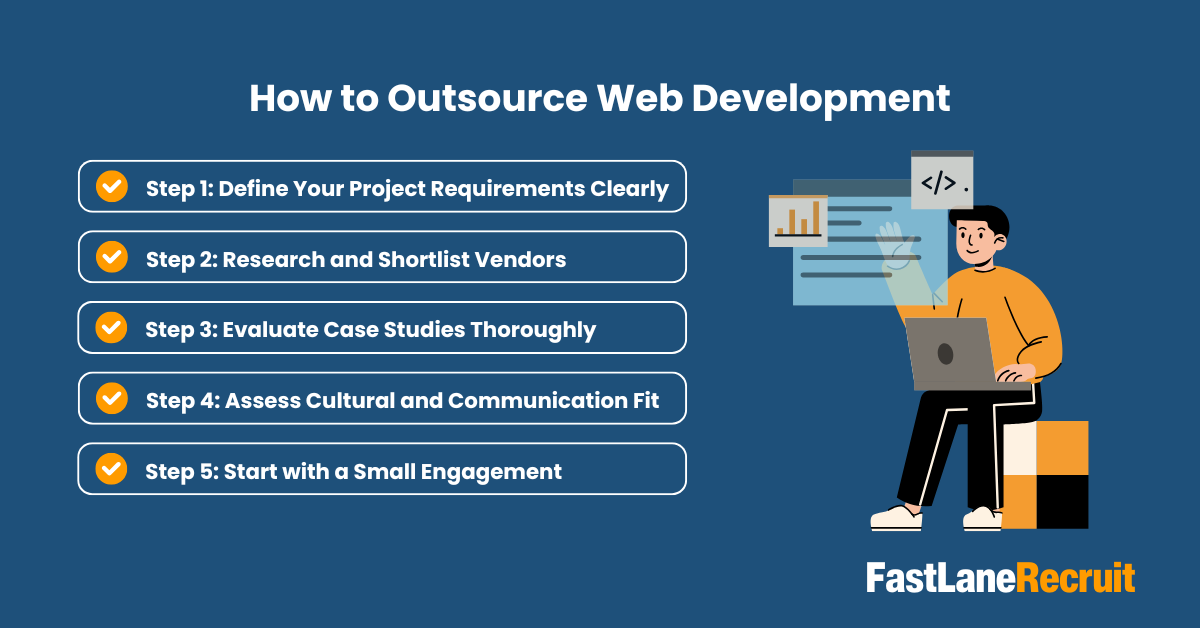
Outsourcing web development becomes significantly easier and less risky when you follow a structured framework. The steps below help ensure you choose the right partner, avoid hidden costs, and set your project up for long-term success.
Step 1: Define Your Project Requirements Clearly
Before talking to any vendor, take time to outline exactly what you want to build. This prevents miscommunication and ensures service providers can give accurate proposals.
Prepare the following:
- Project goals: What business problem are you trying to solve?
- Deliverables: Website, web app, admin panel, integrations, content, etc.
- Functional requirements: User login, payment gateway, booking system, dashboards, automation workflows.
- Preferred tech stack: For example, React, Node.js, Laravel, PHP, Shopify, or WordPress.
- Timeline: Start date, major milestones, expected completion.
- Budget range: Even a rough range helps vendors tailor realistic proposals.
A clearly defined project brief becomes the foundation of cost estimates, timelines, and resource planning.
Also Read: How to Effectively Manage Offshore Software Development Teams in Malaysia
Step 2: Research and Shortlist Vendors
Instead of picking the first agency you find on Google, use trusted directories and official registries to identify legitimate and experienced companies.
Where to look:
- Clutch – Industry-recognized reviews and ratings from verified clients.
- GoodFirms – A directory of global IT service providers with transparent feedback.
- Government registries – For example, Singapore’s ACRA business search or Malaysia’s SSM registry to verify company legitimacy.
- LinkedIn – Company pages, employee profiles, and activity insights.
Create a shortlist of three to five vendors that match your industry, budget, and project type.
Step 3: Evaluate Case Studies Thoroughly
Case studies reveal far more about a vendor than marketing websites or sales pitches.
Look for:
- Experience in your industry (e-commerce, SaaS, logistics, healthcare, education).
- Complex problem-solving that shows technical competency.
- Successful product launches with clear deliverables.
- Measurable outcomes, such as:
- Faster loading speed
- Higher conversion rates
- Increased user engagement
- Reduced operational costs
Strong case studies demonstrate that the vendor can deliver real business results, not just code.
Step 4: Assess Cultural and Communication Fit
Even the most technically skilled vendor can fail if communication is poor. Schedule introductory calls or discovery sessions to assess whether you can work effectively together.
Evaluate:
- Communication style: Clear, proactive, and transparent.
- Time-zone compatibility: Is there at least a few hours of overlap for meetings?
- Project management tools: Jira, Trello, Asana, Slack, or Notion.
- Responsiveness: Do they reply quickly and professionally?
- Problem-solving approach: Are they collaborative and open to suggestions?
The right partner should feel like an extension of your internal team.
Step 5: Start with a Small Engagement
Instead of committing to a large contract immediately, begin with a small, low-risk task such as:
- A UX/UI prototype
- A basic feature build
- A short sprint
- A code audit
- A technical roadmap
This pilot project allows you to assess:
- Work quality
- Communication speed
- Team reliability
- Project management discipline
- Technical capability
If the small engagement goes smoothly, you can confidently scale into a long-term partnership.
Also Read: How to Hire Full-Stack Developers in Malaysia
Tips & Best Practices for Successful Outsourcing
1. Create Clear Specifications
The clearer your requirements, the better the outcome.
2. Agree on Milestones
Use sprint planning, weekly check-ins, and milestone-based payments.
3. Use Collaboration Tools
Examples:
- Jira, Trello, Asana (task management)
- GitHub, GitLab (code)
- Slack, Teams (communication)
4. Prioritize Security
Request:
- NDA
- Secure development practices
- Data handling policies aligned with GDPR, PDPA, or local regulations
5. Document Everything
Avoid future confusion by documenting decisions, architecture, and workflows.
Example Scenario: Outsourcing to Malaysia
Malaysia has emerged as a highly attractive destination for web development outsourcing, offering a combination of cost-effectiveness, skilled talent, and a business-friendly environment. Some key reasons why companies choose Malaysia include:
Competitive Development Rates
Salaries for skilled developers in Malaysia are generally lower than in the US, Europe, or Australia, allowing businesses to access high-quality technical talent at a fraction of the cost of hiring locally.
Strong Technical Education
Malaysia produces a steady stream of graduates from engineering and IT programs, many of whom are trained in the latest technologies, programming languages, and software development best practices.
Widespread English Proficiency
English is widely spoken in Malaysia, which reduces language barriers and makes collaboration with international teams smoother and more efficient.
Government Support for Digital Industries
The Malaysian government actively supports the growth of its digital economy through initiatives like the Malaysia Digital Economy Blueprint (MyDIGITAL), providing incentives, infrastructure support, and regulatory guidance to tech companies and startups.
Also Read: Hiring Front-End Developer Teams in Malaysia
FastLaneRecruit’s EOR Service
For companies that want to hire Malaysian talent directly but prefer not to set up a local legal entity, FastLaneRecruit’s Employer of Record (EOR) service offers a seamless solution. With EOR, FastLaneRecruit becomes the legal employer for your team in Malaysia, handling all compliance, payroll, and HR requirements. This allows you to focus on managing your developers and projects while supporting compliance with local labour laws and employment regulations. It’s an efficient, compliant way to access talent in Malaysia without the administrative burden of establishing a local branch or subsidiary.
By combining Malaysia’s competitive advantages with FastLaneRecruit’s EOR service, businesses can scale their web development projects efficiently, access top-tier talent, and maintain compliance, all while avoiding the complexity of managing local employment logistics.
Also Read: Hiring App Developers in Malaysia
Conclusion
Outsourcing web development helps businesses build high-quality products faster, at a lower cost, and with access to global specialists. Whether you’re a startup launching an MVP or an established enterprise experimenting with new ideas, outsourcing gives you the flexibility and skills you need to grow in today’s digital economy.
And if you want to expand your team into Southeast Asia, especially Malaysia, without setting up a legal entity, there’s an even easier solution.
Hire Malaysian Tech Talent via FastLaneRecruit’s EOR Service
Instead of outsourcing an entire project, you can hire skilled Malaysian web developers directly through FastLaneRecruit’s Employer of Record (EOR) service, which allows you to:
- Legally hire talent in Malaysia without incorporating a company
- Ensure payroll, compliance, benefits, and tax are handled correctly
- Reduce hiring costs compared to other markets
- Build your own dedicated tech team while maintaining full control
Speak with our team to explore compliant web development hiring in Malaysia.
