
As businesses grow, managing people becomes more complex. Payroll deadlines, onboarding new hires, handling employee questions, and staying compliant with labor laws can quickly take up valuable time. For many organizations, these responsibilities slow down growth rather than support it.
This is where HR operations outsourcing comes in. By outsourcing HR operations, businesses can simplify day-to-day workforce management while staying compliant and focused on long-term goals. Instead of spending hours on administrative work, leaders gain the freedom to focus on strategy, innovation, and expansion.
In this guide, we’ll explain how outsourcing HR operations improves efficiency, what functions can be outsourced, and when an Employer of Record (EOR) can be a smarter alternative, especially when hiring talent in Malaysia or managing a global workforce.
Content Outline
Key Summary
Save Time and Boost Productivity
Outsourcing HR tasks like payroll, onboarding, and leave management frees internal teams to focus on strategic business goals.
Ensure Accurate and Consistent HR Processes
Specialized HR providers maintain standardized workflows, reducing errors in payroll, contracts, and statutory filings.
Strengthen Compliance and Reduce Risk
Outsourced partners stay updated on labor laws and regulations, minimizing legal issues and penalties.
Scale HR Operations Efficiently
HR outsourcing adapts to your company’s growth, easily managing additional employees and global teams.
Improve Employee Experience
Employees receive timely support, clear processes, and easy access to HR information through centralized systems.
Access Expert HR Knowledge
Gain professional guidance on policies, compliance, benefits, and employee relations without hiring full-time specialists.
Simplify Global Hiring with EOR Solutions
Combine HR outsourcing with an Employer of Record (EOR) to hire in countries like Malaysia without setting up a local entity.
What Is HR Operations Outsourcing?
HR operations outsourcing means working with a trusted external partner to handle the day-to-day HR tasks that keep your workforce running smoothly. Instead of managing everything in-house, businesses delegate these operational responsibilities to specialists who focus on accuracy, compliance, and efficiency.
This type of outsourcing supports the practical side of HR, not just planning or strategy. It helps ensure employees are paid correctly, onboarded properly, supported consistently, and managed in line with employment regulations.
How HR Operations Outsourcing Works
Imagine a growing company with 30 employees across different locations. Each month, the leadership team spends hours:
- Checking payroll calculations
- Managing leave requests
- Updating employee records
- Responding to HR questions
By outsourcing HR operations, the company hands these tasks to an external provider who manages them using established systems and experienced HR professionals. The internal team can then focus on growth, performance, and customer success.
Common HR Operations That Businesses Outsource
Here are the HR tasks most commonly handled by outsourcing providers, along with easy-to-understand examples.
1. Payroll Processing and Statutory Filings
This includes calculating salaries, processing payroll on time, and handling required contributions and filings with local authorities.
Example:
If you employ team members in Malaysia, an HR outsourcing partner ensures payroll is processed accurately and statutory contributions such as EPF, SOCSO, and income tax are handled correctly and submitted on time.
Also Read: Building a High-Performing Offshore HR and Payroll Management Team in Malaysia (Singapore Edition)
2. Employee Onboarding and Offboarding
Onboarding ensures new employees start smoothly, while offboarding ensures exits are handled professionally and compliantly.
Example:
When a new employee joins, the outsourcing partner prepares the employment contract, sets up payroll, and manages documentation. When someone leaves, they handle final payroll, benefits closure, and record updates.
3. Benefits Administration
This involves managing employee benefits and ensuring employees clearly understand what they are entitled to.
Example:
An HR outsourcing provider helps enroll employees in health insurance, manages leave entitlements, and answers questions such as “How many leave days do I have left?” or “When does my coverage start?”
4. HR Compliance and Documentation
Employment laws differ by country and change over time. Outsourcing partners help ensure all HR processes meet legal requirements.
Example:
If labor regulations are updated, your HR outsourcing partner updates contracts, policies, and internal processes to stay compliant, without your team needing to track every regulatory change.
5. Time Tracking and Leave Management
This includes managing working hours, overtime, public holidays, and different types of leave.
Example:
Employees submit leave requests through an HR system managed by the outsourcing provider, ensuring approvals, balances, and records are accurate and easy to track.
6. Employee Support and HR Helpdesk
Employees often have questions related to payroll, benefits, or policies. An HR helpdesk provides consistent support.
Example:
If an employee has a payroll question or needs clarification on leave policy, they contact the HR helpdesk instead of managers handling queries individually.
Summary Table: Commonly Outsourced HR Functions
Here’s a simplified overview of HR operations businesses often outsource and how it helps:
| HR Function | How Outsourcing Helps |
| Payroll & statutory filings | Ensures accurate, timely, and compliant payroll |
| Onboarding & offboarding | Creates a smooth and professional employee experience |
| Benefits administration | Provides clear, organized employee support |
| HR compliance & policies | Reduces legal and regulatory risk |
| Employee records & HR systems | Keeps data secure, organized, and up to date |
| HR support & employee queries | Delivers faster responses and consistent guidance |
Partial vs End-to-End HR Outsourcing
HR operations outsourcing is flexible and can be tailored to your business needs.
- Partial outsourcing:
You outsource only specific tasks, such as payroll or compliance support, while keeping other HR functions in-house. - End-to-end outsourcing:
The provider manages most or all HR operations, from onboarding to payroll and employee support.
Example:
A startup may outsource only payroll at first, while a growing global company may outsource all HR operations to maintain consistency across regions.
Also Read: Building a High-Performing Offshore HR and Payroll Management Team in Malaysia (Hong Kong Edition)
Why This Matters for Growing and Global Businesses
As teams grow or expand into new markets, HR complexity increases. HR operations outsourcing provides:
- Consistency across locations
- Reduced administrative burden
- Better compliance confidence
- More time for leadership to focus on growth
For businesses hiring internationally, such as building teams in Malaysia, HR operations outsourcing can also be combined with an Employer of Record (EOR) solution to manage legal employment responsibilities without setting up a local entity.
Benefits of Outsourcing HR Functions
Outsourcing HR functions is not just about reducing workload; it’s about creating smoother operations, better employee experiences, and stronger compliance. For growing and global businesses, HR outsourcing provides structure and support without the complexity of building a large internal HR team.
Below are the key benefits explained in a practical and easy-to-understand way.
1. Saves Time and Improves Productivity
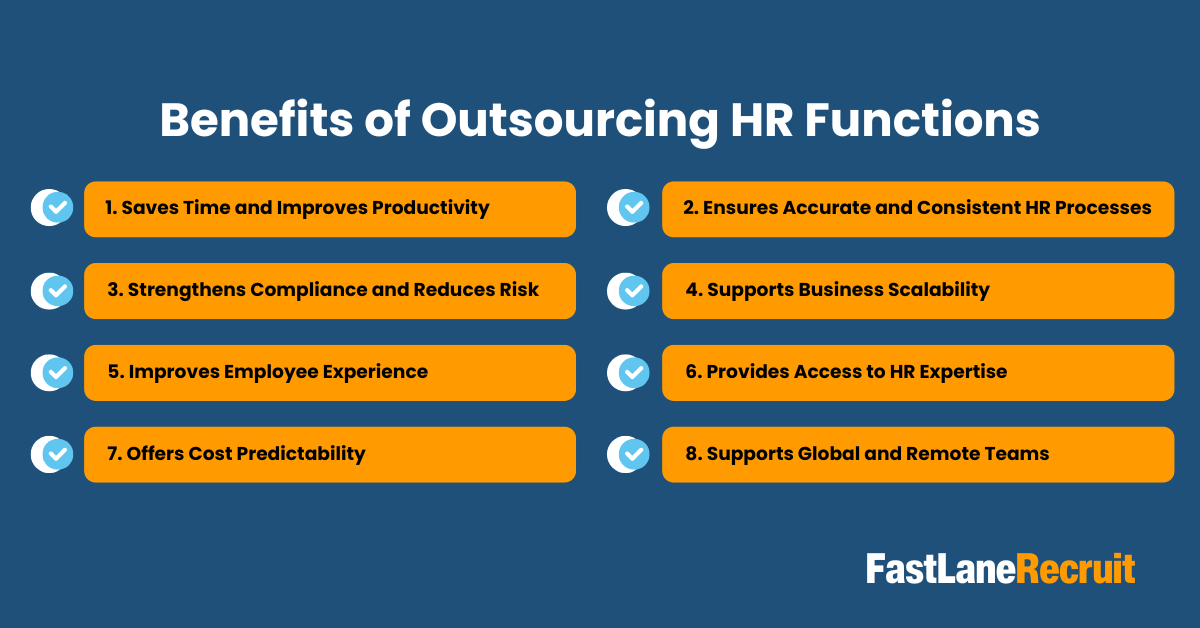
HR tasks such as payroll processing, documentation, and employee support can take up a significant amount of time. When these responsibilities are outsourced, internal teams can focus on activities that directly support business growth.
Example:
Instead of managers handling payroll questions or leave tracking, an HR outsourcing partner manages these requests, allowing leaders to focus on strategy and performance.
2. Ensures Accurate and Consistent HR Processes
HR functions require precision. Errors in payroll, contracts, or statutory filings can create employee dissatisfaction and compliance risks. Outsourcing partners use standardized processes and experienced professionals to ensure consistency.
Example:
Payroll is processed using established systems and review checks, reducing the risk of miscalculations or missed deadlines.
3. Strengthens Compliance and Reduces Risk
Employment laws and regulations change regularly, especially across different countries. HR outsourcing providers stay updated on regulatory requirements and help businesses follow correct practices.
Example:
When labor regulations are updated, the outsourcing partner updates HR policies and documentation to ensure ongoing compliance without additional effort from your internal team.
Also Read: Building a High-Performing Offshore HR and Payroll Management Team in Malaysia (Australia Edition)
4. Supports Business Scalability
As businesses grow, HR needs become more complex. Outsourcing HR functions makes it easier to scale operations without restructuring internal teams or systems.
Example:
If your company expands from 20 to 100 employees, the HR outsourcing provider adjusts payroll, onboarding, and HR support seamlessly to match your growth.
5. Improves Employee Experience
Employees benefit from clearer processes, timely responses, and better access to HR support. Outsourcing providers often offer employee self-service tools and dedicated HR helpdesks.
Example:
Employees can check leave balances, download payslips, or ask HR questions through a centralized platform instead of waiting for manual responses.
6. Provides Access to HR Expertise
Outsourcing gives businesses access to experienced HR professionals without hiring full-time specialists. This expertise supports better decision-making and smoother operations.
Example:
When handling sensitive issues such as employee relations or policy interpretation, businesses can rely on expert guidance from the outsourcing partner.
7. Offers Cost Predictability
HR outsourcing allows businesses to plan costs more clearly by paying for services based on actual needs rather than maintaining a full in-house HR team.
Example:
Instead of hiring multiple HR staff as the company grows, businesses can adjust outsourcing services as needed, keeping operations efficient and predictable.
Also Read: 2026 Hong Kong Salary Guide
8. Supports Global and Remote Teams
For businesses managing remote or international teams, HR outsourcing provides centralized processes and consistent employee support across locations.
Example:
A company with employees in different countries can manage payroll, leave, and HR documentation through one coordinated system, ensuring consistency across regions.
Factors to Consider Before HR Outsourcing
Outsourcing HR operations can bring major benefits, but choosing the right approach and partner is essential. Before making a decision, it’s important to step back and look at your business needs, growth plans, and workforce structure. The points below will help you evaluate HR outsourcing more clearly and confidently.
1. Assess Your Real HR Needs
Start by identifying which HR tasks take up the most time and create the most challenges for your team. Not every business needs to outsource everything.
Ask yourself:
- Are payroll and statutory filings causing delays or errors?
- Is onboarding inconsistent or time-consuming?
- Are managers spending too much time answering HR-related questions?
Example:
A growing company may handle recruitment well internally but struggle with payroll accuracy and compliance. In this case, outsourcing payroll and compliance support makes more sense than full HR outsourcing.
2. Check the Provider’s Compliance Expertise
Employment laws vary by country and are frequently updated. A reliable HR outsourcing partner should have strong knowledge of both local and international employment regulations.
Make sure the provider can:
- Keep up with labor law changes
- Handle statutory contributions and filings correctly
- Support compliance across multiple locations if needed
Example:
If you employ team members in different countries, your provider should understand country-specific requirements such as working hours, leave policies, and termination procedures.
Also Read: 2026 Singapore Salary Guide
3. Ask About HR Technology and Systems
Modern HR operations rely heavily on technology. Your outsourcing partner should offer clear, easy-to-use systems that improve visibility and accuracy.
Look for:
- Centralized HR platforms
- Employee self-service portals
- Payroll and leave tracking systems
- Clear reporting and data access
Example:
Instead of tracking leave manually, employees can submit requests through an online system managed by the outsourcing provider, reducing errors and back-and-forth communication.
4. Plan for Future Growth
HR needs change as your business grows. The right outsourcing partner should be able to scale services without disrupting operations.
Consider:
- Can the provider support additional employees easily?
- Are services flexible during hiring spikes or expansion?
- Can they handle multi-country or remote teams?
Example:
A business planning to double its headcount within a year should choose a provider that can expand payroll, onboarding, and HR support smoothly as the team grows.
5. Consider an Employer of Record (EOR) for Global Hiring
HR outsourcing helps manage operations, but it does not replace the need for a legal employer in another country. If you want to hire internationally without setting up a local entity, an Employer of Record (EOR) may be a better option.
An EOR:
- Becomes the legal employer on your behalf
- Manages payroll, contracts, tax, and compliance
- Reduces legal and operational risks
- Enables faster market entry
Example:
If you want to hire employees in Malaysia but do not have a registered local company, an EOR allows you to legally employ talent while focusing on business operations.
Final Tip
The best HR outsourcing decision is one that aligns with your current needs and your future plans. Some businesses start with partial outsourcing, while others combine HR outsourcing with an EOR solution for global expansion.
Taking the time to evaluate these factors helps ensure a smooth transition, better employee experience, and long-term operational efficiency.
Also Read: 2026 Australia Salary Guide
Example: Outsourcing Malaysian HR Operations Analyst for Global Teams
Global businesses expanding into Malaysia or managing remote teams often need skilled HR operations support without establishing a full local HR department. Hiring a dedicated HR Operations Analyst through outsourcing can streamline HR tasks, ensure compliance, and support employees efficiently across borders.
Why Malaysia Is an Attractive Location for HR Operations Analysts
Malaysia offers a talented workforce in fields like HR, finance, operations, technology, and customer support. Its professionals are well-educated, English-proficient, and experienced in handling structured HR processes. For global teams, this makes Malaysia an ideal location to outsource HR functions with efficiency and quality.
Responsibilities of a Malaysian HR Operations Analyst
Outsourcing an HR Operations Analyst allows your global team to benefit from a local expert who can handle tasks such as:
- Payroll processing and statutory filings
Ensures accurate salaries, deductions, and contributions for EPF, SOCSO, and EIS. - Employee onboarding and offboarding
Smoothly manages new hires, orientation, and exit procedures. - Benefits administration
Supports enrollment, claims, and employee inquiries. - HR compliance and policy documentation
Maintains alignment with Malaysia’s Employment Act and other labor regulations. - Time tracking, leave management, and HR reporting
Ensures accurate records for performance evaluation and operational decisions.
How an Outsourced HR Operations Analyst Supports Global Teams
Outsourcing this role brings efficiency, compliance, and scalability to international teams:
1. Manages Local HR Processes Efficiently
The analyst ensures all HR operations follow Malaysian labor laws and statutory requirements.
Example: Contracts, leave policies, and payroll schedules are correctly applied, reducing risk for the global business.
2. Provides Accurate Payroll and Compliance Support
A dedicated analyst ensures payroll, tax deductions, and statutory contributions are processed correctly each month.
Example: Monthly payroll includes correct EPF and SOCSO contributions, automatically generated and submitted without errors.
Also Read: 2026 Malaysia Salary Guide
3. Enhances Employee Support Across Borders
Employees in Malaysia can access HR support directly from the analyst, improving satisfaction and minimizing delays.
Example: Queries about benefits, leave, or payroll are handled quickly through a centralized helpdesk.
4. Enables Global Team Integration
An outsourced analyst bridges the gap between local HR operations and global business needs, helping teams align across locations.
Example: Global HR dashboards and reports provide managers with a real-time overview of headcount, leave, and compliance metrics.
When to Combine With an Employer of Record (EOR)
For companies without a Malaysian legal entity, combining an outsourced HR Operations Analyst with an Employer of Record (EOR) like FastLaneRecruit is a strategic solution. An EOR:
- Becomes the legal employer on your behalf
- Handles contracts, payroll, tax, and statutory compliance
- Supports smooth, risk-free hiring and onboarding
This approach allows your business to manage performance and strategy globally, while local employment responsibilities are fully handled in Malaysia.
When EOR Is a Better Alternative
For global businesses looking to hire employees in Malaysia without establishing a local legal entity, an Employer of Record (EOR) solution is often the smarter choice. An EOR acts as the official employer for your staff, handling all legal, compliance, and administrative responsibilities while you maintain control over day-to-day management and performance.
What an EOR Does
Partnering with an EOR offers several advantages for international companies:
- Becomes the legal employer on your behalf
The EOR holds all legal responsibilities for employment in Malaysia, allowing your business to hire talent quickly and compliantly. - Manages payroll, contracts, tax, and statutory compliance
Employees are paid on time with accurate statutory contributions such as EPF, SOCSO, and EIS, while employment contracts and tax obligations are fully compliant with Malaysian law. - Ensures employees are hired in line with local laws
From onboarding to termination, all processes adhere to the Employment Act and other relevant regulations. - Reduces compliance and operational risk
The EOR minimizes potential legal or administrative issues, letting your business focus on strategic growth rather than HR paperwork.
Real-World Examples
US Companies:
A US-based technology firm wanted to hire Malaysian HR Operations Analysts to support a global HR team. Using FastLaneRecruit’s EOR, they onboarded staff in Malaysia within weeks, ensured compliance with local laws, and integrated them seamlessly with the US team without setting up a Malaysian entity.
Singapore Companies:
A Singaporean financial services company needed payroll and HR specialists in Malaysia for a regional hub. FastLaneRecruit’s EOR service managed contracts, statutory filings, and benefits administration, allowing the Singapore HQ to focus on business strategy while Malaysian employees received full support and compliance assurance.
Why Businesses Choose FastLaneRecruit’s EOR
FastLaneRecruit provides a comprehensive solution for companies expanding into Malaysia:
- HR Operations Outsourcing: Delegate operational HR tasks like payroll, onboarding, and employee support.
- Talent Solutions: Access skilled professionals for finance, technology, operations, and HR roles.
- Employer of Record (EOR) Services: Hire Malaysian employees legally and efficiently without setting up a local entity.
For international companies, FastLaneRecruit’s EOR service offers a compliant, scalable, and efficient alternative to traditional HR outsourcing. You can hire Malaysian talent quickly, manage performance effectively, and focus on business outcomes, all while ensuring your operations meet local laws and regulations.
Also Read: Malaysia’s Employment Laws for System Administrators
Conclusion
Outsourcing HR operations is no longer just about saving time, it’s about building a smarter, more efficient business. From payroll accuracy and compliance support to scalable HR systems, outsourcing helps organizations stay focused on growth.
For companies hiring across borders or expanding into Malaysia, combining HR outsourcing with an Employer of Record solution provides even greater flexibility and peace of mind.
Ready to Hire in Malaysia Without a Local Entity?
Expanding your business into Malaysia doesn’t have to mean navigating complex legal requirements or setting up a local entity. With FastLaneRecruit’s Employer of Record (EOR) services, you can hire talented Malaysian HR Operations Analysts quickly, compliantly, and efficiently.
Our EOR solution handles all employment responsibilities on your behalf, including:
- Payroll processing and statutory contributions (EPF, SOCSO, EIS)
- Employment contracts and legal compliance
- Benefits administration and HR support
- Onboarding and employee management
This allows your business to focus on performance, growth, and strategy while we take care of the administrative and compliance complexities.
Get Started Today – Partner with FastLaneRecruit and hire Malaysian HR talents with confidence.
