

Accurate data is the backbone of every modern business. From customer records and financial documents to CRM systems and reports, data entry plays a critical role in daily operations and long-term decision-making. However, managing large volumes of data internally can quickly become time-consuming and distracting for growing teams. That is why many global businesses are choosing to outsource data entry operations, not just to streamline processes, but to improve accuracy, scalability, and overall efficiency.
In this guide, we explore the key benefits of outsourcing data entry, practical use cases, tips for choosing the right model, and why Malaysian data entry clerks are increasingly trusted by international companies. We also introduce FastLaneRecruit’s Employer of Record (EOR) solution as a compliant alternative to traditional outsourcing.
Content Outline
Key Summary
Improve Operational Efficiency
Outsourced data entry teams use structured workflows, quality checks, and expertise to process data faster and more accurately, reducing errors and rework.
Focus on Core Business Activities
By delegating routine data entry tasks, internal teams can concentrate on strategic projects, customer engagement, analysis, and growth initiatives.
Flexible Scaling for Workload Changes
Outsourcing allows businesses to increase or decrease capacity based on seasonal demand, expansion, or project-based needs without hiring full-time staff.
Faster Turnaround and Global Coverage
With teams across time zones, outsourced providers can process data overnight, deliver updates faster, and support global operations efficiently.
Access Skilled and Trained Professionals
External data entry specialists are trained in accuracy, formatting, and large dataset handling, ensuring high-quality results across systems.
Maintain Data Quality, Security, and Compliance
Outsourcing partners implement validation processes, access controls, and align with international data protection standards like GDPR and PDPA.
Cost-Effective Resource Allocation and Risk Mitigation
Outsourcing reduces overhead costs for recruitment, training, and infrastructure while maintaining continuity during peak workloads or internal staff changes.
What Is Data Entry Outsourcing?
Data entry outsourcing is the practice of assigning data-related work to an external team instead of managing everything internally. Rather than using your in-house staff for repetitive administrative tasks, businesses partner with a specialised offshore or remote workforce to handle daily data processing activities.
These tasks typically include:
- Database and CRM updates
Keeping customer records, sales data, and system information accurate and up to date. - Document digitisation (paper to digital)
Converting physical documents such as contracts, forms, or records into searchable digital files. - Invoice, order, and form processing
Entering financial and operational data from invoices, purchase orders, and application forms into internal systems. - Audio and text transcription
Turning recorded conversations, meetings, or handwritten notes into structured digital text. - Data validation and cleansing
Reviewing data to remove duplicates, correct errors, and ensure consistency across systems. - Image and PDF data extraction
Extracting information from scanned documents, images, or PDFs and converting it into usable formats like spreadsheets or databases.
By outsourcing these time-consuming yet essential tasks, businesses can reduce administrative workload and allow internal teams to focus on higher-value activities such as analysis, customer engagement, and strategic planning. This approach helps improve overall efficiency while ensuring data is handled accurately and consistently.
Also Read: Recruiting Coordinator Salary Guide 2026
Key Benefits of Outsourcing Data Entry Operations
1. Improved Operational Efficiency
Outsourced data entry teams are trained to work quickly and accurately using structured workflows. They follow standard procedures and quality checks, which helps reduce errors and rework.
Example:
An e-commerce company processing thousands of daily orders can rely on an outsourced data entry team to update product, order, and inventory data efficiently, ensuring systems stay accurate without slowing down operations.
2. Better Focus on Core Business Activities
Data entry is necessary, but it is not strategic work. When internal teams no longer need to manage repetitive data tasks, they can focus on activities that support growth.
Example:
A marketing agency can allow its internal staff to focus on campaign planning and performance analysis, while an external team handles CRM updates and lead data entry.
3. Flexible Scaling Based on Workload
Workload volumes can change due to seasonal demand, company expansion, or short-term projects. Outsourcing allows businesses to increase or reduce data entry capacity without hiring or restructuring internal teams.
Example:
A retail business during peak sales periods can scale up its data entry support to manage higher order volumes, then scale back once demand stabilises.
4. Faster Turnaround Times
Many outsourced data entry teams operate across different time zones or extended hours. This makes it possible to complete tasks outside regular business hours and deliver updates faster.
Example:
A global company submits data at the end of its workday and receives updated reports the next morning, helping decision-makers act quickly.
5. Access to Skilled and Trained Professionals
Although data entry may appear straightforward, it requires attention to detail, consistency, and familiarity with business systems. Outsourced professionals are trained to handle large datasets and follow standardised formats.
Example:
A financial services firm benefits from trained data entry professionals who consistently follow structured templates and formatting rules for client and transaction records.
6. Consistent Data Quality and Accuracy
Dedicated data entry teams apply validation rules and multiple checks to ensure data accuracy. This reduces duplicate entries, missing information, and inconsistencies across systems.
Example:
A healthcare provider ensures patient records are accurately digitised and maintained, supporting smoother reporting and administrative processes.
7. Reduced Operational Costs
Outsourcing removes the need to manage hiring, onboarding, training, office space, and equipment for data entry roles. Businesses can optimise resources while maintaining service quality.
Example:
A growing startup avoids building an internal data entry team and instead partners with an external provider to support expansion without increasing overhead.
8. Improved Data Security and Compliance Awareness
Professional outsourcing providers follow strict data handling policies and align with recognised data protection standards. They implement access controls and internal safeguards to protect business information.
Example:
A company handling customer information works with a provider that follows international data protection frameworks, ensuring responsible data management practices.
Also Read: Employment Laws and Compliance for Hiring Recruitment Teams in Malaysia
9. Access to Technology Without Direct Investment
Outsourcing partners often use modern tools, automation, and software integrations to manage data efficiently. Businesses gain access to these systems without purchasing licences or infrastructure.
Example:
A logistics company benefits from automated data validation tools used by its outsourcing partner, improving accuracy without investing in new software.
10. Better Resource Allocation
Outsourcing allows companies to assign the right people to the right tasks. Administrative work is handled externally, while internal teams focus on strategy and decision-making.
Example:
A regional finance team spends more time analysing reports and forecasting, while an outsourced team manages data updates and reconciliation.
11. Risk Mitigation and Business Continuity
By distributing data entry tasks across specialised teams, businesses reduce reliance on a single internal group. This helps maintain operations during staff changes, peak workloads, or expansion.
Example:
If an internal team faces unexpected turnover, outsourced data entry support ensures operations continue smoothly without disruption.
When Should Businesses Outsource Data Entry?
Outsourcing data entry is not just about reducing workload. It is most effective when businesses want to improve efficiency, maintain data quality, and support growth without putting pressure on internal teams. Below are common situations where outsourcing data entry makes the most sense.
1. Handling Large Volumes of Structured or Unstructured Data
When businesses deal with large amounts of data on a regular basis, managing everything internally can become time-consuming and error-prone.
Examples of structured data:
- Customer records in CRM systems
- Sales reports and inventory data
- Financial transactions
Examples of unstructured data:
- Emails, scanned documents, and PDFs
- Images, handwritten forms, and audio files
Outsourcing ensures this data is processed accurately and consistently, even at high volumes.
2. Digitising Physical or Archived Documents
Many organisations still rely on paper-based or legacy records. Converting these into digital formats is essential for accessibility, compliance, and long-term storage, but it requires time and attention to detail.
Example:
A legal or financial firm digitising years of archived contracts and reports can rely on an outsourced data entry team to convert, organise, and validate documents efficiently without disrupting daily operations.
Also Read: How to Hire Recruiting Coordinators in Malaysia
3. Managing Recurring Administrative Workloads
Data entry tasks often repeat daily, weekly, or monthly. Over time, these tasks can take up a significant portion of internal staff time.
Examples include:
- Invoice and expense data entry
- Customer information updates
- Order processing and reporting
Outsourcing these recurring tasks allows internal teams to focus on higher-value responsibilities instead of routine administration.
4. Supporting Regional or Global Operations
Businesses operating across multiple regions must manage data from different markets, systems, and time zones. Coordinating this internally can be challenging.
Example:
A global company collecting data from regional offices can use outsourced data entry teams to standardise formats, update systems overnight, and ensure consistent reporting across locations.
5. Scaling Operations Without Increasing Internal Headcount
As businesses grow, data volumes often increase faster than internal teams can handle. Hiring full-time staff for data entry may not always be the most efficient solution.
Example:
A fast-growing company expanding into new markets can outsource data entry support to handle increased workloads while keeping internal teams lean and focused.
Summary
Outsourcing data entry is most effective when businesses need to manage growing data demands, maintain accuracy, and scale operations smoothly. It provides a flexible way to support daily operations while allowing internal teams to focus on strategic growth.
Why Choose Malaysian Data Entry Clerks?
Malaysia has become a trusted hub for global back-office and shared services operations. Many international companies choose Malaysian data entry professionals because they combine strong communication skills, technical capability, and a business-ready mindset.
Below are the key reasons why Malaysian data entry clerks are well-suited to support global businesses.
Strong English Proficiency
Malaysian professionals are widely recognised for their strong English language skills. English is commonly used in education, business communication, and professional environments.
Why this matters:
Clear communication reduces errors in data entry, ensures accurate interpretation of instructions, and supports smooth collaboration with international teams.
Example:
A global sales team can rely on Malaysian data entry clerks to accurately update CRM records, customer profiles, and reports without language barriers.
Experience with Global Business Standards
Many Malaysian professionals have experience working with multinational companies, shared service centres, and international clients. This exposure makes them familiar with global workflows, reporting formats, and documentation standards.
Why this matters:
Global businesses can integrate Malaysian data entry clerks into existing systems with minimal onboarding and fewer process adjustments.
Example:
Finance or operations teams benefit from consistent data formatting aligned with international reporting requirements.
Stable Business and Operating Environment
Malaysia offers a stable business environment with established infrastructure, professional employment practices, and long-term workforce availability.
Why this matters:
Businesses can plan long-term operations with confidence, knowing their data entry support team is reliable and sustainable.
Example:
Companies running ongoing data processing or documentation projects can maintain continuity without frequent workforce disruption.
Also Read: Malaysia’s Advantage for Building Offshore Recruitment Teams
Digital-Ready and System-Savvy Talent
Malaysian data entry clerks are comfortable using modern digital tools such as CRM systems, ERP platforms, cloud-based software, spreadsheets, and document management systems.
Why this matters:
This digital readiness allows businesses to integrate data entry teams quickly into their existing technology stack.
Example:
An organisation using cloud-based accounting or CRM software can onboard Malaysian data entry clerks without extensive technical training.
Compliance-Driven Mindset
Malaysia places strong emphasis on professional conduct and responsible data handling. Data entry professionals are trained to follow structured processes and internal controls.
Why this matters:
This mindset supports accuracy, accountability, and adherence to company policies, especially when handling sensitive business or customer information.
Supported by National Digital Initiatives
Malaysia’s digital workforce development is supported by national initiatives led by agencies such as Malaysia Digital Economy Corporation (MDEC). These programmes focus on strengthening digital skills, workforce readiness, and global competitiveness.
This ensures a steady pipeline of professionals equipped for digital and back-office roles.
Data Protection and Responsible Data Handling
Malaysia enforces the Personal Data Protection Act (PDPA), which provides a legal framework for responsible personal data management.
Why this matters:
Businesses can work with Malaysian data entry clerks knowing there is an established regulatory environment that supports data protection and privacy awareness.
Summary
Malaysian data entry clerks offer a strong combination of communication skills, digital capability, global business familiarity, and compliance awareness. For international companies, this makes Malaysia a reliable and strategic choice for building long-term data entry and back-office support teams.
Also Read: How Outsourcing Recruitment Coordination Streamlines Global Hiring
Tips for Outsourcing Data Entry Successfully
Outsourcing data entry can deliver strong results when it is planned and managed properly. The tips below help businesses avoid common challenges and build a smooth, long-term working relationship with their data entry team.
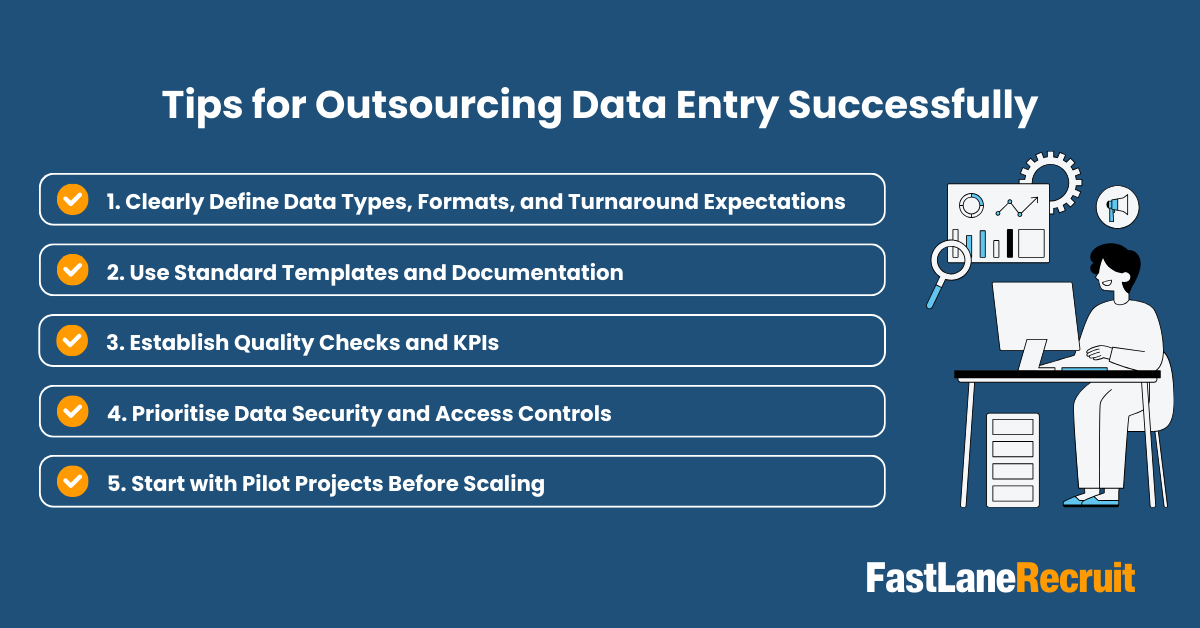
1. Clearly Define Data Types, Formats, and Turnaround Expectations
Before outsourcing, be specific about the type of data involved and how it should be handled. This includes file formats, naming conventions, and delivery timelines.
Why this matters:
Clear instructions reduce misunderstandings, rework, and delays.
Example:
Specify whether data should be delivered in spreadsheets, CRM systems, or databases, and confirm how often updates are required (daily, weekly, or real-time).
2. Use Standard Templates and Documentation
Providing standard templates, data fields, and written guidelines ensures consistency across all entries. This is especially important when multiple people are working on the same datasets.
Why this matters:
Standardisation improves accuracy and makes data easier to review and analyse.
Example:
Use predefined templates for invoices, customer records, or reports so every entry follows the same structure.
3. Establish Quality Checks and KPIs
Set clear performance standards to measure accuracy, timeliness, and consistency. Regular quality checks help maintain data reliability over time.
Why this matters:
KPIs provide visibility into performance and help identify issues early.
Example:
Track accuracy rates, turnaround times, and error resolution speed to ensure service quality remains consistent.
4. Prioritise Data Security and Access Controls
Data security should always be a priority. Limit access to sensitive information and ensure clear rules are in place for data handling.
Why this matters:
Strong access controls help protect business and customer data.
Example:
Grant system access only to authorised team members and review permissions regularly to reduce risk.
5. Start with Pilot Projects Before Scaling
Begin with a small project to test workflows, communication, and quality standards before expanding the scope of work.
Why this matters:
Pilot projects allow businesses to identify gaps, refine processes, and build trust before committing to long-term engagement.
Example:
Outsource a single data entry process first, review the results, and then gradually scale to additional tasks or higher volumes.
Also Read: The Ultimate Playbook for Building and Integrating Offshore Teams (Singapore Edition)
Summary
Successful data entry outsourcing depends on clear communication, standardised processes, quality monitoring, and a gradual approach to scaling. When these elements are in place, outsourcing becomes a reliable way to support operations and long-term growth.
Outsourcing vs EOR: A Smarter Alternative for Growing Businesses
Traditional outsourcing has long been used for short-term or transactional data entry tasks. It works well when businesses need quick support for one-off projects or fluctuating workloads. However, as companies grow and require greater control, consistency, and long-term planning, traditional outsourcing can present limitations.
This is where an Employer of Record (EOR) model becomes a strong and strategic alternative.
An EOR allows businesses to hire dedicated overseas talent while the EOR provider manages local employment responsibilities such as payroll, contracts, and compliance. This model combines the flexibility of outsourcing with the control of having an in-house team.
Key Differences: Traditional Outsourcing vs FastLaneRecruit EOR
| Aspect | Traditional Outsourcing | FastLaneRecruit EOR |
| Team control | Limited control over daily tasks and priorities | Full operational control over workload, processes, and performance |
| Compliance | Managed by the outsourcing vendor | Fully compliant local employment managed by FastLaneRecruit |
| Team integration | External team working separately | Data entry clerks work as part of your internal team |
| Scalability | Typically project-based or short-term | Designed for long-term workforce planning |
| Transparency | Varies by provider | High visibility, clear reporting, and accountability |
Why EOR Works Better for Long-Term Data Entry Needs
Greater Control and Visibility
With an EOR model, businesses manage daily tasks, priorities, and workflows directly. This provides better oversight compared to traditional outsourcing, where work is often handled through a vendor’s internal processes.
Example:
A company can assign tasks, track progress, and set quality standards directly with its data entry clerks, just like an internal team.
Stronger Team Integration
Under the EOR model, data entry professionals work as an extension of your organisation rather than as an external vendor team. This improves collaboration, communication, and alignment with company goals.
Example:
Data entry clerks can join internal meetings, follow company SOPs, and use the same systems as your core team.
Compliance Without Local Entity Setup
Hiring internationally can be complex due to local employment laws, payroll requirements, and regulations. An EOR handles these responsibilities on your behalf.
Example:
FastLaneRecruit manages employment contracts, payroll, and statutory requirements in Malaysia, allowing you to focus on operations without setting up a local company.
Better Scalability for Growing Operations
Unlike project-based outsourcing, EOR supports long-term workforce growth. Teams can scale gradually as data volumes increase, without changing operating models.
Example:
A growing business can start with one data entry clerk and expand the team over time as operations grow.
Higher Accountability and Transparency
Because data entry clerks are legally employed through the EOR, performance tracking, reporting, and accountability are clearer and more consistent.
Hire Malaysian Data Entry Clerks Through FastLaneRecruit EOR
With FastLaneRecruit’s Employer of Record (EOR) service, you can hire dedicated Malaysian data entry clerks legally and compliantly without establishing a local entity in Malaysia.
You maintain full operational control, while FastLaneRecruit manages employment, payroll, and compliance. This makes EOR an ideal solution for businesses looking for long-term, reliable data entry support with greater transparency and control than traditional outsourcing.
Conclusion
Outsourcing data entry operations allows global businesses to improve efficiency, maintain data accuracy, and focus on strategic growth. Whether through traditional outsourcing or a modern EOR approach, the right model can transform how businesses manage information at scale.
Malaysia stands out as a reliable talent hub for data entry operations, offering skilled professionals, strong governance, and global business alignment.
Looking for a Smarter Way to Build Your Data Entry Team?
If you want more control than traditional outsourcing offers, FastLaneRecruit’s Employer of Record (EOR) service provides a compliant, flexible alternative.
Hire dedicated Malaysian data entry clerks who work as an extension of your team while FastLaneRecruit manages payroll, compliance, and local employment requirements.
Explore FastLaneRecruit’s EOR solutions today and build your global data entry team with confidence.
