CPA firms today are dealing with rising salaries, fewer qualified staff, stricter rules, and higher client demands. Offshore accounting has evolved from a cost-cutting experiment into a strategic solution for scaling operations, maintaining quality, and improving profitability.
By hiring offshore accountants, firms gain access to highly qualified professionals at a fraction of costs, enabling 24/7 operations and flexible staffing during peak seasons. Offshore teams can integrate seamlessly into your workflows, tech stack, and client service model.
This guide breaks down everything CPA firms need to know about offshore accounting: why it works, which roles to delegate, how to evaluate vendors, and how to get started confidently.
Content Outline
Key Summary
What Is Offshore Accounting
Offshore accounting involves hiring qualified accountants in another country to handle tasks like bookkeeping, payroll, tax prep, and audit support while integrating seamlessly with your firm.
Tasks Suitable for Offshoring
Routine, repeatable, rules-based tasks, such as daily bookkeeping, payroll processing, and tax return preparation, are ideal for offshore teams. Strategic, sensitive, or client-facing work should remain in-house.
Top Offshore Destinations
India, the Philippines, Malaysia, Latin America, and Eastern Europe each offer unique advantages. Malaysia is emerging as a top choice for its skilled, English-proficient workforce, tech-savviness, and time zone alignment.
Choosing the Right Partner
Consider delivery models (dedicated vs. pooled), specific accounting experience, compliance certifications, operational maturity, and pilot projects to ensure quality and integration.
Cost Savings & ROI
Offshore accounting can reduce labor costs by 50–70% compared to domestic hires while freeing your in-house team for high-value advisory work, increasing client capacity and margins.
Integration & Operational Best Practices
Integrate offshore staff into workflows, accounting systems, and SOPs. Treat them as long-term team members, maintain multiple review layers, and scale strategically to maximize efficiency.
Future-Ready Offshore Accounting
Offshore teams are evolving with specialization, seamless tech integration, rising global compliance standards, and AI-powered tools, enabling firms to increase productivity, accuracy, and client satisfaction.
What Is Offshore Accounting?
Offshore accounting means hiring skilled accounting professionals based in another country to handle specific accounting tasks for your firm. These offshore accountants act as an extension of your team, following your processes, standards, and workflow, so they seamlessly integrate with your firm even while working remotely.
Tasks That Can Be Offshored:
- Bookkeeping: Recording daily transactions, reconciling accounts, and maintaining accurate financial records.
- Payroll: Calculating salaries, preparing payroll reports, and ensuring compliance with local labor regulations.
- Tax Preparation: Organizing and entering tax data, preparing returns, and supporting compliance tasks.
- Audit Support: Preparing workpapers, confirmations, and other documentation needed for audits.
- Internal Operations: Assisting with administrative tasks such as engagement letters, billing, data entry, and CRM management.
Key Benefits of Offshore Accounting:
- Cost Efficiency: Offshore professionals often cost 40–70% less than local staff, saving your firm on salaries, benefits, and overhead.
- Access to Global Talent: Tap into a broader pool of qualified accountants experienced with international standards and modern accounting tools.
- Scalability for Peak Workloads: Easily expand your offshore team during busy seasons without long-term commitments.
- Operational Continuity: Work can continue around the clock thanks to time zone differences, reducing delays and improving efficiency.
- Free Domestic Staff for Strategic Work: Allow your in-house team to focus on advisory, client-facing tasks, and business growth.
- Maintain Compliance & Security: Trusted offshore partners follow rigorous security standards like SOC 2, ISO 27001, and GDPR.
- Continuity Amid Talent Shortages: Offshore staff help meet deadlines and manage workloads without overburdening your domestic team.
Offshore accounting isn’t just about reducing costs; it’s about creating a flexible, efficient, and reliable team that empowers your firm to focus on higher-value work while keeping day-to-day financial operations accurate and consistent.
Also Read: Types Of Accounting Services That Can Be Outsourced
What Offshore Accountants Do
CPA firms can delegate many accounting functions offshore. These offshore accountants handle structured, repeatable work, freeing your in-house team to focus on high-value, client-facing tasks. Here’s a detailed breakdown of common service lines firms offload, along with ideal use cases and what to keep in-house:
| Function | Tasks to Offshore | Ideal For | Avoid Offshoring |
| Tax Preparation | Organizing and reconciling W-2s, 1099s, K-1s; entering data into tax software; drafting returns up to CPA review stage | High-volume 1040s and small business returns | Complex or high-risk returns that require legal strategy or sensitive client decisions |
| Bookkeeping & Client Accounting Services (CAS) | Daily transaction classification, bank/credit card reconciliations, monthly financial reporting, month-end close, dashboards | Firms offering monthly accounting packages or virtual CFO services | Client-facing advisory, strategic planning, or CFO-level decision-making |
| Payroll Support | Processing time and attendance data, entering payroll journal entries, preparing filing reminders | Multi-client payroll operations, white-label payroll services | Final submissions, payment authorizations, or any sensitive corrections |
| Audit & Compilation Prep | Rolling forward workpapers, drafting confirmations, preparing lead schedules, supporting documentation, performing basic audit procedures | Standardized audits and compilation work for repeat clients | Final fieldwork, material judgment calls, or direct client interactions |
| Entity Setup & Compliance | EIN applications, state filings, sales tax registration and returns, BOI reporting preparation | Clients with multiple entities, franchises, or real estate portfolios | Legal filings that require client signatures or highly specialized regulatory work |
| Internal Operations & Admin | Preparing engagement letters, CRM data cleanup, portal setup, billing support, managing deadlines and calendars | Any firm scaling operations or seeking operational efficiency | Sensitive client escalations, legal matters, or tasks requiring partner-level discretion |
Key Takeaways:
- Offshore accountants are best for repeatable, rules-based work that follows clear procedures.
- They help reduce operational burden on your in-house team, especially during busy periods.
- Tasks involving strategic judgment, legal responsibility, or client perception should remain in-house.
Top Offshore Destinations for CPA Firms
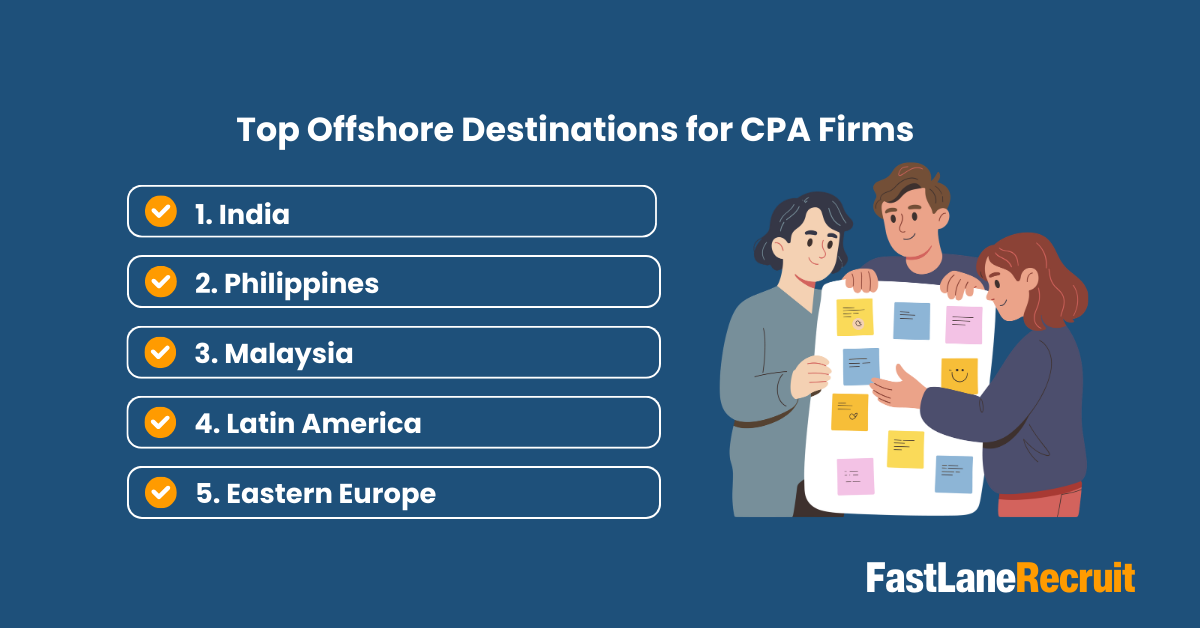
CPA firms today have multiple offshore options to choose from. Each region offers distinct advantages depending on your firm’s workflow, service lines, and management style. Understanding these differences helps you select the best location for your offshore accounting team.
1. India
- Strengths: India has a large, well-trained accounting talent pool familiar with U.S. GAAP and tax practices. The country has mature outsourcing firms with established SOPs, security protocols, and shift-based staffing models.
- Cost: Junior accountants typically cost $7–$12/hour, depending on skill and experience.
- Best Fit: High-volume, repeatable work like tax preparation, bookkeeping, audit prep, and standardized accounting processes. Firms benefit from India’s efficiency, documentation discipline, and cost-effectiveness.
2. Philippines
- Strengths: Known for excellent English communication, strong soft skills, and cultural alignment with the U.S., the Philippines is ideal for roles requiring interaction and real-time collaboration. Many accountants have experience with U.S. tax software and processes.
- Cost: Semi-senior staff usually charge $10–$18/hour.
- Best Fit: Client Accounting Services (CAS), hybrid roles that combine technical and communication requirements, and internal operations where strong verbal skills and time-zone flexibility matter.
Also Read: Why Malaysia Is a Strategic Hub for Offshore Accountants
3. Malaysia
- Strengths: Malaysia boasts a tech-savvy, highly educated workforce with strong English proficiency. The government offers incentives for foreign firms, and professionals are trained in accounting and finance with knowledge of U.S. compliance standards.
- Time Zone Alignment: Close alignment with U.S. work hours allows near real-time collaboration.
- Cost: Mid-to-senior accountants typically cost $10–$20/hour.
- Best Fit: Bookkeeping, payroll, tax prep, and CAS functions that require reliable communication, strong compliance knowledge, and seamless integration with U.S. teams. Malaysia is especially attractive for firms seeking a balance of cost, quality, and operational control.
4. Latin America
- Strengths: Countries like Mexico, Colombia, and Argentina offer shared working hours with the U.S., bilingual talent, and strong cultural compatibility. Nearshore teams make real-time collaboration easier.
- Best Fit: Firms engaging offshore for the first time, hybrid workflows needing live interaction, and roles where synchronous communication is essential.
5. Eastern Europe
- Strengths: Poland, Romania, and Ukraine provide professionals with strong technical, analytical, and documentation skills. Work culture tends to align with Western standards, and infrastructure supports secure remote operations.
- Best Fit: Specialized accounting tasks, international client engagements, and projects requiring EU/U.S. dual compliance. Ideal for firms that need highly technical staff with excellent attention to detail.
Key Takeaways:
- Choose a destination based on service type, team structure, communication needs, and cost expectations.
- Asia (India, Philippines, Malaysia) works well for volume-based, repeatable, and communication-sensitive tasks.
- Latin America is ideal for real-time collaboration, while Eastern Europe suits highly technical or specialized work.
- Malaysia is emerging as a prime hub for CPA firms seeking a balance of skill, cost, and timezone alignment.
Also Read: Offshore Vs Local: Accountants 2025 Salary Benchmark Report (Australia Vs Malaysia Edition)
How to Choose the Right Offshore Accounting Partner
Selecting the right offshore partner is critical for CPA firms. A poorly chosen vendor can create more work than savings, while a well-aligned partner can improve efficiency, reduce costs, and become a seamless extension of your team. Here’s a detailed guide on what to look for.
1. Delivery Model: Dedicated vs. Pooled Staffing
The delivery model defines how your offshore team will operate within your firm:
- Dedicated Teams: These accountants work exclusively for your firm. They use your systems, follow your procedures, and integrate fully into your workflows.
- Pros: Higher accountability, better quality, consistent knowledge retention, and long-term familiarity with your firm’s processes.
- Best For: Recurring tasks such as monthly bookkeeping, tax prep, or audit support.
- Pooled or Task-Based Staffing: Work is assigned to whichever offshore professional is available at the time.
- Pros: Quick access to additional resources during peak seasons, lower commitment.
- Watch Out For: Inconsistent quality, repeated onboarding for new staff, and less ownership of tasks.
- Best For: Overflow during tax season or large audit cycles.
Tip: Many successful firms use a hybrid model: a dedicated team for regular tasks and pooled staff for seasonal surges.
2. Specific Accounting Experience
Not all offshore accountants have expertise in your firm’s standards and workflows, so verifying their experience is essential:
- Relevant Tax & Accounting Knowledge: Confirm experience handling the types of returns or filings your firm manages, whether individual, business, or specialized accounts.
- Software Proficiency: Ask about familiarity with your preferred accounting software, such as QuickBooks, Xero, NetSuite, or any industry-specific tools.
- Client Experience: Review resumes for prior work with similar clients, industries, or accounting frameworks relevant to your operations.
- Regulatory & Compliance Awareness: Ensure they understand the rules and standards your firm follows, including local tax, payroll, and financial reporting requirements.
Tip: Prioritize vendors whose staff regularly handle clients and tasks similar to yours rather than a mix of unrelated international projects, this reduces retraining, errors, and workflow friction.
Also Read: Building a High-Performing Offshore Accounting Team in Malaysia (Singapore Edition)
3. Security & Compliance
Data protection is non-negotiable. Look for vendors with strong security and compliance protocols:
- Certifications: SOC 2 Type II, ISO 27001, GDPR compliance.
- Secure Infrastructure: Virtual desktops (VDIs), encrypted data storage, and secure file portals.
- Access Controls: Role-based permissions to ensure sensitive client data is protected.
- Audit Trails: Systems that log access and changes for accountability.
Tip: Ask for written security policies and examples of how the vendor handles sensitive information. If they cannot provide clear documentation, it’s a red flag.
4. Operational Maturity
A partner’s operational maturity indicates how efficiently they can integrate into your firm:
- SOPs and Playbooks: Look for documented procedures for onboarding, task execution, and quality control.
- Escalation Paths: Clear processes for resolving issues, including U.S.-based contacts for urgent matters.
- Onboarding Processes: Structured training for your specific workflows and software.
- Reporting Practices: Regular updates, task tracking, and progress metrics.
Tip: Operational maturity often matters more than a polished sales pitch. Check references and request sample workflows.
5. Pilot Projects
Before committing to long-term contracts, run a 2–4 week pilot with real work:
- Provide actual client files (with dummy data if needed).
- Assign tasks representative of your recurring processes (tax prep, bookkeeping, or audit prep).
- Define deadlines, communication expectations, and review criteria.
- Evaluate accuracy, responsiveness, and comfort with your tools.
Tip: A successful pilot reduces risk, builds confidence, and reveals gaps in training or communication.
Also Read: Building a High-Performing Offshore Accounting Team in Malaysia (Hong Kong Edition)
6. Specialization Over “Everything Shops”
Avoid vendors that claim they do everything:
- Offshore firms that promise all services, tax prep, bookkeeping, payroll, CFO advisory, and ESG reporting may lack depth in any one area.
- Choose partners who specialize in your specific practice area or workflow.
- Examples: U.S. CPA firms supporting CAS, audit prep, or small business tax.
- Specialization ensures quality, efficiency, and consistent output.
Tip: Ask vendors to clearly outline what they do not provide. This clarity often signals reliability and focus.
Key Takeaways:
- Decide whether a dedicated, pooled, or hybrid model works for your firm’s workflow.
- Verify U.S.-specific tax and accounting experience.
- Ensure data security and compliance through certifications and secure infrastructure.
- Evaluate operational maturity via SOPs, escalation paths, and reporting.
- Run pilot projects to test real tasks before scaling.
- Prioritize specialized vendors over “everything shops” for consistent quality.
Cost Considerations & ROI: Offshore vs. Domestic Accounting Staff
When evaluating offshore hiring, it’s important to compare the total cost and potential return on investment (ROI) against hiring domestic staff. Offshore teams, especially in Malaysia, can dramatically reduce expenses while increasing your firm’s capacity and efficiency.
| Comparison | U.S. Staff Accountant | Offshore (Malaysia) |
| Base Salary | $50K–$120K/year plus benefits | $12K–$45K/year, depending on experience and seniority |
| Overhead | Office space, software licenses, training, taxes, and benefits | Included via EOR or offshore vendor; no separate entity required |
| Savings | N/A | 50–70% of total compensation compared to domestic staff |
| ROI Potential | Limited by domestic labor capacity | Offshore staff frees domestic accountants to focus on high-value work, handle more clients, and improve turnaround times |
Best Practices for Implementing Offshore Teams
- Start with Repeatable Processes
Begin by offshoring standardized, rules-based tasks like bookkeeping, 1040 prep, bank reconciliations, or payroll. Avoid offshoring complex or high-risk client interactions initially. - Integrate Seamlessly
Align offshore staff with your existing workflows, accounting systems, and project management tools. Clear system integration ensures consistent quality and reduces errors. - Develop SOPs and Review Layers
Document processes, checklists, and task handoffs. Implement multiple review layers to maintain quality and ensure domestic staff can efficiently review offshore work without redoing tasks. - Treat Offshore Professionals as Long-Term Team Members
Invest in training, communication, and career development. Long-term engagement improves expertise, retention, and workflow continuity, increasing ROI over time. - Scale Strategically
Expand your offshore team gradually to match seasonal demands or business growth. Keep domestic staff focused on high-value activities such as client advisory, strategic planning, and business development.
Also Read: Building a High-Performing Offshore Accounting Team in Malaysia (Australia Edition)
The Future of Offshore Accounting
The landscape of offshore accounting is evolving rapidly. As firms continue to embrace global talent, several trends are shaping the future, offering both strategic advantages and operational improvements.
- Specialized Offshore Teams for Niche Practice Areas
Offshore accounting is moving beyond general bookkeeping and tax prep. Firms are now creating dedicated teams with expertise in niche areas such as:- Industry-specific accounting (real estate, healthcare, tech startups)
- Audit and assurance support
- Payroll and compliance for multi-entity clients
- Complex financial reporting and consolidation
These specialized teams allow firms to delegate more sophisticated work offshore while maintaining high-quality standards and freeing domestic staff for client-facing strategic work.
- Seamless Tech Integration Between Onshore and Offshore Staff
Advances in cloud-based accounting platforms, project management tools, and secure file-sharing systems make collaboration smooth and transparent. Offshore staff now operate as fully integrated extensions of domestic teams, with real-time access to:- Accounting software (QuickBooks, Xero, NetSuite)
- Workflow and task management tools (Karbon, ClickUp, Asana)
- Document repositories and secure portals
This integration reduces errors, improves turnaround times, and allows firms to maintain consistent service levels regardless of location.
- Rising Global Standards for Quality, Security, and Compliance
Offshore accounting providers are increasingly adopting rigorous standards to meet international expectations:- Security certifications such as SOC 2, ISO 27001, and GDPR compliance
- Regular audits, encryption protocols, and role-based access controls
- Standardized operating procedures and performance monitoring
As quality and compliance standards rise, firms gain confidence in offshoring more critical functions without compromising regulatory or client requirements.
- AI-Assisted Accounting Processes Increasing Efficiency
Artificial intelligence and automation are transforming offshore accounting workflows:- Automated data entry, transaction categorization, and reconciliation
- AI-powered anomaly detection and error checks
- Predictive analytics for cash flow, budgeting, and forecasting
These tools enable offshore teams to focus on higher-value tasks such as analysis and advisory, boosting overall productivity and allowing CPA firms to serve more clients efficiently.
The combination of specialization, technology integration, high standards, and AI-powered efficiency is making offshore accounting an indispensable part of modern CPA firms. Forward-thinking firms that leverage these trends will not only reduce costs but also enhance service quality, turnaround speed, and overall operational resilience.
FastLaneRecruit EOR: Your Malaysian Offshore Advantage
FastLaneRecruit makes hiring Malaysian offshore accountants simple, secure, and fully compliant through its Employer of Record (EOR) solution, allowing CPA firms to scale without the complexity of setting up a local entity.
Simplified Hiring
Employ skilled Malaysian accountants legally without the need to establish a local office or subsidiary. FastLaneRecruit handles all the legal and administrative requirements, so you can focus on growing your team and operations.
Full Compliance
From employment contracts to labor law compliance, payroll processing, statutory benefits, and tax obligations, FastLaneRecruit ensures every aspect of Malaysian employment law is followed. This reduces risk and eliminates administrative headaches for your firm.
Secure Integration
Malaysian offshore staff work on a fully secure and synchronized system that integrates seamlessly with your existing accounting software and workflows. This ensures smooth collaboration, consistent output, and protection of sensitive client data.
Flexible Scaling
Easily adjust the size of your offshore team based on seasonal demand or business growth. Whether it’s ramping up for tax season or scaling down after peak periods, you maintain operational flexibility without long-term commitments.
Transparent Costing
FastLaneRecruit provides a single, predictable monthly fee that covers salaries, taxes, and statutory contributions. No hidden costs, surprises, or administrative burdens, making budgeting for offshore teams simple and reliable.
Comprehensive Onboarding Support
A dedicated team assists with recruitment, onboarding, training, and workflow integration, ensuring your offshore accountants are productive from day one. FastLaneRecruit helps align your offshore staff with your firm’s standards, procedures, and quality expectations.
Strategic Advantage
By leveraging FastLaneRecruit’s EOR, CPA firms gain access to Malaysia’s highly skilled, English-proficient accounting talent while maintaining full control over quality and compliance. This allows your firm to focus on high-value client work, improve turnaround times, and scale operations efficiently.
Start Today: Hire Malaysian offshore accountants with confidence and ease. FastLaneRecruit provides a low-friction, fully compliant solution to expand your accounting capabilities without overhead, legal risks, or operational delays.
Conclusion
Offshore accounting has evolved into a strategic solution for CPA firms. By leveraging Malaysian talent through FastLaneRecruit’s EOR solution, firms can:
- Reduce costs without compromising quality.
- Free domestic teams for advisory and client-facing work.
- Scale operations efficiently and securely.
- Improve turnaround times and operational margins.
Offshore talent isn’t just support, it’s your quiet competitive advantage.
Contact FastLaneRecruit today to explore offshore accounting talent in Malaysia.
FAQs
Q1: What tasks can be offshored?
A: Bookkeeping, payroll, tax prep, audit support, CAS, compliance reporting. Keep advisory and strategic planning in-house.
Q2: How much does a Malaysian offshore accountant cost?
A: $10–$20/hr ($8K–$25K/year), compared to $40K–$80K for U.S. staff.
Q3: How do firms manage offshore teams?
A: Structured SOPs, regular check-ins, task tracking, and cultural training.
Q4: Is offshore accounting safe?
A: Yes, with SOC 2/ISO-compliant vendors, virtual desktops, encrypted portals, and U.S.-licensed oversight.
Q5: How to evaluate offshore partners?
A: Look for dedicated teams, U.S.-specific experience, compliance certifications, operational maturity, pilot testing, and niche specialization.